E-signatures
Are electronic signatures legally binding?
This page does not answer that question, because no software can. Whether a signature binds anybody depends on the law where you are, the kind of document, and eventually on somebody deciding a dispute. What a product can do is be exact about what it recorded.
This is not legal advice
This page is not legal advice. The product makes no claim that a signature produced here satisfies any particular law, in any particular country, for any particular kind of document. Some categories, wills and certain property instruments among them, are treated specially in many places. If the answer matters to you, the person to ask is a lawyer in your jurisdiction, and the useful thing to bring them is the list below.
What is usually argued about
Disputes about a signature rarely turn on whether ink was involved. They turn on three things. Was it really that person. Did they mean to be bound rather than merely commenting. And is the document being waved around now the same document they signed. A signing product cannot make any of those true, but it can record evidence about each of them, and the value of a record is decided long before anybody argues.
What is recorded about the person
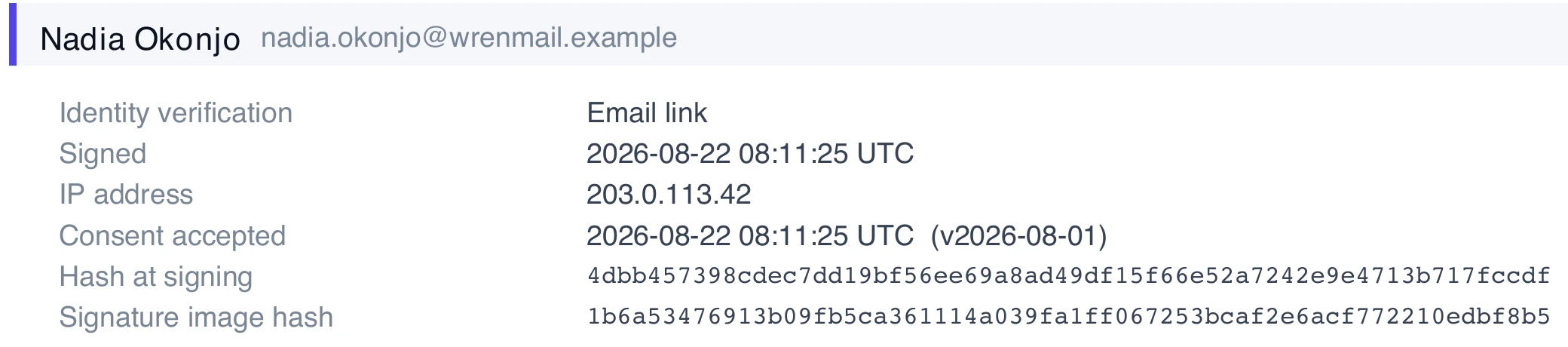
The name and email the request was sent to. Which identity check they passed, written on the certificate as email link, email link plus access code, or email link plus emailed one-time code. The moment they were verified, and the address the request came from. Every failed verification attempt is recorded separately, with its own timestamp and address, so a document somebody struggled to open looks different from one that opened first time.
What is recorded about intent
Before submitting, every signer must tick a line stating they agree to sign electronically and that their electronic signature is as binding as a handwritten one. It cannot be skipped, and the check runs on the server as well as in the browser. The timestamp when it was accepted and the version of that wording are stored against the signer and printed on the certificate. Whether they drew or typed their mark is recorded too.
What is recorded about the document
The file is hashed when it is attached, and each signer's record keeps the hash of the document exactly as it stood when they personally signed, which on a multi party document differs from person to person. The finished file is hashed again and carries a document level certification, so a reader can tell whether a byte has changed since it was issued. The audit trail behind all of it is numbered and hash chained, and the page reports whether that chain still verifies.
What none of that settles
It does not prove the person at the keyboard was who the email belonged to. It does not prove they read the document or understood it. It does not prove they had authority to bind the company they named. And it says nothing about whether the agreement is enforceable on its own terms. Those are the questions worth spending money on advice about, and no amount of hashing touches them.
How it works, in three steps
Step 1
Choose an identity check that matches the stakes
An emailed link for routine documents. A code shared over the phone where the value or the sensitivity justifies asking for one.
Step 2
Let everyone sign as normal
Consent, verification, signing time, address and document hash are recorded per person without anything extra from you.
Step 3
Keep the certificate with the contract
The signed PDF is the agreement. The certificate of completion is the evidence about how it came to be signed, and the two belong in the same folder.
The full walkthrough with screenshots is in the guide Send a PDF for e-signature.
Limits worth knowing
- Nothing here is legal advice, and the product makes no compliance claim for any named law or country.
- Identity checks confirm access to an inbox or knowledge of a code. Neither is proof of who was at the keyboard.
- No authority check is performed. Nobody verifies that a signer may bind the company they typed into the Company line.
- A printed or rescanned copy carries none of the cryptographic evidence. Keep the original PDF.
Questions people ask
Will a court accept this?
Nobody can say in advance, and any vendor that tells you otherwise is guessing about a jurisdiction and a dispute they know nothing about. What the product can show is exactly what was recorded, which is what a lawyer will want to see.
Is a typed signature weaker than a drawn one?
The product treats them the same and records which was used. Whether that distinction matters anywhere is a legal question rather than a technical one.
What is the strongest evidence I hold?
Probably the document hashes. The finished file is certified, and each signer's record carries the hash of the document at the moment they signed, which is what answers a claim that a page was changed.
Are some documents unsuitable for electronic signing?
In many places, yes. Wills and some property and family instruments are commonly treated as exceptions. This page cannot tell you which apply to you, so ask before you send one.
Make your own signing flow
The button opens the generator with this use case already described. Change the wording to match yours, generate, then edit anything you like.
Send a document for signingRelated pages
Certificate of completion
A certificate of completion is the evidence record that comes with a signed document: an A4 PDF listing the envelope, how each signer was verified, and every event from sending to completion. The signed document shows the marks; the certificate shows how they got there. It is built from the event log the moment everyone has finished, and it is the file worth keeping alongside the contract.
Electronic signing consent
A single line above the submit button asks the signer to agree that signing electronically counts. It is the least visually interesting part of the flow and one of the more useful things kept afterwards.
AI explainer video maker
An explainer has a specific problem. The thing being explained usually has no picture. There is nothing to film about a pricing model, a claims process or how a marketplace matches two sides, so the video has to draw the idea instead, and draw it in the order a person builds understanding.
More finished work of this kind is on the e-signature examples hub.
Written and checked by the OneCraft team. Last checked .