Contract clause
Counterparts clause: separate copies, one agreement
A counterparts clause states that the parties may each sign a separate copy of the agreement and that the signed copies together form a single contract. Well drafted versions also say how signed copies may be exchanged, when the agreement takes effect, and that each counterpart must contain the whole document rather than a signature page alone.
Signing in counterparts is how a contract gets done when two signatories are in different cities on the same afternoon. The clause itself is short; the questions it answers about exchange and effective date are the ones that decide whether a deal is actually done.
Nuwan Madhusanka · Co-founder
4 min read · Published
Sample clause
a consulting agreement between Kurrajong Advisory, a fictional strategy consultancy in Perth, and Bellbird Pharmacies, whose two directors sign from Hobart and Cairns in the same week
35. Counterparts 35.1 This Agreement may be executed in any number of counterparts. Each counterpart is an original, and all counterparts together constitute one instrument. 35.2 A counterpart is effective only if it contains the entire text of this Agreement as agreed between the parties, and not only a signature page. 35.3 A party may execute a counterpart by hand or by electronic signature, and a party may deliver its executed counterpart by email as a PDF or through an electronic signing platform. 35.4 This Agreement takes effect when each party has executed a counterpart and delivered it to the other party, and the Effective Date is the date on which the last counterpart is delivered. 35.5 Each party must keep its executed counterpart, and on request must provide a copy to the other party within 5 Business Days.
Sample wording, not legal advice.
Variants
With electronic exchange
Most modern commercial agreements, where copies move by email or signing platform rather than by courier.
This Agreement may be signed in counterparts, which together form one agreement. A party may sign electronically, and may deliver a signed counterpart by emailing a scanned or electronically signed copy. Delivery by email is as effective as delivery of an original signed counterpart. Each party agrees that it will not contest the validity of this Agreement on the ground that it was signed or exchanged electronically.
With a completion date rule
Deals that close on a condition, such as funds clearing, where signature pages are collected in advance and released together.
Counterparts signed by a party are held by that party's solicitor in escrow and are not delivered until each party's solicitor confirms by email that all counterparts have been signed and the Conditions have been satisfied. On that confirmation all counterparts are released at the same time, this Agreement takes effect, and the Completion Date is inserted in Item 1 of the Schedule by agreement of the solicitors.
For company execution of a deed
A deed signed by two officers of an Australian company who will not be in the same place.
This deed may be executed in counterparts. The Company executes it under section 127 of the Corporations Act 2001 by two directors, or a director and a secretary, each of whom may sign a separate counterpart, in physical or electronic form. This deed binds the Company once both officers have signed, without any separate act of delivery, and the Company must send copies of both signed counterparts to the other parties within 5 Business Days.
What to negotiate
When the agreement takes effect
A counterparts clause silent on timing leaves open whether the contract binds when the second party signs, when that party tells the first, or when copies are swapped. Parties who need a certain start date for fees, notice periods or insurance ask for the effective date to be the date the last counterpart is delivered, or a date agreed in writing afterwards.
Whole document or signature page
Sending a signature page alone is quick, but it invites argument about which version of the document it was attached to. Parties concerned about late changes require each counterpart to contain the whole agreed text, or at least that signature pages are released only against a final version identified by date and file name.
Mixed methods
One party may insist on ink while another signs on screen. The clause should accept both methods and both delivery routes so a mixed set is valid, and should say that no party may object to the agreement because of the method another party used.
The risk of leaving it out
Without a counterparts clause the parties can still sign separate copies, but the other side may argue that no single document bears all signatures, that it signed a different version, or that the contract never took effect because copies were not exchanged. Those arguments usually fail, yet each costs time at exactly the point when one party wants out.
What section 110A settled for companies
Part 1.2AA of the Corporations Act 2001 introduced technology neutral signing for documents covered by it, including execution under section 127. Section 110A says a person may sign a physical form by hand or an electronic form by electronic means, provided the method identifies the person and indicates their intention and is reliable or proven in fact. It then states for avoidance of doubt that a signatory does not need to sign the same form, the same page or by the same method as another signatory. That is a statutory counterparts rule for company officers. A contractual clause is still useful because it speaks to every party, not just the company, and deals with exchange and timing.
Counterparts and conditional exchange
In property, finance and share sales, parties often sign in advance and let their lawyers hold the signed copies until completion conditions are met. The counterparts clause has to fit that practice. If it says the agreement binds on signing, the escrow arrangement contradicts it. If it says the agreement binds on delivery, the clause should define delivery as release by the holding solicitor. Clear drafting here stops a party arguing that it was bound early, or that it could still withdraw after every condition had been satisfied.
Where it sits in a generated document
A counterparts clause sits in the general clauses, just before the execution section. In a generated document each signature block party is one signer with a name, email and signing order, and sending it for signature turns each party into a recipient of the same file. That route produces one signed document rather than separate copies, so the clause mainly covers any party that signs outside it.
Documents that carry this clause
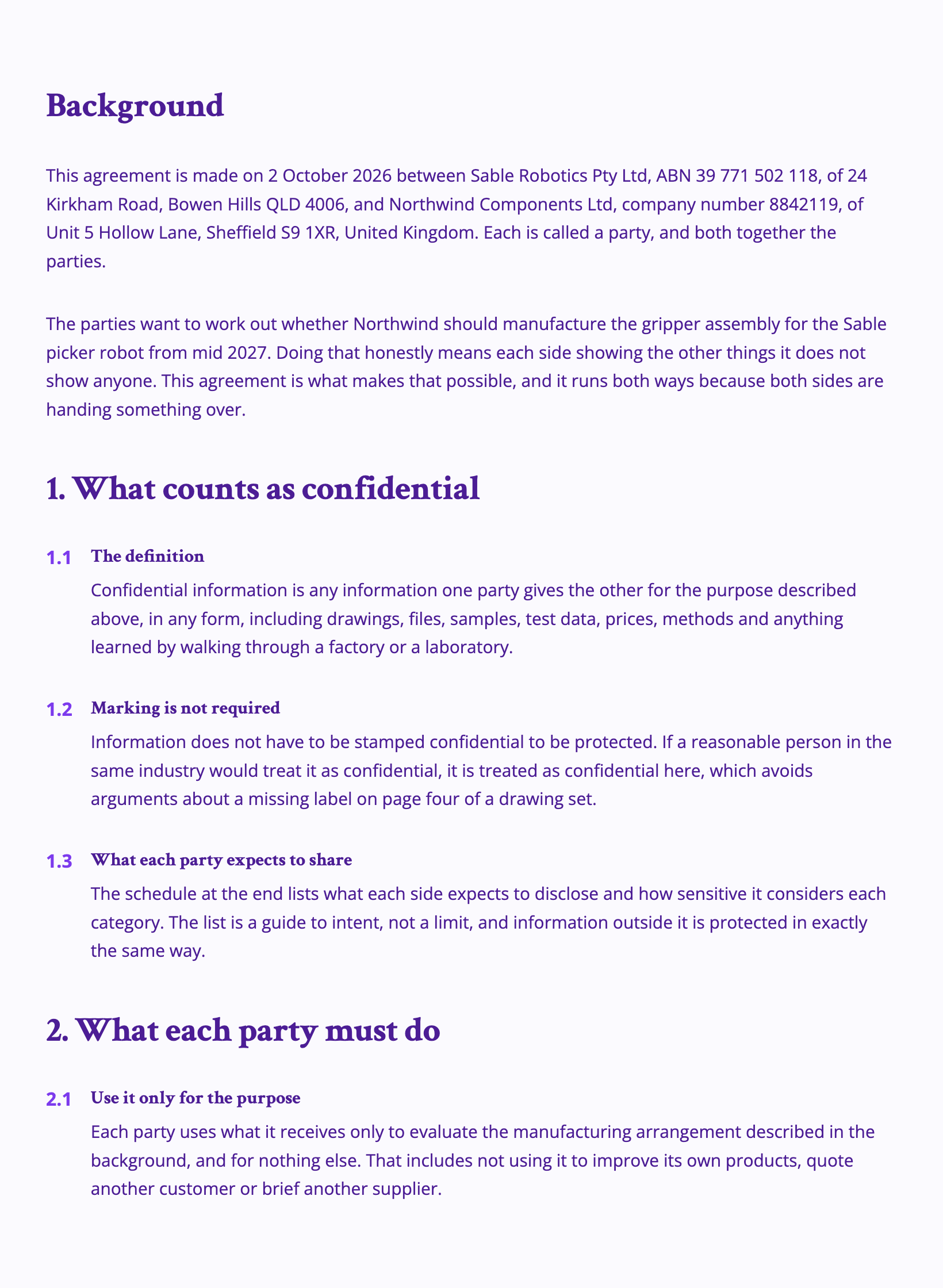 Mutual NDAA robotics company and a British parts maker want to look inside each other before agreeing to anything. Both sides are handing over trade secrets, which is the only real reason to make an NDA mutual.
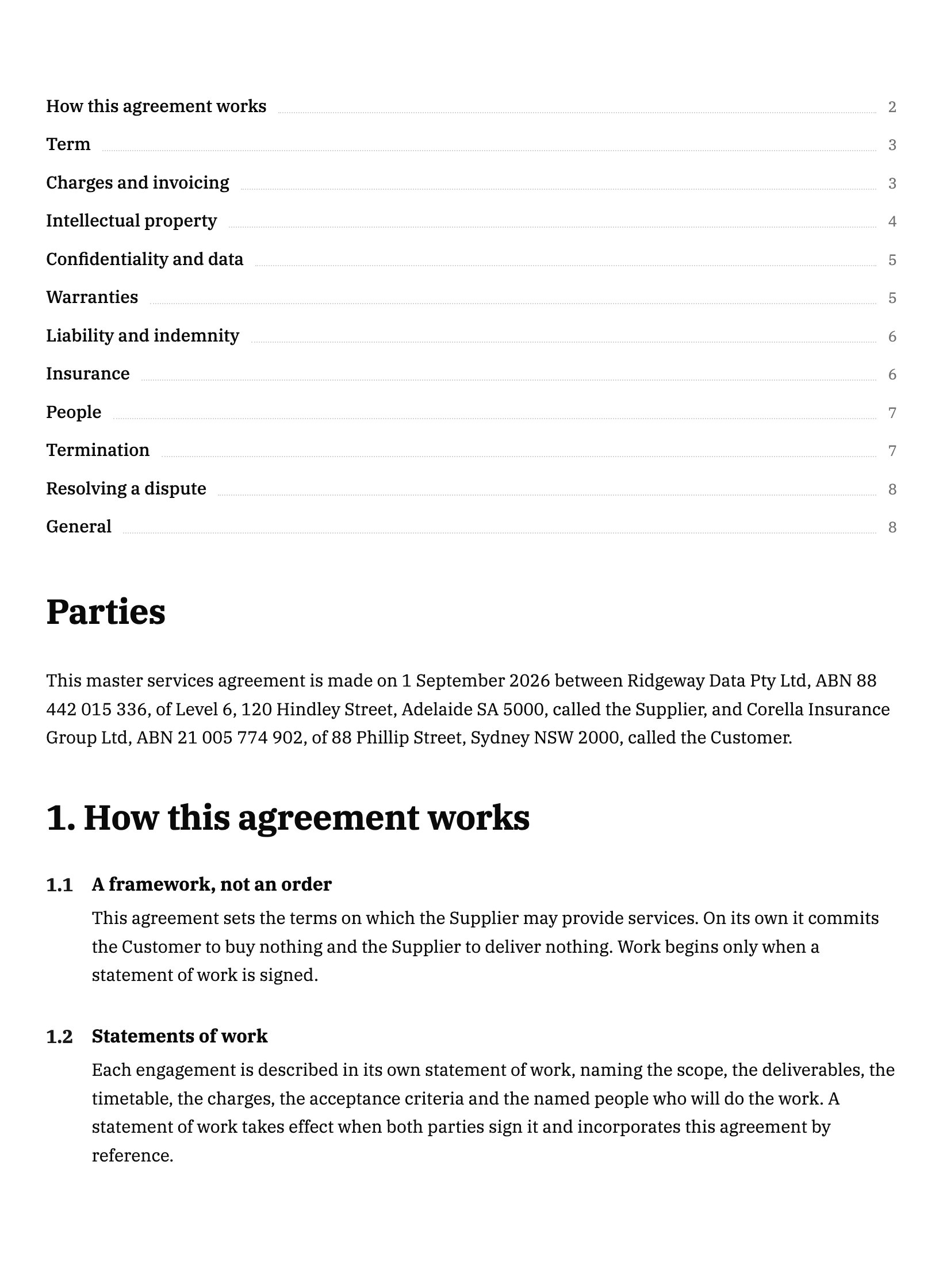 Master services agreementA data consultancy and an insurer sign this once and then buy work under it for three years. It is the rare contract whose whole purpose is to make the next twenty contracts short.
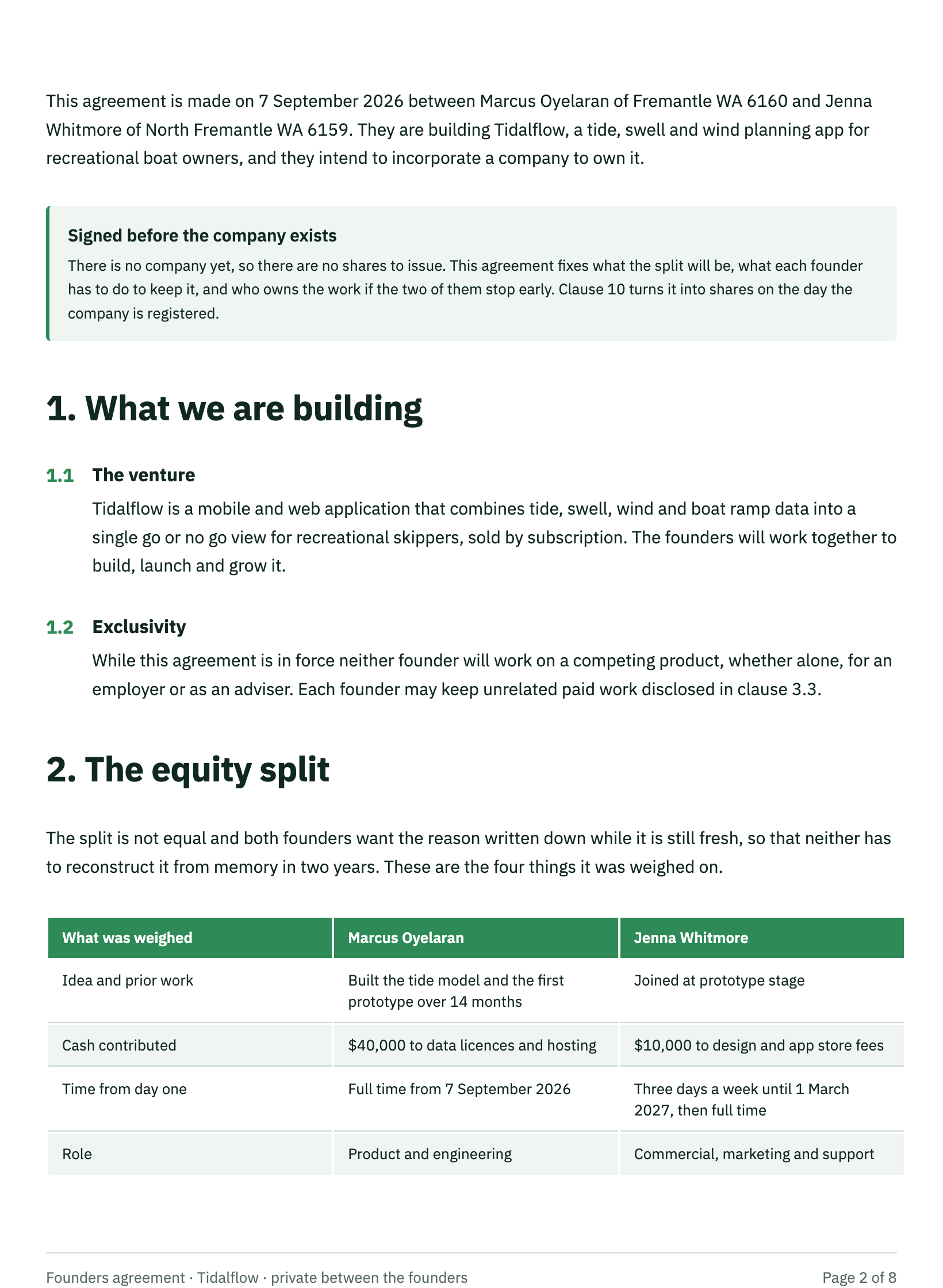 Founders agreement templateTwo people in Fremantle are building a tide and swell planning app and have not registered a company yet. There are no shares to issue, so this agreement fixes the split, records why it is 55/45 while the memory is fresh, and turns itself into shares on the day the company exists.
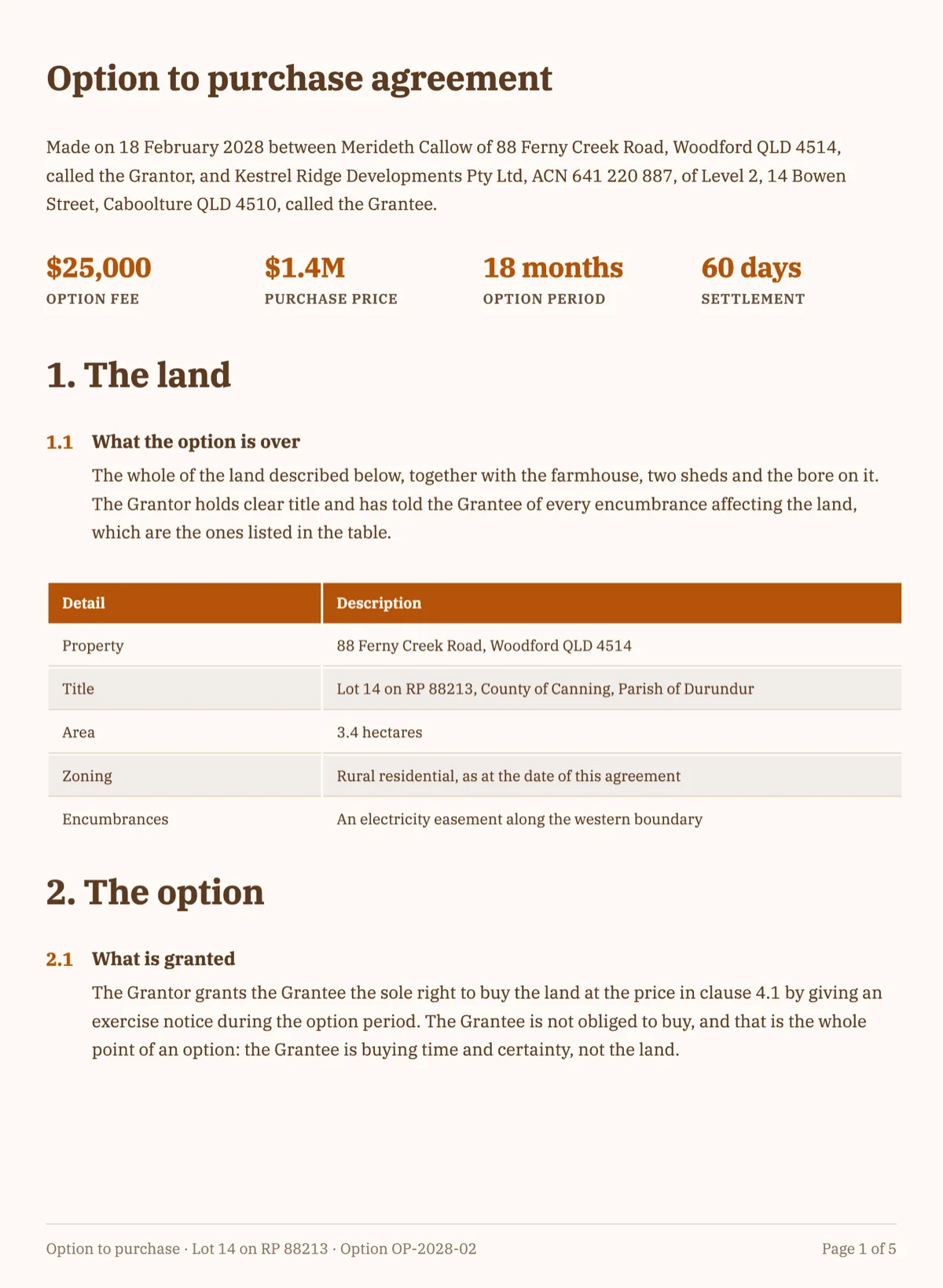 Option to purchase agreement with a fee, a window and a caveatAn option to purchase buys time rather than land. The grantee pays a fee for the exclusive right to buy at a fixed price within a set window, and can walk away without buying anything. This one gives a developer 18 months over a 3.4 hectare block at Woodford for $25,000, at a fixed price of $1,400,000.
Questions people ask
Does a counterparts clause make an emailed signature page binding?
It helps, particularly if it expressly allows delivery by email and electronic signature. Whether a detached page is enough still depends on showing it relates to the agreed final version. Requiring the whole document in each counterpart, or a clearly identified final version, removes most of that risk.
When does a contract signed in counterparts become binding?
When the parties intended, which the clause should state. Common choices are the date the last counterpart is signed, the date it is delivered to the other party, or a date the parties' lawyers confirm after exchange. Without a rule, the answer is inferred from conduct and correspondence.
Can company directors sign different copies of the same document?
Yes. Section 110A of the Corporations Act 2001 says a signatory does not need to sign the same form or page of the document, or use the same method, as another signatory. One director can sign on paper while the other signs electronically, and the company still executes under section 127.
Does it matter if the signed copies look slightly different?
Differences in the text matter a great deal, because they raise the question of which terms were agreed. Differences created by the signing process, such as a platform footer or a stamped date, generally do not. Section 110A of the Corporations Act 2001 expressly allows immaterial information of that kind to be disregarded for company execution.
Should the effective date be written on the first page?
It is clearer to insert it after exchange or define it by reference to the last delivered counterpart. A date typed before signing may be wrong if one party signs days later, and a blank date on the cover invites inconsistent copies. The clause can authorise one person to insert the agreed date.
Do deeds signed in counterparts need special wording?
Deeds bring extra formalities that differ between jurisdictions and between companies and individuals, such as witnessing or delivery. For Australian companies, section 127 now allows execution of a deed electronically without a witness and without delivery. Individuals still follow state rules, so the clause should not promise more than those rules allow.
Put the clause in a finished document
The button opens the document generator with a starting description already filled in. Change it to match your own agreement before you run it.
Create a document with OneCraftRelated clauses
- Electronic signature clause: agreeing in the contract how it will be signedAn electronic signature clause records that the parties agree to sign electronically. Australian sample wording plus UK, US and deeds carve out variants.
- Entire agreement clause: the written contract is the whole dealAn entire agreement clause says the signed contract is the whole deal. Australian sample wording, non reliance and US integration variants, and the ACL limit.
- Notices clause: how a formal notice is sent and when it landsA notices clause sets how formal notices under a contract are sent and when they count as received. Sample email wording, a deemed receipt table and variants.
For everything the document generator can do, see the document maker.
Step by step in the builder: Create a document with AI, then Send a document for signature.
Written and checked by the OneCraft team. Last checked .