Contract clause
Change control clause: requesting, pricing and approving a scope change
A change control clause sets the procedure for changing the scope, timing or price of work on a services or software project: who may request a change, what the request contains, how quickly its impact is assessed, who approves it, and what happens to the work meanwhile. It changes the project, not the legal terms of the agreement.
Projects change weekly, and a change agreed in a stand up meeting has no price or date attached until someone writes it down. The change control clause makes writing it down the only route to more work, more money or more time.
Indunil Asanka · Co-founder
4 min read · Published
Sample clause
a data migration project under a statement of work between Candlebark Digital, a fictional systems integrator in Sydney, and Westgate Mutual Insurance, whose business units keep asking for additional reports and data sources as the project runs
19. Change Control 19.1 Either party may request a change to the Services, Deliverables, Milestone Dates or Fees in a Statement of Work by submitting a Change Request. 19.2 A Change Request must describe the change, the reason for it and the date by which a decision is needed. 19.3 Within 5 Business Days of receiving or submitting a Change Request, Candlebark Digital must give Westgate Mutual Insurance a Change Impact Statement setting out: the work involved and the Deliverables affected; the effect on Fees, by amount and revised total; the effect on Milestone Dates; any new risks, assumptions or dependencies. 19.4 A change takes effect only when both Project Managers sign the Change Impact Statement. Candlebark Digital is not required to perform, and is not entitled to be paid for, any change that has not been approved. 19.5 Until a change is approved, both parties must continue to perform the Statement of Work as it stands. 19.6 Candlebark Digital must keep a change log and include it in each monthly report.
Sample wording, not legal advice.
Variants
Bilateral change control
Collaborative projects where either party may discover that a change is needed, including regulatory or technical changes.
Either party may propose a change by written Change Request. The parties' representatives must meet within 5 Business Days to discuss it. The Supplier must then provide a written impact assessment within a further 5 Business Days. A change is binding only when signed by both representatives. Neither party may unreasonably refuse a change that is required to comply with a change in law, and the cost of such a change is shared equally.
Customer initiated only
Fixed scope engagements where the customer controls requirements and the supplier should not be able to reopen them.
Only the Customer may request a change to the Services. The Supplier must assess each request and provide a quote and revised timetable within 5 Business Days, at no charge for requests taking less than four hours to assess. The Customer may accept or reject the quote in its discretion. The Supplier may not refuse a requested change that is within its capability, but it may decline a change that would require it to breach any law or third party licence.
Minor changes without paperwork
Agile or retainer style work where small adjustments happen constantly and a formal request for each would be ignored.
A Minor Change, being a change that requires no more than 8 hours of effort and does not alter a Milestone Date, may be agreed by email between the Project Managers and recorded in the change log. The Supplier may invoice the effort at the rates in Schedule 1. Once Minor Changes in a calendar month total 24 hours, any further change requires a Change Request under clause 19.1.
What to negotiate
Who pays for assessing a change
Estimating a large change takes real time. Suppliers want to charge for impact assessments beyond a small threshold; customers want free quotes so they can explore options. Common compromises are free assessments up to a set number of hours, and charged assessments above that only if the customer approves the estimate first.
Can the supplier refuse
Customers want the supplier obliged to implement any reasonable change at the quoted price. Suppliers want the right to decline changes outside their expertise, affecting other clients, or making the project unviable. The usual landing point allows refusal only on stated grounds, with any disagreement about price going to the dispute resolution clause.
Work paused or continuing
While a change is under consideration, the supplier may be working on something that will be thrown away. Clauses either require continued performance of the existing scope, or allow the customer to direct a pause on affected work, with the supplier's standby costs added to the change price.
The risk of leaving it out
Without change control, scope changes are agreed informally and priced after the fact. Suppliers do extra work they struggle to charge for, customers receive invoices they did not expect, and both parties dispute whether a missed milestone was caused by a change. The contract offers no agreed way to adjust price or dates, so every change becomes a negotiation.
Change control against variation
Change control and the variation clause do different jobs, and the difference should be written into both. Change control is a project procedure run by project managers: it adjusts deliverables, milestone dates and fees within the commercial framework already agreed. The variation clause governs changes to the agreement itself, such as liability caps, payment terms or intellectual property, and requires authorised signatories. Keeping them separate stops a project manager approving a change request that quietly extends the warranty or waives a service credit. Construction contracts use a different variations mechanism again, driven by a superintendent's direction.
What a change request form captures
A usable change request form has a unique number, the date raised and who raised it, a description of the change and why it is needed, the deliverables and milestones affected, the estimated effort, the price as an amount and as a revised contract total, the effect on dates, new risks or assumptions, a decision field for approved, rejected or deferred, and signature lines for both project managers. Service management frameworks such as ITIL, published by Axelos, treat change as a controlled practice for similar reasons: every change is assessed, authorised and recorded before it is implemented.
Where it sits in a generated document
In a master agreement the change control procedure sits in the delivery section, with the form itself as a schedule. A generated agreement numbers clauses and can set the form out as a table, so the procedure and the form fields line up by reference. Thresholds, response times and signatories come from the description, and the draft cites nothing, so each needs checking.
Documents that carry this clause
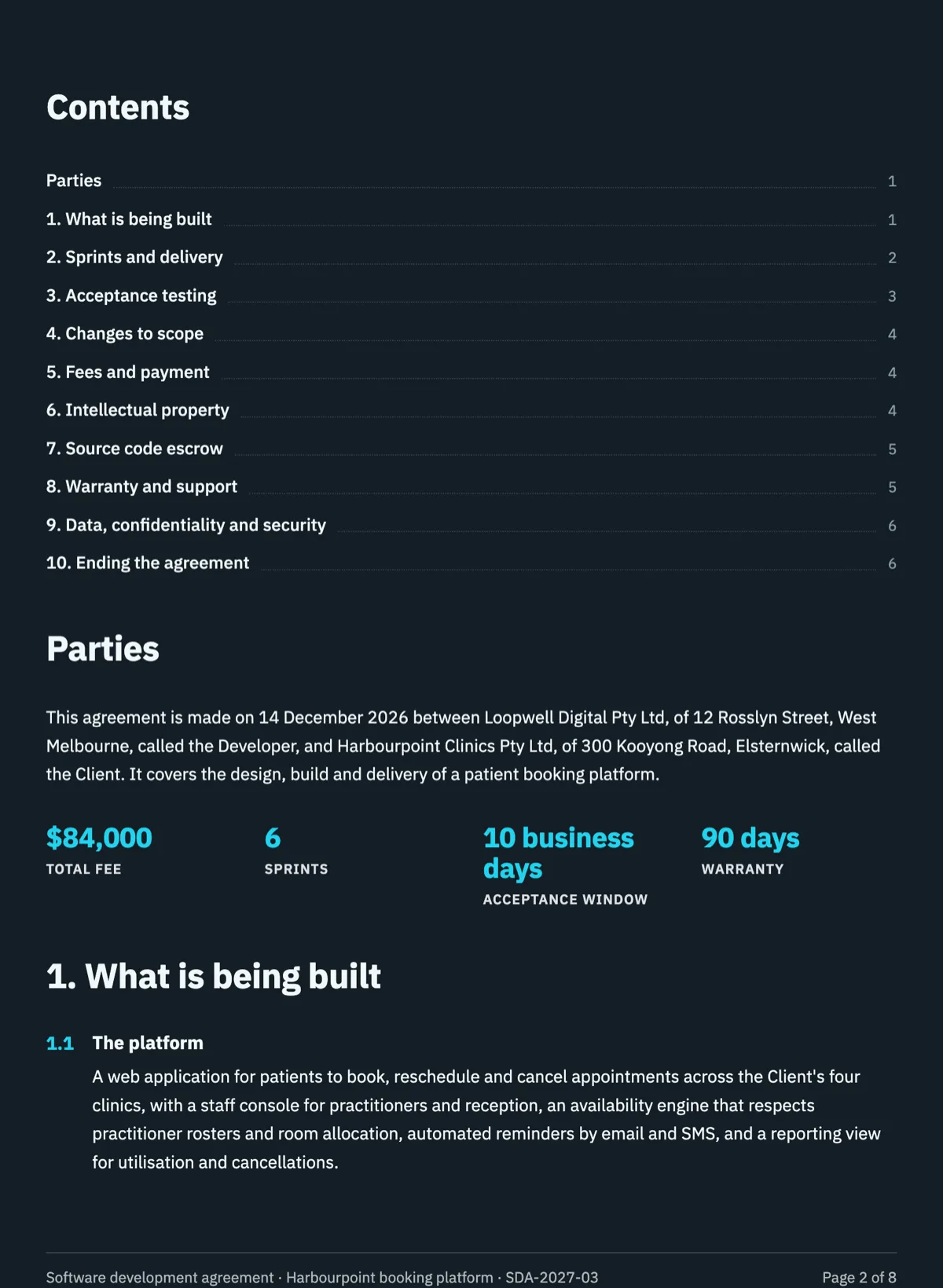 Software development agreement with sprints and an acceptance testCustom software goes wrong in the space between delivered and accepted, where one side thinks a sprint is finished and the other is still writing a list. This agreement fixes a ten business day acceptance window against criteria written before the sprint started, and assigns the intellectual property sprint by sprint as each invoice is paid.
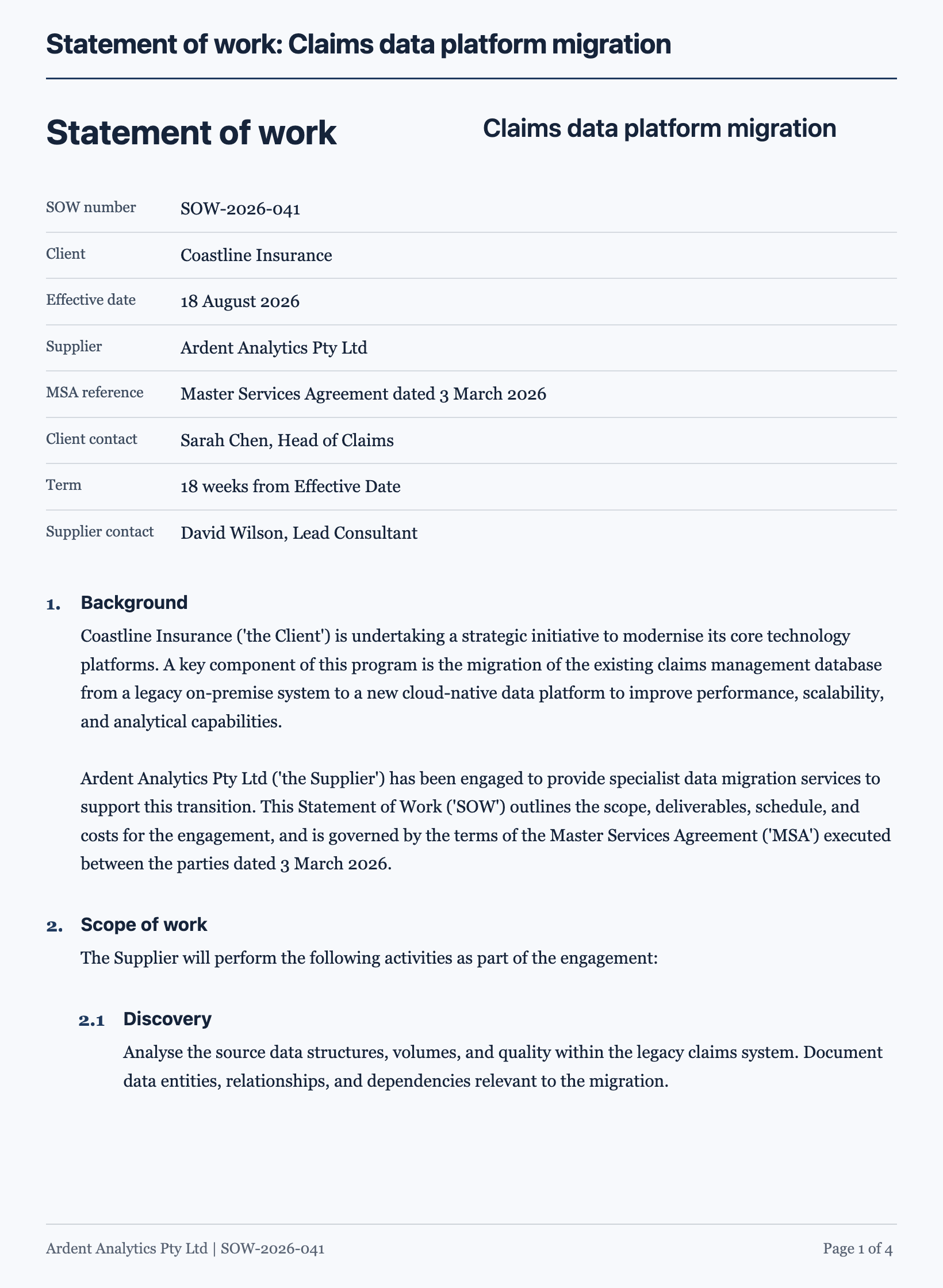 Statement of work template under a master agreementArdent Analytics migrates Coastline Insurance’s claims database to a cloud platform over 18 weeks under SOW-2026-041, governed by a master services agreement dated 3 March 2026. The work is time and materials with four roles priced by the day and a $412,000 estimate before GST, five dated deliverables, ten business days to accept each one, and five assumptions written down before anyone starts.
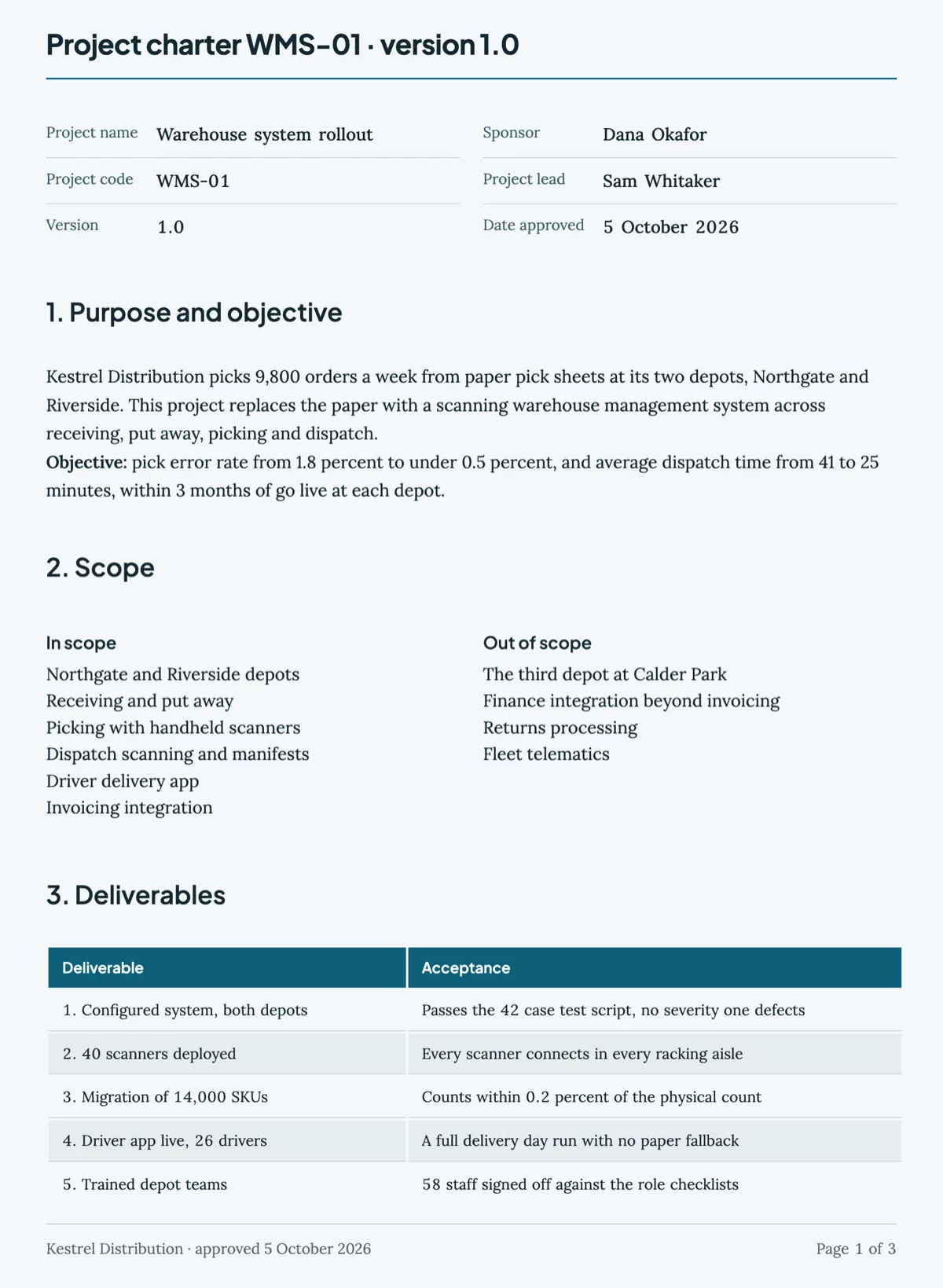 Project charter template with the scope in and out on one pageA charter exists so that a project starts with a sponsor's signature on a page that says what it is and is not. This one fits a system rollout on three pages: a measurable objective, scope in and out as two lists side by side, the team with their authority, a $341,000 budget, five milestones on a timeline and the five risks worth naming on day one.
Questions people ask
Does every small change need a change request?
Not if the clause sets a minor change threshold. Many clauses allow small changes, defined by hours and by having no effect on milestone dates, to be agreed by email and recorded in a log. A monthly cap on minor changes stops the threshold being used to avoid the procedure altogether.
What happens if work is done without an approved change?
Under a well drafted clause, the supplier is not entitled to payment for unapproved work. Suppliers can still argue for payment on other grounds where the customer clearly requested and accepted the work, but that argument is slower and less certain, which is why the clause tells both parties not to proceed without signature.
Can a customer force a supplier to accept a change?
Only if the contract says so. Some clauses oblige the supplier to implement reasonable changes at a price calculated using the contract rates, with price disputes resolved separately. Others let the supplier decline. The answer affects the customer's leverage throughout the project, so it is worth settling during negotiation.
Who should sign change requests?
Usually the project managers named in the statement of work, with a financial limit above which a more senior person must also sign. The limit protects the customer's budget and prevents a large change being approved without appropriate authority on either side.
Is a change log necessary?
It is the practical record of the project's current scope and price. A log listing each change by number, status, price and date effect lets both parties reconcile invoices and milestones quickly, and it is usually the first document requested if a dispute about delay or cost arises.
How does change control interact with fixed price contracts?
It is what keeps a fixed price workable. The price covers the defined scope; anything outside it goes through change control and is priced separately. The clearer the original scope and exclusions, the easier it is to tell whether a request is a change or part of what was already bought.
Put the clause in a finished document
The button opens the document generator with a starting description already filled in. Change it to match your own agreement before you run it.
Create a document with OneCraftRelated clauses
- Variation clause: the rule for changing the contract laterA variation clause sets how a contract can be changed after signing. Sample written variation wording, plus email and one sided price change variants.
- Acceptance testing clause: deciding when the work is doneAn acceptance testing clause sets how a deliverable is tested and when it counts as accepted. Sample 10 day test wording, deemed acceptance and staged variants.
- Key personnel clause: keeping the people the client choseA key personnel clause names the people who must work on a job and limits swapping them out. Sample schedule wording, consent, replacement and fee variants.
- Extension of time clause: moving the completion date fairlyAn extension of time clause gives a contractor more time for delay it did not cause. Australian shop fit out sample, qualifying delay events and notice rules.
For everything the document generator can do, see the document maker.
Step by step in the builder: Create a document with AI, then Document builder components.
Written and checked by the OneCraft team. Last checked .