Contract clause
Extension of time clause: moving the completion date fairly
An extension of time clause lets a contractor or supplier move the completion date when a listed delay event holds up the work, provided it gives notice in the required form and time. It protects the contractor from delay damages for lateness it did not cause, and preserves the principal's right to claim them.
Liquidated damages only work if the completion date can move when the principal causes delay. The extension of time clause is what keeps that date fair, and its notice rules are where most claims are won or lost.
Indunil Asanka · Co-founder
4 min read · Published
Sample clause
a shop fit out subcontract between Tuart Interiors, a fictional joinery contractor, and the head contractor refurbishing a pharmacy in a Geelong shopping centre
14. Extension of Time 14.1 The Subcontractor is entitled to an extension of the Date for Completion if it is or will be delayed in reaching Completion by a Qualifying Delay Event and it complies with clause 14.2. 14.2 Within 5 business days after becoming aware of the delay, the Subcontractor must give the Contractor written notice describing the Qualifying Delay Event, the work affected and its best estimate of the delay, and must update that estimate every 5 business days while the delay continues. 14.3 Qualifying Delay Events are: (a) an act, omission or late instruction of the Contractor or the Centre Manager; (b) a variation directed under clause 12; (c) denial of access to the Premises during the Access Hours in Schedule 1; and (d) an event described in clause 20 (Force Majeure). 14.4 The Contractor must assess the claim reasonably and notify its decision within 10 business days after receiving it. 14.5 The Contractor may extend the Date for Completion at any time for any reason, whether or not the Subcontractor has claimed.
Sample wording, not legal advice.
Variants
Notice as a condition precedent
The principal wants early warning and certainty, and accepts that a late claim loses the extension entirely.
It is a condition precedent to any extension of time that the Contractor gives the Principal written notice of the delay within 10 business days after the delay starts, and a detailed claim within a further 10 business days. If the Contractor does not comply, it is not entitled to an extension for that delay. Clause 14.6 still allows the Principal to grant an extension in its discretion, so the Date for Completion is never incapable of adjustment.
Concurrent delay, time without cost
Projects where causes of delay often overlap, such as late client approvals during a wet month.
Where a delay is caused partly by a Qualifying Delay Event and partly by a cause for which the Contractor is responsible, and the two causes operate over the same period, the Contractor is entitled to an extension of time for that period but not to delay costs for it. Delay costs are payable only for a period in which the Qualifying Delay Event alone delayed the Works.
Relief for customer dependencies in a services contract
Software and managed services with no superintendent and no programme, only milestone dates in a statement of work.
If the Supplier cannot meet a Milestone Date because the Customer has not provided the data, access, approvals or personnel described in the Statement of Work, the Supplier must promptly notify the Customer, and the Milestone Date is extended by the period of that failure. The Supplier is not liable for any service credit, delay payment or breach arising from the missed date during that period, provided it uses reasonable efforts to reduce the delay.
What to negotiate
The notice period and what a late notice costs
Principals want short notice periods and a rule that late notice loses the claim, so delay is flagged while it can still be managed. Contractors want longer periods and the right to claim late with only a reduction for any prejudice caused. Five to ten business days, with a discretionary power for the principal to extend anyway, is a common compromise.
Which events qualify
A narrow list covering only principal caused delay shifts weather, industrial action and authority delays onto the contractor, who then prices that risk into the tender. A broad list moves them to the principal. Parties often split the difference by giving time without money for neutral events, and time plus delay costs for events the principal controls.
The principal's power to extend unilaterally
Contractors sometimes ask why a principal needs power to extend time when nobody has claimed. The reason is the prevention principle: where the principal causes delay and no extension is available, the completion date may fall away, and the right to liquidated damages with it. The power protects the principal, and contractors commonly ask that it be exercised reasonably.
Concurrent delay
When principal caused and contractor caused delay overlap, contracts treat it very differently: time only, time and apportioned cost, or nothing. Leaving the point unaddressed invites a battle of delay experts after the project ends. One sentence stating the rule is far cheaper than arguing later about which cause was dominant.
The risk of leaving it out
Without the clause, a principal that delays the work may be unable to hold the contractor to the original completion date or to claim liquidated damages at all, because a party generally cannot rely on a deadline it prevented the other from meeting. The contractor, for its part, has no agreed process for claiming time and may carry delay it did not cause.
Qualifying delay events at a glance
Delay events usually sort into three groups, and a short table in a schedule saves reading the whole contract on site. Events within the principal's control, such as late instructions, late access, variations and suspension directions, normally give both time and delay costs. Neutral events, such as rain beyond the usual pattern for the season, industry wide industrial action and delay by an authority, often give time without costs. Events within the contractor's control, such as its own labour shortages, a supplier's late materials or rework of defective work, give neither. Listing each event against two columns, time and cost, answers most arguments before they start.
How the standard forms approach it
The AS 4000 general conditions, revised by Standards Australia as AS 4000:2025, carry a detailed extension of time regime that ties entitlement to specified causes of delay and a written claim, alongside liquidated damages and a superintendent who assesses claims. Bespoke subcontracts and fit out agreements often borrow that structure in a shorter form. Where a subcontract flows down from a head contract, the subcontractor's notice period needs to be shorter than the head contractor's own, or the head contractor can be bound to give time it has no opportunity to claim upstream.
Where it sits in a generated document
A generated subcontract places extension of time straight after the programme clause and before liquidated damages, since the damages only run from a properly adjusted date. The qualifying events come out as lettered items inside a numbered sub clause, and the notice periods are written as figures rather than blanks. Where the events need their own schedule, the description can ask for it as a table in the same document, and the built in chat can later tighten the wording of an existing sub clause.
Documents that carry this clause
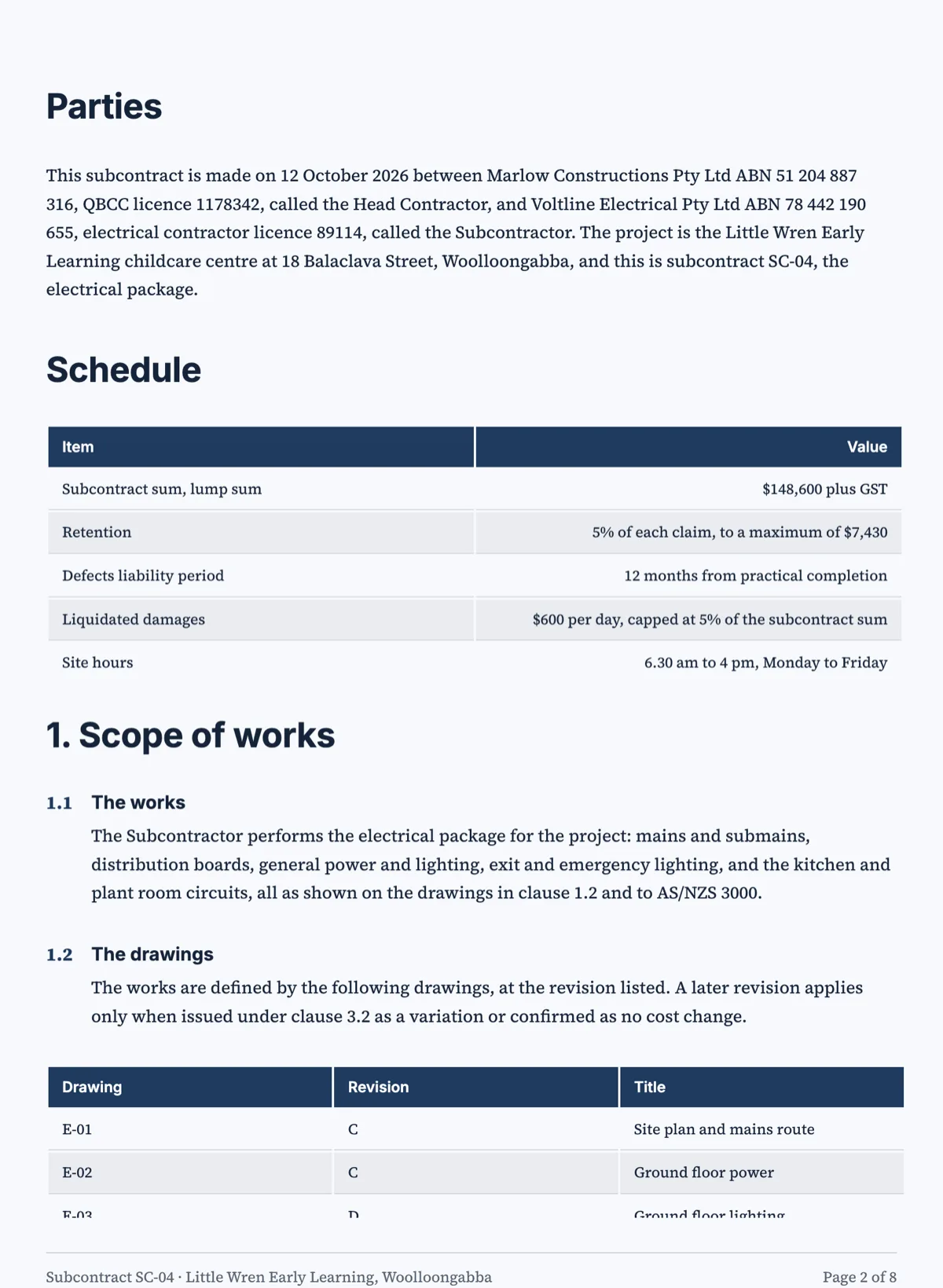 Subcontractor agreement template that flows the head contract downA subcontract exists to pass the head contract's obligations down one level and move the money back up on time. This one names the scope by drawing, sets the progress claim dates against the security of payment rules, holds retention and states the insurances, so the trade knows exactly when it is paid and for what.
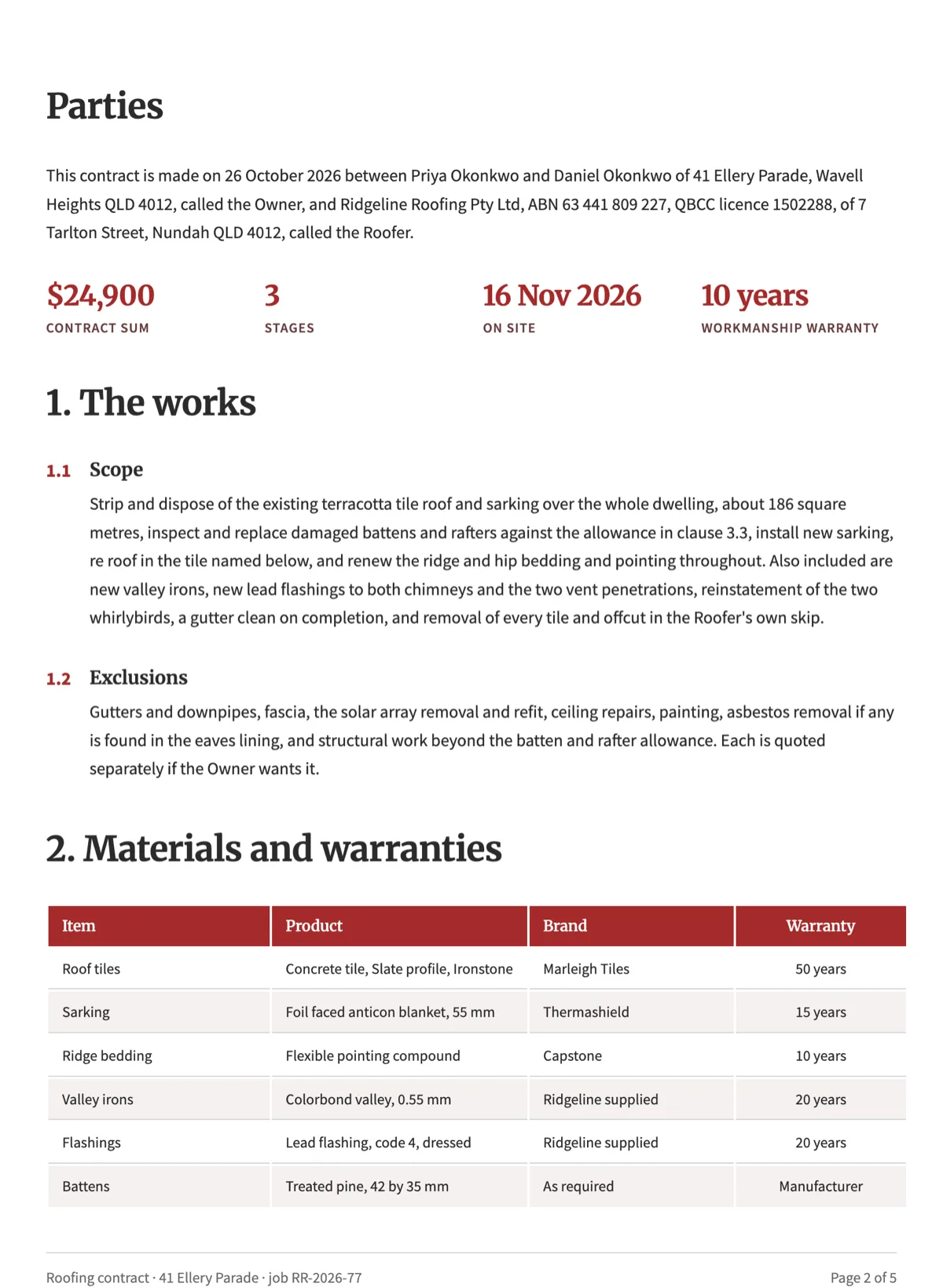 Roofing contract template with a materials table and a weather ruleA roof replacement is the one job where the house is open to the sky at the end of the day, so the clause that matters most is the one about closing it. This contract limits how much roof can be stripped at once, names every product with its warranty years, and says who pays when water gets in.
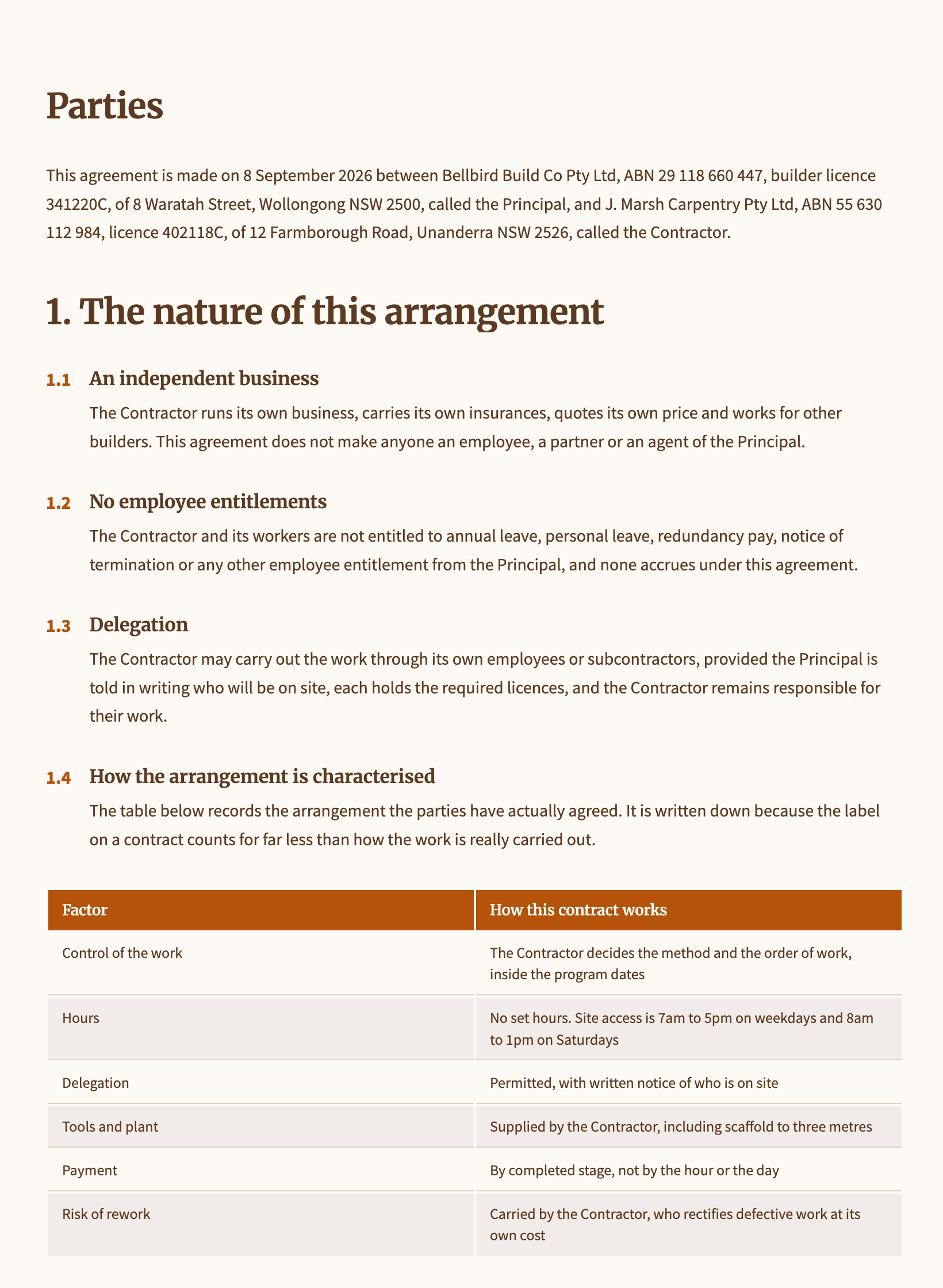 Independent contractor agreementA builder engages a carpentry business for one house. The interesting clause is not the price, it is the table that writes down who controls the work, because that is what decides whether this is a contract at all.
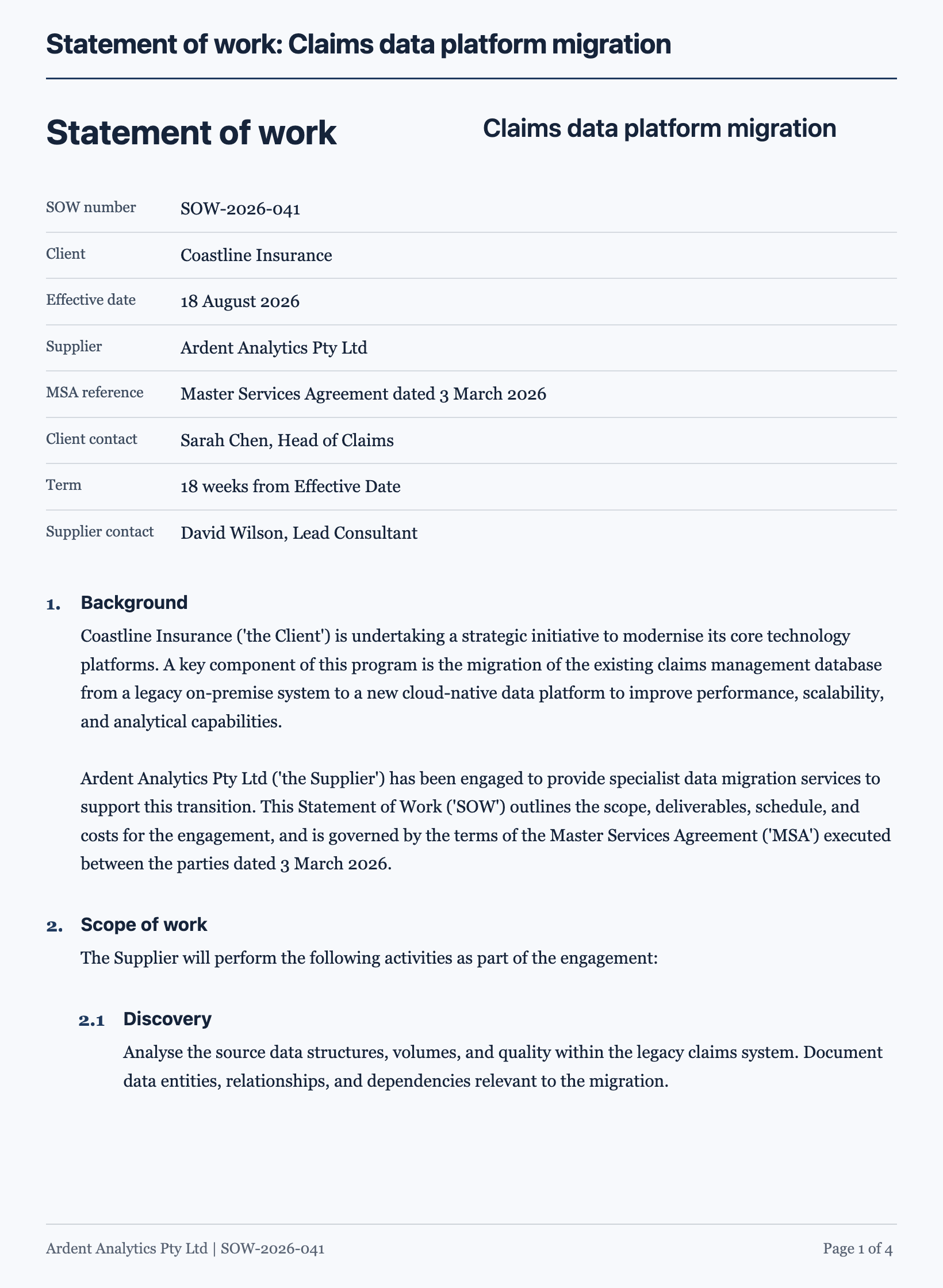 Statement of work template under a master agreementArdent Analytics migrates Coastline Insurance’s claims database to a cloud platform over 18 weeks under SOW-2026-041, governed by a master services agreement dated 3 March 2026. The work is time and materials with four roles priced by the day and a $412,000 estimate before GST, five dated deliverables, ten business days to accept each one, and five assumptions written down before anyone starts.
Questions people ask
What is an extension of time in a construction contract?
It is an adjustment to the date for completion when the contractor is delayed by an event the contract says it should not bear, such as a variation or late access to the site. The contractor then works to the new date, and liquidated damages only accrue if it finishes after that adjusted date rather than the original one.
Is a late extension of time claim always lost?
Only where the contract clearly makes notice a condition precedent, and even then a discretionary power in the principal to extend time may be exercised in the contractor's favour. Where notice is not a condition precedent, a late claim is usually still assessed, although the principal may be able to recover any loss the late notice caused.
Does an extension of time come with extra money?
Not automatically. Many contracts separate time from cost, giving an extension for neutral events such as wet weather without delay costs, and both time and costs for delay the principal causes. The clause, or a linked delay costs clause, has to say which events carry money, otherwise the contractor may receive time alone.
What is the prevention principle?
It is the rule that a party cannot insist on performance by a date it has itself prevented the other party from meeting. In construction, a principal that causes delay without an extension mechanism covering that delay may lose the right to liquidated damages. Extension of time clauses and discretionary extension powers exist largely to keep the completion date enforceable.
What is concurrent delay?
Concurrent delay happens when two causes of delay operate over the same period and one is the principal's responsibility while the other is the contractor's. Contracts deal with it in different ways, commonly by granting time but no delay costs for the overlapping period. Without an express rule, the parties are left arguing about which cause was dominant.
Should a subcontract use the same notice period as the head contract?
Usually it should be shorter. A head contractor that receives a delay notice from a subcontractor needs time to assess it and pass a claim upstream within its own notice period. If both periods are ten business days, the head contractor can miss its own deadline while waiting for the subcontractor, and end up carrying the delay itself.
Put the clause in a finished document
The button opens the document generator with a starting description already filled in. Change it to match your own agreement before you run it.
Create a document with OneCraftRelated clauses
- Liquidated damages clauseA liquidated damages clause fixes what delay costs before it happens. Sample fit out wording, the Australian penalty test, caps, and what each side negotiates.
- Time is of the essence clause: when a missed date ends the dealA time is of the essence clause makes a missed date grounds to terminate. Sample wedding photography wording, listed date variants and how extensions interact.
- Force majeure clause: excusing performance when events interveneA force majeure clause excuses performance during events outside either party's control. Sample wording with a sixty day exit, variants and notice duties.
- Reporting obligations clause: what the supplier must tell you, and whenA reporting obligations clause sets what a supplier reports, how often and in what form. Sample monthly report wording, a contents checklist and three variants.
For everything the document generator can do, see the document maker.
Step by step in the builder: Create a document with AI, then Document builder components.
Written and checked by the OneCraft team. Last checked .