Contract clause
Time is of the essence clause: when a missed date ends the deal
A time is of the essence clause makes a stated date an essential term, so missing it is a breach serious enough for the other party to terminate, whatever the delay actually cost. Without one, a late performer usually only pays damages and the contract carries on.
Five words can turn a late delivery from an irritation into an exit. That is why suppliers read them closely, and why a clause applying them to every date in a contract is rarely what either side needs.
Indunil Asanka · Co-founder
4 min read · Published
Sample clause
a wedding photography agreement between Silvereye Studio and a couple marrying at a fictional winery near Mudgee on a fixed Saturday
7. Time 7.1 Time is of the essence for the Studio's obligation to attend the Venue and begin coverage by 1.00 pm on the Wedding Date. 7.2 Time is not of the essence for any other date in this agreement, including delivery of the Edited Gallery, unless a party makes it so by notice under clause 7.4. 7.3 If the Studio fails to comply with clause 7.1 for a reason other than an event described in clause 12 (Force Majeure), the Client may terminate this agreement by written notice, and the Studio must refund all amounts paid within 5 business days. 7.4 If a party fails to meet a date for which time is not of the essence, the other party may give written notice fixing a new date that allows a reasonable further period, and time is of the essence for that new date. 7.5 Termination under this clause does not limit any other right of the terminating party.
Sample wording, not legal advice.
Variants
Listed dates only, in a print order
A supply where one date carries the whole value, such as a flyer print run for an event that cannot move.
Time is of the essence for delivery of the Printed Flyers to the Client's premises by 5.00 pm on 14 March 2027, two days before the Festival. If the Printed Flyers are not delivered by that time, the Client may cancel the order by written notice, is not required to accept or pay for a late delivery, and may recover the reasonable extra cost of obtaining replacement flyers from another printer. Time is not of the essence for any other obligation under this order.
Every date essential
Uncommon, and usually sought by a customer whose own deadline is fixed by a regulator, a lender or a public event.
Time is of the essence for every date and period stated in this agreement and in each Statement of Work, including each Milestone Date. A failure by the Supplier to meet any such date is a breach of an essential term entitling the Customer to terminate this agreement or the affected Statement of Work by written notice. Where a date is extended by written agreement or under clause 9 (Extension of Time), this clause applies to the extended date.
Time expressly not of the essence
Services and project work where both parties expect dates to move and prefer delay damages or service credits to a right to walk away.
Time is not of the essence for any obligation under this agreement. Each party must use reasonable efforts to meet the dates in the Project Plan and must promptly tell the other party of any expected delay, its cause and its likely length. A failure to meet a date gives rise only to the remedies set out in clauses 10 (Liquidated Damages) and 14 (Termination for Cause), and does not of itself entitle either party to terminate.
What to negotiate
Which dates carry it
Customers facing a fixed event want the clause on the date that matters and sometimes on everything else as well. Suppliers resist a blanket version, because one late status report could then justify ending a profitable contract. The usual landing point names the one or two dates where lateness destroys the value, such as an event day or a shipping cut off, and leaves the rest to ordinary remedies.
Extensions for delay the customer causes
An essential date that cannot move when the customer itself caused the delay is hard to enforce, since a party generally cannot insist on a deadline it prevented the other from meeting. Suppliers ask for an extension for customer caused delay and for force majeure, with the extended date becoming the essential one. Customers accept that if written notice of the delay and its cause is given promptly.
What termination costs the supplier
Ending a contract for a missed essential date normally comes with a refund of amounts paid and sometimes the cost of a replacement. Suppliers ask that the refund exclude work already delivered and accepted, and that replacement costs be capped. Customers with a single event at stake resist the cap, because short notice replacement is exactly the loss the clause exists to cover.
A procedure for making time essential later
Where a date is not essential, the innocent party can generally make it so after unreasonable delay by giving notice that fixes a reasonable further period. Writing that mechanism into the contract removes the argument about what counts as reasonable notice, and gives both sides a clear sequence to follow before anyone relies on a termination right.
The risk of leaving it out
Without the clause, a missed date is usually a breach of an ordinary term, so the innocent party claims damages but must keep performing unless the delay deprives it of substantially the whole benefit of the contract. A wedding or a launch may meet that test, but proving it after the event is slower and less certain than a clause that settled the point beforehand.
How a date becomes essential
The contract's own words come first. A date is treated as essential where the agreement says so, where the nature of the deal makes it obvious, such as perishable goods or a date fixed by an event, or where one party has given proper notice after unreasonable delay. The United Kingdom Sale of Goods Act 1979 puts part of this in statute: section 10 says the time of payment is not of the essence of a sale unless the contract shows a different intention, and that whether any other time stipulation is essential depends on the terms. Section 41 of the Law of Property Act 1925 carries the older equitable approach into the law of England and Wales. Australian courts apply the same general law principles, including the notice procedure.
Why building contracts handle time differently
Standard form construction contracts rarely rely on the phrase. The AS 4000 general conditions, revised by Standards Australia as AS 4000:2025, manage time through a date for practical completion, extension of time claims for qualifying delays and liquidated damages, which compensates the principal for lateness without a right to terminate on the first day late. Adding a bare time of the essence term on top of that machinery invites conflict between the two, particularly where the principal has contributed to the delay. A principal who genuinely needs one date to be essential is better served by a special condition naming that date and saying how extensions of time affect it.
Where it sits in a generated document
A generated agreement places the clause beside the dates it governs, usually straight after the programme or delivery section, and writes each date as content rather than leaving a blank, because the document builder does not use input fields. Naming the exact dates that should be essential in the description is worth the extra sentence, since the generator works from what it is given. A later wording change can be made through the built in chat, which edits the text of existing components.
Documents that carry this clause
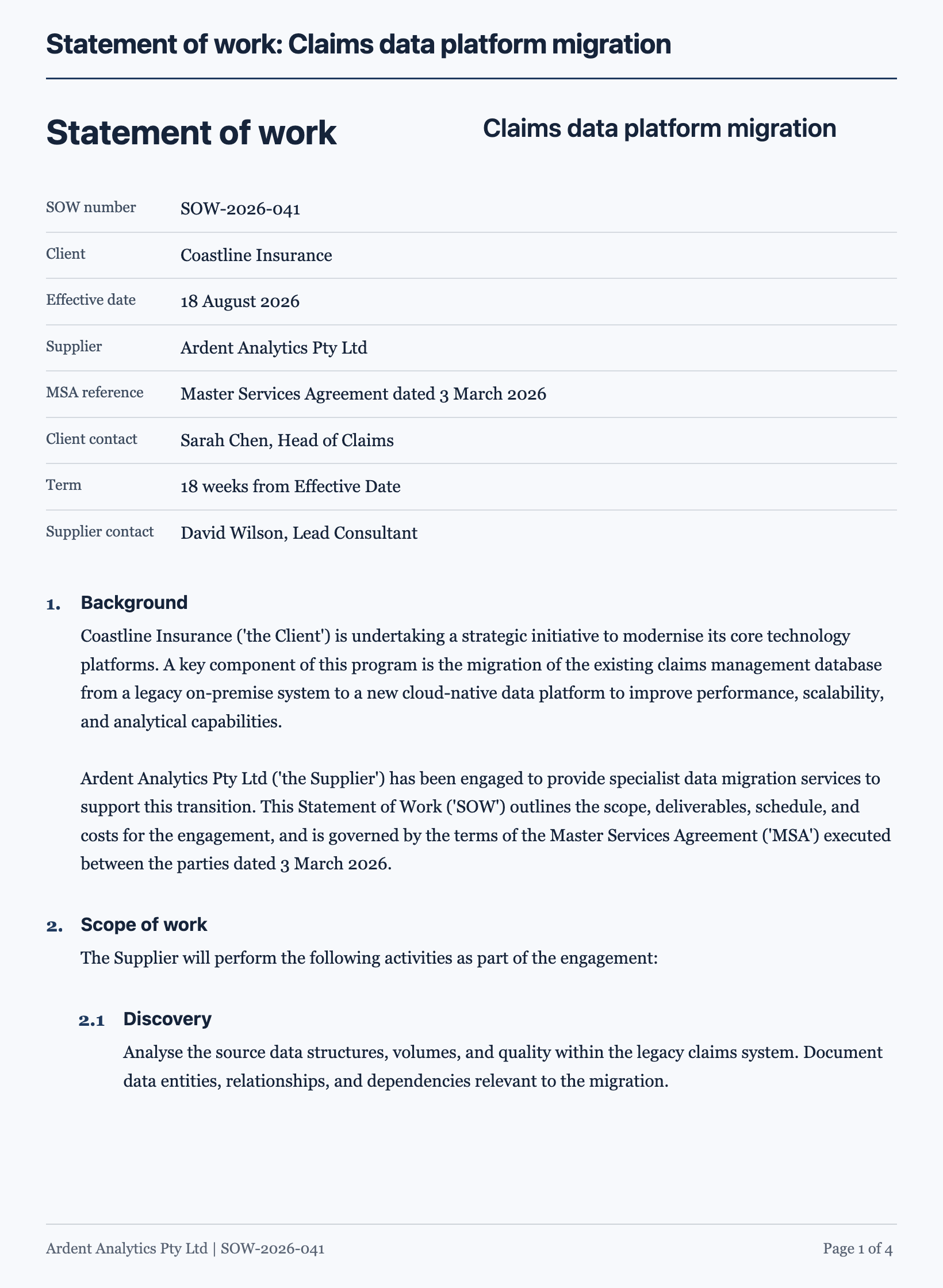 Statement of work template under a master agreementArdent Analytics migrates Coastline Insurance’s claims database to a cloud platform over 18 weeks under SOW-2026-041, governed by a master services agreement dated 3 March 2026. The work is time and materials with four roles priced by the day and a $412,000 estimate before GST, five dated deliverables, ten business days to accept each one, and five assumptions written down before anyone starts.
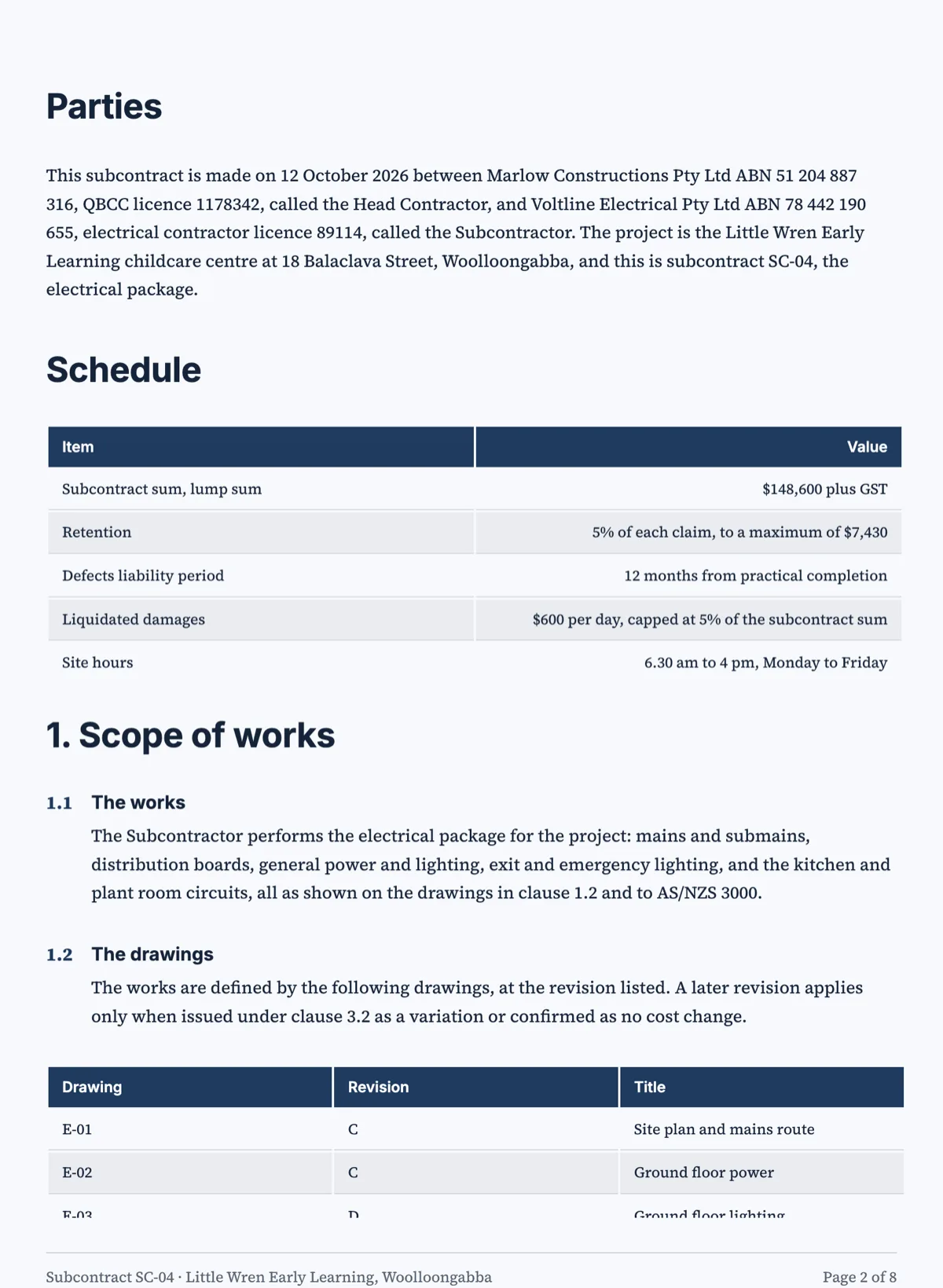 Subcontractor agreement template that flows the head contract downA subcontract exists to pass the head contract's obligations down one level and move the money back up on time. This one names the scope by drawing, sets the progress claim dates against the security of payment rules, holds retention and states the insurances, so the trade knows exactly when it is paid and for what.
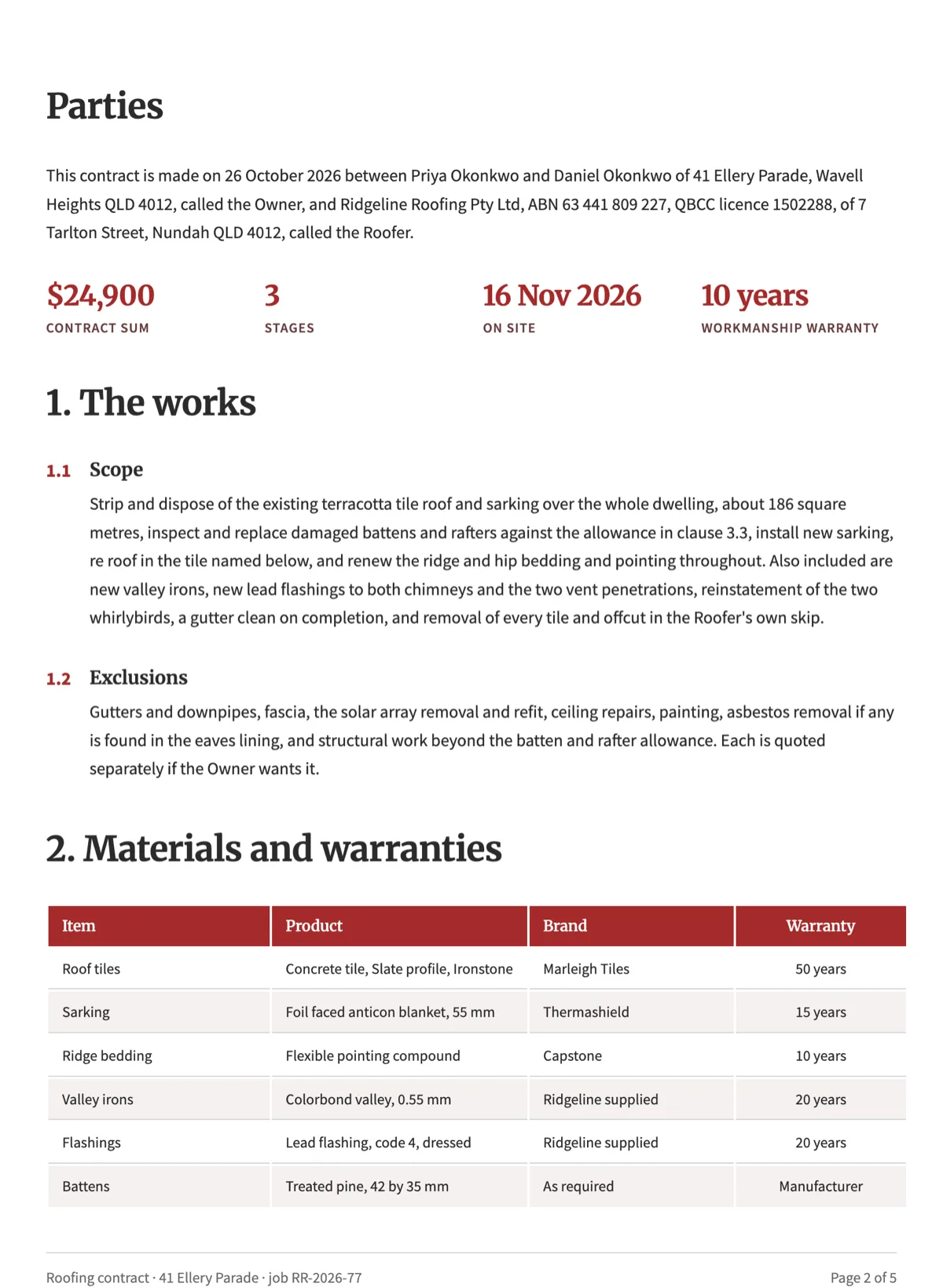 Roofing contract template with a materials table and a weather ruleA roof replacement is the one job where the house is open to the sky at the end of the day, so the clause that matters most is the one about closing it. This contract limits how much roof can be stripped at once, names every product with its warranty years, and says who pays when water gets in.
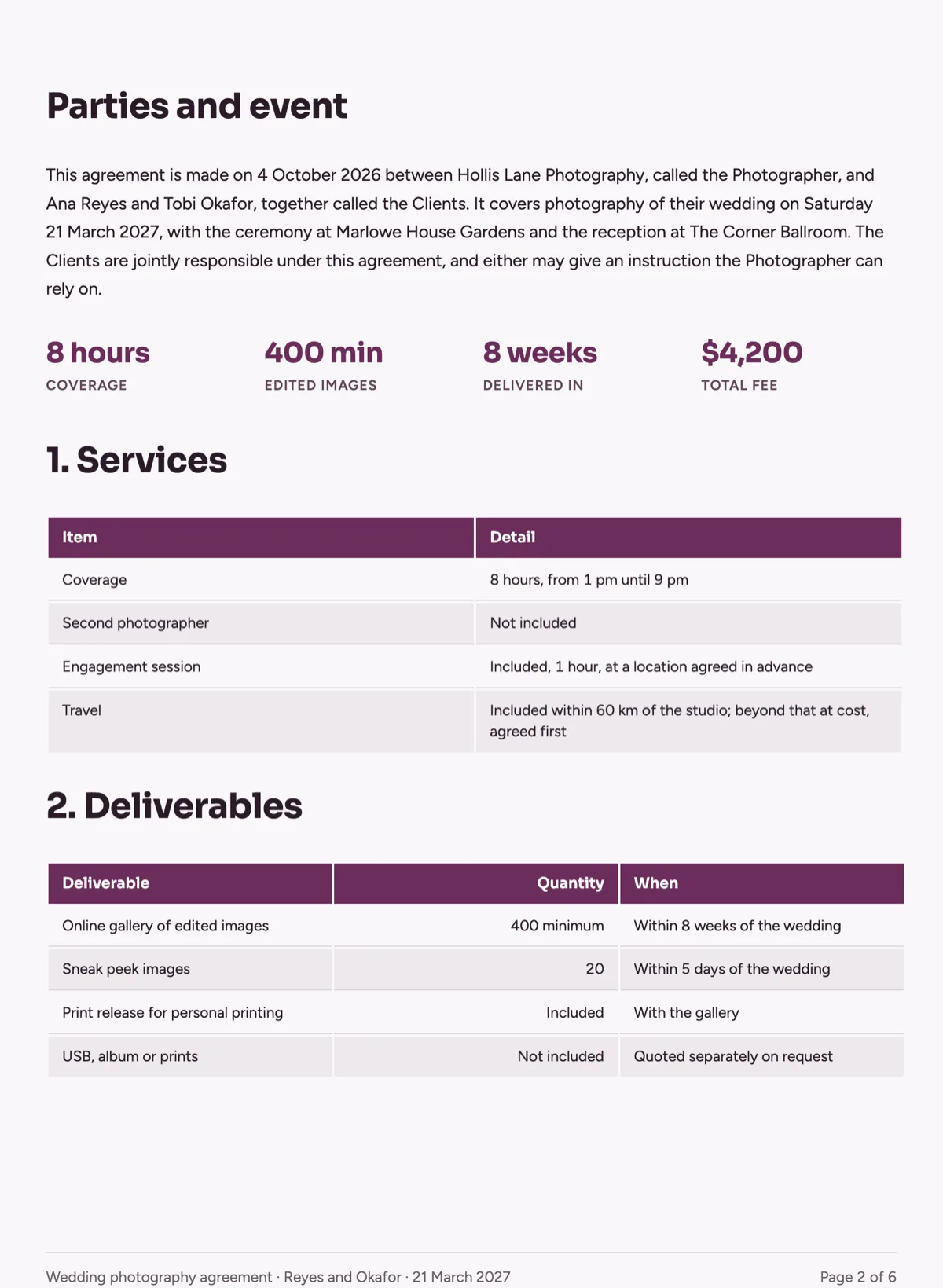 Photography contract template with deliverables you can countA photography contract is mostly a list of numbers: hours, images, weeks, dollars and the date after which the deposit is gone. This one writes every number down, then handles the three things that go wrong with weddings, a postponement, a sick photographer and an argument over who owns the photos.
Questions people ask
What does time is of the essence mean in a contract?
It means the parties have agreed that meeting a stated date is an essential term. If the date is missed, the other party may terminate rather than only claim damages, even where the delay was short and caused little loss. The phrase only has that effect for the dates it covers, so reading which obligations it attaches to matters more than the phrase itself.
Can time be made of the essence after the contract is signed?
Usually yes. Where one party has delayed unreasonably on a date that was not essential, the other party can generally serve a notice fixing a further period that is reasonable in the circumstances and stating that time is of the essence for it. The notice must be clear and the period genuinely reasonable, or a termination relying on it may itself be a wrongful repudiation.
Does the clause still apply after an agreed extension?
It depends on the wording. A well drafted clause says that a date extended by agreement or under an extension of time clause becomes the date for which time is of the essence. Without that sentence, an extension granted informally can be argued to have waived the essential character of the date, leaving only damages for any further delay.
Is a time of the essence clause the same as liquidated damages?
No. Liquidated damages fix a sum payable for each day of delay while the contract continues, whereas a time of the essence clause gives a right to end the contract. Some agreements carry both, with delay damages accruing up to a cap and a termination right arising once the cap is reached, which stops the two remedies overlapping.
Why do suppliers resist the clause?
Because it turns a minor slip on any covered date into grounds for termination, often with a refund of money already earned. A supplier running a long project with many linked dates carries real exposure from one late report. Suppliers therefore ask for the clause to be limited to named dates, for extensions where the customer causes delay, and for notice before termination.
Is the time of payment treated as essential?
Not usually. Payment dates are generally not essential unless the contract says so, and the United Kingdom Sale of Goods Act 1979 states that rule expressly for sales of goods. A supplier that needs prompt payment normally relies on late payment interest, a suspension right and termination for non payment rather than making every payment date essential.
Put the clause in a finished document
The button opens the document generator with a starting description already filled in. Change it to match your own agreement before you run it.
Create a document with OneCraftRelated clauses
- Extension of time clause: moving the completion date fairlyAn extension of time clause gives a contractor more time for delay it did not cause. Australian shop fit out sample, qualifying delay events and notice rules.
- Delivery clause: where, when and how the handover happensA delivery clause sets where, when and how goods or deliverables are handed over. Sample site delivery wording, plus fixed date, window and on call variants.
- Liquidated damages clauseA liquidated damages clause fixes what delay costs before it happens. Sample fit out wording, the Australian penalty test, caps, and what each side negotiates.
- Termination for cause clauseA termination for cause clause ends a contract for serious breach. Sample wording, what counts as material, cure periods and immediate termination events.
For everything the document generator can do, see the document maker.
Step by step in the builder: Create a document with AI, then Document builder components.
Written and checked by the OneCraft team. Last checked .