Contract clause
Delivery clause: where, when and how the handover happens
A delivery clause says where goods or deliverables are handed over, when, in what condition and how the handover is recorded. It fixes the moment the supplier has performed its side, which is also the moment inspection periods, invoices and often risk in the goods start to run.
A truck at the wrong gate at the wrong hour is a delivery that did not happen, whatever the docket says. The clause earns its place by deciding in advance what a successful handover looks like and who pays when one fails.
Nuwan Madhusanka · Co-founder
4 min read · Published
Sample clause
a supply agreement between Karri Precast, a fictional concrete panel maker, and a builder taking delivery on a residential site in Baldivis, south of Perth
9. Delivery 9.1 The Supplier must deliver the Panels to the Site between 7.00 am and 9.00 am on the Delivery Date stated in the Order, or on another date the Customer confirms in writing at least 3 business days before. 9.2 Delivery occurs when the Panels are unloaded at the set down area marked on the Site Plan and the Customer's representative signs the delivery docket. 9.3 The Customer must provide clear crane access and a representative on Site for the delivery window. If delivery cannot occur because the Customer has not done so, the Supplier may charge the redelivery fee in Schedule 2. 9.4 The Supplier may not make partial deliveries without the Customer's written consent. 9.5 Signing a delivery docket confirms the number of Panels received only, and does not waive any right under clause 10 (Inspection and Rejection).
Sample wording, not legal advice.
Variants
Fixed date with a named cut off
Digital deliverables tied to a launch or an event, where a late handover has little value.
The Supplier must deliver the Deliverables by 5.00 pm Australian Western Standard Time on 2 June 2027 by uploading them to the shared folder named in Schedule 1. Delivery is complete when the Supplier notifies the Customer by email that every file listed in Schedule 1 has been uploaded. A Deliverable uploaded after that time is treated as not delivered until the Customer confirms in writing that it accepts the late delivery.
Delivery window
Trade and freight supplies where the exact day depends on production and transport, but the customer must plan labour around it.
The Supplier must deliver the Goods during the Delivery Window, being the 5 business days starting on the date stated in the Order. The Supplier must confirm the actual delivery day and a 2 hour arrival period at least 2 business days in advance. If the Supplier misses a confirmed arrival period by more than 2 hours, it must reimburse the Customer's reasonable standby labour costs, capped at $1,500 for each missed delivery.
On call delivery
Ongoing supply where the customer draws down stock as its own work progresses.
The Supplier must hold the Stock at its warehouse and deliver any quantity the Customer calls for within 48 hours of a written call off, to the address stated in that call off. A call off made after 2.00 pm is treated as made on the next business day. The Supplier need not deliver less than one pallet per call off, and Stock not called off within 90 days after the Order date attracts storage at the rate in Schedule 3.
What to negotiate
What counts as delivered
Suppliers want delivery complete when goods leave their premises or reach the kerb, since that ends their exposure. Customers want delivery at the point of use, signed for by someone authorised. The usual settlement defines delivery by a physical place and a named act, such as unloading at a marked set down area, and treats the docket as evidence of quantity only.
Partial and early deliveries
Partial deliveries let a supplier invoice sooner and keep production moving, but they can leave a customer holding half a kit it cannot install. Early delivery creates storage and security problems on site. Customers commonly require consent for both, while suppliers ask that consent not be unreasonably withheld where the part delivered can be used on its own.
Who pays for a failed delivery
A truck turned away from a locked site is the customer's problem, and a truck that arrives outside its window is the supplier's. A clause that prices only the first case reads as one sided. A redelivery fee for customer caused failures, balanced by reimbursement of standby costs for supplier caused ones, is a common and workable pairing.
The risk of leaving it out
Without a delivery clause the statutory defaults apply, and they rarely suit a site or a project. Under sale of goods legislation in Australia and the United Kingdom, the place of delivery can default to the seller's place of business, and a buyer need not accept instalments. Nothing will say who unloads, what hour is acceptable or who pays for a wasted trip.
The default rules the clause replaces
Sale of goods statutes supply delivery rules when a contract is silent. In the United Kingdom, section 29 of the Sale of Goods Act 1979 makes the seller's place of business the default place of delivery, requires goods to be sent within a reasonable time where the seller must send them and no time is fixed, and allows a demand or tender of delivery to be treated as ineffective unless made at a reasonable hour. Section 30 deals with delivery of the wrong quantity. The Australian state and territory sale of goods acts contain rules of the same shape. Every one of those defaults can be displaced by agreement, which is the purpose of the clause: site access, unloading method, times and documents are commercial facts only the parties know.
Delivery, risk and title are separate questions
Delivery moves possession. Risk decides who bears the loss if the goods are damaged, and title decides who owns them. Contracts often tie risk to delivery and title to payment, but nothing requires that, and silence leaves each question to a different default rule. For goods shipped across a border, parties commonly adopt one of the International Chamber of Commerce Incoterms rules, which allocate the delivery point, transport costs and risk through a three letter code. An Incoterms reference does not deal with ownership or payment, so the contract still needs its own clauses for those.
Where it sits in a generated document
In a generated supply agreement, delivery is normally its own numbered clause placed ahead of inspection and payment, since both count from it. Dates, windows, fees and addresses are written as content, and where the description lists several delivery points they can be set out as a table rather than a paragraph. The generator writes from the brief it is given, so a site address, an unloading method and a redelivery fee each need to appear in the description to appear in the clause.
Documents that carry this clause
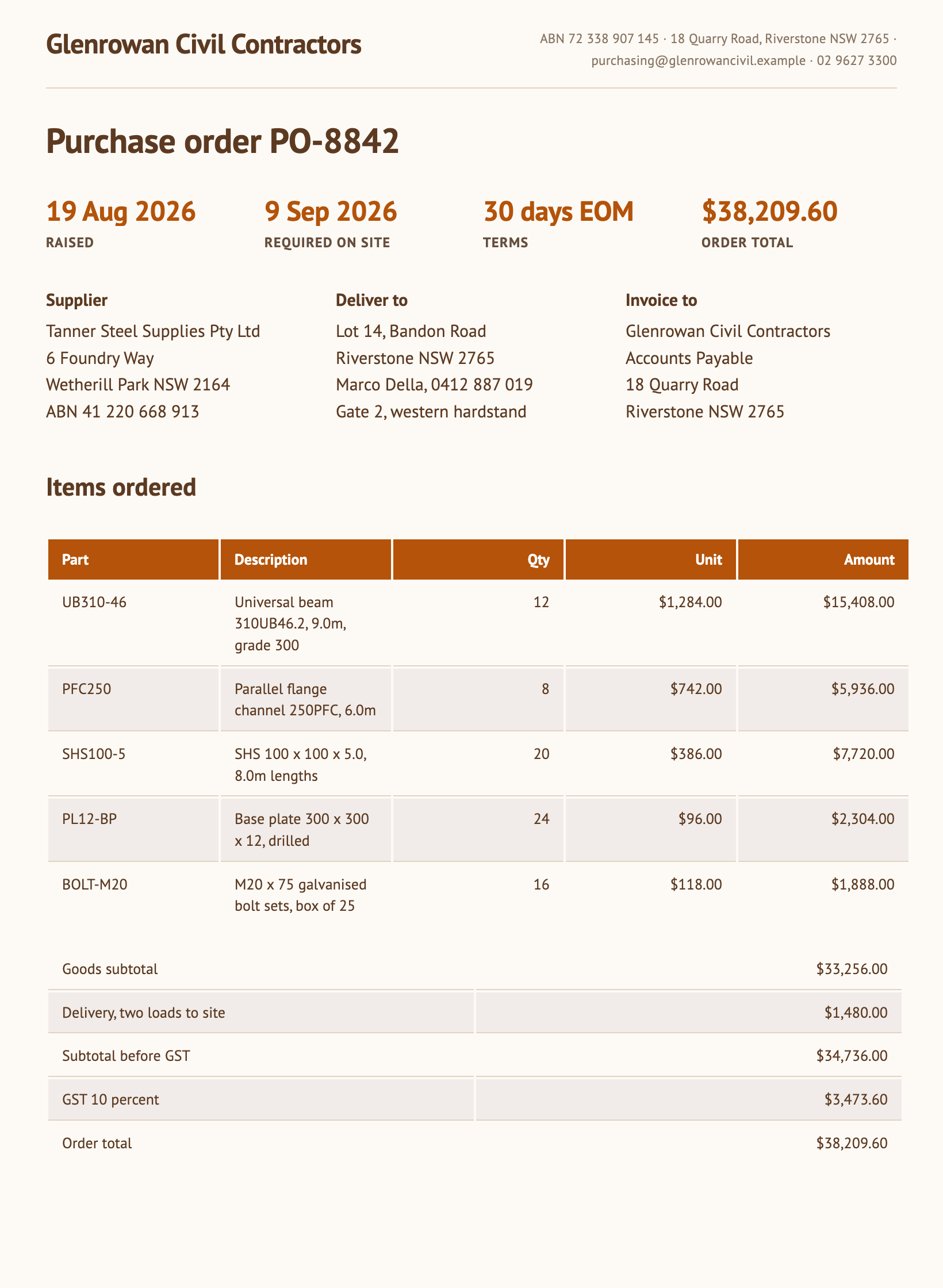 Purchase orderA civil contractor buys structural steel for a job that starts in three weeks. The order is written by the buyer, not the seller, and almost everything on it exists to stop a surprise arriving on the truck.
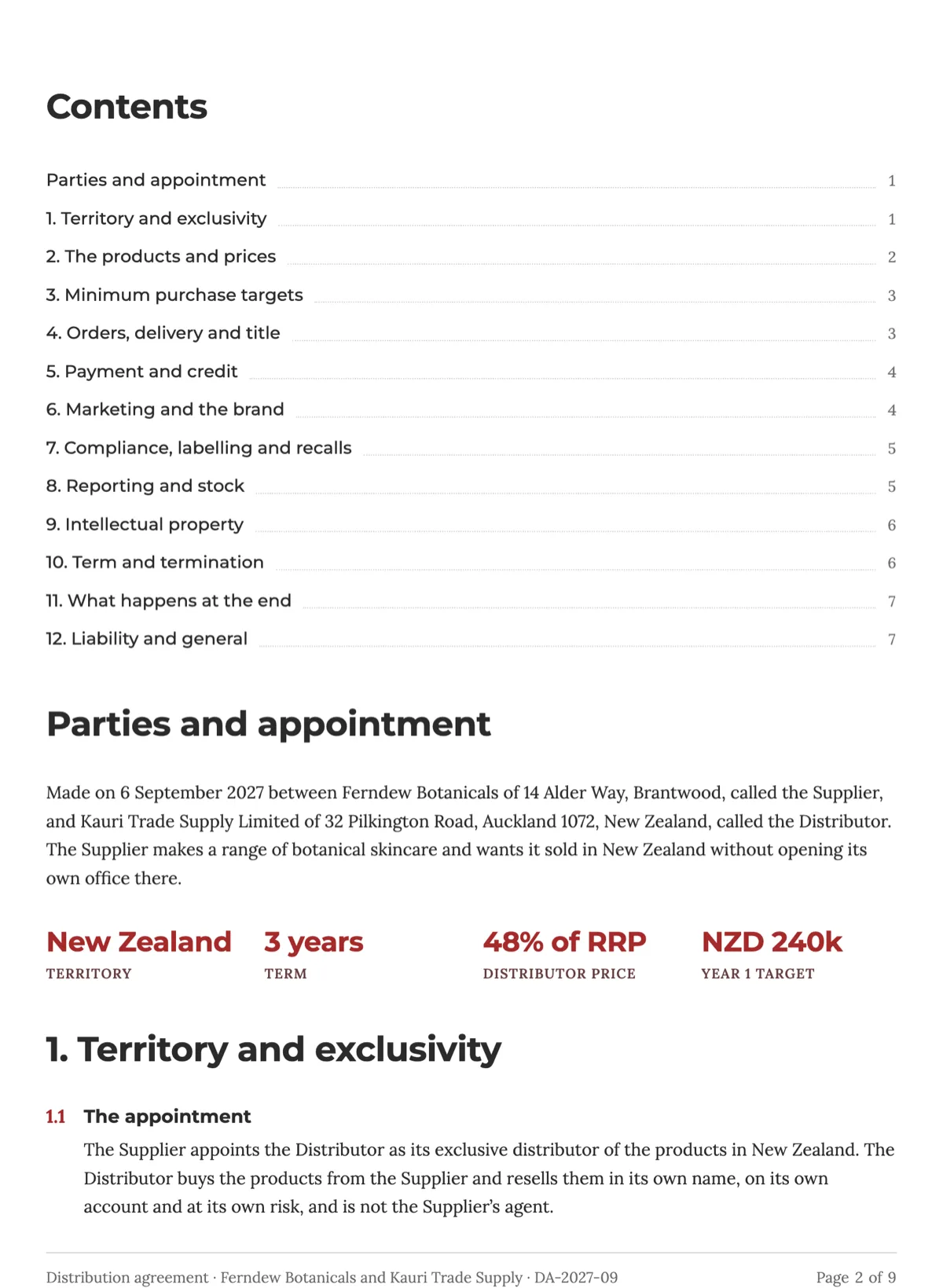 Distribution agreement template with territory and targetsAn exclusive distribution agreement is a trade: a territory in exchange for volume. This one appoints a New Zealand distributor for a skincare range at 48 per cent of recommended retail, with purchase targets rising from NZD 240,000 to NZD 420,000 across three years, and exclusivity that converts to non exclusive if a target is missed by more than 15 per cent.
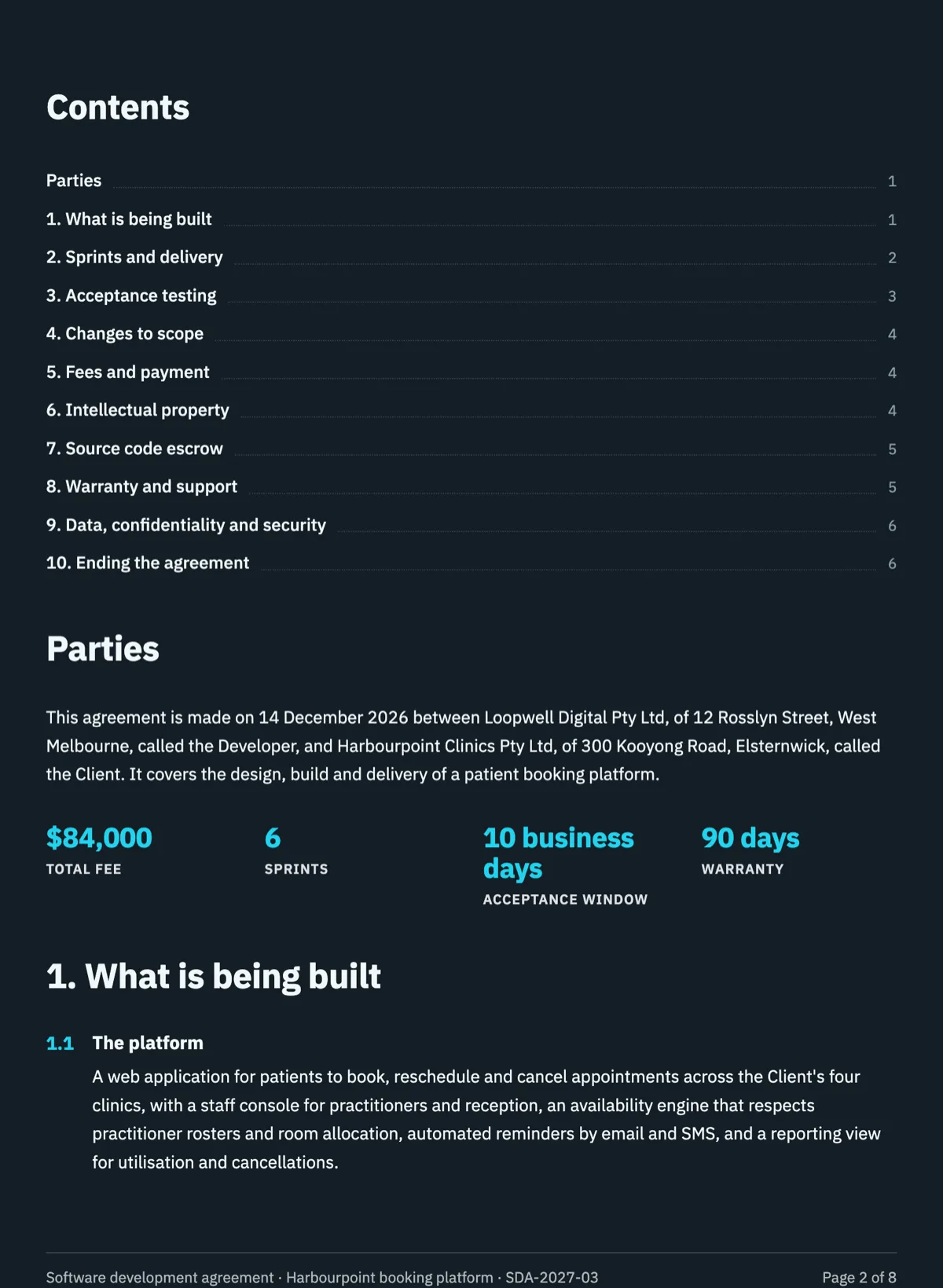 Software development agreement with sprints and an acceptance testCustom software goes wrong in the space between delivered and accepted, where one side thinks a sprint is finished and the other is still writing a list. This agreement fixes a ten business day acceptance window against criteria written before the sprint started, and assigns the intellectual property sprint by sprint as each invoice is paid.
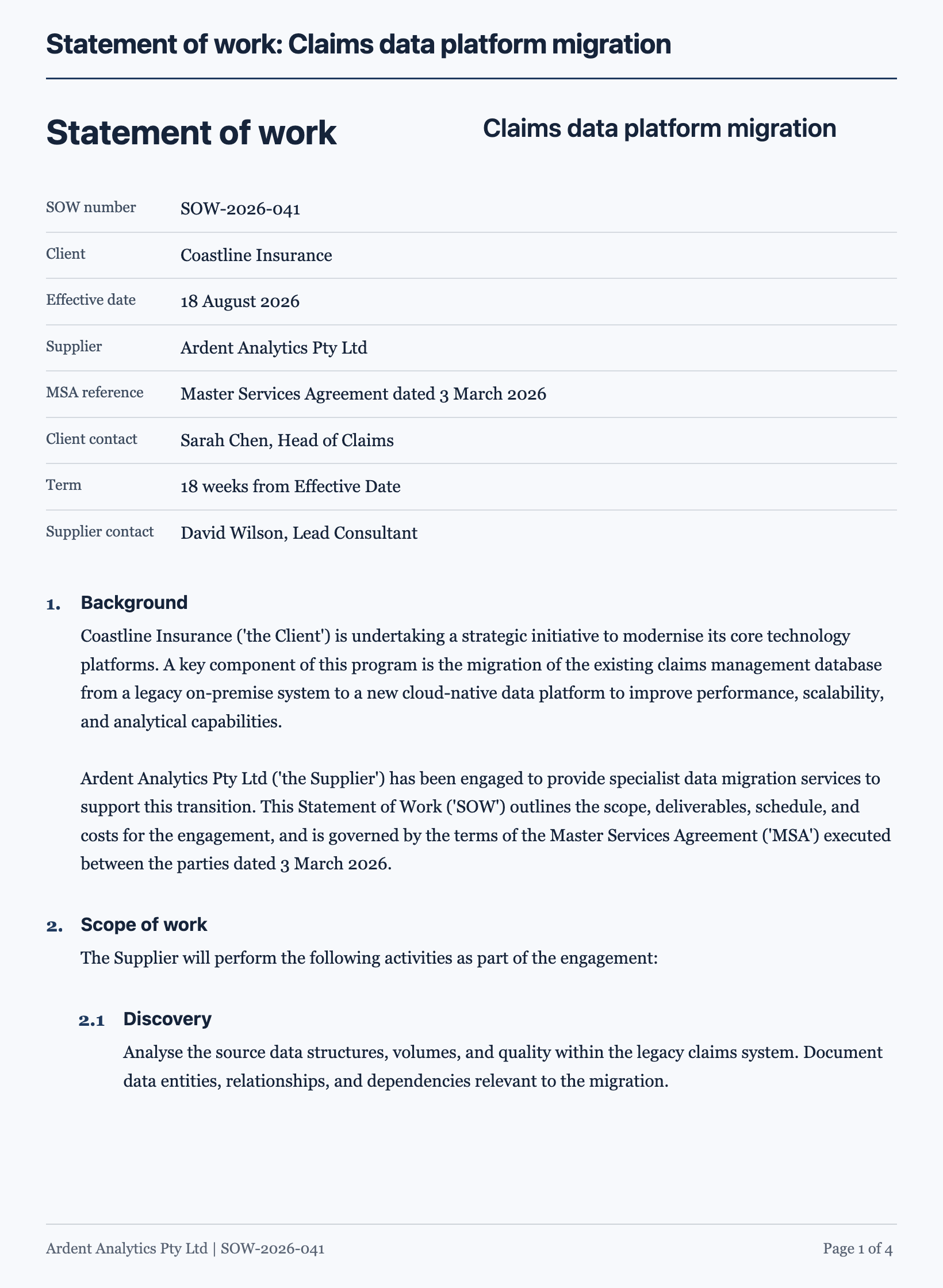 Statement of work template under a master agreementArdent Analytics migrates Coastline Insurance’s claims database to a cloud platform over 18 weeks under SOW-2026-041, governed by a master services agreement dated 3 March 2026. The work is time and materials with four roles priced by the day and a $412,000 estimate before GST, five dated deliverables, ten business days to accept each one, and five assumptions written down before anyone starts.
Questions people ask
What should a delivery clause include?
The place of delivery, the date or window, the event that completes delivery, who unloads and with what equipment, the documents that travel with the goods, and what happens when delivery fails on either side. For digital deliverables, replace the place with a named folder or system and the unloading step with a notice that every listed item has been supplied.
Where does delivery happen if the contract says nothing?
The statutory default under sale of goods legislation is generally the seller's place of business, with goods sent within a reasonable time where the seller agreed to send them but no time was fixed. That rarely matches what a building site or a retailer expects, which is why commercial agreements define delivery by an address, a time and a recorded handover.
Does signing a delivery docket mean the goods are accepted?
Not unless the contract says so, and a careful customer makes sure it does not. A docket signed on a busy site usually confirms only that a number of items arrived. A sentence stating that the signature is evidence of quantity and not acceptance keeps the right to inspect the goods and reject any that miss the specification.
Can a supplier deliver in instalments?
Only where the contract allows it. Under the United Kingdom Sale of Goods Act 1979 a buyer is not bound to accept delivery by instalments unless that was agreed, and the Australian state acts contain similar rules. Agreements that expect staged supply should name the stages, and those that do not should require written consent for any partial delivery.
Who pays when a delivery has to be rebooked?
Whoever caused the failure, if the clause is drafted evenly. A customer that leaves a site locked or has no crane ready usually pays a redelivery fee set out in a schedule. A supplier that misses its own confirmed arrival period commonly reimburses standby labour up to a cap, so each side carries the cost of its own mistakes.
How is delivery different from acceptance?
Delivery is the handover of possession, while acceptance is the customer's confirmation that what arrived meets the contract. Most agreements separate the two with an inspection period after delivery, so an invoice can fall due on delivery while the right to reject defective goods or deliverables stays open for a stated number of days afterwards.
Put the clause in a finished document
The button opens the document generator with a starting description already filled in. Change it to match your own agreement before you run it.
Create a document with OneCraftRelated clauses
- Time is of the essence clause: when a missed date ends the dealA time is of the essence clause makes a missed date grounds to terminate. Sample wedding photography wording, listed date variants and how extensions interact.
- Extension of time clause: moving the completion date fairlyAn extension of time clause gives a contractor more time for delay it did not cause. Australian shop fit out sample, qualifying delay events and notice rules.
- Minimum purchase commitment clause: buying a set amount or paying anywayA minimum purchase commitment clause makes a buyer take a set volume or pay for the shortfall. Sample quarterly wording, take or pay and true up variants.
- Acceptance testing clause: deciding when the work is doneAn acceptance testing clause sets how a deliverable is tested and when it counts as accepted. Sample 10 day test wording, deemed acceptance and staged variants.
For everything the document generator can do, see the document maker.
Step by step in the builder: Create a document with AI, then Document builder components.
Written and checked by the OneCraft team. Last checked .