Contract clause
Minimum purchase commitment clause: buying a set amount or paying anyway
A minimum purchase commitment clause obliges a buyer to order at least a stated quantity or value over a period, and says what happens if it falls short, usually a shortfall payment, a price change or a right for the supplier to end exclusivity or the agreement. It gives the supplier volume it can plan around.
Suppliers price for volume, so a buyer that wants the low price is often asked to promise the volume as well. The drafting question is what the buyer pays when demand drops, and whether that amount is a fair price or a penalty in disguise.
Indunil Asanka · Co-founder
4 min read · Published
Sample clause
a three year supply agreement between Wandoo Bottling, a fictional contract bottler, and a craft kombucha brand that needs 500 cases a quarter at a discounted rate
8. Minimum Commitment 8.1 In each Quarter of the Term, the Customer must order at least 500 Cases of bottling services (the Minimum Quarterly Volume). 8.2 Within 15 business days after the end of each Quarter, the Supplier must give the Customer a statement of the Cases ordered in that Quarter. 8.3 If the Customer ordered fewer Cases than the Minimum Quarterly Volume, the Customer must pay, within 30 days after the statement, a Shortfall Amount equal to the number of Cases short multiplied by $6.40, being the reserved line cost per Case set out in Schedule 2. 8.4 Cases ordered above the Minimum Quarterly Volume in a Quarter are credited against any shortfall in the next Quarter only. 8.5 The Minimum Quarterly Volume is reduced proportionately for any period in which the Supplier cannot perform because of an event described in clause 15 (Force Majeure) or its own failure to supply. 8.6 The Shortfall Amount is a payment for capacity reserved for the Customer.
Sample wording, not legal advice.
Variants
Take or pay
Energy, processing and capacity arrangements where the supplier has built or reserved capacity for one customer.
In each Contract Year the Customer must take, or pay for if not taken, the Annual Contract Quantity of 2,400 megawatt hours. Where the quantity taken is less, the Customer must pay for the difference at 85 percent of the Contract Price. The obligation to pay for quantity not taken is a primary obligation to pay for capacity made available, and quantity paid for but not taken may be taken during the following Contract Year only.
Minimum spend with an annual true up
Services and software where usage varies month to month but the discount is set against a yearly figure.
The Customer commits to spend at least $180,000 excluding GST on the Services in each Contract Year and is invoiced monthly for actual usage. Within 20 business days after each Contract Year ends, the Supplier must issue a true up statement. If actual spend was below the commitment, the Customer must pay the difference on a single true up invoice, less any service credits accrued because the Supplier missed a service level during that year.
Minimum with a termination right instead of a payment
Distribution relationships where the parties would rather part ways than charge for unused volume.
If the Distributor's purchases in any Contract Year are less than 80 percent of the Minimum Annual Target in Schedule 3, the Supplier may, by written notice given within 30 business days after that Contract Year ends, either convert the Distributor's appointment to a non exclusive one or terminate this agreement on 90 days notice. No other amount is payable because of the shortfall, and these rights are the Supplier's only remedies for it.
What to negotiate
How the shortfall amount is calculated
A shortfall charged at full sale price hands the supplier profit on goods it never made. A charge based on reserved cost, such as line time or capacity set aside, is easier to justify commercially and less exposed to the penalty doctrine. Buyers ask to see the calculation, and suppliers that resist opening their books will usually agree a fixed per unit figure in a schedule.
Measurement period and carry forward
A quarterly minimum hurts a seasonal business that sells most of its volume in summer. Buyers ask for an annual period or a right to carry excess volume forward against later shortfalls. Suppliers accept longer periods where their own costs are annual, and often limit carry forward to the next period so the commitment still means something.
Relief when the supplier is the problem
A buyer should not pay for volume the supplier could not have delivered. Common reductions cover the supplier's own supply failures, force majeure events and goods rejected for quality. Buyers also ask for a reduction when a price increase under the agreement takes effect, since the minimum was agreed against the original price.
An exit if demand collapses
A three year commitment signed on a forecast becomes a heavy liability if the product is discontinued. Buyers ask for a right to reduce the minimum, or to leave on notice with a capped payment. Suppliers that invested in capacity resist, but a buy out amount that falls each year of the term is a common compromise.
The risk of leaving it out
Without the clause the discounted price is given for volume the buyer is free never to order, so the supplier carries the cost of any capacity it reserved. Silence is not always safe for the buyer either: when volumes were discussed in correspondence but never written into a commitment clause, arguments about what was promised surface as soon as orders fall.
Shortfall payments and the penalty doctrine
Australian courts can refuse to enforce a sum that operates as a penalty, meaning an amount out of all proportion to the legitimate interest the clause protects, and the doctrine can reach a payment triggered without any breach if it really secures a primary obligation. A shortfall amount reflecting the supplier's genuine cost of reserving capacity, or the discount the buyer received on the volume it did take, is far easier to defend than a charge at the full price of goods never supplied. Calling the payment a price for capacity does not settle the question on its own; the arithmetic behind it does. In a standard form contract with a small business, a one sided commitment is also open to review under the unfair contract terms regime.
Minimum commitments next to exclusivity
Minimum commitments often travel with exclusivity: the distributor receives a territory and the supplier receives a volume. The pairing is usually sensible, because each promise justifies the other. Where the supplier is powerful and the commitment is set so high that it absorbs all of the buyer's demand, it can work like exclusive dealing in practice, which the ACCC treats as prohibited only where it substantially lessens competition. A minimum set comfortably below the buyer's total requirements leaves room to buy elsewhere and eases that concern.
Where it sits in a generated document
A generated supply agreement would usually place the minimum commitment after pricing, because the shortfall rate refers back to the price schedule, and before termination, which may rely on it. Volumes, rates and dates are written as figures, and a worked shortfall example can be requested as a small table so both parties see the calculation before signing. The text is written from the description it is given, so the per unit shortfall rate needs to be stated there.
Documents that carry this clause
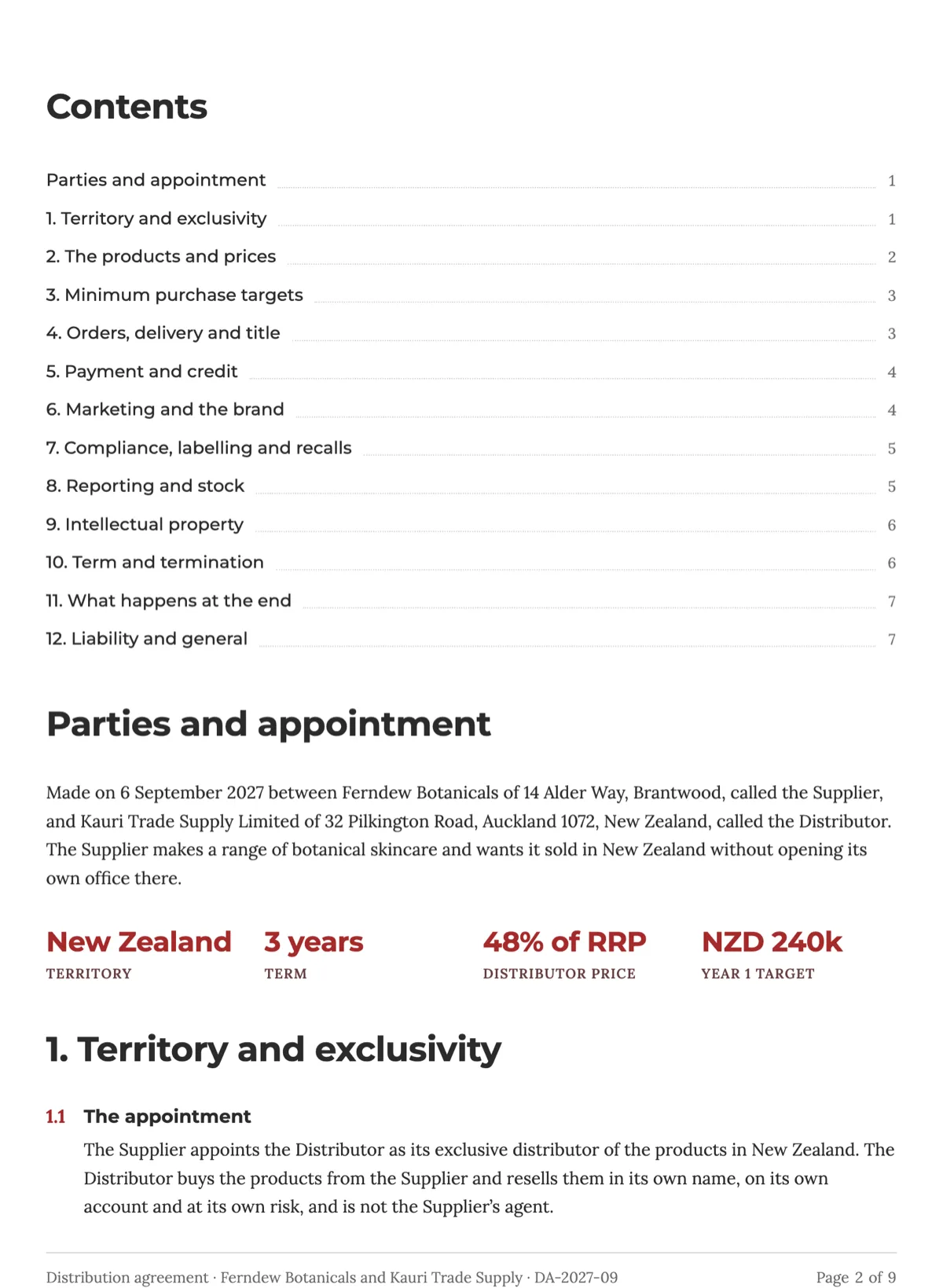 Distribution agreement template with territory and targetsAn exclusive distribution agreement is a trade: a territory in exchange for volume. This one appoints a New Zealand distributor for a skincare range at 48 per cent of recommended retail, with purchase targets rising from NZD 240,000 to NZD 420,000 across three years, and exclusivity that converts to non exclusive if a target is missed by more than 15 per cent.
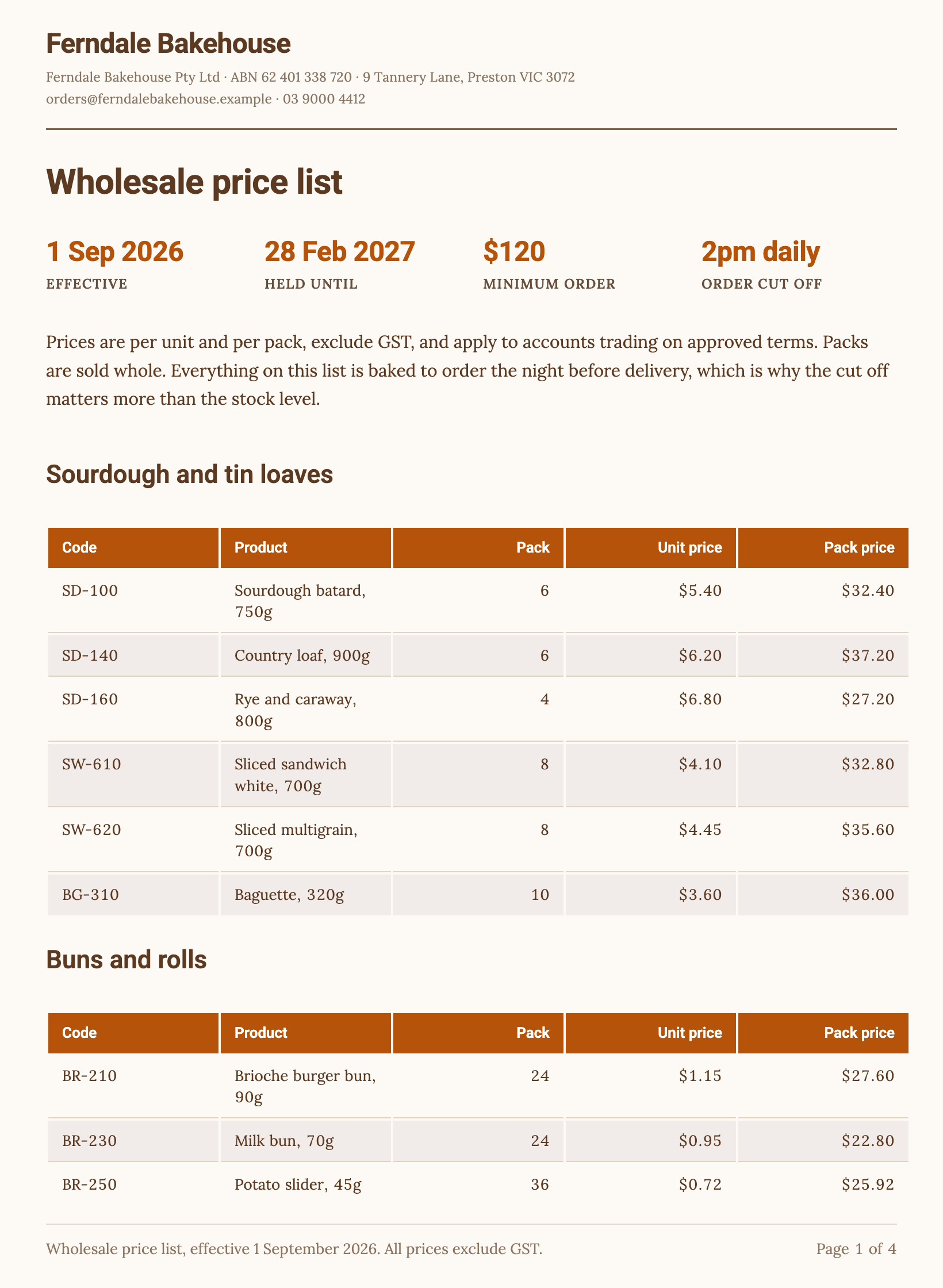 Wholesale price listA bakehouse sells to cafes, so the price that matters is the pack price, not the unit price. This list shows both for seventeen products, then the four things that decide what a cafe actually pays: volume, zone, cut off and terms.
Questions people ask
What is a take or pay clause?
A take or pay clause obliges a buyer to take a contracted quantity each period or pay for it anyway, often at a reduced rate for the quantity not taken. It is common where the supplier has built or reserved capacity, as in energy or processing agreements, and it is usually framed as a primary obligation to pay rather than as damages for failing to take delivery.
Is a shortfall payment a penalty?
Not necessarily. A sum is at risk as a penalty where it is out of all proportion to the legitimate interest it protects. A shortfall calculated from the supplier's reserved cost, or from the discount the buyer received, is much easier to defend than a charge at full price for goods never made. The calculation belongs in the agreement or a schedule.
What is a true up?
A true up is a reconciliation at the end of a period comparing what the buyer committed to order or spend with what it actually did. If actual volume fell short, the buyer pays the difference in one invoice, and some clauses also credit overperformance. True ups suit services and software, where monthly usage varies but the commercial commitment is annual.
How is a minimum commitment different from a minimum order quantity?
A minimum order quantity is the smallest single order a supplier will accept, such as 200 units of a product line. A minimum commitment is a total volume or spend across many orders over a period. A buyer can satisfy every minimum order quantity and still miss the period commitment, so the two clauses deal with different risks.
Should the minimum fall if the supplier fails to deliver?
It should. A buyer cannot order volume the supplier is unable to supply, so well drafted clauses reduce the minimum for periods of supplier failure, force majeure and rejected nonconforming goods. Without that adjustment the buyer could owe a shortfall payment caused entirely by the supplier's own performance, which is an outcome neither side would defend.
What happens to the commitment if the agreement ends early?
The agreement has to say. Options include no further commitment after termination, a pro rata commitment for the part of the period already run, or a buy out amount for the remaining term. A buy out attracts the strongest penalty arguments, so it is usually set on a declining scale and linked to costs the supplier cannot recover elsewhere.
Put the clause in a finished document
The button opens the document generator with a starting description already filled in. Change it to match your own agreement before you run it.
Create a document with OneCraftRelated clauses
- Exclusivity clause: dealing only with each other, within limitsAn exclusivity clause commits a party to deal only with the other for a period. Australian venue catering sample, supply and territory variants, ACCC limits.
- Delivery clause: where, when and how the handover happensA delivery clause sets where, when and how goods or deliverables are handed over. Sample site delivery wording, plus fixed date, window and on call variants.
- Early termination fee clauseAn early termination fee clause charges for ending a contract before the term ends. Sample wording, sliding scales, the penalty test and unfair terms limits.
For everything the document generator can do, see the document maker.
Step by step in the builder: Create a document with AI, then Document builder components.
Written and checked by the OneCraft team. Last checked .