Contract clause
Exclusivity clause: dealing only with each other, within limits
An exclusivity clause is a promise by one party to deal only with the other for a defined product, service, territory or period, such as buying all its supplies from one supplier or appointing only one caterer. In return the other party usually commits to volume, price or performance standards.
Exclusivity swaps one party's freedom to shop around for something measurable in return. The clauses that cause trouble describe the promise in careful detail and the return in a single vague line.
Nuwan Madhusanka · Co-founder
4 min read · Published
Sample clause
a two year catering agreement between Banksia Hall, a fictional function venue in the Adelaide Hills, and Saltpan Kitchen, the caterer it appoints for every booked event
6. Exclusivity 6.1 During the Term, the Venue appoints the Caterer as the exclusive supplier of food and non alcoholic beverages for all Functions held at the Venue, and must not permit any other caterer to supply food at a Function except under clause 6.3. 6.2 In return, the Caterer must: (a) accept every Function booked with at least 21 days notice; (b) meet the service standards in Schedule 2; and (c) keep its menu prices within Schedule 3, adjusted only under clause 8. 6.3 A client of the Venue may supply a celebration cake, or food required for a documented cultural or religious reason, without breaching clause 6.1. 6.4 If the Caterer fails to meet the service standards in Schedule 2 at three Functions in any six month period, the Venue may by written notice end the exclusivity in clause 6.1 while the rest of this agreement continues. 6.5 This clause does not restrict the Caterer from providing catering elsewhere.
Sample wording, not legal advice.
Variants
Exclusive purchase
A buyer commits to take all of a product from one supplier, usually in exchange for a price or supply security.
During the Term the Buyer must purchase all of its requirements for Recycled Packaging used at its Melbourne facilities from the Supplier. The Supplier must supply each conforming order in full within 5 business days at the prices in Schedule 1. If the Supplier fails to supply an order in full and on time, the Buyer may buy that quantity from another supplier, and the exclusivity in this clause does not apply to it.
Exclusive supply
A manufacturer agrees not to sell a product to the customer's competitors, often for a new or custom product.
For 18 months after the Launch Date, the Manufacturer must not supply the Product, or any product made to substantially the same formulation, to any person other than the Retailer for sale in Australia. The Retailer must order at least 12,000 units of the Product in each quarter of that period. If the Retailer orders fewer units in a quarter, the Manufacturer may end this exclusivity by written notice given within 20 business days after that quarter ends.
Territory exclusivity
Agency, franchise and distribution arrangements where one party receives an area.
The Principal appoints the Agent as its only agent for the Territory, being the local government areas listed in Schedule 1, and must not appoint another agent or actively seek customers in the Territory during the Term. The Principal may still accept unsolicited orders from customers in the Territory and must pay the Agent the commission in Schedule 2 on each of them. Exclusivity ends if the Agent's annual sales fall below the minimum in Schedule 3.
What to negotiate
What the exclusive party receives
A party that gives up its freedom to shop around usually asks for price protection, guaranteed supply or a service standard, plus a right to end the exclusivity if the other side falls short. Without that return, exclusivity is a one way restraint. The strongest clauses tie exclusivity to a measurable commitment, such as minimum orders or service levels, and end it when the commitment is missed.
Scope and carve outs
Exclusivity drafted as all food and beverages at a venue soon meets a wedding cake, a client's cultural requirements or a sponsor's product. Listing carve outs in advance prevents a technical breach every other weekend. The narrower the defined product or service, the easier the clause is to comply with and the easier it is to defend if challenged.
Length of the exclusive period
Longer exclusivity justifies more investment by the party receiving it, such as fitting out a kitchen or building stock for a territory, but it locks the other party in if the relationship sours. Periods of one to three years with a performance based exit are common, and longer periods usually come with a review point or a right to end exclusivity on notice.
Competition law exposure
Most exclusive arrangements are lawful, but a powerful supplier or a long exclusive period across a whole market can attract scrutiny. Parties with significant market share sometimes lodge a notification with the ACCC to gain protection for the conduct. At the least, the business imposing the condition should consider whether it could substantially lessen competition before signing.
The risk of leaving it out
Without an express clause there is no exclusivity, however the parties described the relationship in conversation. The venue could appoint a second caterer a month after the first fitted out its kitchen, and the caterer would have no claim, because a promise to deal only with one party is not generally implied from a long or close trading relationship.
When exclusivity raises competition law questions
Part IV of the Competition and Consumer Act 2010 prohibits exclusive dealing that has the purpose, effect or likely effect of substantially lessening competition. The ACCC describes exclusive dealing as one business placing conditions on another's freedom to choose who it does business with, what business it does or where it does business, and notes that harm is more likely where the product cannot be bought elsewhere or the business setting the conditions is powerful. A business can lodge a notification, and the ACCC then assesses whether the conduct is likely to substantially lessen competition and, if so, whether it is still in the public interest. For a single venue and its caterer the exposure is usually slight; for a major supplier tying up retailers across a market it is not.
Exclusivity as a restraint of trade
An exclusivity clause restrains a business, and the general law doctrine of restraint of trade can reach commercial agreements as well as employment contracts. A restraint wider than needed to protect a legitimate interest, or one that runs long after its commercial reason has ended, risks not being enforced. Tying exclusivity to the life of the relationship, confining it to the products actually supplied, and ending it once the counterparty stops performing all help keep it inside what a court is likely to accept as reasonable.
Where it sits in a generated document
A generated supply or services agreement places exclusivity near the front, straight after the appointment or scope clause, because the minimum commitments and termination rights later in the document depend on it. Territories, product lists and service standards can be generated as schedules in the same document. When the agreement is sent for signature, each party named in its signature block becomes one signer.
Documents that carry this clause
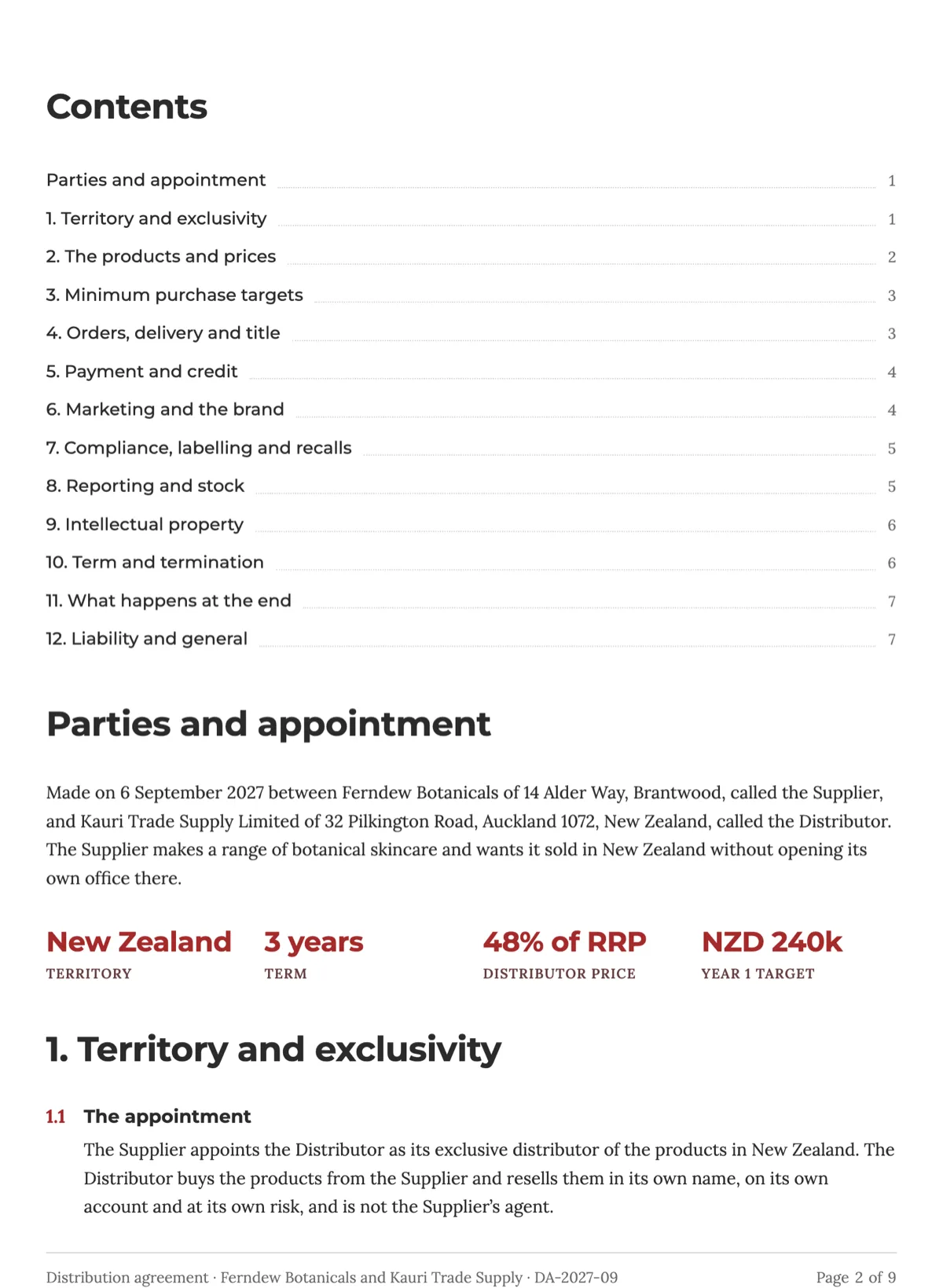 Distribution agreement template with territory and targetsAn exclusive distribution agreement is a trade: a territory in exchange for volume. This one appoints a New Zealand distributor for a skincare range at 48 per cent of recommended retail, with purchase targets rising from NZD 240,000 to NZD 420,000 across three years, and exclusivity that converts to non exclusive if a target is missed by more than 15 per cent.
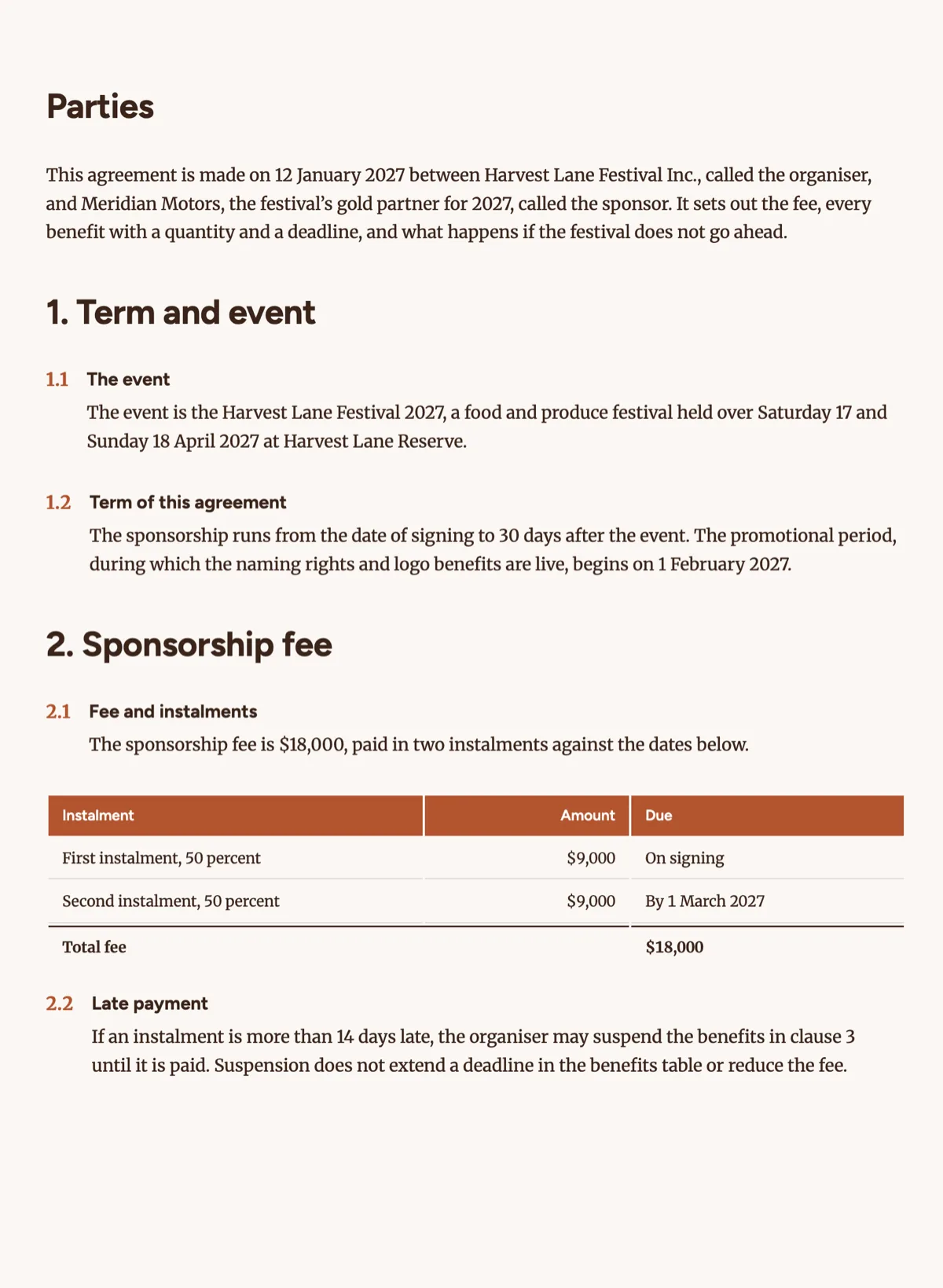 Sponsorship agreement template that lists every benefit with a numberSponsorship falls apart in the delivery, when nobody can find the email that said how many banners and which stage. This agreement is the benefits list as a table with quantities and dates, the $18,000 fee in instalments tied to those dates, and the two clauses sponsors care about most: exclusivity, and what happens if the event does not go ahead.
Questions people ask
Is an exclusivity clause legal in Australia?
Usually. Most exclusive arrangements between businesses are lawful. The Competition and Consumer Act 2010 prohibits exclusive dealing only where it has the purpose, effect or likely effect of substantially lessening competition, which is more likely when the business imposing it is powerful or the product cannot be obtained elsewhere. A business concerned about that test can lodge a notification with the ACCC.
What is the difference between an exclusive and a sole appointment?
In distribution and agency drafting, an exclusive appointment usually means the principal appoints no one else in the territory and does not sell there itself. A sole appointment usually means no other agent or distributor is appointed, but the principal keeps the right to sell directly. Because usage varies, the clause should state which rights the principal keeps rather than rely on the label.
How long can exclusivity last?
There is no fixed legal maximum, but the longer and wider the exclusivity, the harder it is to justify as reasonable and the more attention it may draw under competition law. Commercial periods of one to three years are common, often renewable on performance. The period should reflect the investment the exclusivity is meant to protect.
Can exclusivity end without ending the whole contract?
Yes, and it is often the better outcome. A clause can convert an exclusive appointment to a non exclusive one when a target or service standard is missed, while the rest of the agreement continues. The underperforming party keeps its existing business and the other party regains its freedom to appoint others, without the disruption of a full termination.
Does an exclusivity clause stop the supplier working elsewhere?
Only if it says so, and many do not. A venue appointing an exclusive caterer restricts the venue, not the caterer, which remains free to cater other events. Where the parties intend a two way restriction, both promises need to be written out, and the second one deserves its own reasonableness check because it restrains a different business.
What happens if the exclusive supplier cannot supply?
The clause should answer that directly. A common approach lets the buyer source the shortfall elsewhere without breaching exclusivity, and treats repeated supply failures as grounds to end the exclusive arrangement. Without that release valve, a buyer could be bound to wait on a supplier that cannot deliver, which is commercially unworkable and an obvious source of dispute.
Put the clause in a finished document
The button opens the document generator with a starting description already filled in. Change it to match your own agreement before you run it.
Create a document with OneCraftRelated clauses
- Minimum purchase commitment clause: buying a set amount or paying anywayA minimum purchase commitment clause makes a buyer take a set volume or pay for the shortfall. Sample quarterly wording, take or pay and true up variants.
- Most favoured customer clause: promising the best priceA most favoured customer clause promises nobody else gets a better price. Sample wording with a rebate mechanism, three variants and the competition law risk.
- Restraint of trade clause and how a cascade is builtA restraint of trade clause limits what a person may do after leaving. How an Australian cascading restraint is built, with employment and sale variants.
For everything the document generator can do, see the document maker.
Step by step in the builder: Create a document with AI, then Send a document for signature.
Written and checked by the OneCraft team. Last checked .