Contract clause
Restraint of trade clause and how a cascade is built
A restraint of trade clause is any contract term that limits a person's freedom to work or do business after a relationship ends, covering non compete, non solicitation and no dealing promises. In Australia these clauses are often drafted as a cascade, a ladder of alternative periods and areas that lets a court drop the unreasonable rungs.
Australian drafters cannot know in advance which period and area a judge will accept, so they write several and let the court choose. That device, the cascading restraint, is useful, frequently criticised, and now the subject of federal consultation.
Indunil Asanka · Co-founder
4 min read · Published
Sample clause
an employment contract between Gidgee Veterinary Clinics, a fictional group of three clinics in Dubbo, and an associate veterinarian who treats both farm and companion animals
17. Restraint 17.1 In this clause, Restraint Period means, in order of preference, 12 months, 6 months or 3 months after employment ends, and Restraint Area means, in order of preference, within 20 kilometres, 10 kilometres or 5 kilometres of any clinic at which the Employee regularly worked in the final 12 months of employment. 17.2 During the Restraint Period and within the Restraint Area, the Employee must not practise as a veterinarian in or for a business that competes with Gidgee Veterinary Clinics. 17.3 Clause 17.2 operates as a separate restraint for each combination of Restraint Period and Restraint Area, so that it creates nine restraints. 17.4 If any combination is unenforceable, it is severed and the remaining combinations continue to apply, beginning with the longest period and the widest area that is enforceable. 17.5 Nothing in this clause prevents the Employee from giving emergency treatment to an animal.
Sample wording, not legal advice.
Variants
Employment, activity and period only
Mobile or online roles where a radius means little and the risk is the activity rather than the location.
For the Restraint Period the Employee must not provide services to a Restricted Client. Restraint Period means 9 months, 6 months or 3 months after employment ends, and Restricted Client means a client the Employee dealt with in the last 12 months, or failing that the last 6 months, of employment. Each combination is a separate covenant, and an unenforceable combination is severed without affecting any other.
Sale of business
A seller receiving payment for goodwill, where the buyer needs time for clients to transfer their loyalty.
In consideration of the Purchase Price, the Vendor must not carry on or be concerned in a business similar to the Business within the Restraint Area for the Restraint Period. Restraint Period means 3 years, 2 years or 1 year from Completion, and Restraint Area means the State of New South Wales, the Orana region or the Dubbo local government area. Each combination is a separate and severable restraint.
Partnership or shareholder exit
A departing owner who has had full access to strategy and pricing, and who is paid out for an interest in the business.
For 18 months, 12 months or 6 months after ceasing to hold Shares, the Outgoing Shareholder must not solicit any client or employee of the Company or hold an interest in a competing business in Australia, New South Wales or the Central West. Each combination of period, area and activity is a separate restraint, and the parties acknowledge that each was negotiated between commercially advised parties.
What to negotiate
The top rung
Employers are tempted to start the ladder at an ambitious period and area, expecting the court to step down. Employees point out that the widest rungs still shape behaviour, because few people want to test them. A top rung the employer could genuinely justify is fairer and removes the argument that the cascade was built to intimidate.
How many combinations
Three periods and three areas already produce nine restraints. Ladders with dozens of combinations invite criticism that the person could never know what they agreed to. Employees commonly ask for fewer rungs, and employers gain little from more than two or three steps on each axis.
What sits alongside the cascade
A cascade is sometimes used in place of narrower drafting. Employees ask for carve outs, such as emergency work or unrelated roles, and for garden leave to be deducted. Employers who accept those changes usually end up with a restraint that needs fewer fallback rungs to survive.
The risk of leaving it out
A single fixed restraint that a court finds too wide is severed entirely in most states, leaving the business with no restraint at all. Omitting any restraint means the employee or seller is free to compete immediately, restrained only by confidentiality obligations and, for a seller, whatever protection of goodwill the general law implies.
How the cascade works
A court will not rewrite an unreasonable restraint in most Australian jurisdictions, but it can sever words that leave a sensible clause behind. A cascade exploits that by defining the period and the area as lists of alternatives and declaring that every combination is a separate promise. If the widest combination fails, the court strikes it out and tests the next one, until it reaches a combination that protects a legitimate interest without going further than necessary. New South Wales differs, because the Restraints of Trade Act 1976 lets a court read down a restraint to what is reasonable, so cascades matter less there, although national employers use them anyway. Courts have generally accepted cascades, while criticising those with so many steps that certainty disappears.
Employment, sale of business and the 2026 consultation
The setting changes how much a restraint can carry. In employment, the interests are confidential information and client or staff connections, and periods are usually measured in months rather than years. On a sale of business, the buyer has paid for goodwill, so longer periods and wider areas are more readily accepted. On 7 September 2026, alongside draft legislation to ban non compete clauses for workers earning under $190,100, the Government opened consultation on banning cascading restraint of trade clauses, with submissions due by 2 October 2026. That proposal is not yet law and its scope is still being consulted on, so a cascade drafted today should be reviewed again once the final legislation and any transitional rules are known.
Where it sits in a generated document
A generated agreement sets out the restraint as a numbered clause with the period and area alternatives as defined terms, so the severance sub clause can refer to them precisely. Each value is written as text rather than a blank. For documents long enough to need one, the contents list mirrors the headings exactly, which makes the restraint easy to locate.
Documents that carry this clause
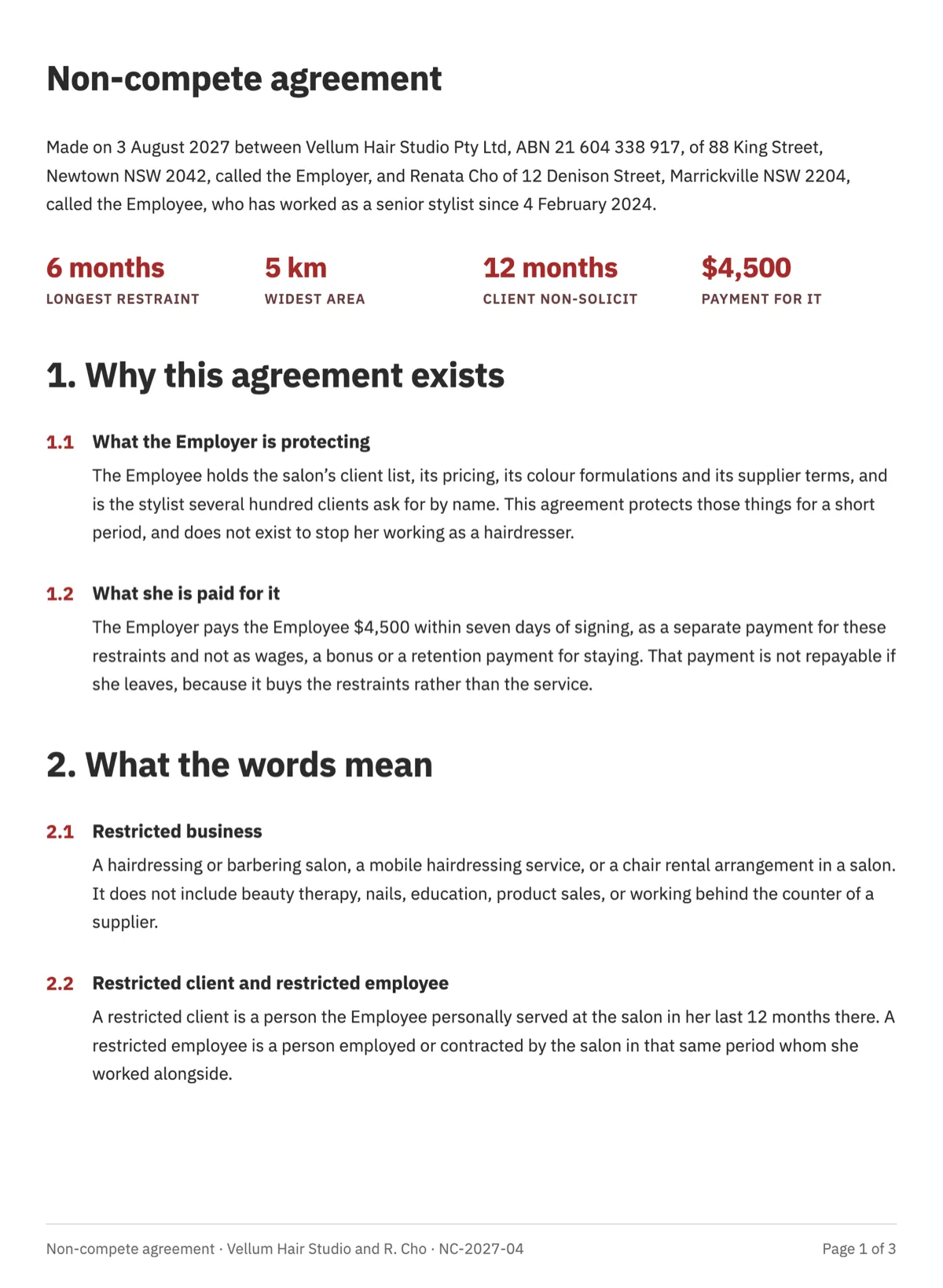 Non-compete agreement template with cascading restraint clausesAn Australian non-compete lives or dies on how it is drafted, because a court will not rewrite one that reaches too far. This one restrains a senior stylist from a competing salon using three separate covenants of falling reach, from 5 kilometres for six months down to 1 kilometre for three, and pays $4,500 for them.
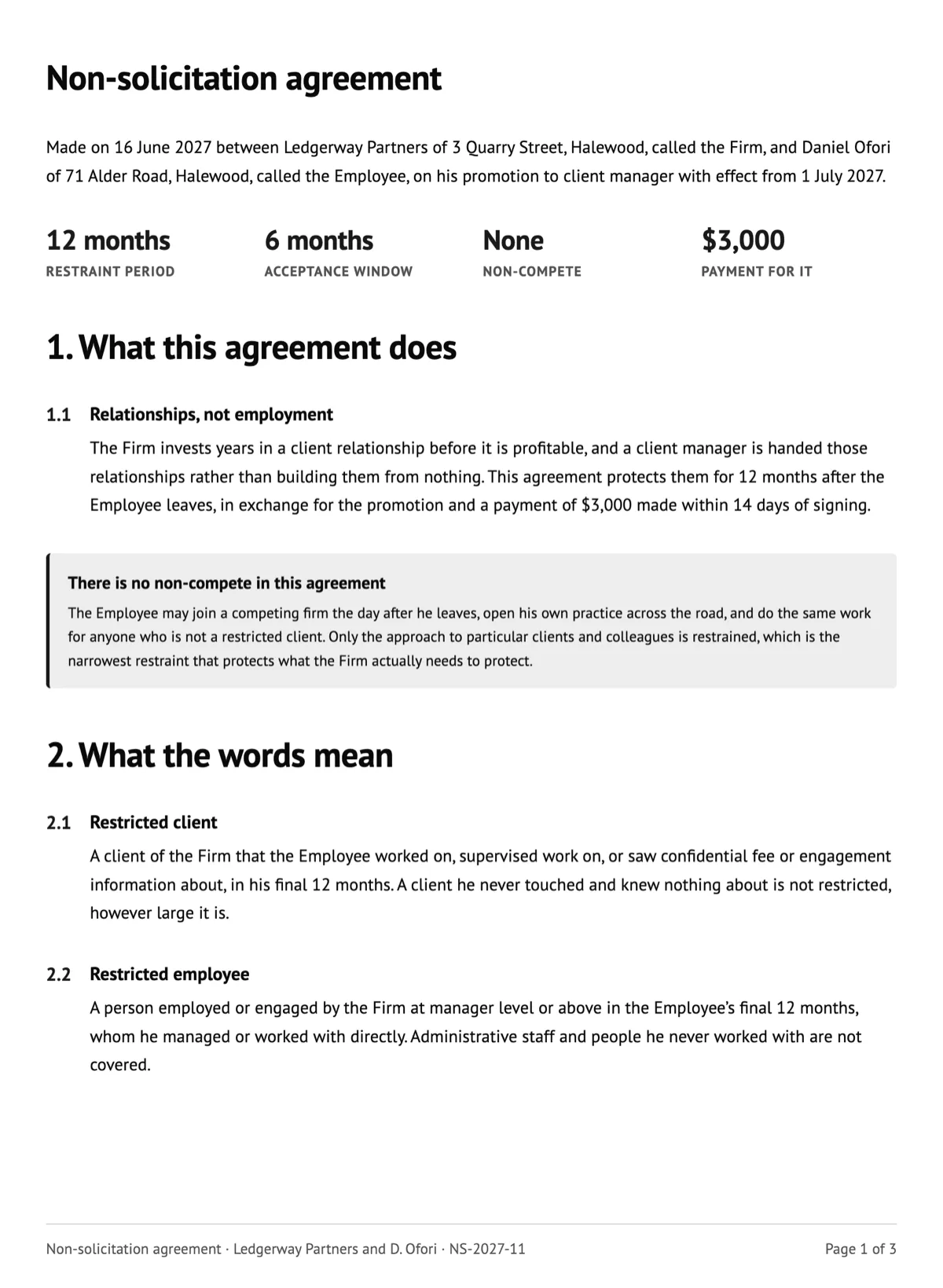 Non-solicitation agreement for clients, staff and durationA non-solicitation agreement restrains the approach, not the work. This one lets an accounting manager join a competitor the day after he leaves, and stops him approaching the clients he handled or the colleagues he managed for twelve months, with a six month window in which he also cannot accept work from those clients.
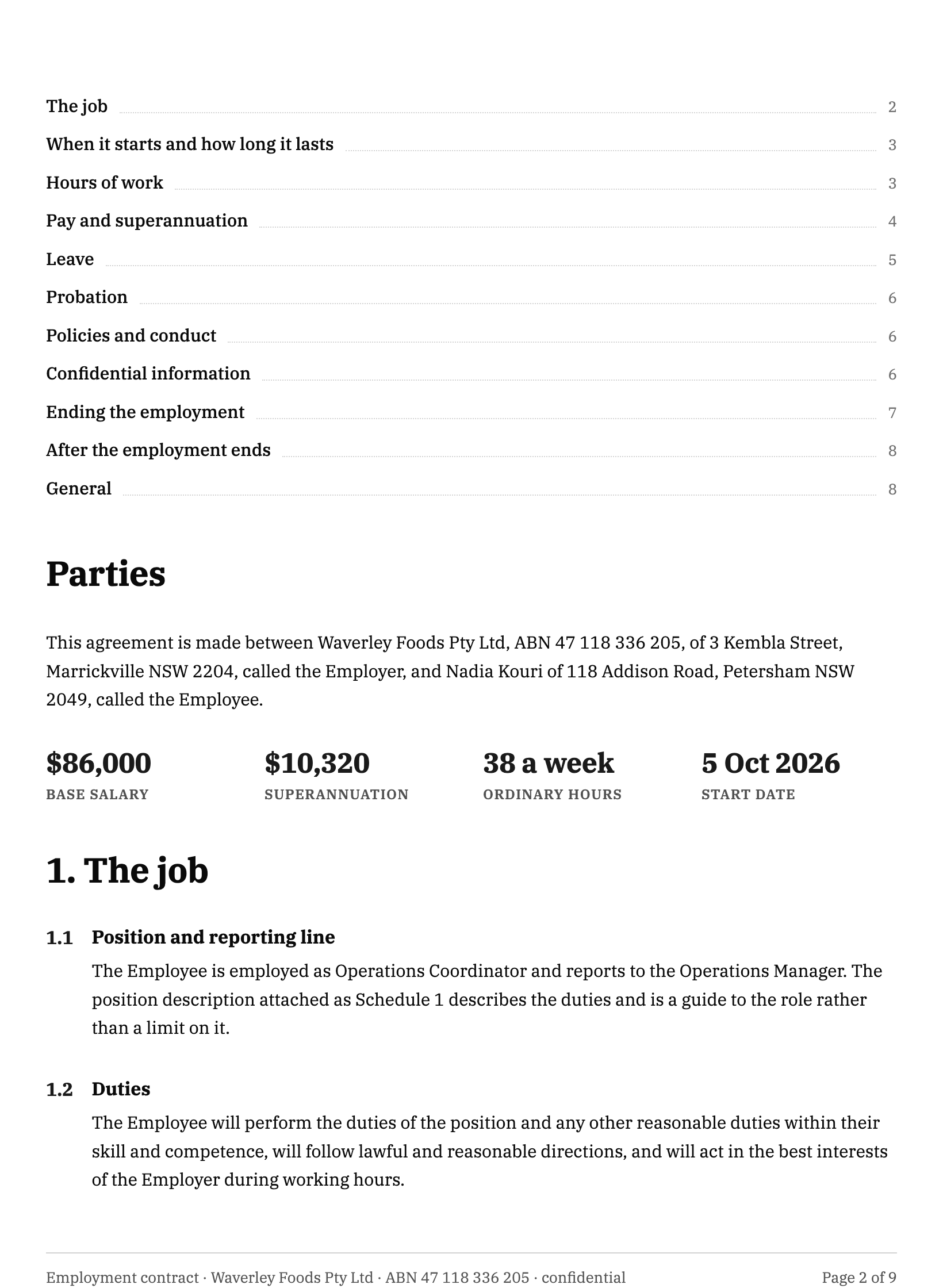 Employment contractA full time ongoing contract for an operations coordinator on $86,000 plus $10,320 of superannuation. Eleven numbered clauses, a leave table drawn from the National Employment Standards, and a notice table that scales with service.
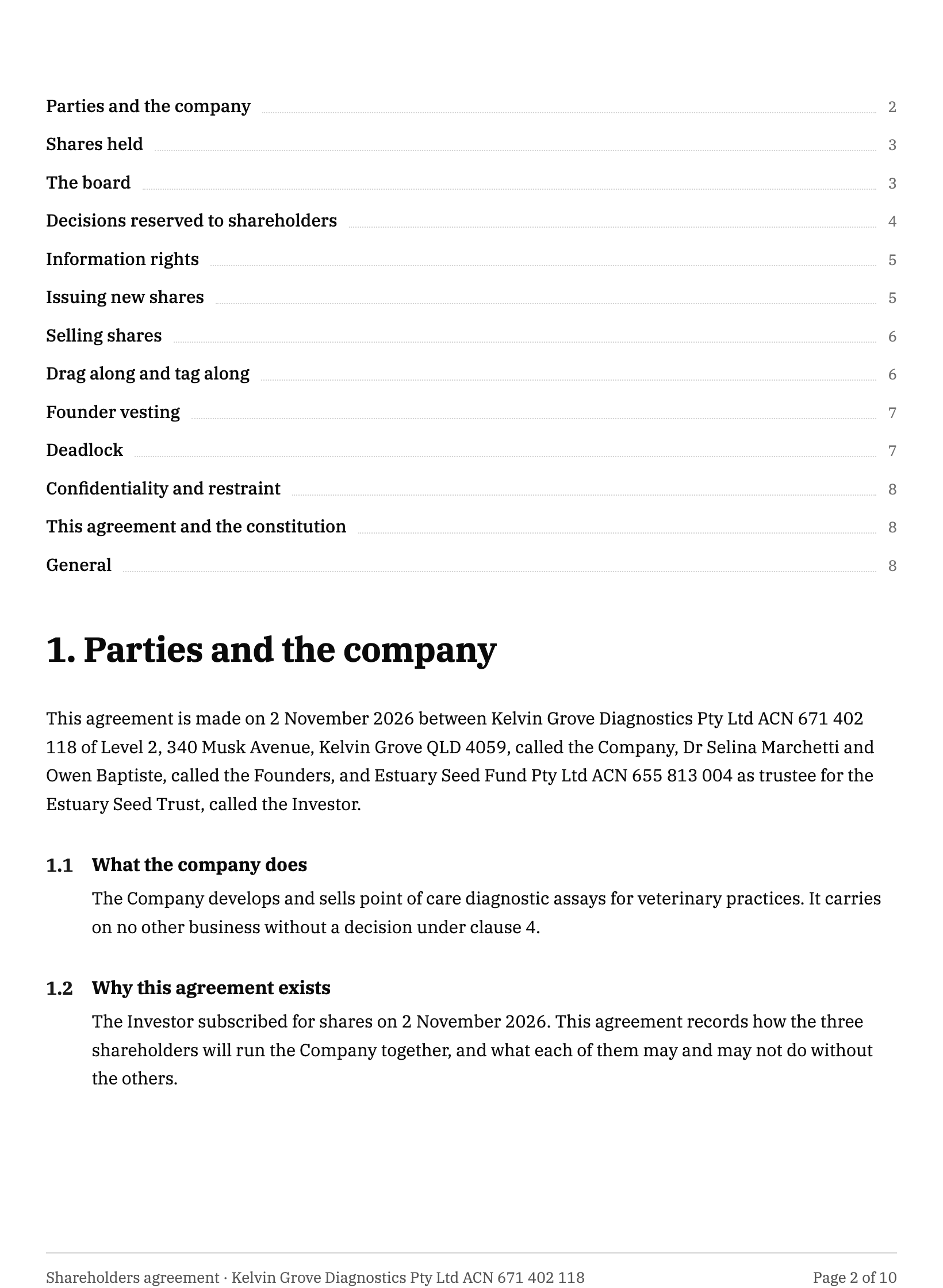 Shareholders agreement templateA veterinary diagnostics company has just taken $1.5 million from one seed fund. The founders keep 80 percent between them, so the whole agreement turns on a single number: the 75 percent consent threshold that puts the investor on one side of every decision that matters.
Questions people ask
What does a restraint of trade clause cover?
Any promise that limits what a person may do after the relationship ends: not competing, not soliciting clients or staff, not dealing with particular clients, or not using a business name. Each promise is presumed unenforceable unless the party relying on it shows a legitimate interest and a reasonable scope.
Are cascading restraints enforceable in Australia?
Courts have generally accepted them as a legitimate way to let severance work, provided each combination is a genuine alternative and at least one protects a real interest reasonably. Cascades with a very large number of combinations attract criticism for uncertainty, and each rung is still judged on ordinary reasonableness principles.
Why do cascades matter less in New South Wales?
The Restraints of Trade Act 1976 allows a New South Wales court to read down a restraint to what is reasonable rather than striking it out. That gives a single restraint a way to survive in part. Businesses operating across states still use cascades so the same clause works everywhere.
Is a sale of business restraint treated differently from an employment restraint?
Yes. A buyer has paid for goodwill that the seller could otherwise take back by competing, so courts accept longer periods and wider areas than in employment. The parties are also usually advised and bargaining more evenly, which supports the reasonableness of the terms they chose.
Will cascading restraint clauses be banned?
The Government opened consultation on banning cascading restraint of trade clauses on 7 September 2026, with submissions closing on 2 October 2026. It is a consultation, not a law, and how any ban would apply to existing contracts or to different kinds of restraint has not been settled.
What makes a restraint reasonable?
It must protect a legitimate interest, such as confidential information, client connections or goodwill, and go no further in time, area or activity than that interest needs. Reasonableness is assessed at the time the contract was made, taking account of the role, the parties and any payment given for the restraint.
Put the clause in a finished document
The button opens the document generator with a starting description already filled in. Change it to match your own agreement before you run it.
Create a document with OneCraftRelated clauses
- Non compete clause: wording, enforceability and reformA non compete clause stops a worker joining or starting a competitor. Australian sample wording, how courts test it, and the 2026 draft ban explained.
- Non solicitation clause for clients and staffA non solicitation clause stops a former employee approaching clients or staff. Australian sample wording for clients and staff, with three variants.
- Exclusivity clause: dealing only with each other, within limitsAn exclusivity clause commits a party to deal only with the other for a period. Australian venue catering sample, supply and territory variants, ACCC limits.
- Severability clause: keeping the contract alive when one term failsA severability clause keeps a contract standing when one term is unenforceable. Sample cascading restraint wording, read down and replacement variants, limits.
For everything the document generator can do, see the document maker.
Step by step in the builder: Create a document with AI, then Send a document for signature.
Written and checked by the OneCraft team. Last checked .