Contract clause
Non solicitation clause for clients and staff
A non solicitation clause stops a person who leaves a business from approaching its clients, its staff or both for a stated period. Unlike a non compete, it does not stop them taking a job with a competitor; it only stops them using the relationships they built to pull work or people away.
Most businesses worry less about where a departing account manager works next than about which clients and colleagues follow. A well drafted non solicitation clause targets exactly that, which is why it is often the restraint that survives when a broader one fails.
Indunil Asanka · Co-founder
4 min read · Published
Sample clause
an employment contract between Quandong Freight, a fictional freight forwarder in Townsville, and an account manager who handles mining and agricultural shippers
14. Non Solicitation 14.1 In this clause, Restricted Client means a person to whom Quandong Freight supplied freight forwarding services in the 12 months before the Employee's employment ended and with whom the Employee dealt personally during that period. 14.2 For 12 months after employment ends, the Employee must not solicit, canvass or approach a Restricted Client in order to supply freight forwarding services in competition with Quandong Freight. 14.3 For 6 months after employment ends, the Employee must not induce or encourage an employee of Quandong Freight with whom the Employee worked in the last 12 months of employment to leave that employment. 14.4 Clause 14.3 is not breached by a job advertisement that is not directed at Quandong Freight's employees, or by employing a person who responds to one. 14.5 This clause does not prevent the Employee from dealing with a Restricted Client who approaches the Employee without any solicitation.
Sample wording, not legal advice.
Variants
Clients only
The business values its client book but has no particular concern about staff moving with the employee.
For 12 months after employment ends, the Employee must not, on the Employee's own account or for any other person, solicit or entice away from the Company any client to whom the Employee provided services, or whose account the Employee managed, in the 12 months before employment ended. The Employee may announce a change of employer publicly, provided the announcement is not sent directly to any such client.
Staff only
Team leaders whose departure could take a whole crew, in businesses where client relationships sit with the firm rather than the individual.
For 6 months after employment ends, the Employee must not solicit, induce or encourage any person who was employed or engaged by the Company in a role reporting to the Employee, or in the same team, during the last 12 months of employment to leave the Company. A general recruitment advertisement, or employing a person who approaches the Employee on their own initiative, is not a breach of this clause.
Clients with a no dealing limb
Senior advisers with close personal client relationships, where clients would follow without any approach being made.
For 9 months after employment ends, the Employee must not solicit any Restricted Client, and for the first 4 months of that period must also not accept instructions from or provide competing services to any Restricted Client, whether or not the client approached the Employee. Restricted Client is limited to clients the Employee personally advised in the final 12 months of employment and is listed in a schedule provided when employment ends.
What to negotiate
Which clients count
Employers prefer every client of the business. Employees argue for clients they personally dealt with, over a recent lookback such as twelve months, because those are the only relationships they can exploit. The narrower definition is also the one most likely to be treated as protecting a legitimate interest, so employers often settle there.
Soliciting against dealing
A pure non solicitation clause stops approaches but lets a client who calls the former employee move freely. A no dealing limb blocks that too, which restrains more and needs more justification. A common compromise is a short no dealing period inside a longer non solicitation period, limited to named clients.
Carve outs for ordinary recruiting and announcements
Employees ask that a public job advertisement, a response to someone who approaches them, and a general announcement of a new role are not breaches. Without those carve outs a clause can be breached by routine behaviour, which makes it harder to live with and invites a fight over what an approach means.
The risk of leaving it out
With no non solicitation clause, a former employee is free to contact every client and colleague the day after leaving, limited only by the duty not to misuse confidential information. Proving that a client list was copied is far harder than proving that a restricted client was approached, so the business loses its most practical protection.
What counts as soliciting
Soliciting requires the former employee to take a step toward the client or colleague, such as a call, a direct message or an offer. Doing good work that attracts clients without an approach is generally not soliciting, which is why many employers add a no dealing limb for key clients. Announcements are the grey area: a general post about a new role reads differently from the same message sent to a named client. Defining the restricted group by personal dealings and a recent lookback keeps the clause tied to relationships the employee really holds, and a schedule of named clients given at exit removes argument about who was on the list.
Staff clauses and the 2026 consultation
Treasury describes client non solicitation clauses and co worker non solicitation clauses as related to, but different from, non compete clauses. When the Government released draft legislation on 7 September 2026 to ban non competes for workers earning under $190,100, it also opened consultation on banning co worker non solicitation clauses, with submissions closing on 2 October 2026. Client non solicitation was not on that list. Nothing has changed in the law yet, but a staff clause is the part of this restraint most exposed to reform, so drafting it as a separate sub clause keeps the client protection intact if it is later struck out.
Where it sits in a generated document
A generated contract carries non solicitation as its own numbered clause after confidentiality, with clients and staff in separate sub clauses so either can be removed without renumbering the other. The legal register keeps defined terms such as Restricted Client consistent through the text. Any later change through the built in chat edits the words of that clause rather than adding a new one.
Documents that carry this clause
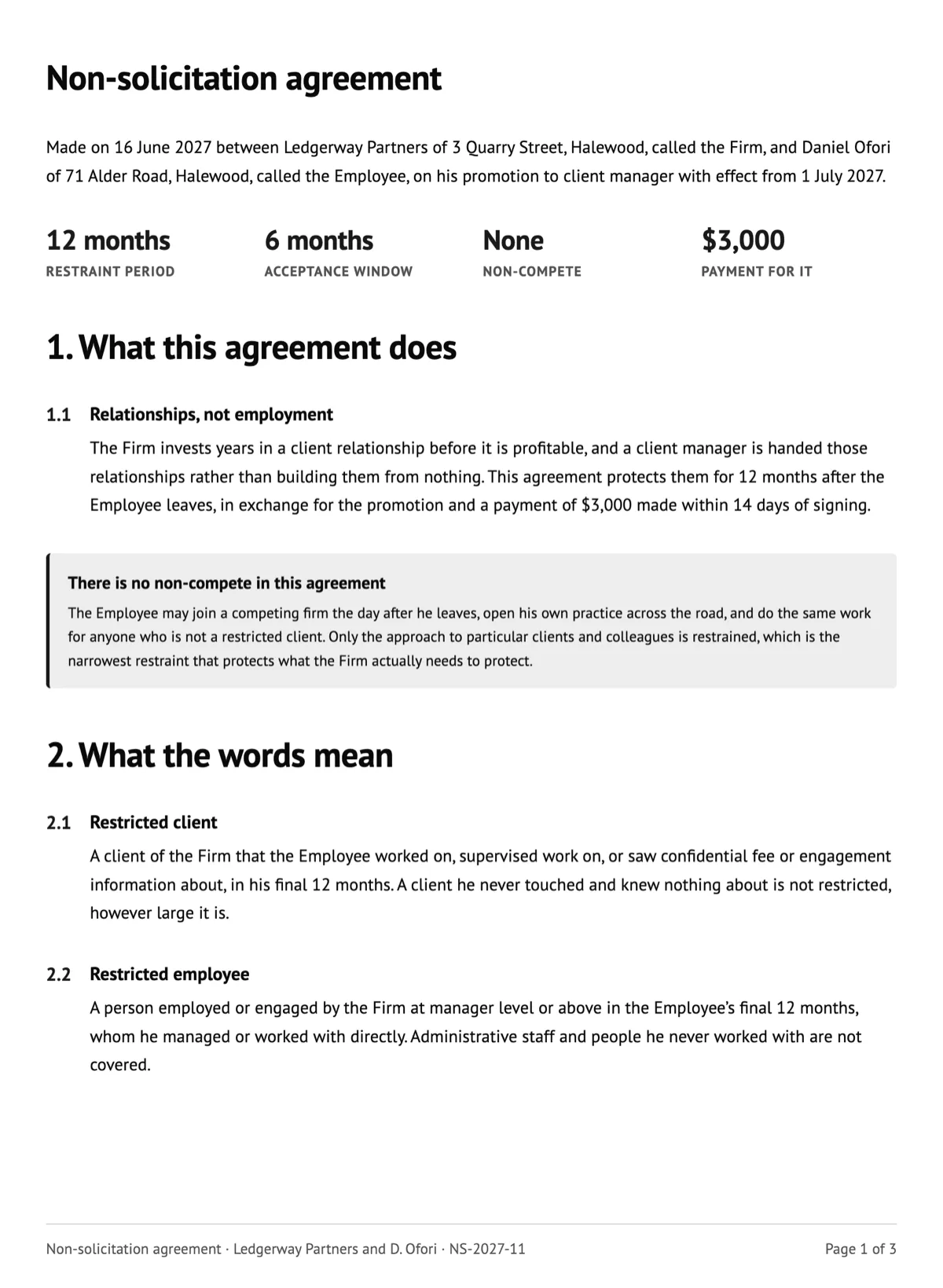 Non-solicitation agreement for clients, staff and durationA non-solicitation agreement restrains the approach, not the work. This one lets an accounting manager join a competitor the day after he leaves, and stops him approaching the clients he handled or the colleagues he managed for twelve months, with a six month window in which he also cannot accept work from those clients.
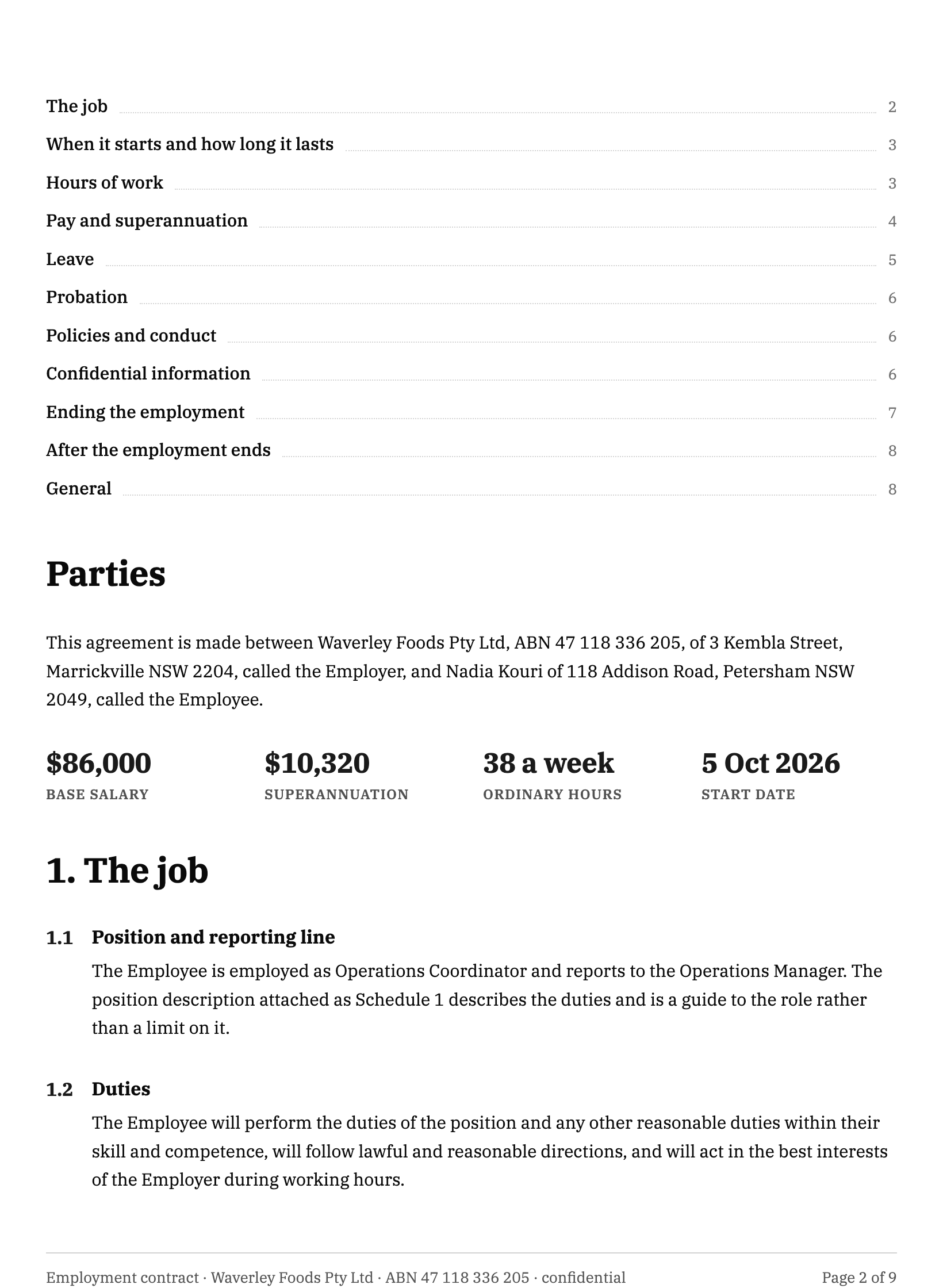 Employment contractA full time ongoing contract for an operations coordinator on $86,000 plus $10,320 of superannuation. Eleven numbered clauses, a leave table drawn from the National Employment Standards, and a notice table that scales with service.
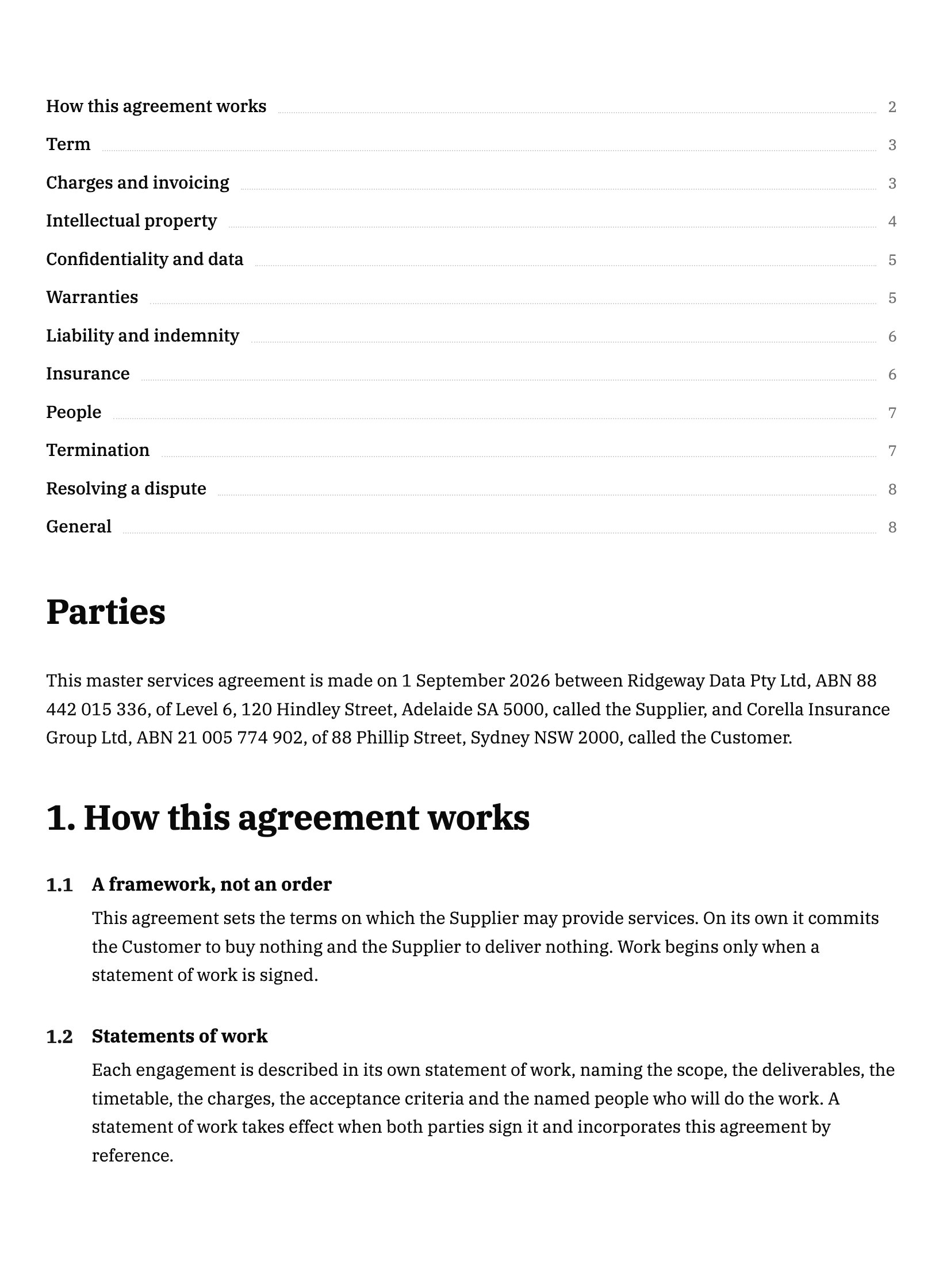 Master services agreementA data consultancy and an insurer sign this once and then buy work under it for three years. It is the rare contract whose whole purpose is to make the next twenty contracts short.
Questions people ask
Is a non solicitation clause easier to enforce than a non compete?
Usually, because it restrains less. The person can take any job, so the question is only whether stopping approaches to particular clients or staff for the stated period protects a legitimate interest. Clauses limited to clients the employee actually dealt with, over a recent period, are the ones courts are most comfortable enforcing.
How long should a non solicitation period be?
Long enough for the business to introduce a new contact and give clients a reason to stay. Six to twelve months is common for client clauses and three to six months for staff clauses. A longer period needs a reason tied to the role, such as unusually long client contracts or tender cycles.
Can a client follow an employee who has a non solicitation clause?
Yes, unless the clause also contains a no dealing restriction. A client is free to choose its supplier, and a pure non solicitation clause only restrains the former employee from making the approach. Where the client moves after being contacted, the question becomes whether that contact was an approach the clause prohibits.
Does the draft non compete ban affect non solicitation clauses?
The draft released on 7 September 2026 bans non compete clauses for workers under the high income threshold. The Government is separately consulting on banning co worker non solicitation clauses, which would affect staff restraints. Client non solicitation clauses were not part of that consultation list, although they remain subject to the ordinary reasonableness test.
Is announcing a new job on social media a breach?
It depends on the wording and what was actually sent. A general public post is less likely to be treated as an approach than a message sent directly to a restricted client. Clauses increasingly deal with this expressly, allowing a general announcement while prohibiting direct messages to named clients during the restraint.
Should a contractor agreement include a non solicitation clause?
Many do, particularly where the contractor works inside the client's team or is placed with the client's own customers. The same reasonableness principles apply. Agencies often pair a staff non solicitation clause with a placement fee, so hiring a contractor directly is priced rather than prohibited outright.
Put the clause in a finished document
The button opens the document generator with a starting description already filled in. Change it to match your own agreement before you run it.
Create a document with OneCraftRelated clauses
- Non compete clause: wording, enforceability and reformA non compete clause stops a worker joining or starting a competitor. Australian sample wording, how courts test it, and the 2026 draft ban explained.
- Restraint of trade clause and how a cascade is builtA restraint of trade clause limits what a person may do after leaving. How an Australian cascading restraint is built, with employment and sale variants.
- Trade secrets clauseA trade secrets clause protects know how that has value because it is secret. Sample wording for a recipe and supplier list, perpetual terms and the US notice.
For everything the document generator can do, see the document maker.
Step by step in the builder: Create a document with AI, then Send a document for signature.
Written and checked by the OneCraft team. Last checked .