Contract clause
Non compete clause: wording, enforceability and reform
A non compete clause is a promise not to work for, set up or help a competing business for a stated period within a stated area after a job or engagement ends. It is a restraint of trade, so an Australian court enforces it only to the extent it protects a legitimate interest and is reasonable.
The live question with a non compete is rarely whether it was signed, but how much of it would survive a challenge. Since September 2026 there is a second question, because draft federal legislation would ban the clause for most workers.
Nuwan Madhusanka · Co-founder
4 min read · Published
Sample clause
an employment contract between Mulgara Software, a fictional software consultancy in Hobart, and a senior solutions architect who looks after its insurance and health fund clients
12. Non Compete 12.1 In this clause, Restricted Business means a business that supplies custom software or cloud migration services to insurers or health funds, Restraint Period means 6 months or, if that is unenforceable, 3 months after employment ends, and Restraint Area means within 50 kilometres or, if that is unenforceable, 25 kilometres of the Hobart office. 12.2 During the Restraint Period and within the Restraint Area, the Employee must not be employed or engaged by, or hold an interest in, a Restricted Business in a role involving the services the Employee provided to Mulgara Software in the last 12 months of employment. 12.3 Clause 12.2 does not prevent the Employee from holding up to 2 percent of the shares in a listed company, or from working for a Restricted Business in an unrelated role. 12.4 The Employee acknowledges that this clause protects Mulgara Software's confidential information and client connections. 12.5 Mulgara Software may release the Employee from all or part of this clause by written notice.
Sample wording, not legal advice.
Variants
Cascading period and area
The employer cannot predict what a court will treat as reasonable and wants a fallback rather than all or nothing.
The Employee must not work in a Competing Business within the Restraint Area during the Restraint Period. Restraint Period means 9 months, 6 months or 3 months after employment ends, and Restraint Area means Tasmania, the Greater Hobart area or the Hobart local government area. Each combination of period and area is a separate restraint, and if any combination is unenforceable it is severed without affecting the remaining combinations.
Single fixed restraint for a senior role
A narrow market and a clearly defined role, where the employer prefers one defensible restraint to a ladder.
For 6 months after employment ends, the Employee must not be employed or engaged in a sales, solution design or account management role by any of the businesses listed in Schedule 3, each of which competes with the Company for insurance and health fund clients in Australia. The Company may shorten the period or remove a listed business by written notice at any time before or after employment ends.
No non compete, protection through other clauses
A role below the high income threshold, or a business whose real concern is its information and clients rather than competition itself.
The Employee is free to work for any business after employment ends. The Employee's obligations after employment are limited to the confidentiality obligations in clause 10 and the client non solicitation obligation in clause 13, which continue for the periods stated in those clauses. Nothing in this agreement restricts the Employee from using the general skill, knowledge and experience gained during employment.
What to negotiate
Length and area matched to the actual risk
Employers tend to draft for the longest period and widest area they can imagine. Employees push back by asking what the restraint protects and for how long that information or client connection stays valuable. A period tied to how quickly pricing or client relationships go stale, and an area tied to where clients actually are, is the version most likely to hold.
Which roles are caught
A clause that bans any work for a competitor stops a developer taking a payroll job at a rival, which protects nothing. Limiting the restraint to roles that use the same client relationships or information narrows it to the legitimate interest. Employees commonly ask for that limit, and employers often accept it because it strengthens enforceability.
Release and payment
A right for the employer to release the employee in writing costs nothing and is widely accepted. Some employees also ask for payment during the restraint, or for any garden leave to be deducted from it. Payment is not a legal requirement, but it bears on whether the overall restraint looks reasonable.
The risk of leaving it out
Without a non compete, a departing employee can join a competitor the next day. The employer then relies on confidentiality obligations, any client non solicitation clause and the general law, which restrain misuse of information and approaches to clients but not the new job itself, and the employer has to prove the misuse rather than point to the move.
How Australian courts decide whether it holds
A restraint is prima facie void as a restraint of trade and is enforced only if the employer shows it protects a legitimate interest, such as confidential information, client connections or the stability of its workforce, and goes no further than reasonably necessary. Reasonableness is judged at the date the contract was made, not the date the employee left, so a restraint signed by a junior employee who later became a director is tested against the junior role. A clause that simply stops competition, with no information or relationships behind it, fails. In New South Wales the Restraints of Trade Act 1976 lets a court read down a restraint that goes too far; elsewhere courts sever rather than rewrite, which is why cascading drafting became common.
The draft ban, and the position in the UK and US
The 2025 to 26 Budget announced a ban on non compete clauses for low and middle income workers, and Treasury says the reforms should take effect from 2027 after consultation and legislation. On 7 September 2026 the Government released draft legislation banning them for workers earning under $190,100 a year, the Fair Work Act high income threshold, and opened consultation on also banning co worker non solicitation clauses, no poach and wage fixing arrangements, and cascading restraints, with submissions closing on 2 October 2026. It is a draft, not law. In the UK, a Department for Business and Trade working paper published in November 2025 set out options including a three month statutory limit and a ban. In the US, the Federal Trade Commission's nationwide rule was set aside by a court and removed from the Code of Federal Regulations in February 2026, leaving state law in charge.
Where it sits in a generated document
In a generated employment contract the non compete belongs with the clauses about what happens after employment ends, beside confidentiality and non solicitation, with each period and area as its own numbered sub clause. Every value is written as content, so the months and kilometres can be changed as ordinary text afterwards. The generated text does not print citations, so any reference to the draft ban or a state Act has to be checked against the law in force before signing.
Documents that carry this clause
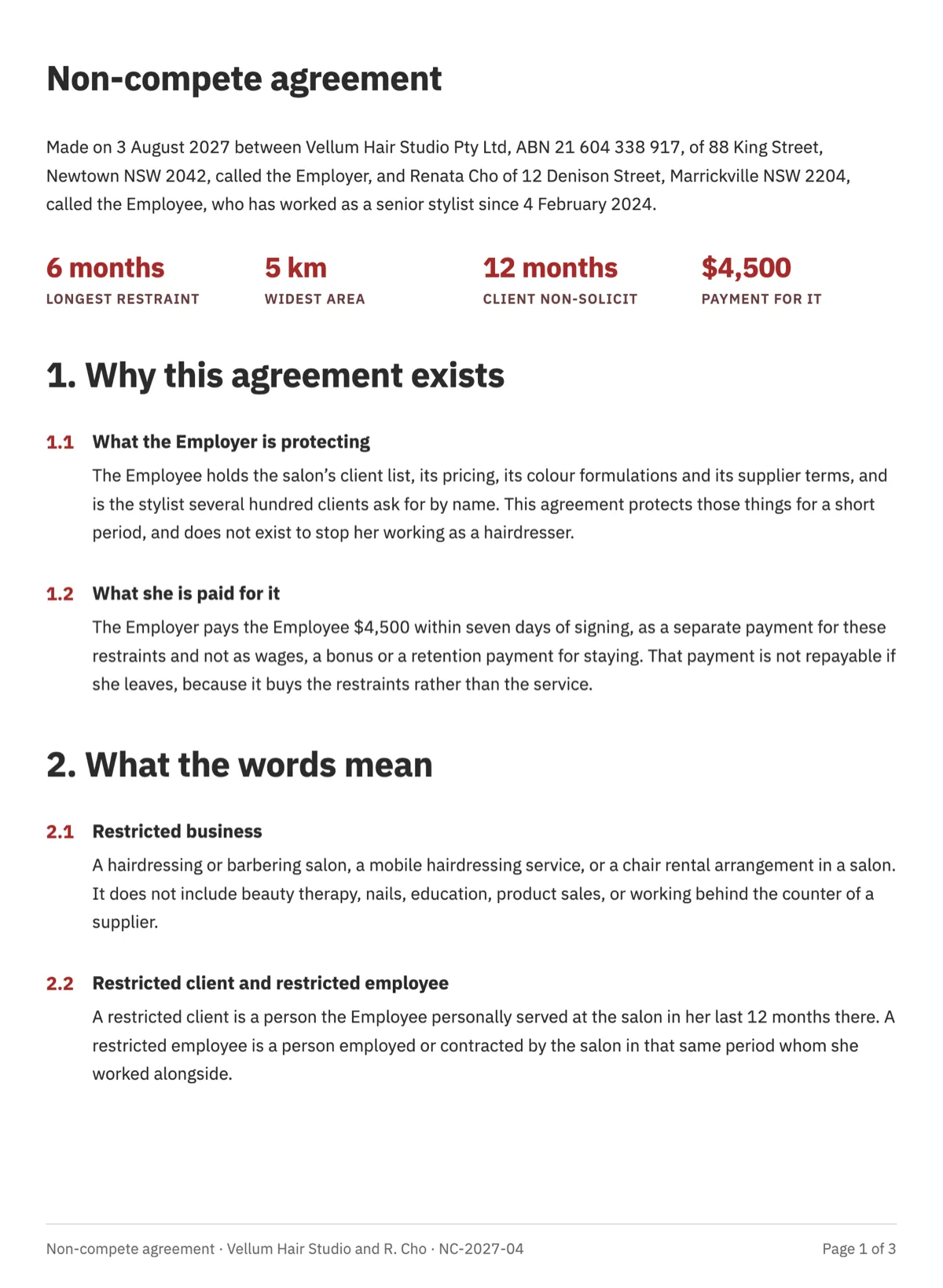 Non-compete agreement template with cascading restraint clausesAn Australian non-compete lives or dies on how it is drafted, because a court will not rewrite one that reaches too far. This one restrains a senior stylist from a competing salon using three separate covenants of falling reach, from 5 kilometres for six months down to 1 kilometre for three, and pays $4,500 for them.
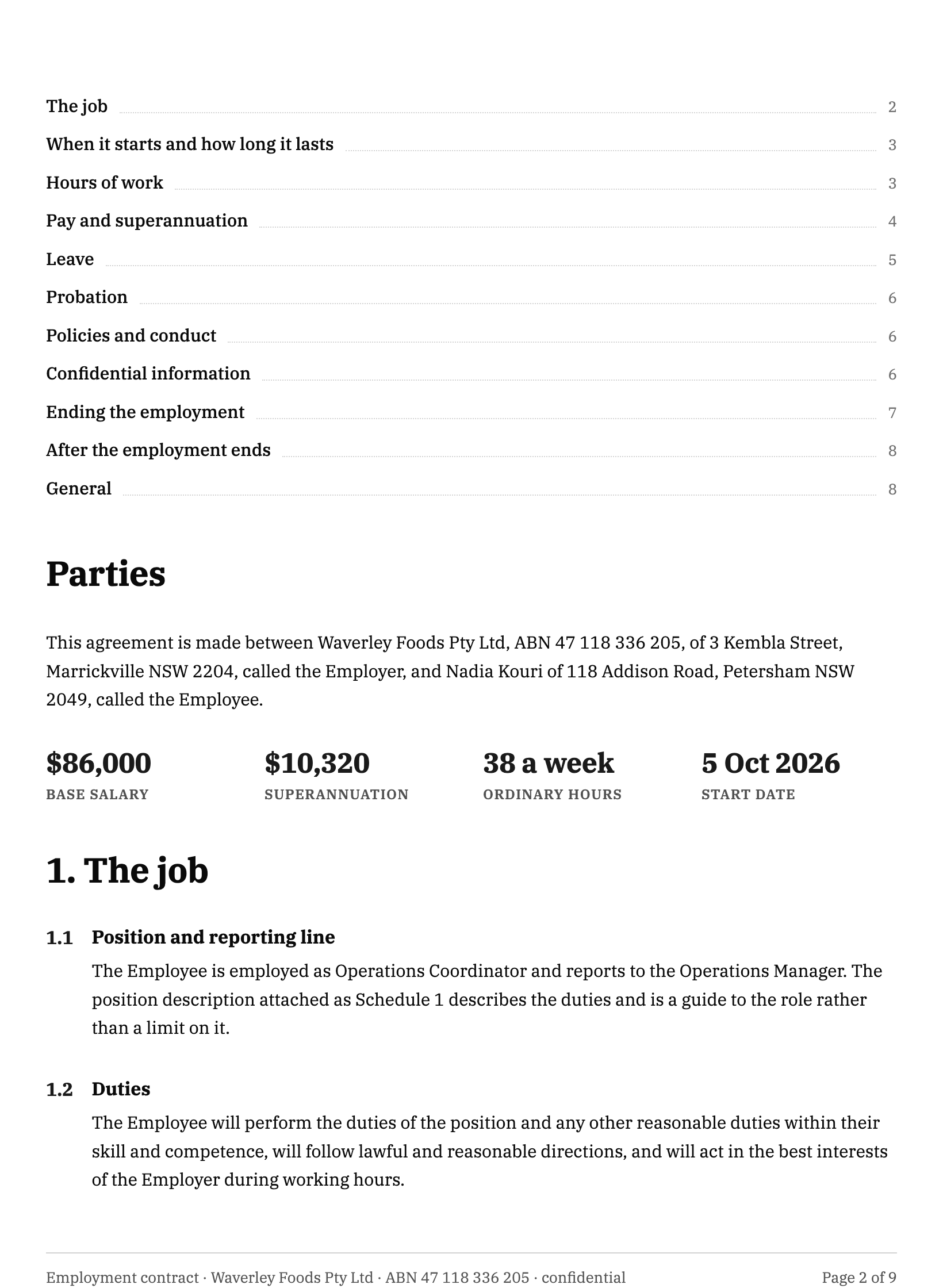 Employment contractA full time ongoing contract for an operations coordinator on $86,000 plus $10,320 of superannuation. Eleven numbered clauses, a leave table drawn from the National Employment Standards, and a notice table that scales with service.
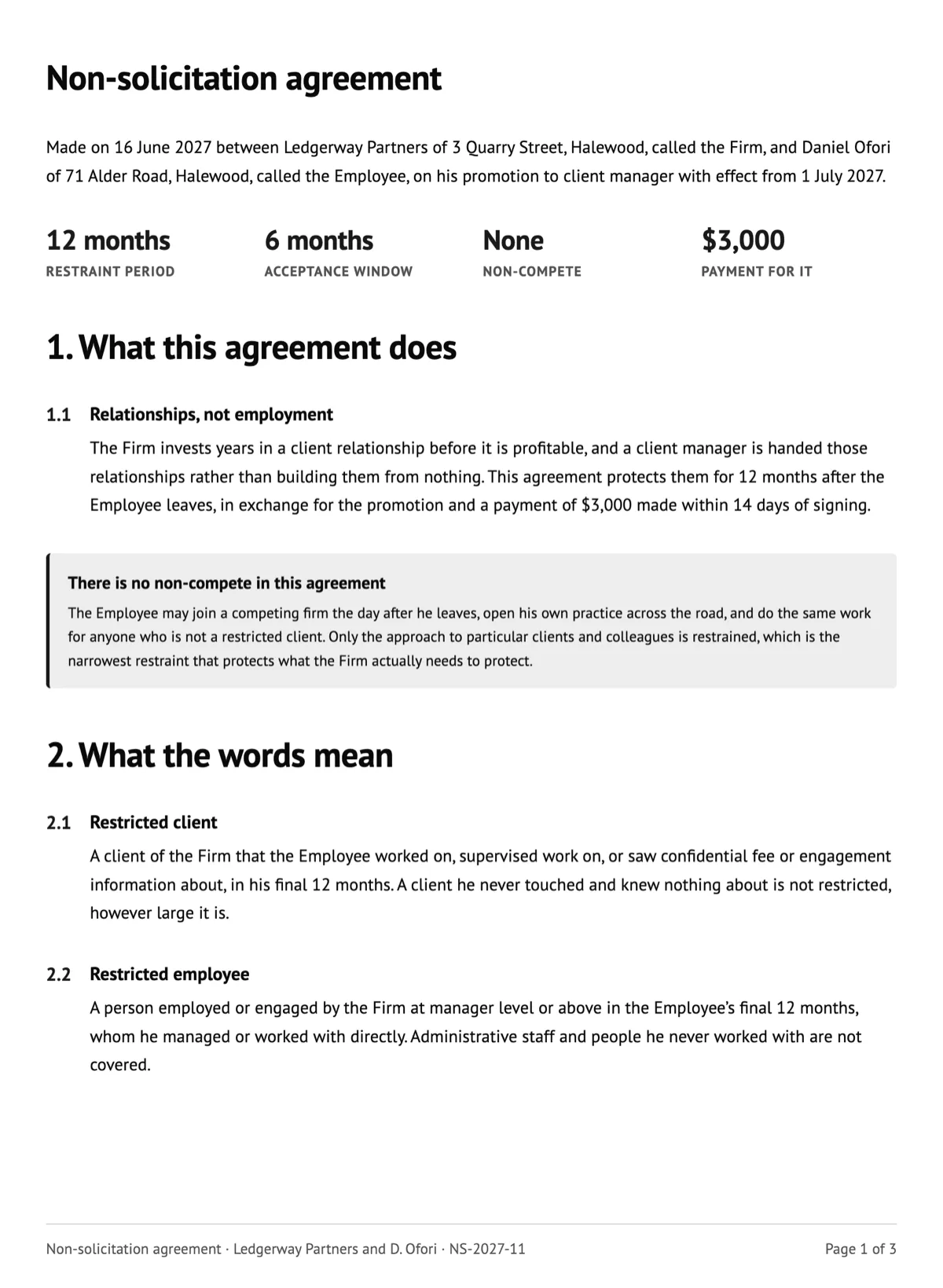 Non-solicitation agreement for clients, staff and durationA non-solicitation agreement restrains the approach, not the work. This one lets an accounting manager join a competitor the day after he leaves, and stops him approaching the clients he handled or the colleagues he managed for twelve months, with a six month window in which he also cannot accept work from those clients.
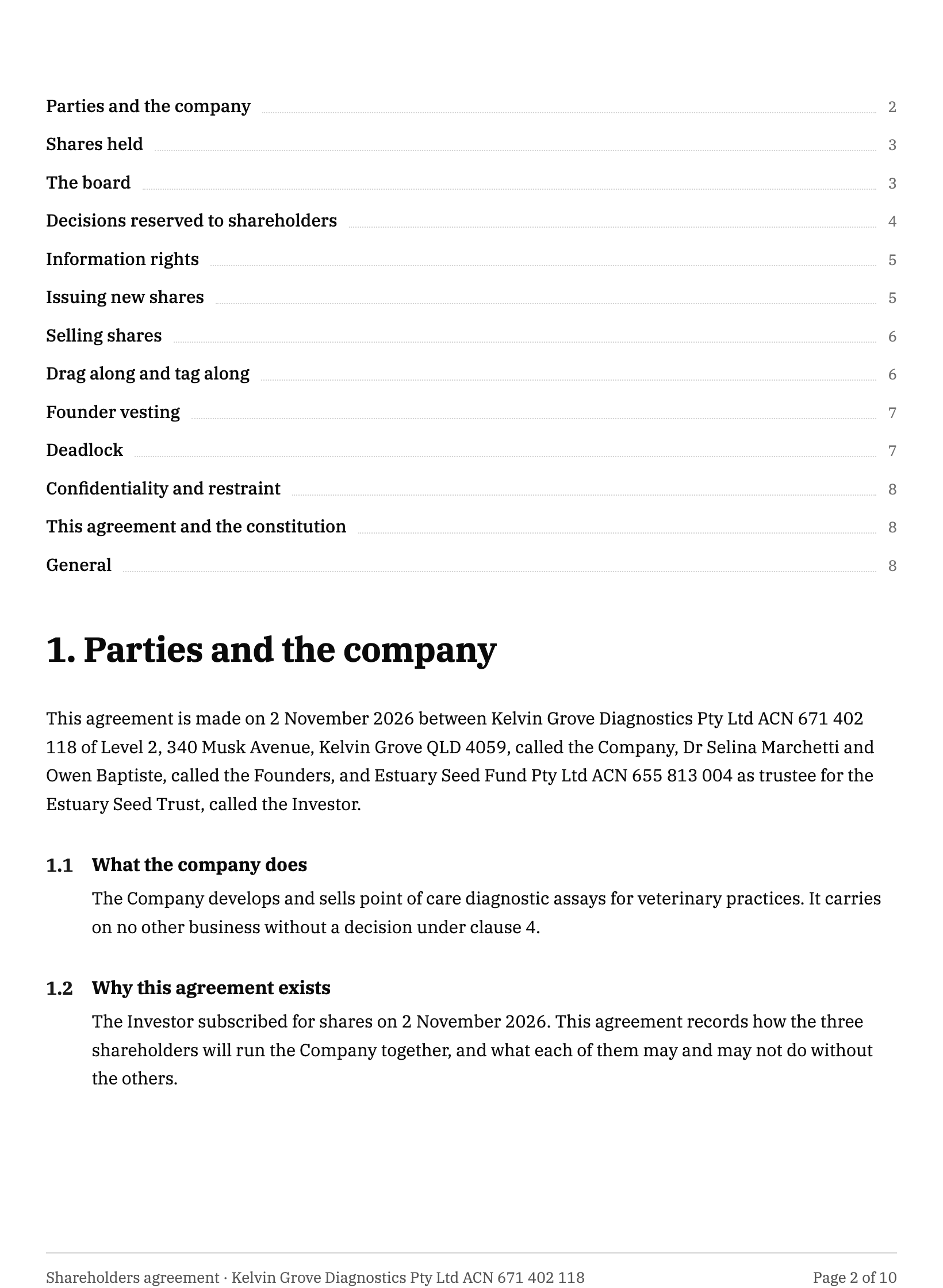 Shareholders agreement templateA veterinary diagnostics company has just taken $1.5 million from one seed fund. The founders keep 80 percent between them, so the whole agreement turns on a single number: the 75 percent consent threshold that puts the investor on one side of every decision that matters.
Questions people ask
Is a non compete clause enforceable in Australia?
Only as far as it protects a legitimate interest and is reasonable in length, area and the activities it restrains, judged when the contract was signed. Courts regularly strike out restraints that reach further than the employee's actual role, clients or information. A narrow, well justified clause can be enforced, and injunctions are granted where the interest is real.
Is Australia banning non compete clauses?
Draft legislation released on 7 September 2026 would ban them for workers earning under $190,100 a year, and the Government is consulting on related bans until 2 October 2026. Treasury says the reforms should take effect from 2027 once legislation passes. Until then the existing restraint of trade rules apply to every clause.
How long can a non compete last?
There is no fixed maximum for employment restraints in Australian law. The period has to be no longer than needed to protect the interest, which is often measured by how long client relationships or pricing information stay valuable. Periods of three to twelve months are common, with longer periods usually justified only for very senior roles.
What is the difference between a non compete and a non solicitation clause?
A non compete restrains the new job or business itself. A non solicitation clause lets the person take any job but stops them approaching the former employer's clients or staff. Because it restrains less, a non solicitation clause is usually easier to justify, and many contracts use both so that one can survive if the other fails.
Does a non compete apply to contractors and business sellers?
The restraint of trade doctrine applies to contractors and to sellers of a business as well as employees. Sale of business restraints are generally given more room, because the buyer has paid for goodwill that the seller could otherwise take straight back. The reasonableness of the period and area still has to be shown.
What happened to the US federal non compete ban?
The Federal Trade Commission's rule was set aside by a federal court before it took effect. In September 2025 the Commission stopped defending it, and the rule was removed from the Code of Federal Regulations in February 2026. Non competes in the United States are therefore governed by state law, which varies widely.
Put the clause in a finished document
The button opens the document generator with a starting description already filled in. Change it to match your own agreement before you run it.
Create a document with OneCraftRelated clauses
- Restraint of trade clause and how a cascade is builtA restraint of trade clause limits what a person may do after leaving. How an Australian cascading restraint is built, with employment and sale variants.
- Non solicitation clause for clients and staffA non solicitation clause stops a former employee approaching clients or staff. Australian sample wording for clients and staff, with three variants.
- Garden leave clause: paid notice away from the businessA garden leave clause keeps an employee paid but away from work during notice. Australian sample wording, restraint set off and three variants compared.
- Confidentiality clauseA confidentiality clause inside a wider contract, not a standalone NDA. Sample consulting wording, mutual and one way variants, the tail period and exceptions.
For everything the document generator can do, see the document maker.
Step by step in the builder: Create a document with AI, then Send a document for signature.
Written and checked by the OneCraft team. Last checked .