Contract clause
Garden leave clause: paid notice away from the business
A garden leave clause lets an employer direct an employee who is serving notice to stay away from work, or to do only limited duties, while remaining employed on full pay and benefits. It keeps the person out of the market and away from clients for the notice period without ending the employment early.
When a senior salesperson resigns to join a rival, the last thing the business wants is three more months of client meetings. Garden leave solves that problem, but only cleanly when the contract gave the employer the right to use it.
Indunil Asanka · Co-founder
4 min read · Published
Sample clause
an employment contract between Brolga Insurance Brokers, a fictional commercial insurance broker in Darwin, and its head of sales, who is on 3 months notice
15. Garden Leave 15.1 After either party gives notice to end the employment, Brolga Insurance Brokers may direct the Employee not to attend work, or to perform only the duties it specifies, for all or part of the notice period (Garden Leave). 15.2 During Garden Leave the Employee remains employed and continues to receive salary, superannuation and every other contractual benefit. 15.3 During Garden Leave the Employee must not contact any client, insurer or employee of Brolga Insurance Brokers about its business except as directed, and must not work for any other person. 15.4 If directed, the Employee must return all property, devices and documents on the first day of Garden Leave, and must remain reasonably available to help with the handover. 15.5 Brolga Insurance Brokers may end Garden Leave early and pay the balance of the notice period instead. 15.6 Each day of Garden Leave reduces the Restraint Period in clause 16 by one day.
Sample wording, not legal advice.
Variants
Full pay and no duties
The simplest form, for an employee whose continued presence carries client or information risk from the day notice is given.
At any time after notice of termination is given, the Company may require the Employee to remain away from the workplace and perform no duties for the rest of the notice period. The Employee continues to receive full salary and benefits, remains bound by every obligation of employment, and must not start work with another employer or business before the notice period ends.
Set off against the post employment restraint
Contracts with both a long notice period and a restraint, where the total time out of the market has to stay reasonable.
Any period during which the Employee is on garden leave under this clause counts toward, and reduces by the same number of days, the restraint periods in clause 16. If the Employee spends the whole notice period on garden leave, the non compete restraint in clause 16.2 ends on the date employment ends and only the non solicitation restraint in clause 16.3 continues for its remaining period.
At the employer's election, with partial duties
Handover heavy roles where the employer needs some work done but wants to cut client contact.
During any notice period the Employer may, by written direction, require the Employee to perform only duties that do not involve contact with clients or suppliers, to work from home or another location, or to perform no duties. The Employer may change or withdraw that direction on 2 business days notice. The Employee's pay, benefits and hours remain unchanged whatever direction is given.
What to negotiate
Total time out of the market
Three months of garden leave followed by a six month non compete keeps a person out of their industry for nine months. Employees ask for garden leave to be deducted from the restraint, and employers often agree because a court is likely to look at the combined effect anyway when judging whether the restraint is reasonable.
Commission and bonus during garden leave
A salesperson paid largely in commission earns little on garden leave if pay means base salary only. Sales employees commonly negotiate an average of recent commission for the garden leave period, or confirmation that a bonus already earned is not lost because they were kept away from work.
How far the contact ban reaches
Employers want no contact with clients, suppliers or staff. Employees ask to keep ordinary social contact with colleagues and to deal with suppliers of their own personal services. A ban limited to contact about the employer's business is the usual middle ground.
The risk of leaving it out
Without the clause, an employer who does not want a resigning employee at work can let them work out notice or pay notice instead and end the employment immediately. Paying out ends the employment early, so the employee is free to start with a competitor straight away and any restraint period starts running sooner.
Why the right needs to be written down
The Fair Work Ombudsman describes three choices an employer has during notice: let the employee work it, end the employment early and pay out the notice, or combine the two. Garden leave is a fourth path, where the person stays employed but away. An express clause matters because some employees, particularly those whose pay or professional standing depends on doing the work, can argue that being kept idle is itself a breach. A written right removes that argument, keeps the duty of fidelity and confidentiality running, and stops the employee starting elsewhere until the notice ends. It also buys time to introduce a new contact to each client while the departing employee is still bound, which is often worth more than anything the employee could hand over in person.
Garden leave, pay in lieu and the UK position
The choice between garden leave and pay in lieu is really a choice about when employment ends. Pay in lieu ends it now, so the restraint clock starts and the employee is free to work for anyone subject to that restraint. Garden leave postpones the end, which protects the business for longer but costs full pay for the period. Either way, leave continues to matter, since unused annual leave is paid out when the employment finally ends. The same concept operates in the United Kingdom, where government guidance describes garden leave as an employer asking an employee not to come in, or to work from home or elsewhere, during notice while receiving the same pay and contractual benefits.
Where it sits in a generated document
A generated contract places garden leave between the notice clause and the restraint clause, so the set off can refer to the restraint by clause number. Periods are written into the text rather than left as blanks, because input fields are not used in documents. The built in chat can then tighten the wording of the sub clauses without changing the structure.
Documents that carry this clause
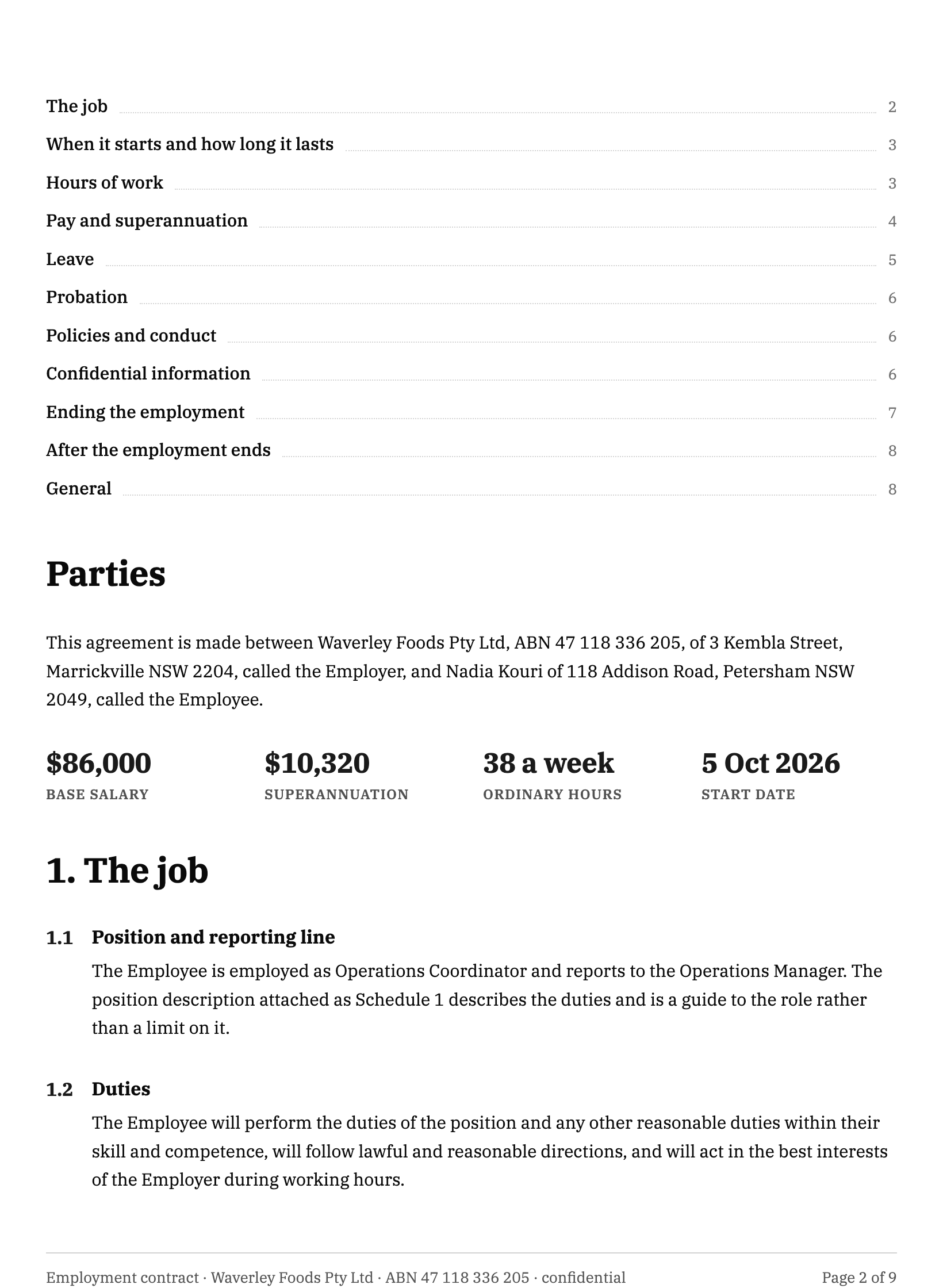 Employment contractA full time ongoing contract for an operations coordinator on $86,000 plus $10,320 of superannuation. Eleven numbered clauses, a leave table drawn from the National Employment Standards, and a notice table that scales with service.
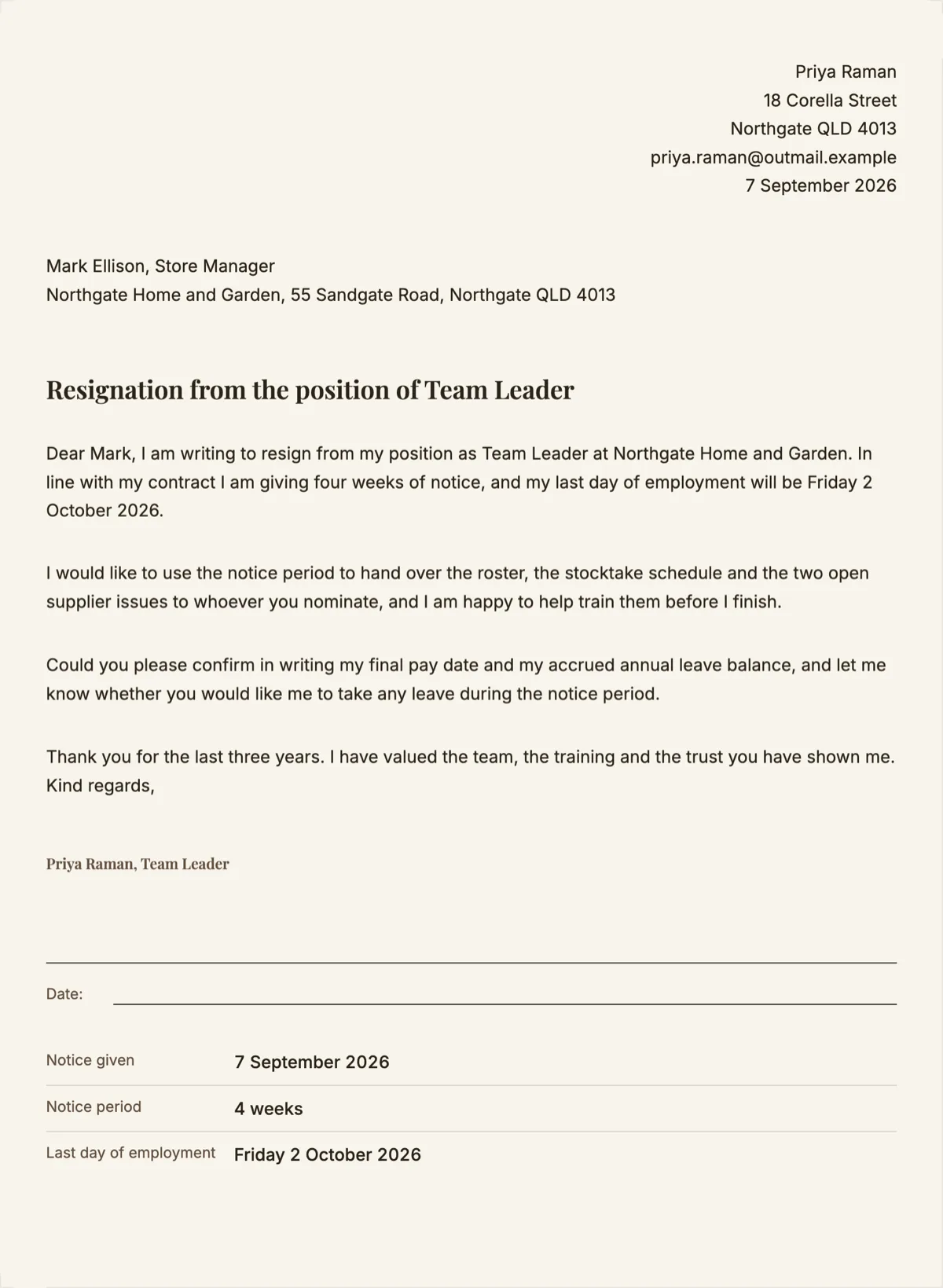 Resignation letter template that says the last day and stopsA resignation letter template has one job, to start the notice period on a date nobody can dispute, and every extra sentence is a risk. This finished example names Friday 2 October 2026 as the last day, offers a handover of three named things, asks for the final pay date and leave balance in writing, and is six sentences long.
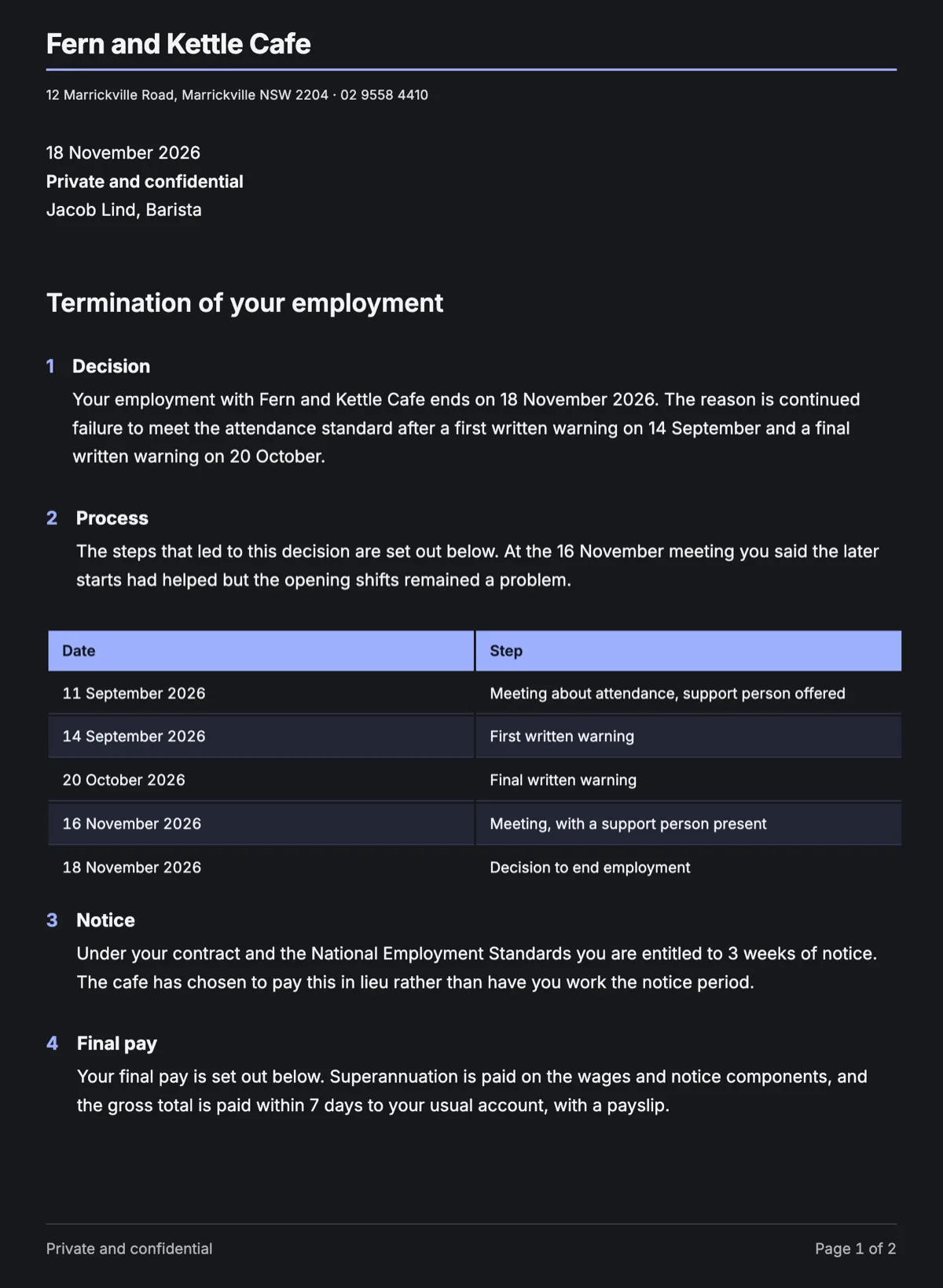 Termination letter template that shows the final payA termination letter is read twice, once by the employee in the meeting and once by a lawyer or a tribunal months later, and both need the same facts. This one states the reason and the process in dates, shows the final pay as a table with each component, and says what happens next, so there is nothing to ask afterwards.
Questions people ask
Is garden leave allowed in Australia?
Yes, and it is common for senior and client facing roles. The safest basis is an express contract clause giving the employer the right to direct the employee away from work during notice. Without one, an employer can still pay notice instead, but keeping someone employed and idle can be contested in some roles.
Is an employee paid during garden leave?
Yes. The employee remains employed and receives full salary, superannuation and contractual benefits for the whole garden leave period. The issue worth settling in the clause is variable pay, such as commission or bonuses, which can fall away if pay is defined narrowly as base salary.
Can an employee start a new job during garden leave?
Not while still employed, if the contract prohibits it, and a garden leave clause normally does. The employee remains bound by the duties of employment until the notice period ends. That is the main advantage over paying out notice, which frees the employee to start elsewhere immediately.
Does garden leave count toward a restraint period?
Only if the contract says so. Many clauses deduct garden leave from the post employment restraint, so the total time out of the market stays reasonable. Where there is no set off, the combined length of notice and restraint may count against the employer when a court decides whether the restraint goes too far.
What is the difference between garden leave and payment in lieu of notice?
Payment in lieu ends the employment straight away and pays out the notice period. Garden leave keeps the employment going until the notice period ends, with the employee on full pay but away from work. The practical difference is when the employee becomes free to join a competitor.
Can the employer end garden leave early?
If the clause allows it, yes. A common approach lets the employer end garden leave at any point and pay the balance of the notice period instead, which ends the employment on that day. That flexibility is useful once the handover is finished or the client risk has passed.
Put the clause in a finished document
The button opens the document generator with a starting description already filled in. Change it to match your own agreement before you run it.
Create a document with OneCraftRelated clauses
- Notice period clause in an employment contractA notice period clause sets how much notice ends employment. Australian sample wording, the National Employment Standards minimums and three variants.
- Non compete clause: wording, enforceability and reformA non compete clause stops a worker joining or starting a competitor. Australian sample wording, how courts test it, and the 2026 draft ban explained.
- Restraint of trade clause and how a cascade is builtA restraint of trade clause limits what a person may do after leaving. How an Australian cascading restraint is built, with employment and sale variants.
For everything the document generator can do, see the document maker.
Step by step in the builder: Create a document with AI, then Send a document for signature.
Sources
Written and checked by the OneCraft team. Last checked .