Contract clause
Notice period clause in an employment contract
A notice period clause states how much warning the employer and the employee must each give to end the employment, whether notice can be paid instead of worked, and how notice is given. In Australia the clause can improve on the National Employment Standards minimums for employers but can never reduce them.
Notice is the clause most people read only on the day they need it. By then its two numbers, what the employer owes and what the employee owes, decide the final pay, the last day and sometimes when a new job can start.
Nuwan Madhusanka · Co-founder
4 min read · Published
Sample clause
a full time employment contract between Currawong Print Co, a fictional commercial printer in Launceston, and a prepress operator who has passed probation
11. Ending the Employment 11.1 After the Probationary Period, either party may end the employment by giving the other 4 weeks written notice. 11.2 If the National Employment Standards or an applicable award require Currawong Print Co to give a longer period of notice, that longer period applies. 11.3 Currawong Print Co may require the Employee to work all of the notice period, may pay the Employee instead of all or part of it, or may combine the two. A payment instead of notice is calculated at the rate the Employee would have received for the ordinary hours in the period not worked. 11.4 Notice must be given in writing, by email to the other party's nominated address or by hand, and the notice period starts on the day after it is received. 11.5 No notice is required if Currawong Print Co ends the employment because of serious misconduct.
Sample wording, not legal advice.
Variants
Equal notice, scaled to service
Employers who want one simple rule that tracks the statutory scale and treats both sides the same.
Either party may end the employment by giving written notice equal to the period set out in the National Employment Standards for the Employee's length of continuous service at the date notice is given, including any additional week the Employee is entitled to because of age and service. The Employer may pay the Employee instead of all or part of the notice period.
Longer notice from the employer
Senior hires leaving secure roles, who want protection if the new role ends early, while the employer keeps a shorter period for resignations.
The Employer may end the employment by giving the Employee 12 weeks written notice, or the notice required by the National Employment Standards if that is longer. The Employee may end the employment by giving the Employer 6 weeks written notice. The Employer may pay the Employee instead of all or part of any notice period, whichever party gave notice.
Payment instead of notice and an early release
Roles where a long handover rarely helps, and both parties benefit from ending cleanly once notice is given.
Either party may end the employment on 4 weeks written notice. Where the Employee resigns, the Employer may accept the resignation from an earlier date and pay the Employee for the balance of the notice period. Where the Employer gives notice, it may pay the whole notice period immediately and end the employment on the date the notice is given.
What to negotiate
Length against seniority
Employers want long notice from senior staff so a replacement can be found. Senior candidates want long notice from the employer as income protection. Matching periods is the common result, although some employees negotiate a longer employer period and a shorter resignation period.
What counts in a payment instead of notice
The minimum is pay for the hours that would have been worked. Employees on commission, allowances or regular overtime ask for those amounts to be included, because base salary alone can be much less than their normal earnings. Spelling out the calculation avoids a dispute over final pay.
Whether the employer can shorten a resignation
An employee who resigns often wants to work the full period and be paid for it. Employers sometimes want to end the employment straight away. A clause allowing early release on payment of the balance gives the employer that option without leaving the employee out of pocket.
The risk of leaving it out
Without a notice clause the employer still owes the National Employment Standards minimum, and an award may add to it. The employee's obligation becomes unclear, and a court may imply a reasonable notice period that can be considerably longer than the statutory minimum, particularly for senior employees without an award. Even the last day of employment can become a point of disagreement.
The minimum notice table
Under the National Employment Standards the minimum notice an employer gives depends on continuous service on the day notice is given. One year or less of service requires 1 week. More than 1 year and up to 3 years requires 2 weeks. More than 3 years and up to 5 years requires 3 weeks. More than 5 years requires 4 weeks. An employee over 45 with at least 2 years of continuous service gets one extra week. An award, agreement or contract can require more, but a contract cannot provide less. Notice does not apply to casual employees, employees engaged for a specified period, task or season, or dismissal for serious misconduct.
Notice from the employee, and the UK comparison
The National Employment Standards table sets what employers must give. How much notice an employee must give usually comes from the award, the agreement or the contract, which is why the clause should state the resignation period expressly. Where an award applies, it may set its own resignation period, so the contract is best read alongside it rather than written as if the award did not exist. An employer can let the employee work the notice, pay it out, or combine the two. In the United Kingdom, statute sets a minimum from the employer that rises with service and, under guidance for employees, requires at least a week's notice from anyone employed for more than a month, with longer periods coming from the contract.
Where it sits in a generated document
In a generated employment contract the notice clause sits in the section on ending the employment, after probation. The service based minimums can be written as a small table in the same document, and each number is written as content rather than a blank. Because the generated text prints no citations, the table should be checked against the current standards before signing.
Documents that carry this clause
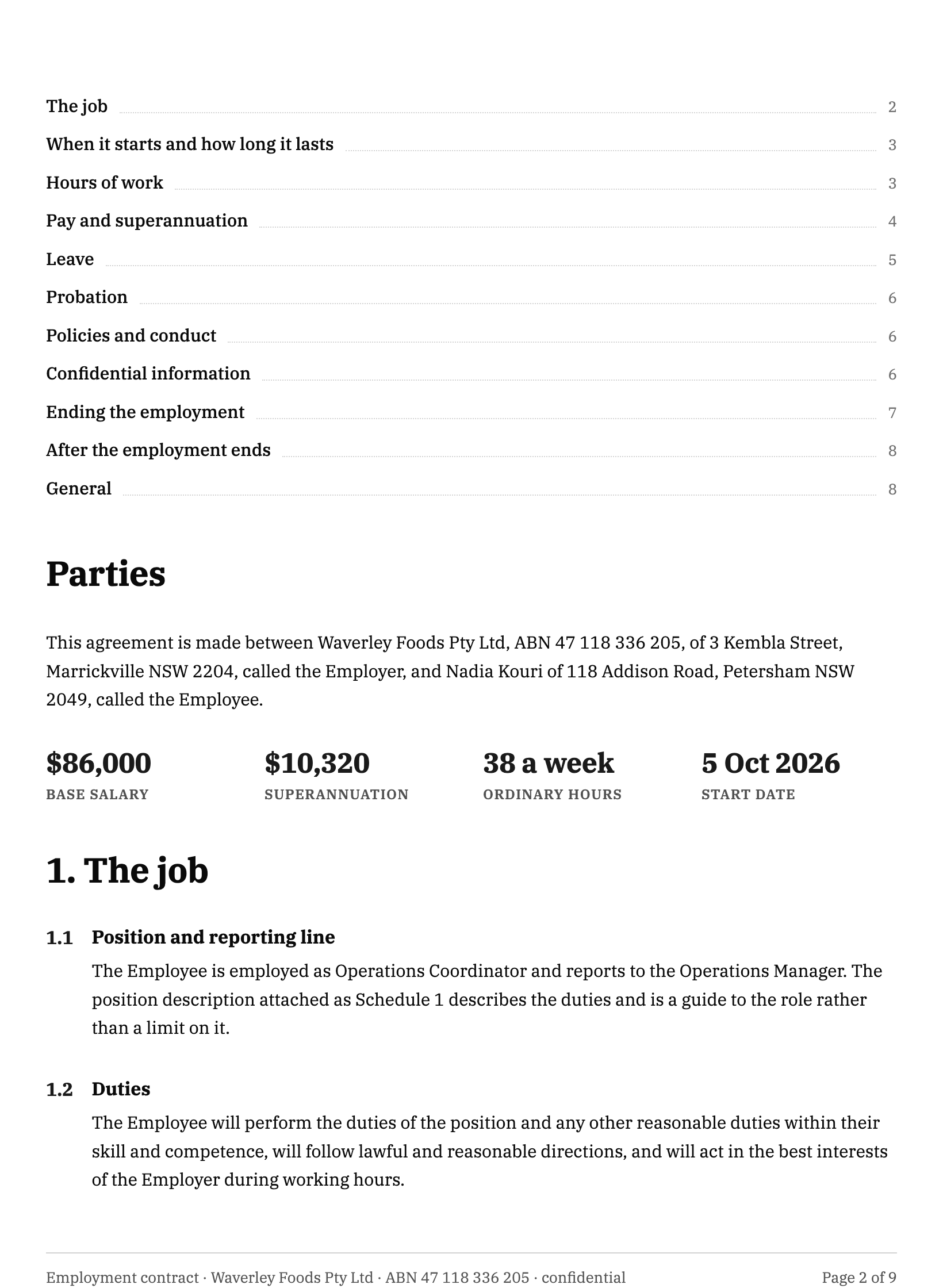 Employment contractA full time ongoing contract for an operations coordinator on $86,000 plus $10,320 of superannuation. Eleven numbered clauses, a leave table drawn from the National Employment Standards, and a notice table that scales with service.
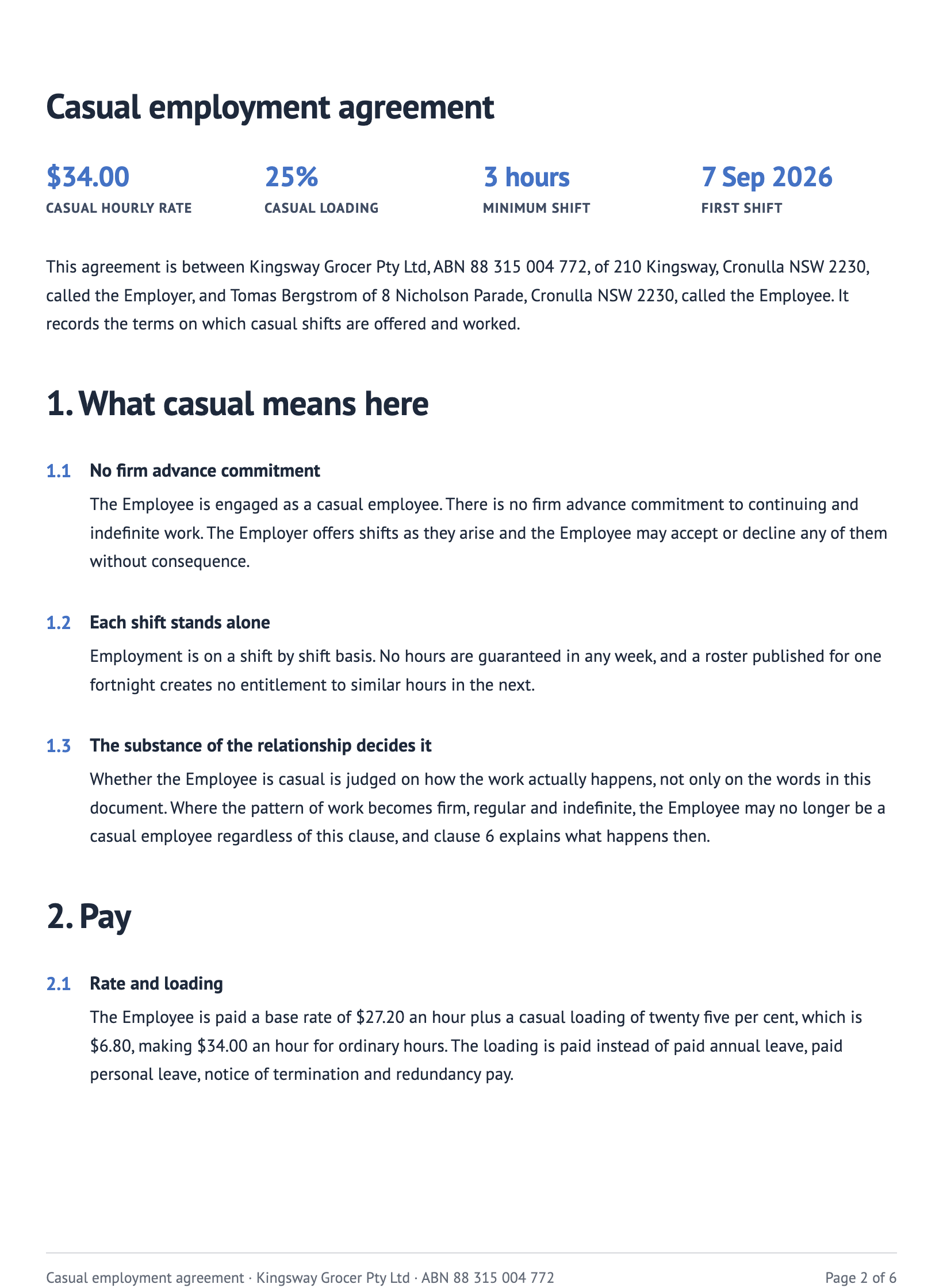 Casual employment agreementA retail assistant is paid $34.00 an hour, which is a base of $27.20 plus a twenty five per cent loading. The agreement shows how every other rate is built from that base, and what the loading is paid instead of.
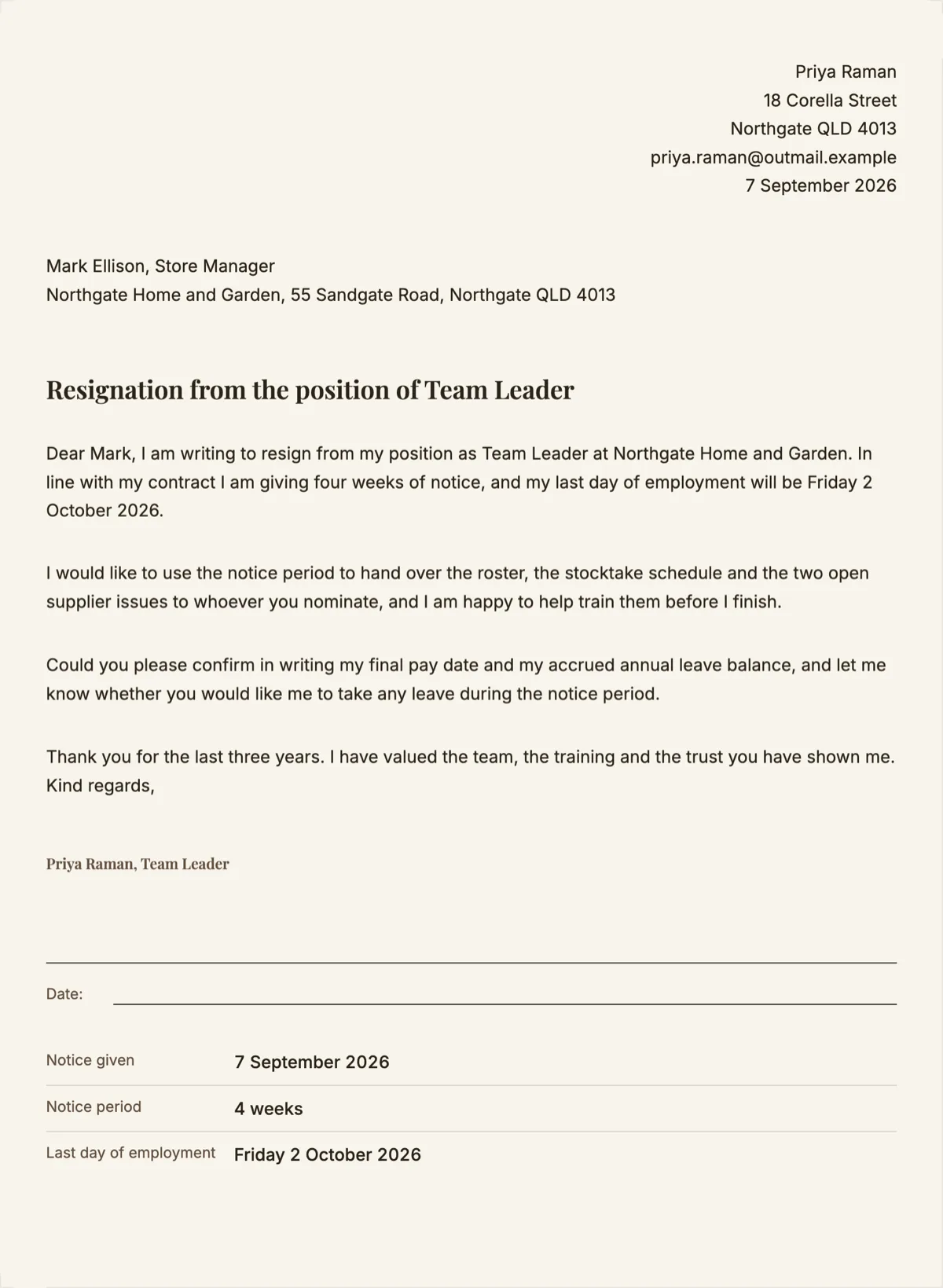 Resignation letter template that says the last day and stopsA resignation letter template has one job, to start the notice period on a date nobody can dispute, and every extra sentence is a risk. This finished example names Friday 2 October 2026 as the last day, offers a handover of three named things, asks for the final pay date and leave balance in writing, and is six sentences long.
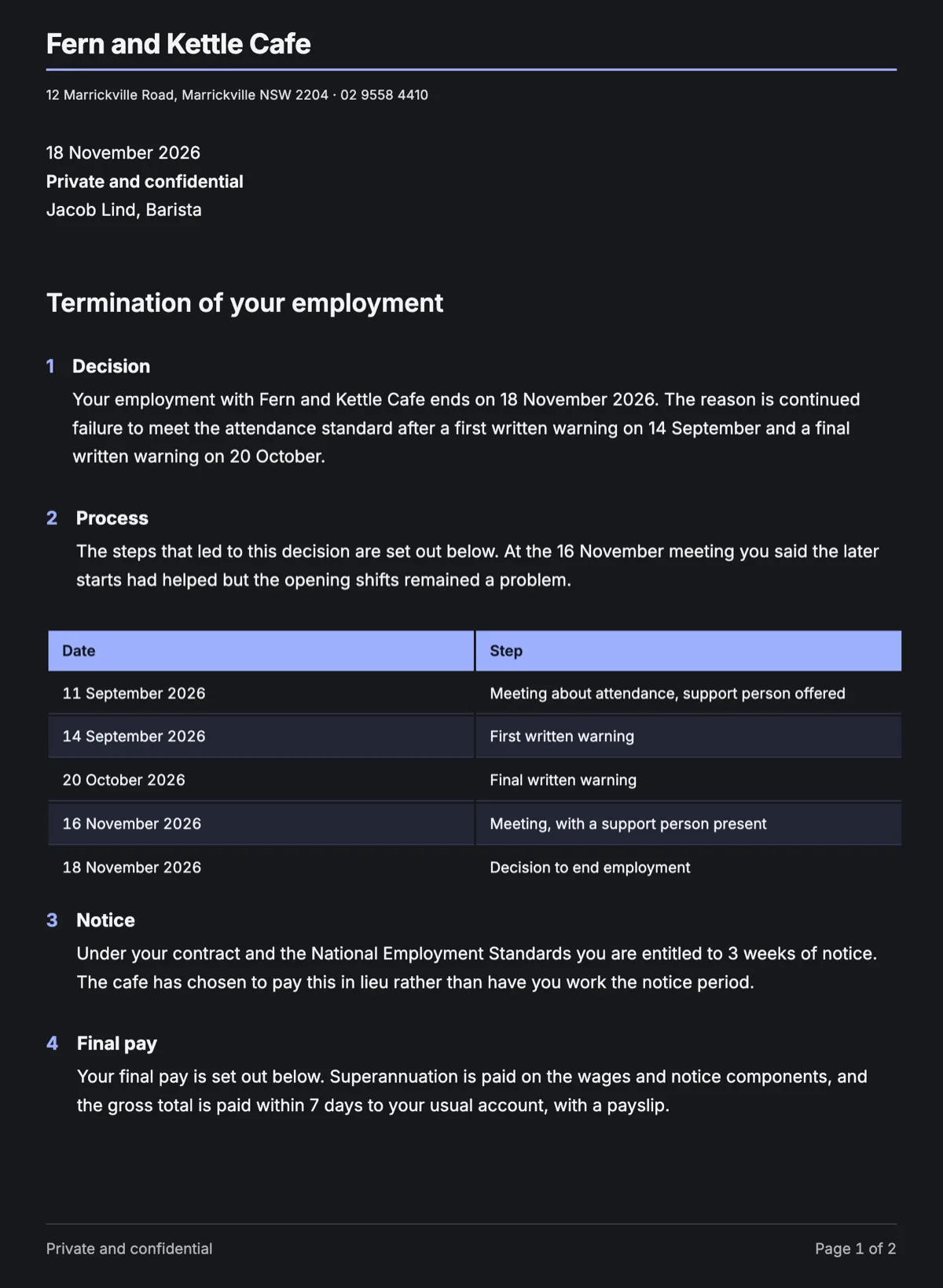 Termination letter template that shows the final payA termination letter is read twice, once by the employee in the meeting and once by a lawyer or a tribunal months later, and both need the same facts. This one states the reason and the process in dates, shows the final pay as a table with each component, and says what happens next, so there is nothing to ask afterwards.
Questions people ask
How much notice must an employer give in Australia?
At least the National Employment Standards minimum for the employee's continuous service: 1 week for up to 1 year, 2 weeks for over 1 and up to 3 years, 3 weeks for over 3 and up to 5 years, and 4 weeks beyond that, plus a week for employees over 45 with 2 years of service.
Does an employee have to give notice when resigning?
Usually, if the award, agreement or contract requires it. The National Employment Standards table sets the employer's minimum, and the employee's obligation typically comes from those other instruments. A clear resignation period in the contract removes any doubt about when the last day falls and what the final pay covers.
Can notice be paid instead of worked?
Yes. An employer can let the employee work the notice period, end the employment early and pay out the notice, or do a combination of the two. A payment instead of notice must be at least what the employee would have earned for the hours they would have worked in that period.
Can a contract give less notice than the National Employment Standards?
No. A contract cannot provide less than the National Employment Standards, the applicable award or an enterprise agreement. A clause that tries to is ineffective to that extent, and the higher minimum applies. A contract can, however, provide more notice than the minimum, which is common for professional and senior roles.
Do casual employees get notice?
Casual employees are not entitled to notice under the National Employment Standards, and neither are employees engaged for a specified period, task or season. An award or the contract can still require notice. A casual who becomes permanent through the employee choice pathway gains notice entitlements from that point.
Is notice required for serious misconduct?
No. Where employment ends because of serious misconduct, such as theft, fraud, assault or deliberate conduct inconsistent with continuing the employment, the employer does not have to give notice. Because that is a significant step, employers usually document the conduct and the process followed before relying on it.
Put the clause in a finished document
The button opens the document generator with a starting description already filled in. Change it to match your own agreement before you run it.
Create a document with OneCraftRelated clauses
- Probation period clause in an employment contractA probation period clause sets a trial period, a review and the notice during it. Australian sample wording, extension rules and the minimum employment period.
- Garden leave clause: paid notice away from the businessA garden leave clause keeps an employee paid but away from work during notice. Australian sample wording, restraint set off and three variants compared.
- Termination notice clauseA termination notice clause says how notice must be given for it to count. Sample wording, delivery methods, deemed receipt rules and who is allowed to sign.
For everything the document generator can do, see the document maker.
Step by step in the builder: Create a document with AI, then Send a document for signature.
Written and checked by the OneCraft team. Last checked .