Contract clause
Probation period clause in an employment contract
A probation period clause sets an initial trial period in which the employer and employee check the fit, usually with a scheduled review and a short notice period. In Australia it is a contractual arrangement only: it does not remove minimum entitlements, and it is separate from the statutory period before unfair dismissal protection starts.
A probation clause is most useful as a promise to review performance at a set point and say so in writing. It is least useful when someone believes it lets a job end without notice or protection, because neither is true.
Nuwan Madhusanka · Co-founder
4 min read · Published
Sample clause
a full time employment contract between Lorikeet Dental, a fictional dental practice in Geelong, and a newly hired practice coordinator
6. Probation 6.1 The first 6 months of employment are a Probationary Period. 6.2 Lorikeet Dental will meet the Employee to review performance at the end of the third month, and will give the Employee written feedback within 5 business days of that meeting. 6.3 During the Probationary Period either party may end the employment by giving 1 week of written notice, or any longer notice required by the National Employment Standards or an applicable award, and Lorikeet Dental may pay the Employee instead of requiring the notice to be worked. 6.4 The Employee accrues and may take paid leave during the Probationary Period on the same basis as after it. 6.5 Lorikeet Dental will confirm in writing, within 10 business days after the Probationary Period ends, that the Employee has completed it. 6.6 After the Probationary Period, the notice periods in clause 11 apply.
Sample wording, not legal advice.
Variants
Three month probation
Roles where performance shows quickly, such as reception, retail or trades assistance, and the employer wants an early decision point.
The first 3 months of employment are a probationary period. The Employer will review the Employee's performance during the tenth week and discuss the outcome with the Employee. Either party may end the employment during the probationary period by giving the minimum notice required by the National Employment Standards and any applicable award, which the Employer may pay instead of having it worked.
Six months with two reviews
Professional or supervisory roles where the work runs in longer cycles and a single review would come too early.
The first 6 months of employment are a probationary period, with formal reviews at the end of the second and fifth months. At each review the Employer will identify in writing any standard the Employee is not yet meeting and the support it will provide. Notice during the probationary period is 2 weeks from either party, or any longer period required by law or an applicable award.
Extendable once
Employers who want flexibility where leave or illness interrupted the trial, without an open ended probation.
The probationary period is 3 months. Before it ends, the Employer may extend it once, by up to 3 further months, by written notice stating the reasons and the standards the Employee must meet during the extension. The probationary period cannot exceed 6 months in total, and an extension does not change any right the Employee has under the Fair Work Act 2009.
What to negotiate
Length of the trial
Employers usually set the length, and three to six months is the common range. Candidates leaving secure jobs sometimes ask for a shorter probation, or for probation to be waived where they are being recruited away from a competitor. Tying the length to how long the role takes to show results is the easiest position to defend.
A review that actually happens
A clause that names a review date, a written outcome and a timeframe for feedback gives the employee a fair chance to fix problems and gives the employer a record. Employees value that certainty. Employers sometimes resist fixed dates, but a missed review is the most common reason a probation decision later looks unfair.
Notice during probation
The contractual notice during probation is often shorter than after it, but it can never be less than the National Employment Standards or an applicable award. Senior hires sometimes negotiate the same notice throughout, so leaving a stable job carries less risk.
Whether probation can be extended
An extension right is useful when leave interrupts the trial. Employees ask for a single extension, a written reason and a cap. Without a cap, a probation can be extended again and again, which damages trust between the parties without changing any statutory protection.
The risk of leaving it out
Without a probation clause nothing statutory changes: the employee still has National Employment Standards entitlements and the same minimum employment period before unfair dismissal protection applies. What is lost is a structured review, an agreed shorter contractual notice for the early months, and a clear record that the fit was assessed at a known point.
Probation is not the minimum employment period
The two are often confused. Probation is whatever the contract says. The minimum employment period is set by the Fair Work Act: an employee generally has to work for 6 months, or 12 months for a small business employer with fewer than 15 employees, before they can claim unfair dismissal, and must also be covered by an award or agreement or earn less than the high income threshold, currently $190,100. A 12 month probation does not delay that protection for an employee of a larger business, and a 3 month probation does not bring it forward. Drafting the clause as if the two were linked is a common and misleading mistake.
What stays the same during probation
The Fair Work Ombudsman is clear that employees on probation keep the same entitlements as everyone else, including National Employment Standards leave, which full time and part time employees accrue and can take. An employee who does not pass probation is still entitled to notice and to be paid unused annual leave. Probation is also no reason to engage someone as a contractor for a trial, because the whole of relationship test looks at the real substance of the arrangement, not the label on the contract. A worker told they are a contractor while doing an employee's job remains an employee for every entitlement that follows.
Where it sits in a generated document
A generated employment contract places probation near the start date and hours, as a short numbered clause whose review date and notice period are written as plain content. The document is numbered throughout, so the probation clause can refer to the later termination clause by number. Where the contract ends in a signature block, each party in it is one signer with a name, an email and a place in the signing order.
Documents that carry this clause
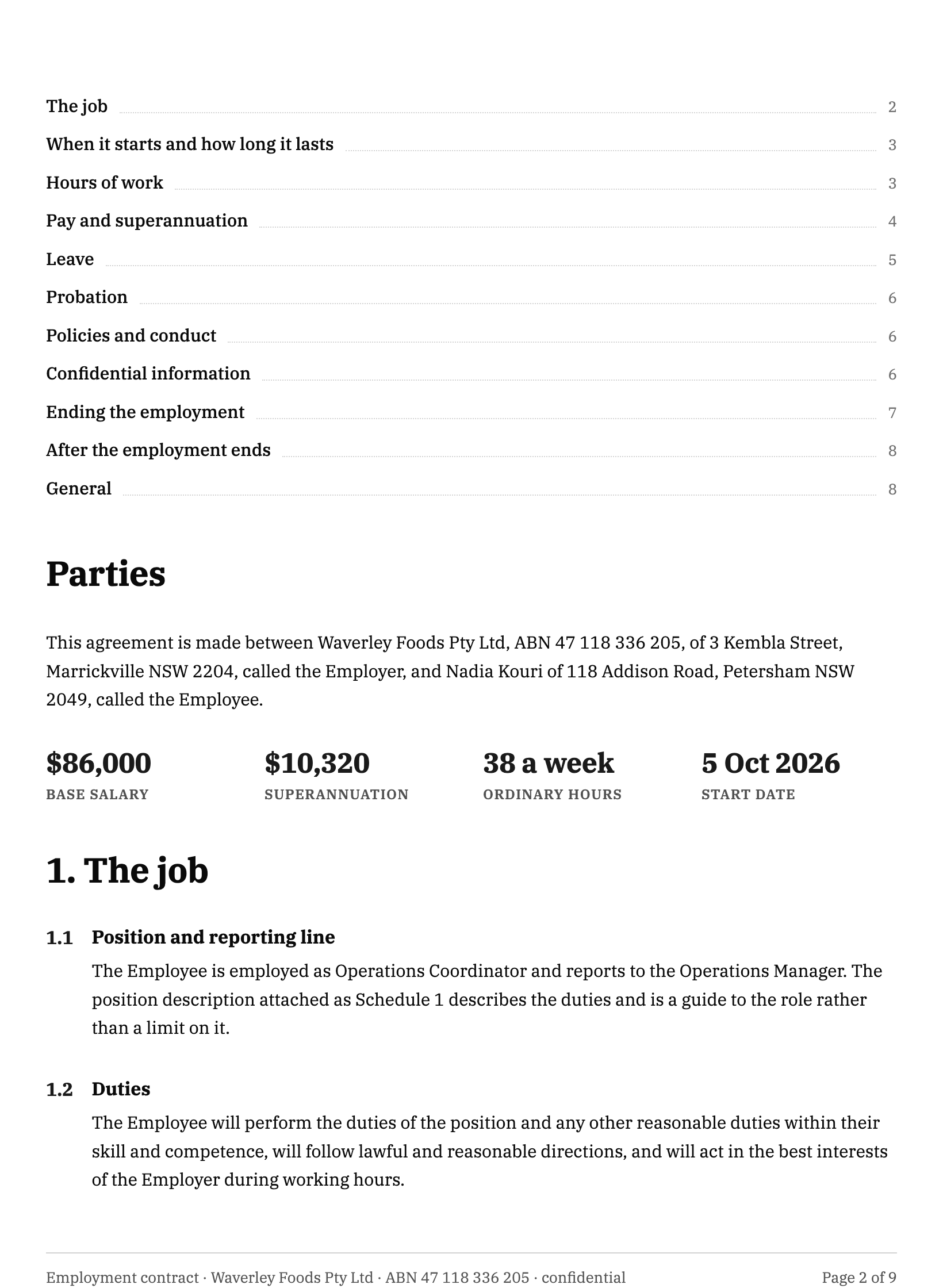 Employment contractA full time ongoing contract for an operations coordinator on $86,000 plus $10,320 of superannuation. Eleven numbered clauses, a leave table drawn from the National Employment Standards, and a notice table that scales with service.
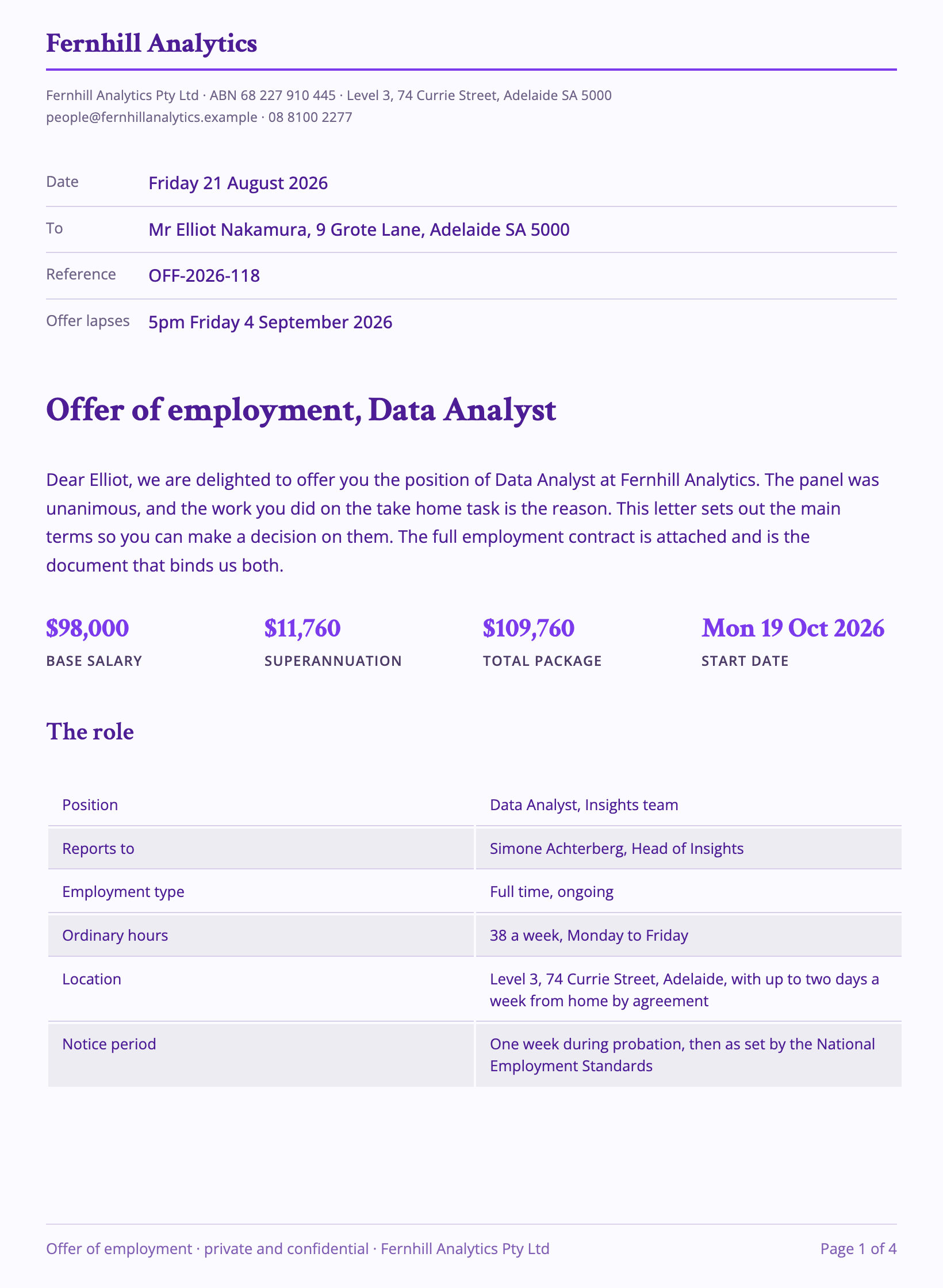 Job offer letterAn offer of $98,000 plus $11,760 of superannuation, with the three checks it depends on and a clear instruction not to resign until they clear. The letter also names what is not in the offer, which is the part candidates most often assume.
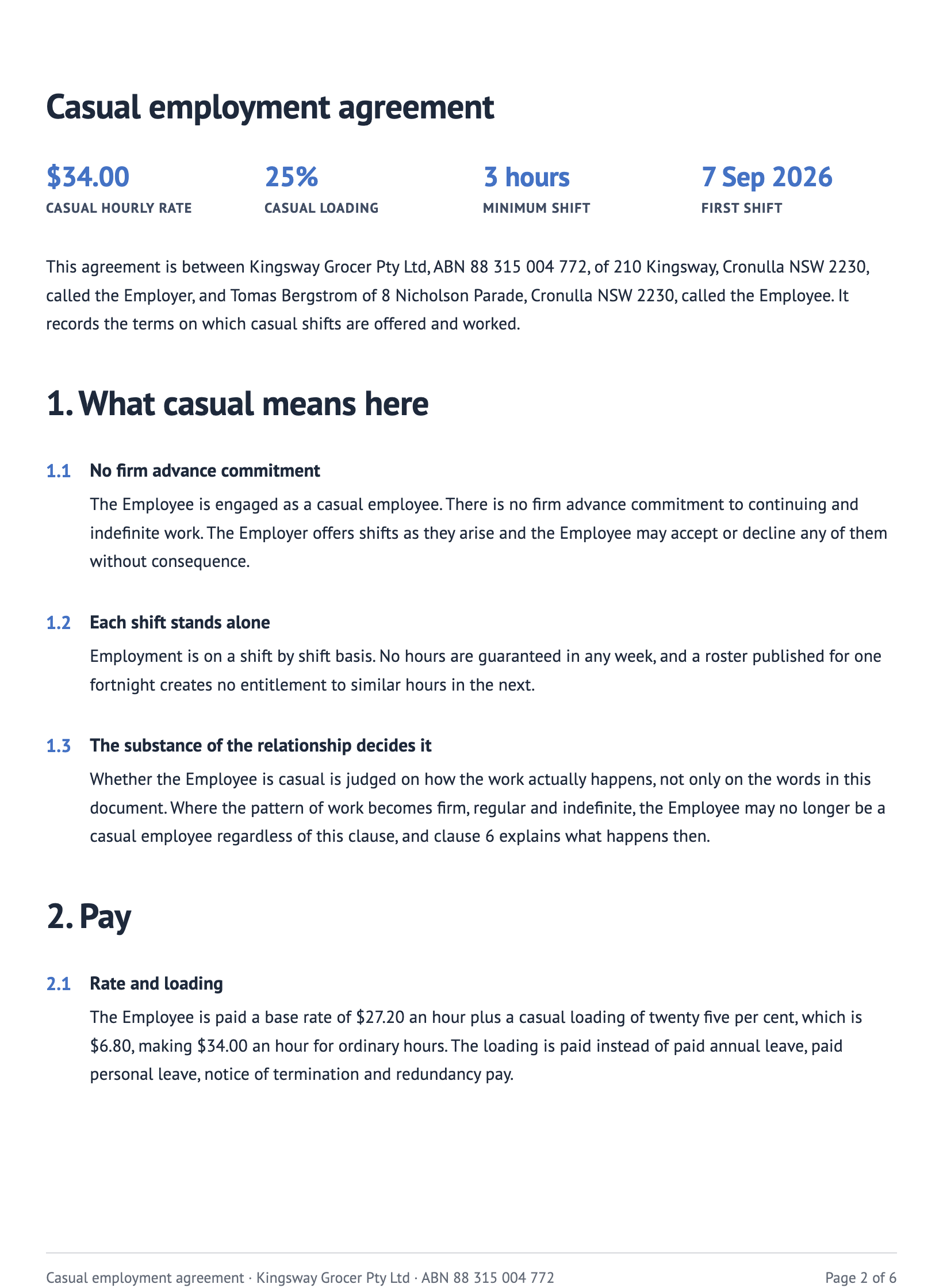 Casual employment agreementA retail assistant is paid $34.00 an hour, which is a base of $27.20 plus a twenty five per cent loading. The agreement shows how every other rate is built from that base, and what the loading is paid instead of.
Questions people ask
How long can a probation period be in Australia?
The law sets no maximum, and the employer usually decides the length. Three to six months is the common range. A longer probation does not delay unfair dismissal protection, which depends on the minimum employment period of 6 months, or 12 months for a small business employer, together with the other eligibility rules.
Can an employer end employment during probation without notice?
Not ordinarily. An employee on probation is still entitled to notice under the National Employment Standards, or payment instead of notice, unless an exception applies such as serious misconduct. The contract can provide more notice than the minimum, but never less than the standards or an applicable award require.
Can a probation period be extended?
If the contract allows it, usually by written notice before the original period ends. A fair extension clause states the reason, the standards to be met and a total cap. Extending probation changes only the contractual arrangement; it does not change when the statutory minimum employment period for unfair dismissal is completed.
Do employees on probation get paid leave?
Yes. Full time and part time employees on probation accrue and can take paid leave such as annual leave and personal leave in the same way as any other employee. If employment ends during probation, unused accrued annual leave has to be paid out with the final pay.
Can an employee on probation claim unfair dismissal?
Only once the minimum employment period is met and the other eligibility rules apply. For most employers that period is 6 months, and for a small business employer it is 12 months. An employee on a longer probation can therefore become eligible before probation ends, provided they are also award covered or earn under the high income threshold.
Is probation the same as a casual trial?
No. A permanent employee on probation is already permanent, with notice and leave entitlements. A casual employee is not on a permanent contract at all, and becomes eligible to use the employee choice pathway to permanent employment after 6 months, or 12 months with a small business, if they no longer meet the casual definition.
Put the clause in a finished document
The button opens the document generator with a starting description already filled in. Change it to match your own agreement before you run it.
Create a document with OneCraftRelated clauses
- Notice period clause in an employment contractA notice period clause sets how much notice ends employment. Australian sample wording, the National Employment Standards minimums and three variants.
- Independent contractor clause and the test behind itAn independent contractor clause states the worker is not an employee. Australian sample wording, the whole of relationship test factors, UK and US notes.
- Termination for cause clauseA termination for cause clause ends a contract for serious breach. Sample wording, what counts as material, cure periods and immediate termination events.
For everything the document generator can do, see the document maker.
Step by step in the builder: Create a document with AI, then Send a document for signature.
Written and checked by the OneCraft team. Last checked .