Contract clause
Independent contractor clause and the test behind it
An independent contractor clause records that a worker is engaged as a contractor running their own business rather than as an employee. The statement helps, but it does not decide the question: Australian law looks at the real substance of the working relationship, so the rest of the contract and the way the work is done must match it.
Calling someone a contractor is the easy part of a contractor agreement. The clause earns its place only when the terms around it, and the daily reality of the work, point the same way.
Nuwan Madhusanka · Co-founder
4 min read · Published
Sample clause
a services agreement between Blackbutt Surveying, a fictional land surveying firm in Armidale, and Kowari Aerial Mapping Pty Ltd, a one operator drone mapping business
4. Nature of the Engagement 4.1 The Contractor is engaged as an independent contractor to deliver the Deliverables in Schedule 1, and nothing in this agreement makes the Contractor or any of its personnel an employee of Blackbutt Surveying. 4.2 The Contractor decides how, when and by whom the Services are performed, subject only to the site access times and safety rules in Schedule 2. 4.3 The Contractor supplies and maintains its own drones, software, vehicle and equipment at its own cost. 4.4 The Contractor may delegate or subcontract any part of the Services to a suitably licensed person, and remains responsible for that person's work. 4.5 The Contractor holds its own public liability and professional indemnity insurance, and is responsible for its own tax and GST. 4.6 The Contractor is paid a fixed price for each accepted Deliverable, bears the cost of correcting defective work, and may provide services to other clients.
Sample wording, not legal advice.
Variants
Australian wording that looks at practice as well as paper
Any Australian engagement, because the whole of relationship test considers how the contract is performed, not only what it says.
The parties intend the Contractor to be an independent contractor, and each party must perform this agreement in a way that is consistent with that intention. If the way the Services are performed changes so that the Contractor is directed as to hours, methods or location in the manner of an employee, either party may raise the change in writing and the parties must meet within 10 business days to restructure or end the engagement.
United Kingdom engagement through a personal service company
A UK client engaging an individual through their own limited company, where the off payroll working rules may apply.
The Consultant provides the Services through its own company and is not an employee of the Client. Where the Client is required by the off payroll working rules to decide the status of the engagement, the Client will do so with reasonable care and give the Consultant a copy of its decision and reasons. The Consultant must promptly provide any information the Client reasonably requests for that purpose.
California engagement under the ABC test
A US engagement governed by California law, where the hiring business must prove all three limbs of the statutory test.
The Contractor performs the Services free from the Company's control and direction, both under this agreement and in fact. The Services are outside the usual course of the Company's business, which is residential property management. The Contractor represents that it is customarily engaged in an independently established business providing the same kind of services to other clients, and will provide evidence of that business on request.
What to negotiate
Control over hours and methods
Principals often want to set hours and supervise closely, especially on a shared site. Every instruction about how the work is done pushes the relationship toward employment. Limiting directions to outcomes, deadlines and safety rules, and leaving method to the contractor, protects both parties from a later reclassification.
Exclusivity
A clause stopping the contractor working for anyone else looks like employment, because an employee works in the business and a contractor runs their own. Where the principal needs availability, a minimum service commitment or response time serves the purpose without removing the contractor's other clients.
How payment is calculated
Hourly pay for time worked is characteristic of employment, while a price for a result, with the contractor bearing the cost of fixing defects, is characteristic of a business. Contractors sometimes prefer hourly rates for cash flow; a milestone price with a progress payment usually meets both needs.
A right to delegate that is real
A delegation right that the principal never allows in practice carries little weight. Principals worried about quality can require delegates to hold the same licences and insurance rather than refusing delegation outright, which keeps the right genuine. Contractors in turn accept that they stay responsible for the delegate's work and safety.
The risk of leaving it out
Leaving the clause out does not by itself make a contractor an employee, but it removes the clearest record of what both parties intended and why. If the relationship is later found to be employment, the business can face claims for minimum wages, leave, superannuation and notice, and misrepresenting an employee as a contractor can amount to sham contracting.
The whole of relationship test
Since 26 August 2024, constitutionally covered businesses decide whether a worker is an employee or a contractor under the whole of relationship test in the Fair Work Act. It asks about the real substance, practical reality and true nature of the relationship, considering the contract terms and how the contract is performed in practice. A worker earning above the contractor high income threshold can opt out and have the older start of relationship test apply. The Fair Work Ombudsman also warns that representing an employee as a contractor is unlawful unless the business reasonably believed the worker was a contractor.
The factors, read across both sides
Control: a contractor decides how the work is done, while an employee is directed. Financial risk: a contractor can make a profit or a loss and fixes defects at its own cost, while an employee is paid regardless. Tools and equipment: a contractor supplies its own, while an employee uses the employer's. Delegation: a contractor can send someone else, while an employee must do the work personally. Hours: a contractor sets its own, while an employee works set or rostered hours. Continuity: a contractor is engaged for a result or a period, while an employee expects ongoing work. No single factor decides the answer, and a contract that ticks every contractor box on paper can still describe an employment relationship once the day to day facts are examined.
Where it sits in a generated document
A generated contractor agreement usually opens with the nature of the engagement, before scope and price, so every later clause reads in that light. A factor comparison like the one above can be written as a table inside the same document. The generated text does not print citations, so any statutory test it describes should be checked before the agreement is signed.
Documents that carry this clause
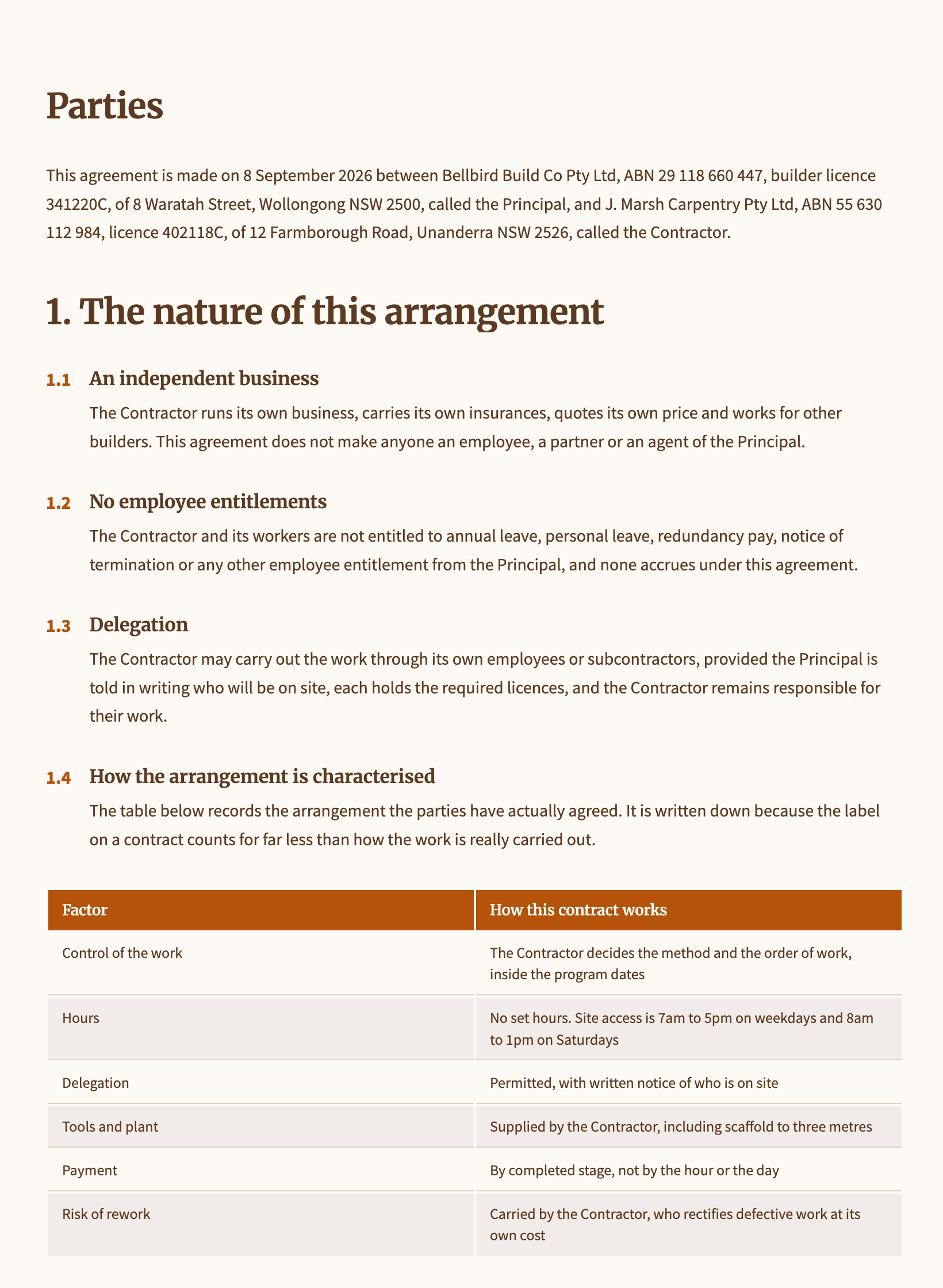 Independent contractor agreementA builder engages a carpentry business for one house. The interesting clause is not the price, it is the table that writes down who controls the work, because that is what decides whether this is a contract at all.
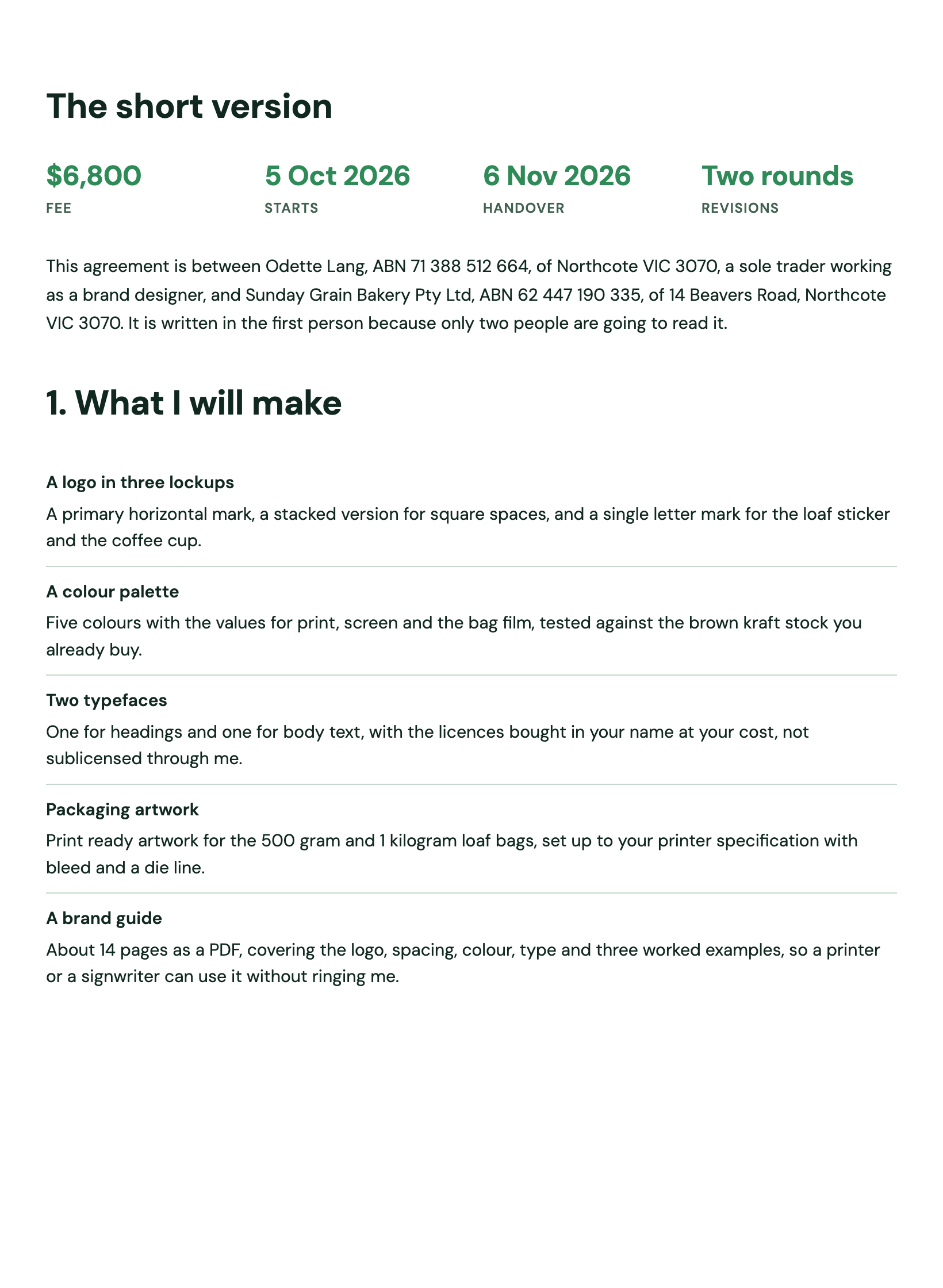 Freelance contractA brand designer and a bakery owner agree five weeks of work in language they can both read. It covers everything a longer contract would, and it never once says party of the first part.
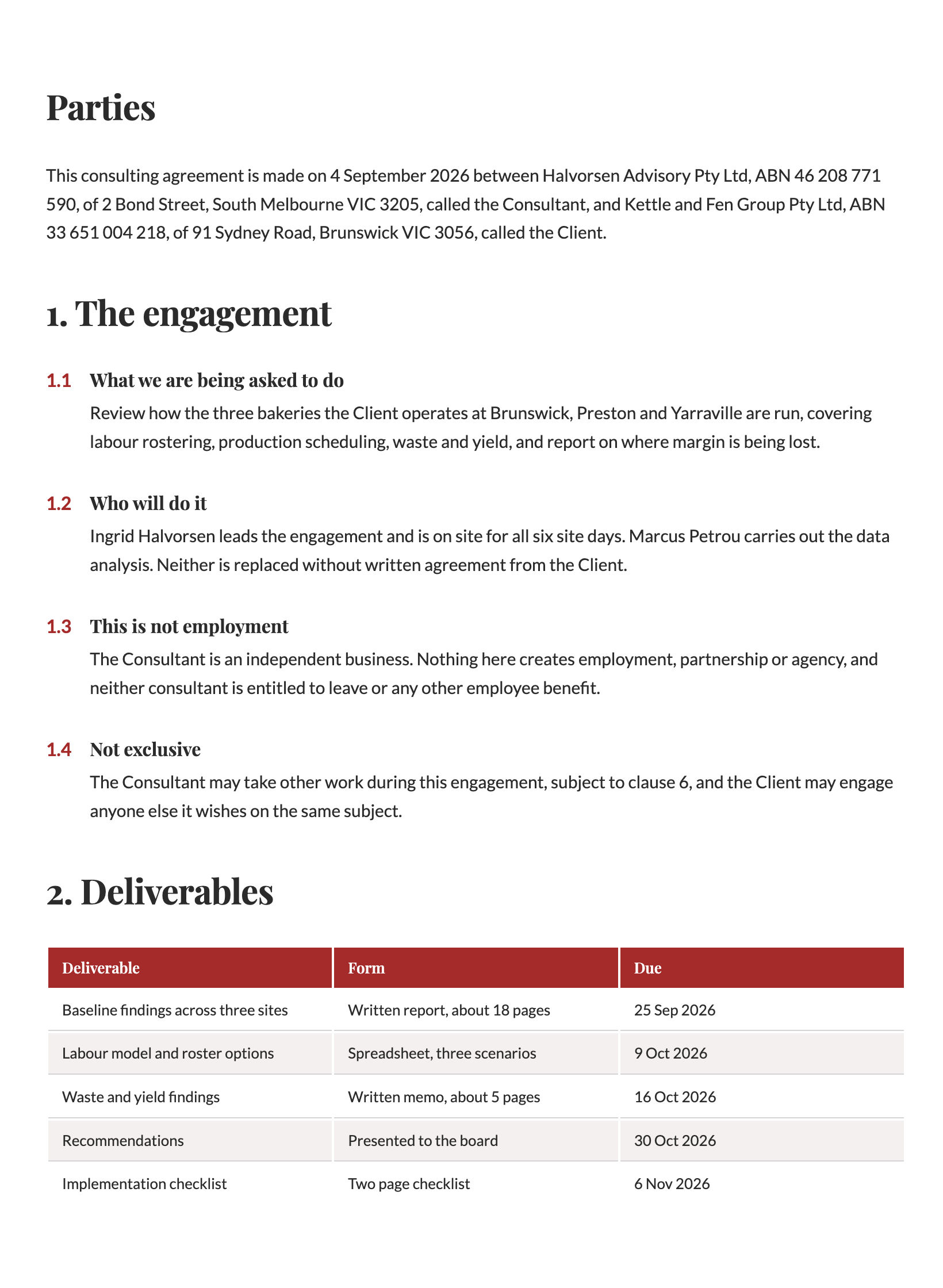 Consulting agreementAn advisory firm reviews three bakeries over seven weeks. What makes this agreement useful is not the fee clause but the two clauses that say what the advice is not.
Questions people ask
Does a contract that says contractor make someone a contractor?
No. The label is one piece of evidence, but the whole of relationship test looks at the real substance and practical reality of the arrangement, including how the contract is actually performed. A worker described as a contractor who is directed, paid by the hour and works only for one business may still be an employee.
What is the whole of relationship test?
It is the test constitutionally covered businesses have used since 26 August 2024 to decide whether a worker is an employee. It weighs factors such as control, financial risk, who supplies tools, the ability to delegate, hours of work and whether work is expected to continue, across the whole relationship.
What happens if a contractor is really an employee?
The worker can claim the entitlements an employee would have had, such as minimum pay, leave and notice, and tax and superannuation obligations may also have been missed. Where a business told the worker they were a contractor without reasonably believing it, the Fair Work Ombudsman treats that as possible sham contracting.
Can a contractor work for only one client?
They can, and many do for a period, but exclusivity is a factor pointing toward employment. It weighs less where the contractor genuinely runs a business, markets to others and could take other work. A contract that forbids other clients adds weight to the employment side and is worth avoiding unless it is essential.
How does the UK treat contractors working through their own company?
The off payroll working rules, often called IR35, apply where a worker who provides services through their own intermediary would have been an employee if engaged directly. In most cases the client decides the worker's status, although for small private sector clients the worker's own company makes that decision.
What is the ABC test in the United States?
California's Labor Code treats a worker as an employee unless the hiring business shows all three limbs: freedom from control and direction, work outside the usual course of the hiring business, and an independently established trade or business of the same nature. Other states use different tests, so the governing law matters.
Put the clause in a finished document
The button opens the document generator with a starting description already filled in. Change it to match your own agreement before you run it.
Create a document with OneCraftRelated clauses
- Relationship of the parties clause: no partnership, no agency, no employmentA relationship of the parties clause states a contract creates no partnership, agency or employment. Sample referral wording, four variants and its real limits.
- Overtime clause: paid, time off or built into salaryAn overtime clause says whether extra hours are paid, given as time off or absorbed in salary. Australian sample wording with an annual reconciliation.
- Insurance clause: which policies, what amounts, what proofAn insurance clause sets the policies a contractor must hold, the amounts and the proof. Australian sample wording, typical cover levels and three variants.
- Work made for hire clauseA work made for hire clause makes the commissioning party the author under US law. Sample wording, the nine statutory categories, and the assignment fallback.
For everything the document generator can do, see the document maker.
Step by step in the builder: Create a document with AI, then Send a document for signature.
Written and checked by the OneCraft team. Last checked .