Contract clause
Work made for hire clause
A work made for hire clause treats the commissioning party as the author of the work under United States copyright law, rather than the person who created it. It only operates in the situations the statute allows, which is why every careful draft pairs it with an assignment that works when the doctrine does not.
The phrase appears in contracts all over the world and has legal effect in only one of them. Used outside the United States it is decoration, and used inside it without a fallback it fails more often than it works.
Indunil Asanka · Co-founder
4 min read · Published
Sample clause
a contractor agreement between Bluegum Software and a fictional Delaware company, Harborline Retail Inc, governed by New York law
1. Work Made for Hire. The parties agree that each Deliverable prepared by the Contractor under this agreement is a work made for hire as that term is defined in section 101 of the Copyright Act of 1976, and that the Company is the author of each Deliverable for copyright purposes. 2. Assignment Fallback. To the extent a Deliverable does not qualify as a work made for hire, the Contractor irrevocably assigns to the Company all right, title and interest in it, including all copyright and all rights of renewal and extension, effective on creation. 3. Further Assurance. The Contractor must sign any document and take any other step the Company reasonably requests, at the Company's expense, to record the Company's ownership, including recordation with the United States Copyright Office. 4. Third Party Material. The Contractor must not include material owned by a third party in a Deliverable without the Company's prior written consent, and must identify the licence that applies to any such material. 5. Contractor Materials. The Contractor retains ownership of the tools listed in Exhibit B and licenses them to the Company under clause 9.
Sample wording, not legal advice.
Variants
Work made for hire with an assignment fallback
The only form worth using in a United States commissioning contract, because the doctrine does not reach every kind of work.
Each Deliverable is a work made for hire under section 101 of the Copyright Act of 1976 and the Company is the author of it. If any Deliverable is determined not to be a work made for hire, the Contractor irrevocably assigns to the Company, effective on creation, all right, title and interest in that Deliverable throughout the world, including all copyrights and all rights to sue for past infringement. The Contractor waives any right of rescission, termination or reversion it may hold in respect of the assignment to the extent permitted by law.
Assignment only, no work made for hire language
Contracts governed by Australian, United Kingdom or New Zealand law, where the doctrine has no equivalent.
The Contractor assigns to the Company all present and future copyright and other intellectual property rights in each Deliverable, on creation of that Deliverable. The Contractor must promptly disclose each Deliverable to the Company and must sign any document the Company reasonably requires to record or perfect the assignment. The Contractor consents to the Company dealing with each Deliverable in the ways described in clause 10, and acknowledges that nothing in this agreement assigns the Contractor's moral rights, which remain with the Contractor.
Employee version
United States employment agreements, where the first statutory category applies without any express agreement being required.
All works of authorship the Employee prepares within the scope of employment are works made for hire under section 101 of the Copyright Act of 1976, and the Company is the author and owner of them. To the extent any such work is determined not to be a work made for hire, the Employee assigns it to the Company on creation. The Employee must disclose each such work promptly and must not incorporate material owned by any third party without the Company's prior written consent.
What to negotiate
Whether the fallback is present
The doctrine covers employees within the scope of employment, and commissioned work only in nine listed categories agreed in a signed writing. Software, logos and photographs frequently fall outside those categories. A clause with no assignment fallback therefore leaves ownership with the creator in exactly the engagements companies most want to own. Commissioning parties should treat the fallback as non negotiable.
When the assignment takes effect
Companies want the assignment effective on creation, so there is no window in which the contractor owns the deliverable. Contractors sometimes ask for it to take effect on payment, which gives them leverage over an unpaid invoice. United States contracts more often land on assignment on creation with a separate payment remedy, while commissioned creative work outside the country tends to go the other way.
What the contractor keeps
Developers and studios reuse frameworks and templates, and a clause that sweeps everything into the company leaves them unable to work. An exhibit listing contractor materials, licensed to the company on terms broad enough to operate the deliverable, solves it. Companies should require the exhibit at signing so it cannot expand quietly after delivery.
Termination and reversion rights
United States copyright law gives authors certain rights to terminate transfers after a period of years, and those rights do not apply to genuine works made for hire. That difference is part of why commissioning parties prefer the doctrine where it is available, and why the drafting of the fallback matters. Specialist advice is usual where a long lived asset such as a brand or a franchise is involved.
The risk of leaving it out
Without either a work made for hire clause or an assignment, the individual creator generally owns the copyright in commissioned work under United States law, and the commissioning party holds at most an implied licence for the purpose it was made for. That leaves the company unable to modify, license or sell the asset, which usually surfaces during diligence rather than during the project.
What the statute actually covers
Section 101 of the United States Copyright Act defines a work made for hire in two ways. The first is a work prepared by an employee within the scope of employment, which needs no written agreement at all. The second is a work specially ordered or commissioned for use as one of nine listed categories, including a contribution to a collective work, part of a motion picture or other audiovisual work, a translation, a supplementary work, a compilation, an instructional text, a test, answer material for a test, and an atlas, and only where the parties expressly agree in a written instrument signed by them. Section 201 then treats the employer or commissioning party as the author. Software, standalone photographs and logo designs are not in the nine categories, which is why the fallback matters so much.
Why the phrase travels badly
Australian, United Kingdom and New Zealand law have no work made for hire doctrine. Ownership of commissioned work in those systems is dealt with by assignment, which for Australian copyright must be in writing signed by the assignor under the Copyright Act 1968. A contract governed by Australian law that says the deliverables are works made for hire and stops there has said nothing effective, and the creator keeps the copyright. The same template also tends to omit a moral rights consent, because United States law has no general moral rights regime, which leaves a second gap alongside the first. Replacing the phrase with an assignment and adding a consent fixes both.
Where it sits in a generated document
The document generator writes an agreement as numbered content, so the work made for hire statement, the assignment fallback and the further assurance obligation each become their own numbered provision. The generated text is written from the description it is given and it never prints citations, so any statutory reference or category list in a draft has to be checked before the document is used. Asking for both the doctrine and the fallback in the description produces two clauses rather than one sentence doing both jobs badly.
Documents that carry this clause
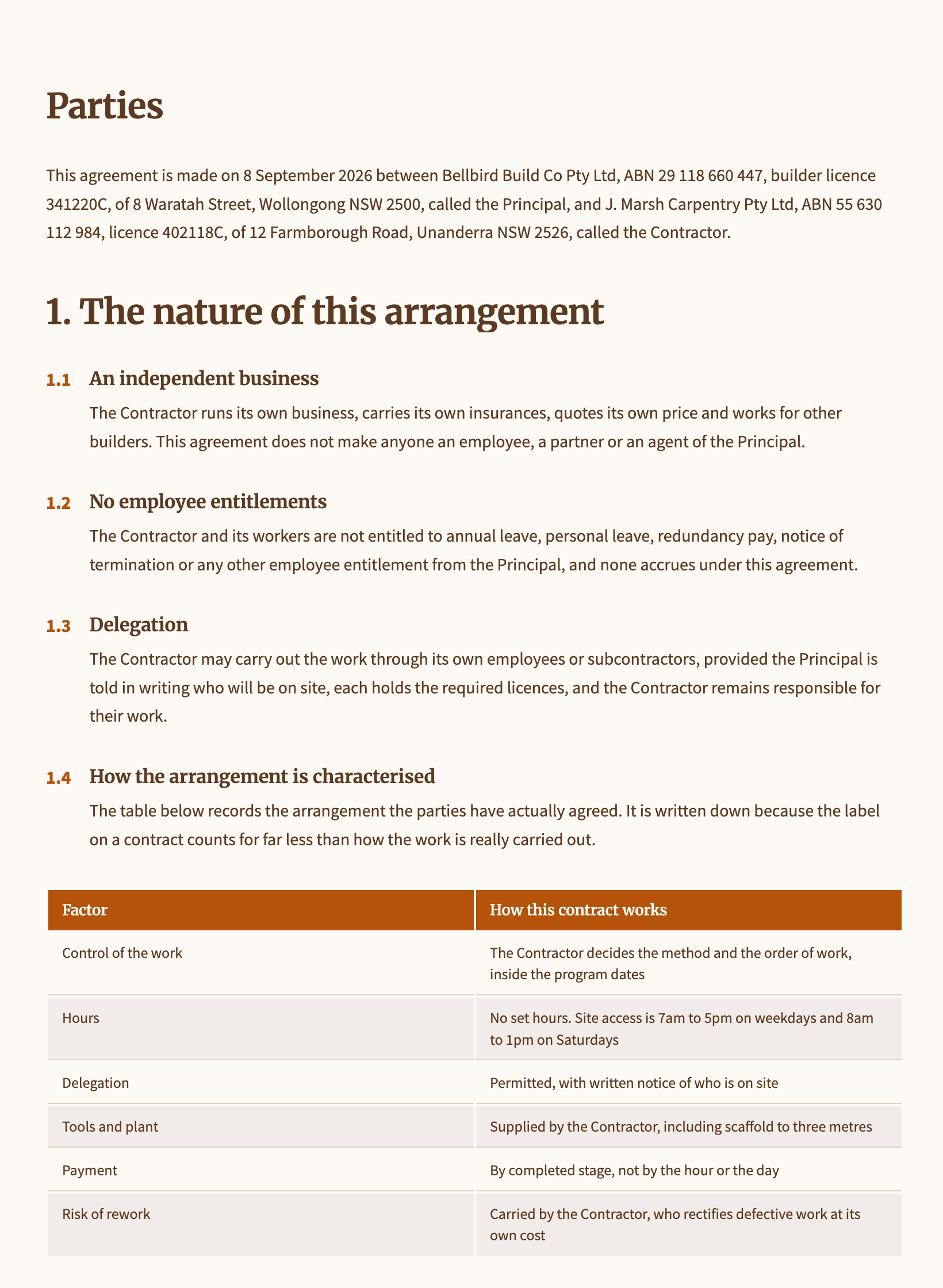 Independent contractor agreementA builder engages a carpentry business for one house. The interesting clause is not the price, it is the table that writes down who controls the work, because that is what decides whether this is a contract at all.
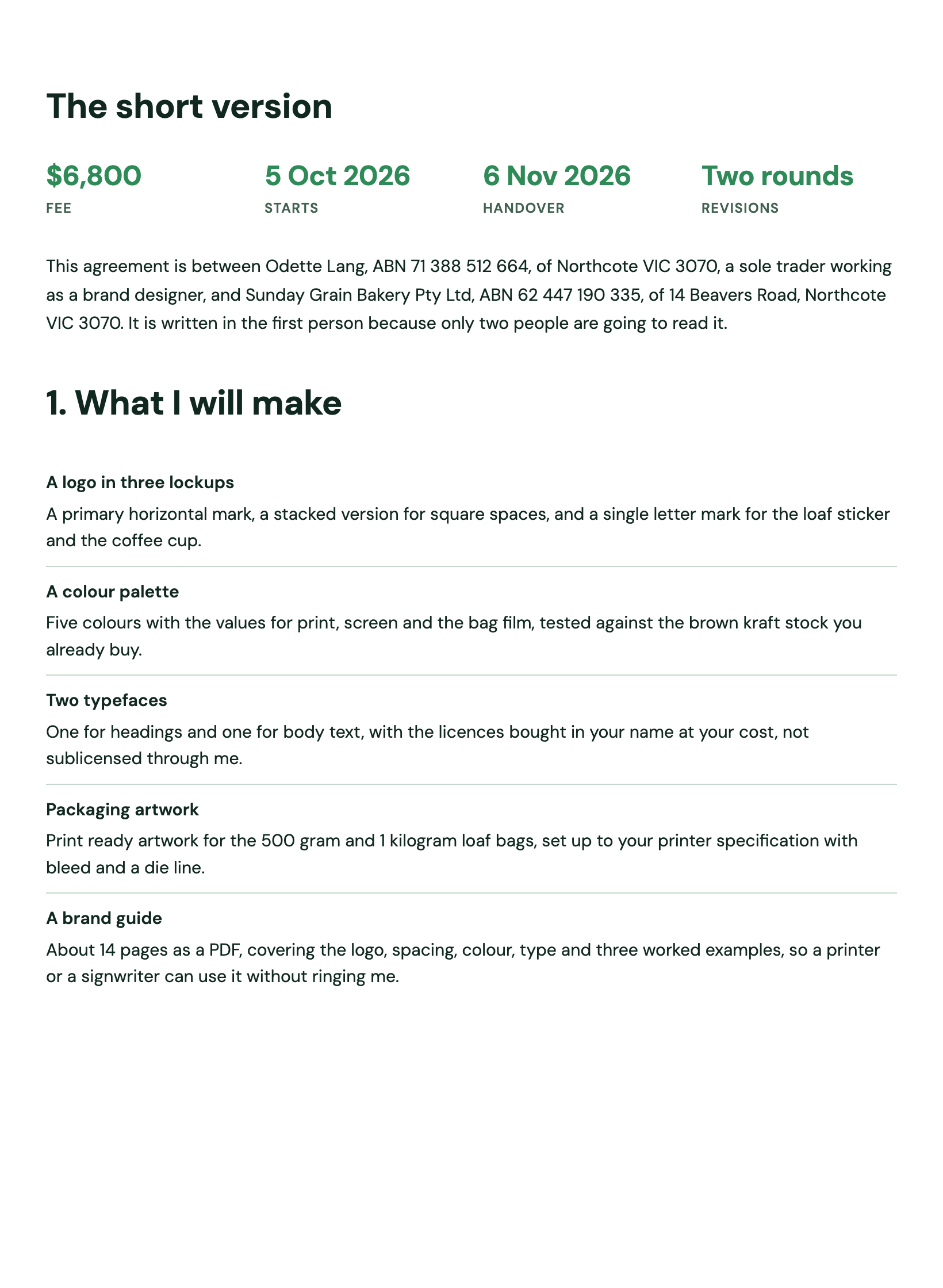 Freelance contractA brand designer and a bakery owner agree five weeks of work in language they can both read. It covers everything a longer contract would, and it never once says party of the first part.
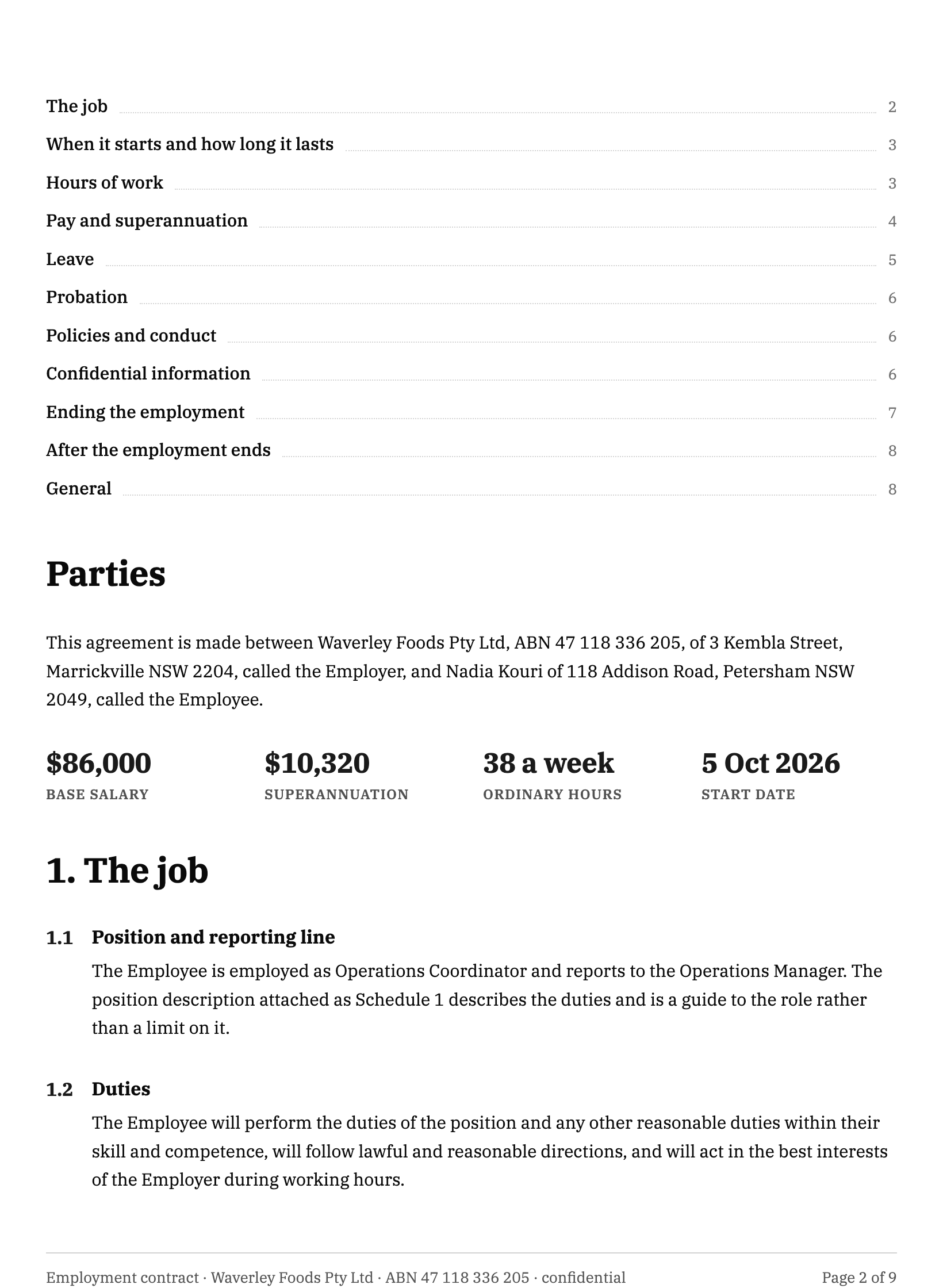 Employment contractA full time ongoing contract for an operations coordinator on $86,000 plus $10,320 of superannuation. Eleven numbered clauses, a leave table drawn from the National Employment Standards, and a notice table that scales with service.
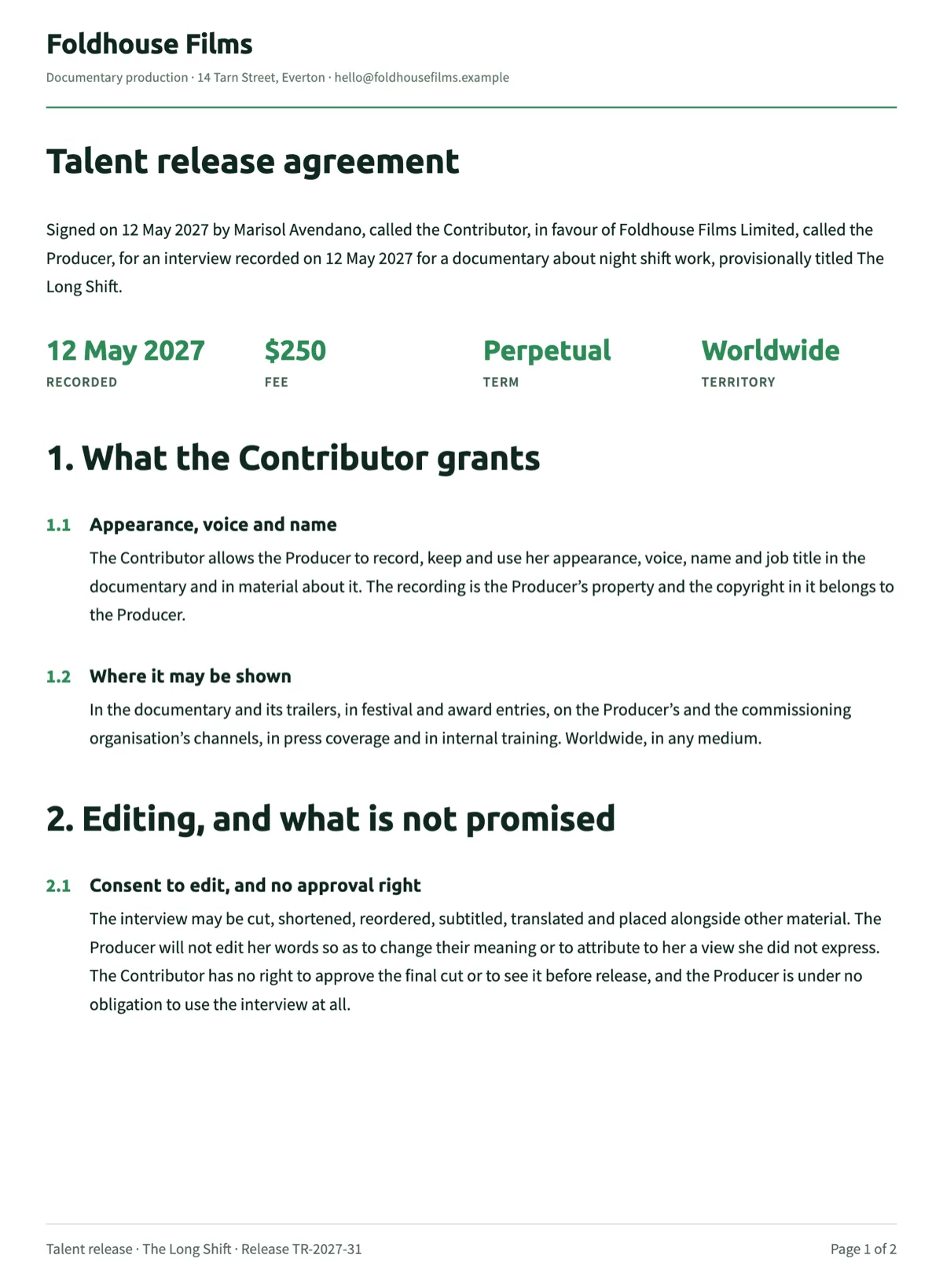 Talent release agreement for a video appearance and editsA talent release is what a production company needs before it can cut an interview into a film. This one covers a single filmed interview for a documentary about night shift work: appearance, voice and name, edited freely, no approval right, perpetual and worldwide, for $250 or a donation to a charity the contributor nominates.
Questions people ask
Does work made for hire apply outside the United States?
No. It is a United States copyright doctrine with no equivalent in Australia, the United Kingdom or New Zealand. A contract governed by one of those laws that relies on the phrase has not transferred anything, and the creator keeps the copyright. Those jurisdictions use an assignment instead, which for Australian copyright must be in writing and signed.
Which works can be commissioned as works made for hire?
Section 101 lists nine categories for commissioned work: a contribution to a collective work, part of a motion picture or other audiovisual work, a translation, a supplementary work, a compilation, an instructional text, a test, answer material for a test, and an atlas. The parties must also agree expressly in a signed written instrument.
Is software a work made for hire?
Not when it is commissioned from an independent contractor, because software is not one of the nine statutory categories. Software written by an employee within the scope of employment is a different case and does qualify. This is the single most common reason a commissioning party discovers it does not own code it paid for.
Why include an assignment fallback?
Because the doctrine fails silently. If a deliverable turns out not to fit the statute, a clause with no fallback leaves ownership with the creator and the company holding at most an implied licence. A fallback assigning all rights effective on creation covers that outcome, and costs one extra sentence to include.
Does work made for hire affect termination rights?
Yes. United States copyright law allows authors to terminate certain transfers after a period of years, and those rights do not apply to genuine works made for hire. That difference is one reason commissioning parties prefer the doctrine where it is available, and a reason to take specialist advice where the asset is long lived.
What should replace the phrase in an Australian contract?
An assignment of present and future copyright, in writing and signed by the creator, paired with a moral rights consent. The assignment deals with ownership and the consent deals with attribution and changes to the work, which United States drafting rarely covers because federal moral rights there are limited to certain works of visual art.
Put the clause in a finished document
The button opens the document generator with a starting description already filled in. Change it to match your own agreement before you run it.
Create a document with OneCraftRelated clauses
- Intellectual property assignment clauseAn intellectual property assignment clause transfers ownership of created work to the client. Sample wording, assign on payment or creation, and moral rights.
- Moral rights consent clauseIn Australia moral rights cannot be assigned, only consented to. Sample consent wording for a copywriter, the three rights, and the UK waiver and US position.
- Background IP clauseA background IP clause separates what each party brought from what was built for the project. Sample software wording, the schedule and the licence back.
For everything the document generator can do, see the document maker.
Step by step in the builder: Create a document with AI, then Document builder components.
Written and checked by the OneCraft team. Last checked .