Contract clause
Moral rights consent clause
A moral rights consent clause records an author's written agreement to acts that would otherwise infringe their attribution and integrity rights. In Australia those rights belong to the individual creator and cannot be assigned or sold, so consent is the only way a client can deal with them.
An assignment of copyright moves ownership and leaves the author's personal rights untouched. A client that edits, crops or publishes work without a byline is dealing with those rights, whether or not anybody planned to.
Nuwan Madhusanka · Co-founder
4 min read · Published
Sample clause
a copywriting engagement between Wattle Lane Studio and Saltbush Brewing, a fictional craft brewery in Ballarat
1. Consent. The Writer consents to the following acts by the Client and by anyone authorised by the Client, in relation to the Copy, for the purposes of the Harvest Ale campaign: 1.1 publishing, distributing and reproducing the Copy without identifying the Writer as its author; 1.2 editing, shortening, rearranging and combining the Copy with other material, including images, headlines and legal disclaimers; 1.3 adapting the Copy for other formats, including packaging, point of sale material and social media posts; and 1.4 using the Copy alongside the Client's trade marks and product descriptions. 2. Scope. This consent is given for the acts described in clause 1 only. It is not a consent to acts that would falsely attribute authorship of the Copy to another person. 3. Genuine Consent. The Writer gives this consent freely and has had the opportunity to seek independent advice about it. 4. No Assignment. Nothing in this agreement assigns or purports to assign the Writer's moral rights, which remain with the Writer.
Sample wording, not legal advice.
Variants
Consent limited to named acts
The author will consent to what the project actually needs and no more, which is the position most individual creators take.
The Author consents to the Client reproducing, publishing and distributing the Work without identifying the Author, and to the Client cropping, resizing and colour correcting the Work for the purposes described in Schedule 1. The Author does not consent to any other alteration of the Work, to its use in a context that would be prejudicial to the Author's honour or reputation, or to its use after the end of the Term. Any further use requires a separate written consent.
Broad consent for commissioned commercial work
Advertising and marketing engagements where the finished material is routinely edited, versioned and republished without a credit.
The Author consents to all acts or omissions by the Client, and by any person authorised by the Client, that would otherwise infringe the Author's moral rights in the Work, including publication without attribution, alteration, adaptation, addition to and combination of the Work with other material, in any medium and for any purpose connected with the Client's business. This consent is given genuinely and without duress, applies during and after the Term, and does not extend to falsely attributing authorship of the Work to another person.
United Kingdom waiver wording
A contract governed by the law of England and Wales, where moral rights can be waived rather than consented to.
The Author waives unconditionally all moral rights in the Work to which the Author is or may become entitled under Chapter IV of the Copyright, Designs and Patents Act 1988, including the right to be identified as author and the right to object to derogatory treatment of the Work. This waiver is given in writing and signed by the Author, extends to the Client and to anyone authorised by the Client, and applies to the Work in every medium and for the full period of copyright.
What to negotiate
How wide the consent should be
Clients want an all acts consent so no future edit needs a fresh conversation. Authors want the consent tied to the project and the uses described in the brief. Commercial marketing work usually settles on a broad consent, while editorial, photographic and illustrative work more often settles on named acts plus a right to be consulted on anything outside them.
Credit where the work is editorial
Authors often accept no attribution in advertising but want a credit when the work appears in editorial, awards or portfolio contexts. Clients rarely object once the distinction is drawn, because the credit costs them nothing there. Writing the distinction into the clause avoids the situation where a broad consent is used to strip a byline the client never intended to remove.
Whether the consent survives the engagement
Material keeps being republished long after a project ends, so a consent limited to the term leaves later reuse exposed. Clients ask for the consent to continue after the agreement ends. Authors generally accept this for the uses already agreed, while resisting an open ended consent covering uses that have not yet been described.
Consent given freely
A consent obtained by pressure is a weaker document. Including a sentence confirming the author gave it genuinely, and had the chance to take advice, costs nothing and strengthens the clause. For employee creators, contracts commonly deal with moral rights at the start of employment rather than at the moment a particular work is about to be published.
The risk of leaving it out
Without a consent, publishing the work without a credit, cropping it, or adding to it can infringe the author's moral rights even where the client owns the copyright outright. That exposure sits with the client and anyone it authorises, including its agency and its printer, and it is not cured by paying the invoice or by holding an assignment of copyright.
The three rights, and why they cannot be assigned
Part IX of the Copyright Act 1968 gives an individual creator three moral rights: the right of attribution of authorship, the right not to have authorship falsely attributed, and the right of integrity of authorship, which covers derogatory treatment of the work. They belong to the individual rather than to an employer or a company, and they cannot be assigned, which is the point most often missed in Australian contracts that simply copy a United States or United Kingdom template. The Act instead allows the author to consent in writing to acts or omissions that would otherwise infringe. A consent is narrower than a waiver by design, because it operates only to the extent of what it describes.
How Australia, the United Kingdom and the United States differ
In Australia the mechanism is consent, and moral rights cannot be assigned away. In the United Kingdom, Chapter IV of the Copyright, Designs and Patents Act 1988 allows moral rights to be waived in writing signed by the person giving them up, and the right to be identified as author has to be asserted before it can be enforced. In the United States the position is narrower still, because federal moral rights under the Visual Artists Rights Act apply only to certain works of visual art, so most commissioned commercial work carries none. A single clause used across all three will be wrong in at least two of them, which is why locale specific wording is worth the extra paragraph.
Where it sits in a generated document
The document generator writes an agreement as numbered content, so a consent normally appears as its own numbered clause immediately after the intellectual property assignment it accompanies, with each consented act as a sub clause. The generated text is written from the description it is given and it never prints citations, so any statutory reference in a draft has to be checked against the legislation before the document is used. Where the document ends in a signature block, each party in that block becomes one signer, so an individual author consenting in their own name signs once.
Documents that carry this clause
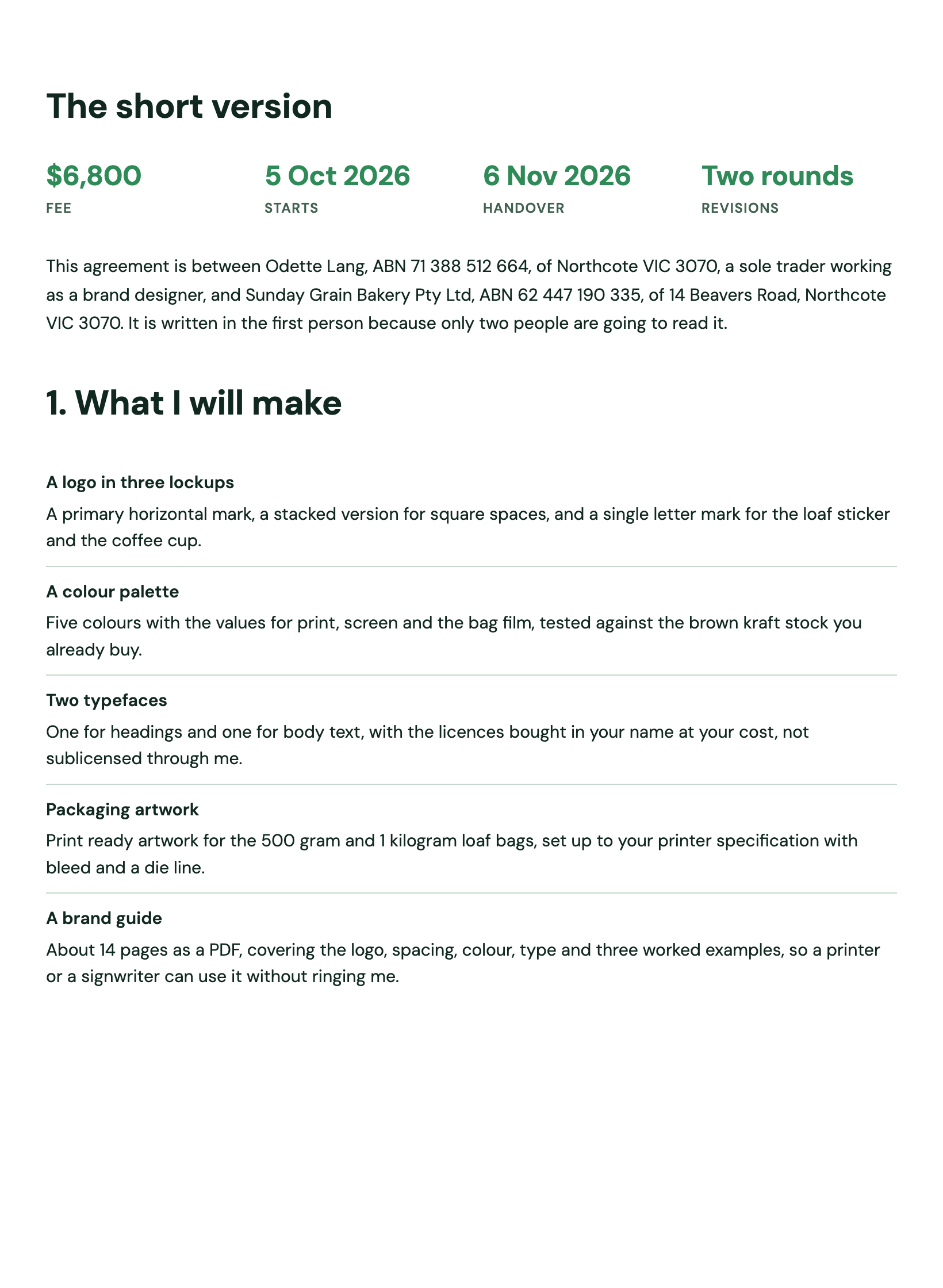 Freelance contractA brand designer and a bakery owner agree five weeks of work in language they can both read. It covers everything a longer contract would, and it never once says party of the first part.
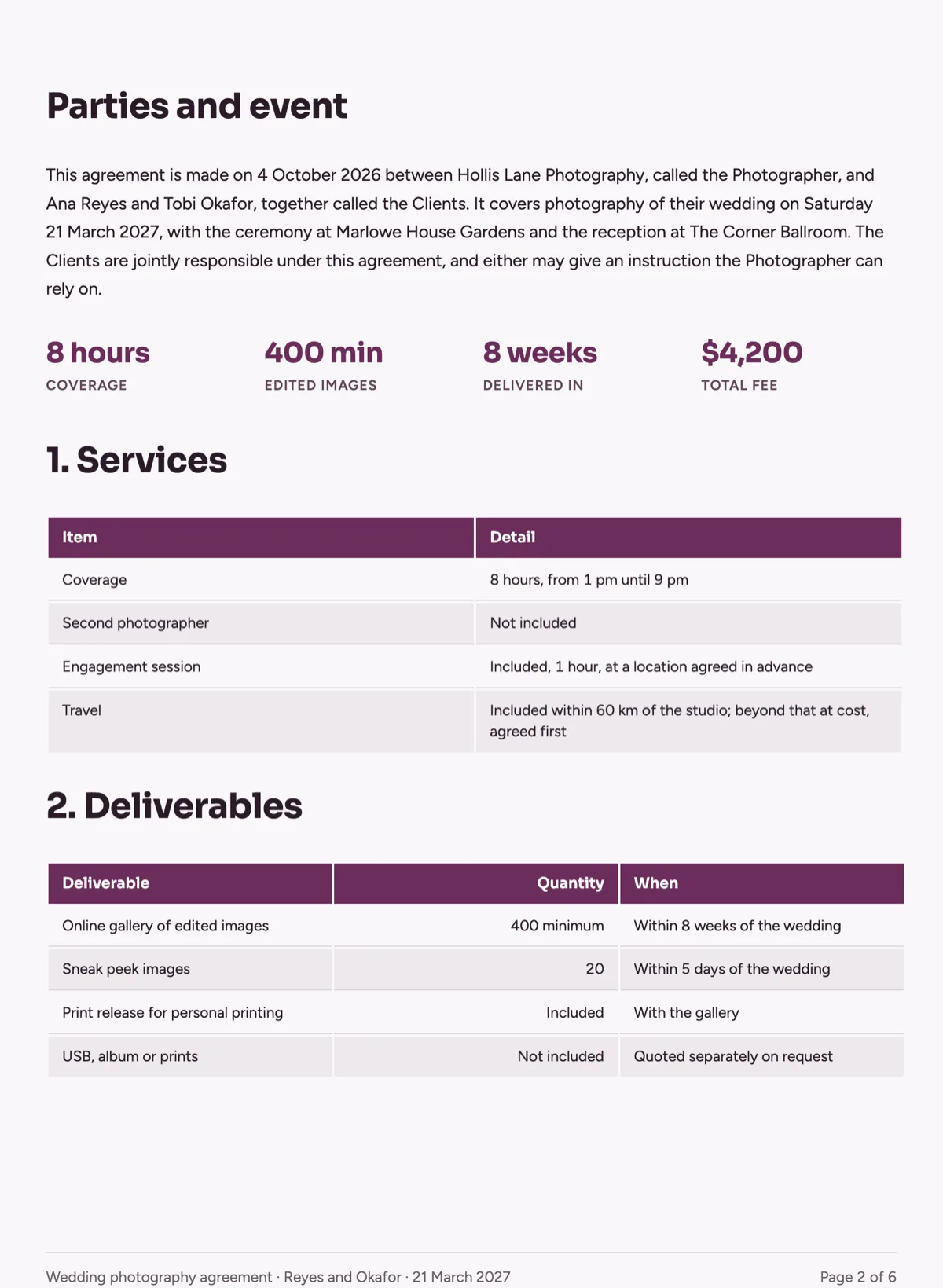 Photography contract template with deliverables you can countA photography contract is mostly a list of numbers: hours, images, weeks, dollars and the date after which the deposit is gone. This one writes every number down, then handles the three things that go wrong with weddings, a postponement, a sick photographer and an argument over who owns the photos.
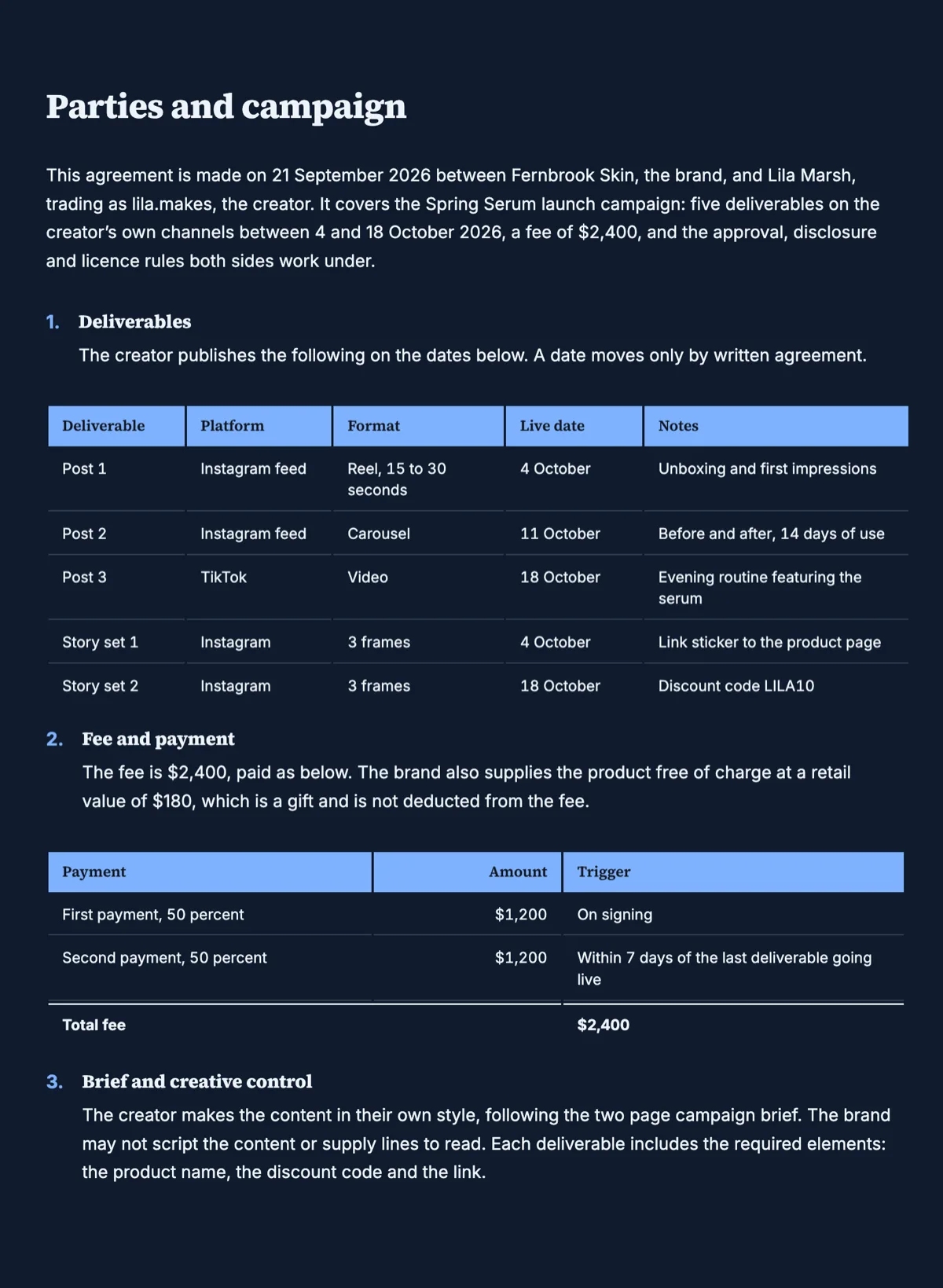 Influencer agreement template with the posts, dates and rights in one tableA creator deal is a schedule of posts and a set of permissions, and the disputes are about the reuse and the disclosure, not the fee. This agreement lists each deliverable with its platform and live date, splits the $2,400 fee across delivery, gives the brand a 12 month licence rather than ownership, and puts the ad label rule in the creator's obligations.
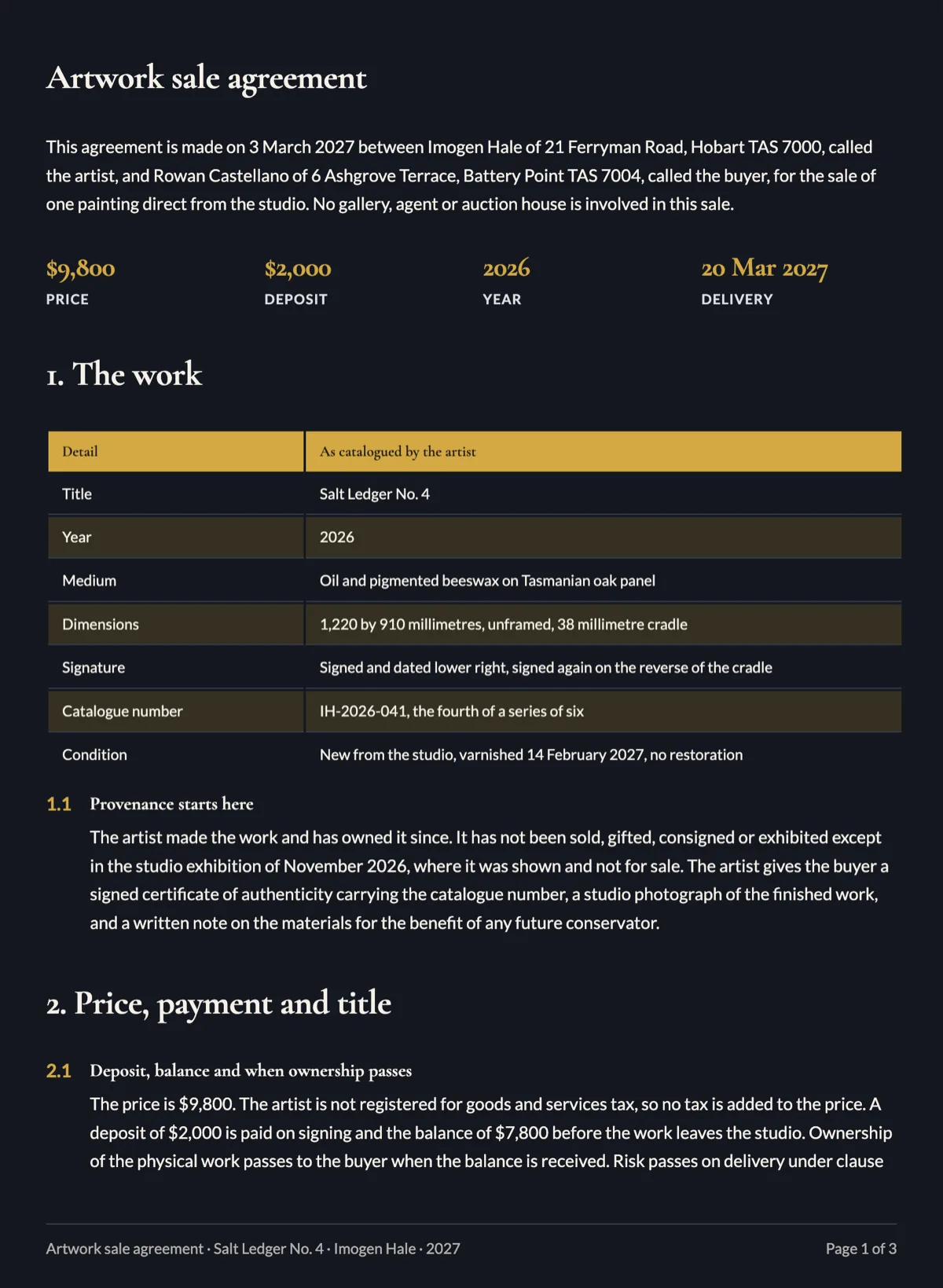 Artwork sale agreement with provenance and a resale royalty noteWhen a painting leaves a studio it takes its provenance with it, and whatever is not written down on the first sale is gone by the third. This agreement catalogues the work, keeps the copyright with the artist in plain words, and explains where the Australian resale royalty starts, which is not on this sale.
Questions people ask
Does an Australian employee need to sign a moral rights consent?
It is common practice, because moral rights belong to the individual creator and are not transferred by an employment relationship or by copyright ownership. Employers usually deal with them once at the start of employment, covering acts such as publication without a credit and editing of material, rather than seeking a fresh consent for each work.
Can moral rights be assigned in Australia?
No. Part IX of the Copyright Act 1968 treats them as personal to the individual creator, so they cannot be assigned or sold, and a clause purporting to assign them does not work. What the Act permits is a written consent to acts or omissions that would otherwise infringe, which is why Australian contracts use consent language rather than waiver language.
What are the three moral rights?
The right of attribution of authorship, the right not to have authorship falsely attributed, and the right of integrity of authorship, which covers derogatory treatment of the work. The first covers being credited, the second covers somebody else being credited, and the third covers changes that are prejudicial to the author's honour or reputation.
Is a moral rights waiver valid in the United Kingdom?
Yes. Chapter IV of the Copyright, Designs and Patents Act 1988 allows moral rights to be waived by an instrument in writing signed by the person giving them up. The United Kingdom also requires the right to be identified as author to be asserted before it can be enforced, which is a step Australian law does not have.
Do moral rights exist in the United States?
Only in a narrow form. Federal moral rights under the Visual Artists Rights Act apply to certain works of visual art, so most commissioned commercial work carries none. That is why United States templates rarely include a consent clause, and why using one of those templates unchanged in Australia leaves a real gap.
Does a consent cover false attribution?
It should not. Consenting to publication without a credit is different from consenting to somebody else being named as the author, and most clauses say so expressly. Keeping false attribution outside the consent protects the author without limiting anything a client actually needs to do with the work.
Put the clause in a finished document
The button opens the document generator with a starting description already filled in. Change it to match your own agreement before you run it.
Create a document with OneCraftRelated clauses
- Intellectual property assignment clauseAn intellectual property assignment clause transfers ownership of created work to the client. Sample wording, assign on payment or creation, and moral rights.
- Work made for hire clauseA work made for hire clause makes the commissioning party the author under US law. Sample wording, the nine statutory categories, and the assignment fallback.
- Licence grant clauseA licence grant clause gives permission to use intellectual property without owning it. Sample photo licence wording and the six terms every grant settles.
For everything the document generator can do, see the document maker.
Step by step in the builder: Create a document with AI, then Document builder components.
Written and checked by the OneCraft team. Last checked .