Contract clause
Licence grant clause
A licence grant clause gives one party permission to use intellectual property that somebody else owns. Every grant is defined by six things: what is licensed, for what uses, where, for how long, whether anyone else may have the same rights, and whether they can be passed on.
A licence that names only the work and the price has left five of the six questions open, and each of them decides something the parties will care about later. Most licensing disputes are about a term the grant never mentioned.
Nuwan Madhusanka · Co-founder
4 min read · Published
Sample clause
a photography licence between Wattle Lane Studio and Saltbush Brewing, a fictional craft brewery in Ballarat
1. Grant. The Photographer grants the Client a licence to use the Images on the terms in this clause. 1.1 Scope: reproduction of the Images in digital advertising, social media posts, the Client's website and point of sale material for the Harvest Ale campaign. 1.2 Territory: Australia and New Zealand. 1.3 Term: 12 months from 1 March 2027. 1.4 Exclusivity: non exclusive, except that the Photographer must not license the Images to another brewer during the Term. 1.5 Sublicensing: the Client may sublicense to its media agency and its retail stockists for the permitted uses only. 1.6 Transfer: the licence may be transferred with the sale of the Harvest Ale brand, on written notice to the Photographer. 2. Outside the Grant. Use in television advertising, on packaging, or after the Term requires a further written licence and a further fee. 3. Credit. Where the Images appear in editorial content the Client must credit the Photographer. 4. Archive. The Client may keep copies of the Images after the Term for internal record keeping only.
Sample wording, not legal advice.
Variants
Exclusive licence
The licensee is paying enough that it needs to be the only one using the work, and often needs to stop others as well.
The Licensor grants the Licensee an exclusive licence to use the Work for the Permitted Uses in the Territory during the Term. During the Term the Licensor must not use the Work for the Permitted Uses in the Territory itself, and must not license any third party to do so. The Licensee may bring proceedings against a third party infringing the licensed rights, and the Licensor must provide reasonable assistance at the Licensee's cost, including being joined as a party where that is required.
Non exclusive licence
Software, stock media and templates, where the same work is licensed to many customers on the same terms.
The Licensor grants the Licensee a non exclusive, non transferable licence to use the Software for its internal business purposes during the Term, for the number of users stated in Item 2 of the Schedule. The Licensee must not sublicense, resell, or make the Software available to a third party as a service. The Licensor may license the Software to any other person on any terms, and nothing in this agreement restricts how it does so.
Perpetual licence with a limited scope
The licensee needs the right to keep using something indefinitely, but only inside a narrow set of uses.
The Licensor grants the Licensee a perpetual, irrevocable, worldwide, non exclusive licence to use, reproduce and display the Work solely as part of the Product and solely for the purposes described in Schedule 1. The licence continues after this agreement ends. It does not permit use of the Work separately from the Product, modification of the Work beyond resizing and cropping, or sublicensing to any person other than an end user of the Product.
What to negotiate
Scope, and what sits just outside it
A grant listing permitted uses implies everything else is excluded, which is exactly what the licensor wants and what surprises the licensee later. The useful addition is a short sentence naming the obvious uses that are not included and what they would cost, so the conversation about packaging or television happens at drafting rather than the week before a launch.
Term, and what happens to material already published
A 12 month licence raises a question the grant often skips: what happens to printed posters, agency archives and social posts after the term. Licensors want everything taken down; licensees point out that some of it cannot be. The practical settlement is removal from channels the licensee controls, plus a right to keep archival copies for record keeping only.
Exclusivity, and how narrow it can be
Full exclusivity is expensive because it stops the licensor selling the same work elsewhere. Category exclusivity is the common middle: the licensor may license the work to anyone except a competitor in a named category, for a named period. Defining the category precisely matters, since brewer, beverage producer and alcohol brand are three different restrictions.
Sublicensing and transfer
A licence with no sublicensing right cannot be given to the media agency that actually runs the campaign, which makes it unusable in practice. Licensors accept sublicensing limited to named categories for the permitted uses. Transfer is a separate question, usually answered by allowing the licence to move with a sale of the relevant business or brand on written notice.
The risk of leaving it out
Without an express grant the licensee relies on an implied licence, which a court will usually read as narrowly as the purpose of the engagement requires. That typically means one use, in the market the parties had in mind, for as long as that purpose lasts, with no right to modify, sublicense or transfer, which is far less than most licensees believe they bought.
The six terms every grant settles
Scope says what may be done with the work: reproduce, modify, distribute, display, or make derivative works. Territory says where. Term says for how long, and whether it renews. Exclusivity says whether anyone else may do the same things, including the owner. Sublicensing says whether the licensee can pass rights down to an agency, a reseller or an end user. Transfer says whether the licence survives a sale of the licensee's business. A grant that names all six can be read in a minute by somebody who was not in the negotiation, which is the real test, because the person enforcing a licence is rarely the person who agreed it.
Licence against assignment
An assignment moves ownership permanently and, for copyright in Australia, must be in writing signed by the assignor under the Copyright Act 1968. A licence leaves ownership where it is and grants permission on stated terms. The commercial difference shows up at the edges. An owner can license the same work to others, can enforce it against infringers, and gets it back when the licence ends. A licensee under a perpetual exclusive licence has something close to ownership in practice but cannot stop the owner dealing with the work outside the licensed scope. Where a client says it wants to own the work, the question worth asking is which of those outcomes it actually needs.
Where it sits in a generated document
The document generator writes an agreement as numbered content, so a grant works well as a numbered clause with one sub clause for each of the six terms, which is easier to check than a single dense sentence. The generated text is written from the description it is given and it never prints citations, so any territory, term or fee in a draft has to be checked before the document is used. Listing the six terms in the description produces them as separate provisions rather than a paragraph.
Documents that carry this clause
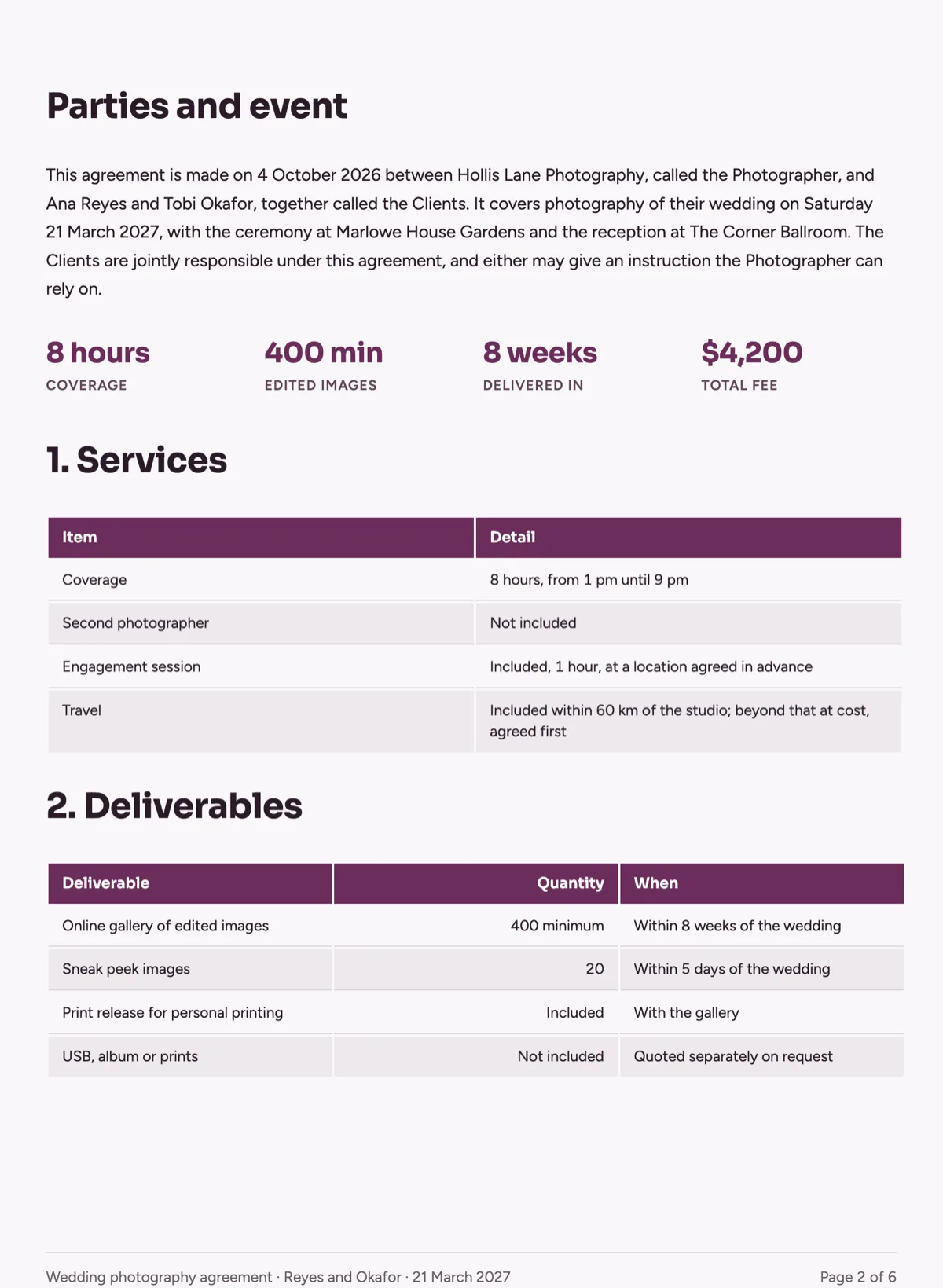 Photography contract template with deliverables you can countA photography contract is mostly a list of numbers: hours, images, weeks, dollars and the date after which the deposit is gone. This one writes every number down, then handles the three things that go wrong with weddings, a postponement, a sick photographer and an argument over who owns the photos.
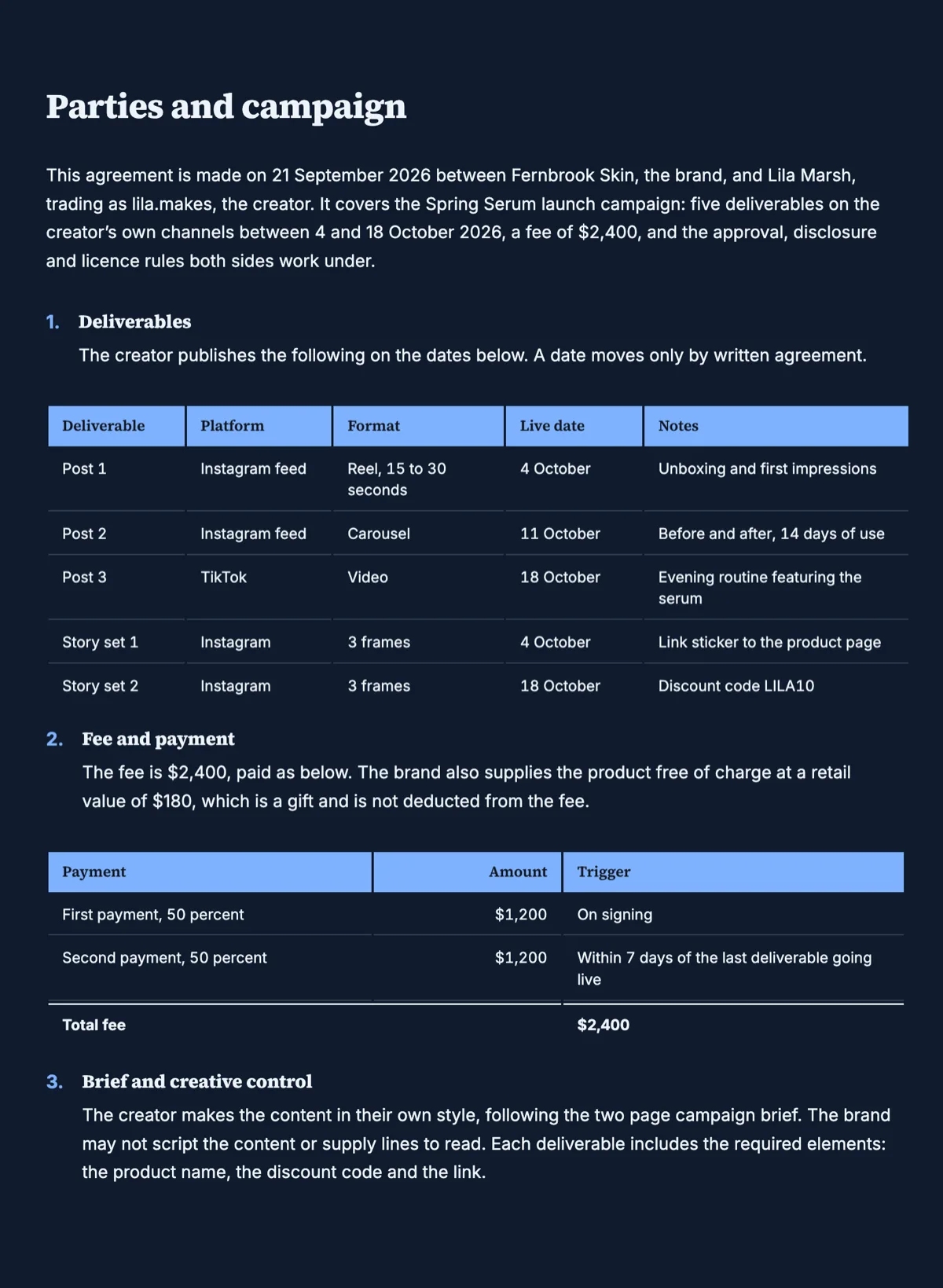 Influencer agreement template with the posts, dates and rights in one tableA creator deal is a schedule of posts and a set of permissions, and the disputes are about the reuse and the disclosure, not the fee. This agreement lists each deliverable with its platform and live date, splits the $2,400 fee across delivery, gives the brand a 12 month licence rather than ownership, and puts the ad label rule in the creator's obligations.
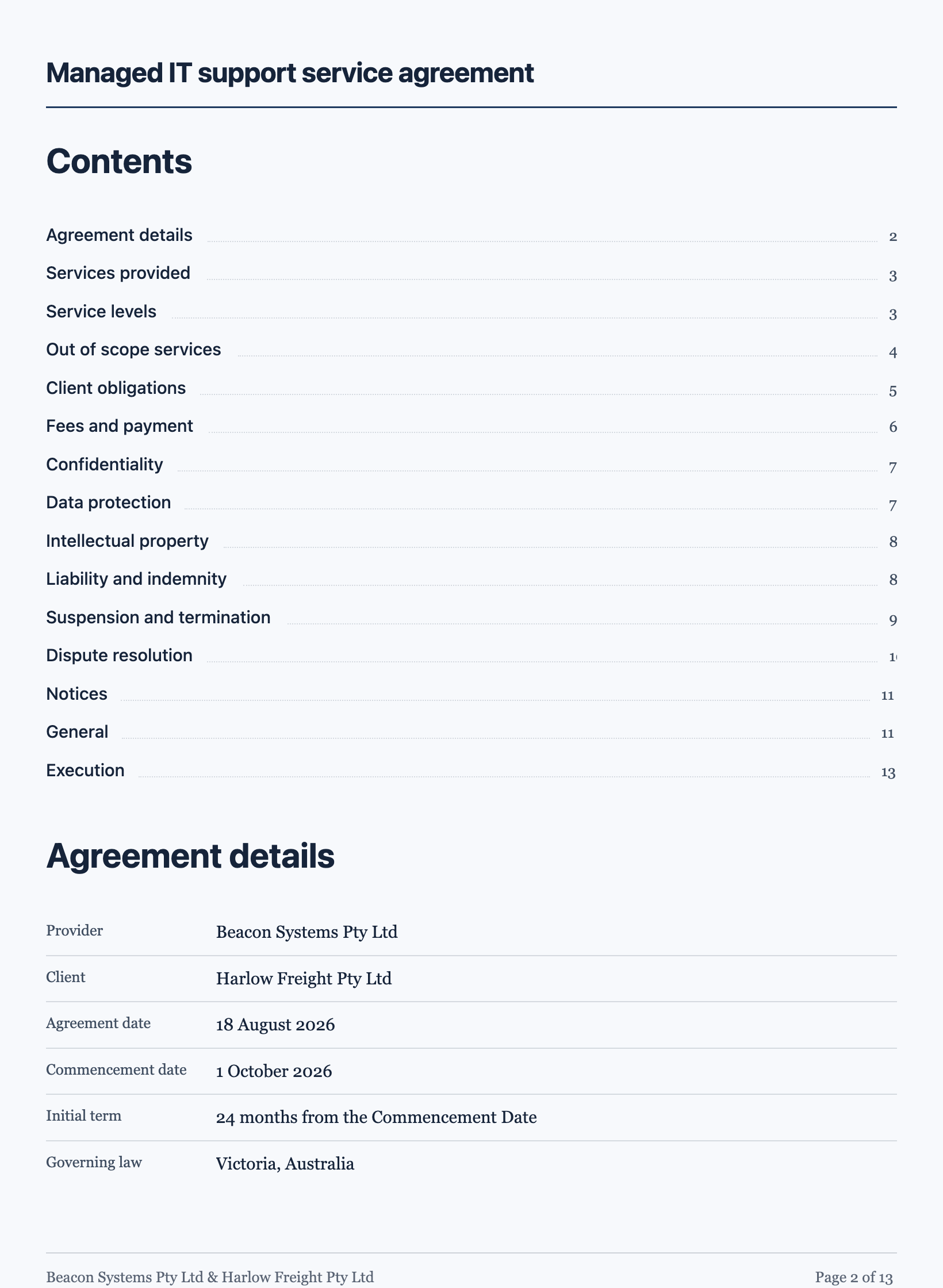 Service agreementBeacon Systems supports Harlow Freight’s IT for an initial 24 months from 1 October 2026 at $8,400 a month plus GST, with 40 hours included and $220 an hour beyond them. Twelve numbered clauses cover the services, a four level severity table, client duties, fees with a CPI adjustment, confidentiality, privacy, IP, a liability cap, termination and a three step dispute ladder.
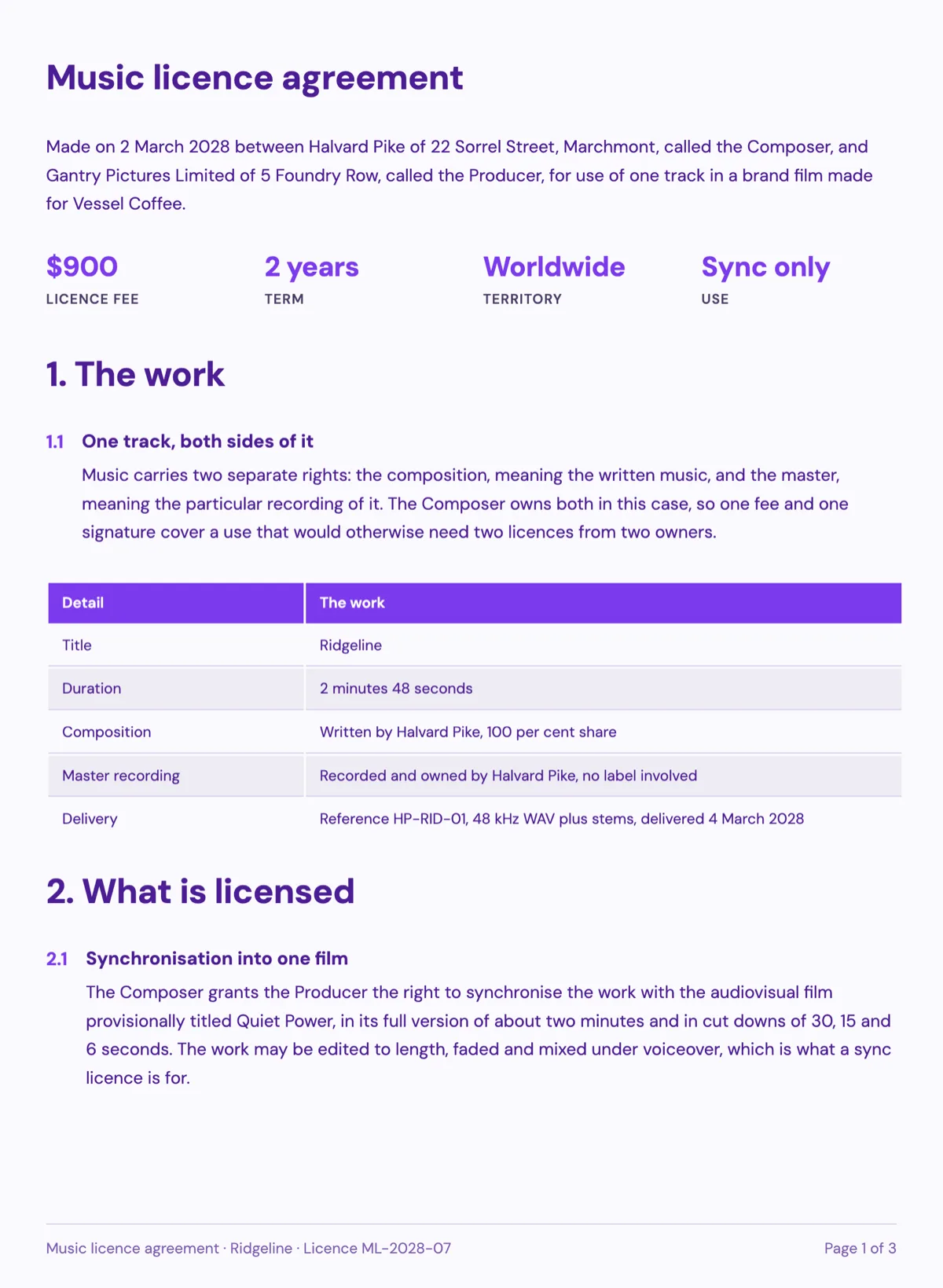 Music licence agreement for sync use, term and creditsMusic carries two rights, the composition and the recording, and a sync licence needs both. This one works because the composer owns both: one fee of $900 covers a single track in a single brand film, worldwide for two years, with paid social at twelve months and broadcast and cinema left off the list.
Questions people ask
What is the difference between a licence and an assignment?
An assignment transfers ownership permanently, and for copyright in Australia it must be in writing signed by the assignor. A licence leaves ownership with the original owner and grants permission on stated terms. A licensee can be given very broad rights, but the owner keeps the right to deal with the work outside whatever the licence covers.
What does exclusive licence mean?
It means nobody else gets the same rights in the same territory for the same uses during the term, including the owner. That is broader than most licensors intend, so many grants use category exclusivity instead: the owner may license the work to anyone except a competitor in a named category. Defining the category carefully is what makes that workable.
Can a licence be sublicensed?
Only if the grant says so. A campaign licence with no sublicensing right cannot be passed to the media agency actually running the work, which makes it unusable. The usual answer is sublicensing limited to named categories, such as agencies, stockists or end users, and only for the permitted uses already granted.
What happens when a licence term ends?
Use has to stop, which raises a practical question about material already published. Most grants require removal from channels the licensee controls, allow archival copies for internal record keeping, and accept that printed material already distributed cannot be recalled. Saying this in the clause avoids a dispute about posters that are still on a wall.
Does a licence survive a sale of the business?
That depends on the transfer term. Many licences are non transferable by default, which means a sale of the business can leave the buyer without rights to material the business depends on. A common compromise allows transfer with a sale of the relevant business or brand, on written notice to the licensor.
What if the contract does not mention a licence at all?
The licensee relies on an implied licence, read as narrowly as the purpose of the engagement requires. That usually means one use in the market the parties had in mind, with no right to modify, sublicense or transfer. It is almost always less than the licensee assumed, and the gap tends to appear at the worst moment.
Put the clause in a finished document
The button opens the document generator with a starting description already filled in. Change it to match your own agreement before you run it.
Create a document with OneCraftRelated clauses
- Intellectual property assignment clauseAn intellectual property assignment clause transfers ownership of created work to the client. Sample wording, assign on payment or creation, and moral rights.
- Background IP clauseA background IP clause separates what each party brought from what was built for the project. Sample software wording, the schedule and the licence back.
- Publicity clauseA publicity clause says whether a supplier can name a client, use its logo or issue a release. Sample agency wording, consent variants and what to negotiate.
For everything the document generator can do, see the document maker.
Step by step in the builder: Create a document with AI, then Document builder components.
Written and checked by the OneCraft team. Last checked .