Contract clause
Intellectual property assignment clause
An intellectual property assignment clause transfers ownership of the rights in work created under the contract from the person who made it to the person who paid for it. Without an assignment the creator usually keeps the copyright, even when the work was commissioned and paid for in full.
Commissioning work and owning it are different things, and the default under Australian copyright law favours the maker rather than the payer. The clause that changes that has to be in writing and signed to have effect.
Indunil Asanka · Co-founder
4 min read · Published
Sample clause
a brand identity contract between Wattle Lane Studio and Saltbush Brewing, a fictional craft brewery in Ballarat
1. Assignment. On receipt by the Studio of payment in full of the Fees, the Studio assigns to the Client all right, title and interest in the copyright and any other intellectual property rights in the Deliverables, including any future copyright in them. 1.1 Until payment in full is received, the Client has a non exclusive licence to use the Deliverables for internal review only. 2. Further Assurance. The Studio must sign any document and do anything else the Client reasonably requires, at the Client's cost, to record or perfect the assignment, including an assignment in registrable form for any registered right. 3. Excluded Materials. This clause does not assign the Studio's Background Materials listed in Schedule 2, which are licensed to the Client under clause 8. 4. Third Party Materials. Where a Deliverable includes stock imagery or a licensed typeface, the Studio must tell the Client before delivery, identify the licence, and must not assign rights it does not own. 5. Moral Rights. The consent given in clause 9 applies to every Deliverable assigned under this clause.
Sample wording, not legal advice.
Variants
Assignment on payment in full
The maker's preferred position, and fair in most commissioned work, because ownership follows the money.
On payment in full of all Fees due under this agreement, the Supplier assigns to the Customer all present and future copyright and other intellectual property rights in the Deliverables. Until that payment is received, the Supplier retains ownership and grants the Customer a revocable, non exclusive licence to use the Deliverables for the purpose of reviewing and approving them only. If this agreement is terminated before payment in full, no assignment takes place and the licence ends on the effective date of termination.
Assignment on creation
The customer's preferred position, common in employment style and long term development arrangements.
All present and future copyright and other intellectual property rights in the Deliverables vest in the Customer immediately on creation, and to the extent they do not, the Supplier assigns them to the Customer on creation. The Supplier must promptly disclose each Deliverable to the Customer and must sign any document the Customer reasonably requires to record or perfect the vesting. The Customer's obligation to pay the Fees is not conditional on the vesting, and non payment does not reverse it.
Exclusive licence instead of assignment
The maker will not part with ownership, often because the work builds on tools it reuses across clients.
The Supplier grants the Customer an exclusive, perpetual, irrevocable, worldwide licence to use, reproduce, modify and distribute the Deliverables for any purpose, with the right to sublicense. The Supplier retains ownership of the Deliverables and must not license them to any third party. The Customer may enforce the licensed rights against a third party infringer, and the Supplier must provide reasonable assistance, at the Customer's cost, including joining any proceedings where its participation is required.
What to negotiate
Whether ownership passes on payment or on creation
Makers want ownership to follow payment, so an unpaid invoice leaves the client using work it does not own. Clients want ownership from the moment of creation, so a dispute cannot strand a project. The usual settlement is assignment on payment in full, paired with a review licence during the project, which gives the client something to work with while the maker keeps its leverage.
What the maker keeps
Studios and developers reuse tools, templates and frameworks across clients, and assigning those away would end that practice. Clients want certainty that nothing they depend on is withheld. The answer is a schedule of background materials, listed at the start rather than asserted at the end, licensed to the client on terms broad enough to run the deliverable without further permission.
Portfolio and case study use
Makers want to show the work. Clients worry about confidential campaigns and unannounced products. Most contracts allow portfolio use after a public launch, sometimes with an embargo period or a requirement to seek approval for a written case study. Writing that down at the start is easier than asking for permission from a client relationship that has since ended.
Third party material inside a deliverable
Nobody can assign rights they do not own, so stock images, fonts and open source components need to be identified and licensed separately. Clients ask for disclosure before delivery and a warranty that the maker has the right to grant what it is granting. Makers ask that the warranty be limited to material they selected, not material the client supplied.
The risk of leaving it out
Without an assignment the maker generally keeps the copyright, so a client that has paid in full may hold only an implied licence to use the work for the purpose it was commissioned for. That becomes a problem the first time the client wants to modify the work, license it onward, use it in a different market, or sell the business that depends on it.
Assignment has to be in writing
Under the Copyright Act 1968 an assignment of copyright does not have effect unless it is in writing signed by or on behalf of the assignor, and the Act also allows future copyright to be assigned before the work exists. Those two rules shape how the clause is drafted. Writing and signature mean an assignment agreed only over email or implied from conduct is at risk, which is why the assignment sits in the signed agreement rather than in a purchase order. Future copyright matters because most commissioned work does not exist when the contract is signed, so the clause has to cover work not yet made rather than only what is in front of the parties.
Employees and contractors are treated differently
Work made by an employee in the course of employment generally belongs to the employer under the Copyright Act 1968, subject to the exceptions in that Act and to anything the employment contract says. Work made by an independent contractor does not, which is the gap that catches most businesses. A company that commissions a logo, a website or a codebase from a contractor and pays for it does not own the copyright unless the contract assigns it. This is why contractor agreements carry an assignment clause and employment contracts usually carry a shorter confirmatory one. Where the same person works in both capacities over time, the safest drafting covers both.
Where it sits in a generated document
The document generator writes an agreement as numbered content, so an assignment clause appears as a numbered section with the trigger, the further assurance obligation and the excluded materials as sub clauses. The generated text is written from the description it is given and it never prints citations, so any statutory reference in a draft has to be checked against the legislation before the document is used. Naming the assignment trigger and the background materials schedule in the description keeps them from being merged into one sentence.
Documents that carry this clause
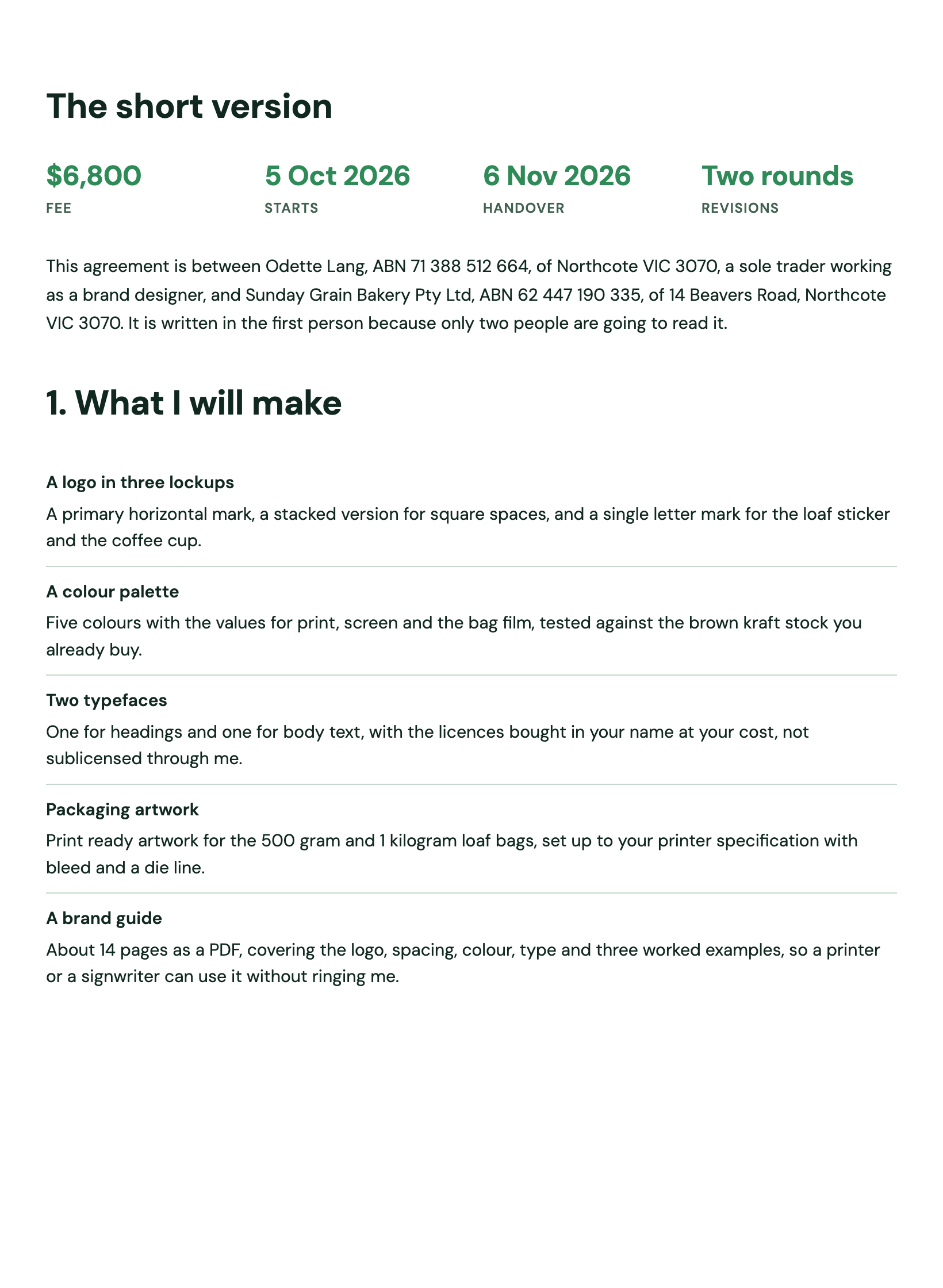 Freelance contractA brand designer and a bakery owner agree five weeks of work in language they can both read. It covers everything a longer contract would, and it never once says party of the first part.
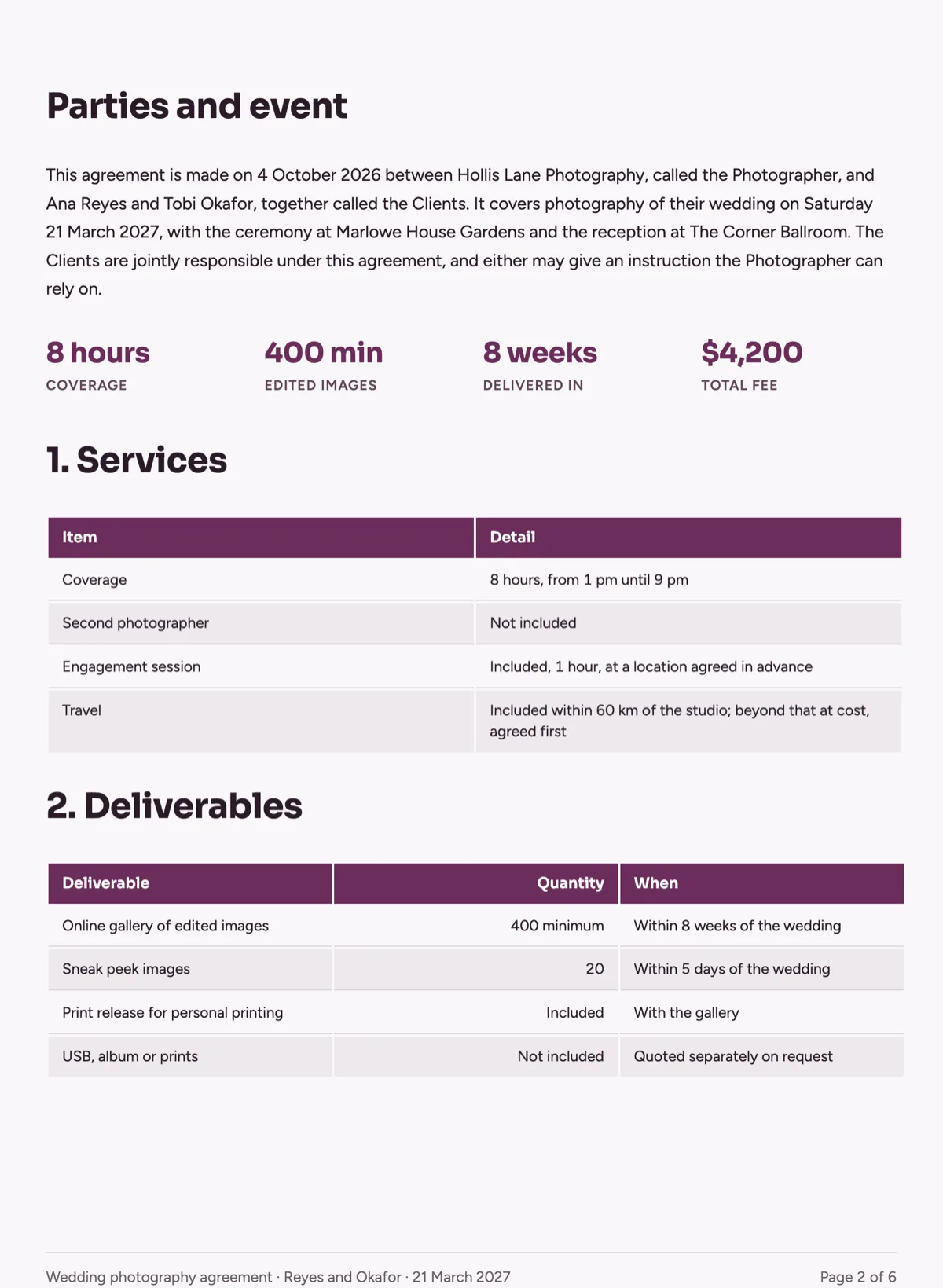 Photography contract template with deliverables you can countA photography contract is mostly a list of numbers: hours, images, weeks, dollars and the date after which the deposit is gone. This one writes every number down, then handles the three things that go wrong with weddings, a postponement, a sick photographer and an argument over who owns the photos.
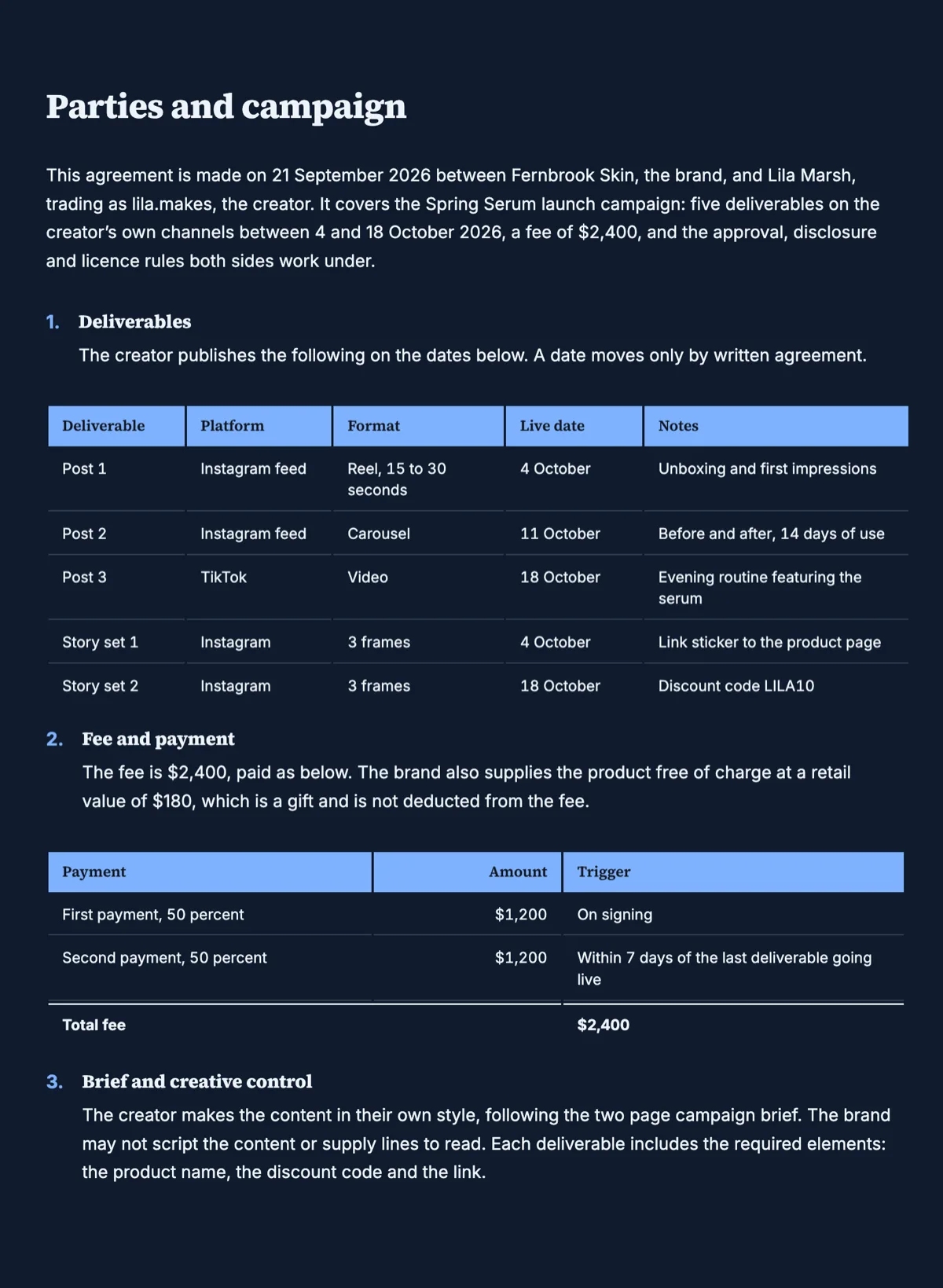 Influencer agreement template with the posts, dates and rights in one tableA creator deal is a schedule of posts and a set of permissions, and the disputes are about the reuse and the disclosure, not the fee. This agreement lists each deliverable with its platform and live date, splits the $2,400 fee across delivery, gives the brand a 12 month licence rather than ownership, and puts the ad label rule in the creator's obligations.
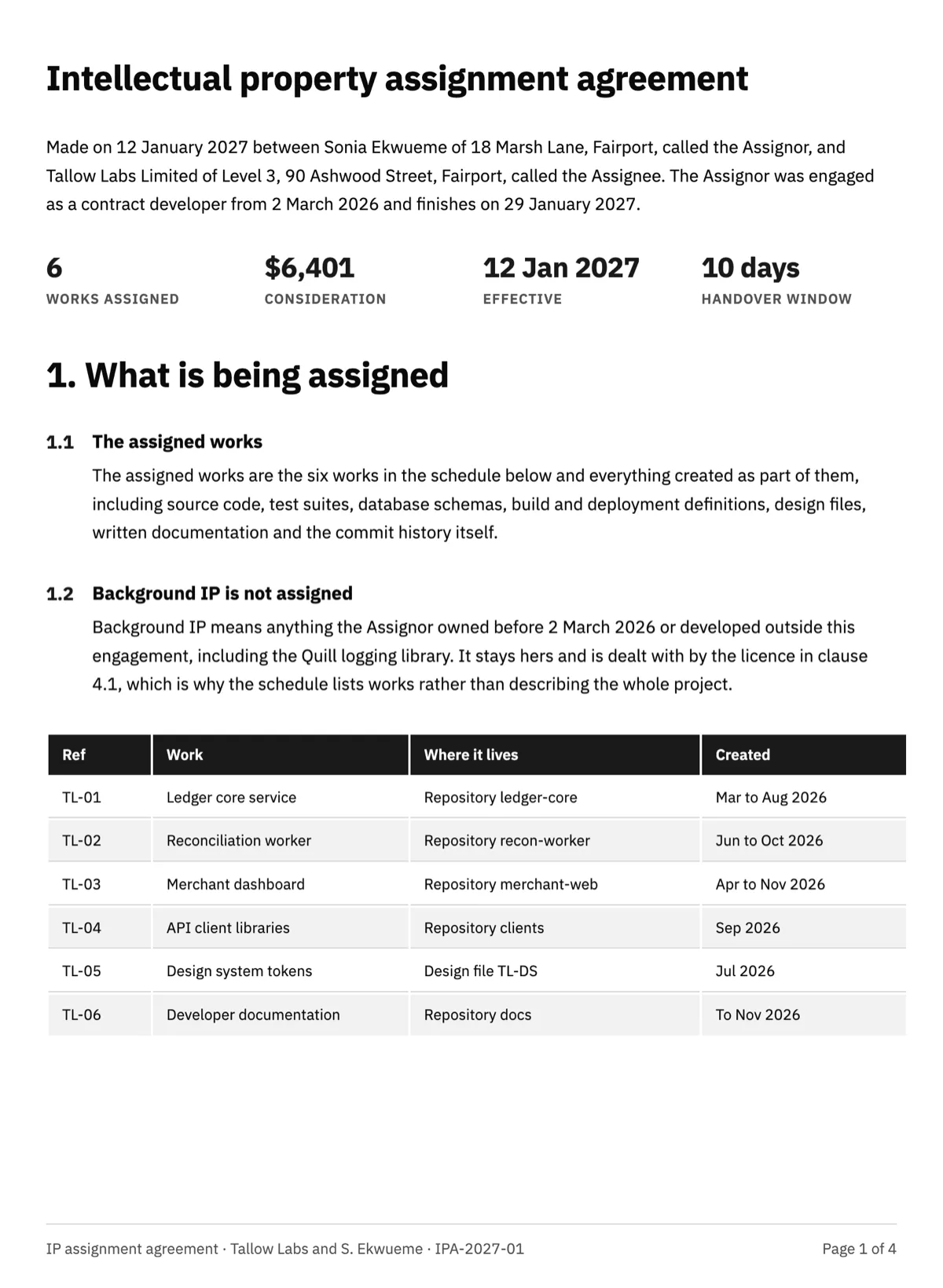 IP assignment agreement template with a schedule and moral rightsAn IP assignment transfers ownership of work that already exists, which is why the schedule matters more than the wording around it. This one moves six named works from a departing contract developer to the startup that paid for them, licenses back her own library, and lists what gets handed over in the ten days after signing.
Questions people ask
Does paying for work mean you own the copyright?
Not by itself. Under Australian copyright law the person who created the work is usually the first owner, and commissioning and paying for it does not transfer ownership. A client who pays in full without an assignment clause typically holds only a licence to use the work for the purpose it was commissioned for, which is narrower than most people expect.
Does an IP assignment have to be in writing?
Yes. The Copyright Act 1968 provides that an assignment of copyright does not have effect unless it is in writing signed by or on behalf of the assignor. That is why the assignment belongs in the signed agreement rather than in an email exchange or a purchase order, and why a further assurance clause is worth adding for registered rights.
Can future work be assigned before it exists?
Yes. The Copyright Act 1968 allows future copyright to be assigned, which is essential for commissioned work, since the deliverables do not exist when the contract is signed. Good clauses say present and future rights expressly, rather than relying on a general assignment that a reader could argue only covers what already existed.
Who owns work made by an employee?
Work made by an employee in the course of employment generally belongs to the employer under the Copyright Act 1968, subject to the exceptions in that Act and to the employment contract. Work made by an independent contractor does not, which is the difference that catches businesses out when they treat a long term contractor as though they were staff.
Should the maker keep anything?
Usually yes, and listing it is better than arguing about it. Studios and developers reuse frameworks, templates and tools across clients, and those are normally kept as background materials and licensed to the client instead of assigned. The list belongs in a schedule agreed at the start, not asserted after delivery.
Does assignment cover moral rights?
No. In Australia moral rights belong to the individual creator and cannot be assigned. They can be dealt with through a written consent to acts that would otherwise infringe them, which is why assignment clauses in Australian contracts usually sit next to a separate moral rights consent covering attribution and changes to the work.
Put the clause in a finished document
The button opens the document generator with a starting description already filled in. Change it to match your own agreement before you run it.
Create a document with OneCraftRelated clauses
- Moral rights consent clauseIn Australia moral rights cannot be assigned, only consented to. Sample consent wording for a copywriter, the three rights, and the UK waiver and US position.
- Background IP clauseA background IP clause separates what each party brought from what was built for the project. Sample software wording, the schedule and the licence back.
- Licence grant clauseA licence grant clause gives permission to use intellectual property without owning it. Sample photo licence wording and the six terms every grant settles.
- Work made for hire clauseA work made for hire clause makes the commissioning party the author under US law. Sample wording, the nine statutory categories, and the assignment fallback.
For everything the document generator can do, see the document maker.
Step by step in the builder: Create a document with AI, then Document builder components.
Written and checked by the OneCraft team. Last checked .