Contract clause
Background IP clause
A background intellectual property clause separates what each party already owned from what is created under the contract. The maker keeps its existing tools and frameworks, the client receives what was built for it, and a licence covers the parts of the background that the new work depends on.
Almost nothing is built from nothing. A development team brings libraries, a studio brings templates, and a consultant brings models, so an assignment clause with no background carve out promises something the maker cannot deliver.
Indunil Asanka · Co-founder
4 min read · Published
Sample clause
a software development agreement between Bluegum Software and Marlow Logistics, a fictional freight business in Brisbane
1. Definitions. Background IP means intellectual property owned or licensed by a party before the Commencement Date, or developed by it outside this agreement, including the items listed in Schedule 3. Project IP means intellectual property created by the Developer under this agreement for the Client. 2. Ownership. Each party retains ownership of its Background IP. Nothing in this agreement transfers Background IP. 3. Project IP. The Developer assigns the Project IP to the Client on payment in full of the Fees. 4. Licence of Background IP. The Developer grants the Client a perpetual, irrevocable, worldwide, non exclusive licence to use, reproduce and modify the Developer's Background IP to the extent it is embedded in or required to operate the Project IP, with the right to sublicense to a supplier operating the system on the Client's behalf. 5. Additions to the Schedule. The Developer may add an item to Schedule 3 only with the Client's written agreement before the item is used in the Project IP.
Sample wording, not legal advice.
Variants
Listed schedule, closed
The client wants certainty and will not accept a category that can expand after delivery.
Background IP means only the items listed in Schedule 3 as at the Commencement Date. Any material incorporated into the Project IP that is not listed in Schedule 3 forms part of the Project IP and is assigned to the Client under clause 3. The Developer may propose an addition to Schedule 3 at any time, and the addition takes effect only if the Client agrees in writing before the material is used. The Developer warrants that Schedule 3 is complete and accurate at the Commencement Date.
Broad definition with a licence back
The maker reuses a large toolkit and cannot list every component, so the client is protected by the breadth of the licence instead.
Background IP means any intellectual property owned or licensed by a party before the Commencement Date or developed independently of this agreement. The Developer grants the Client a perpetual, irrevocable, worldwide, royalty free, non exclusive and sublicensable licence to use, reproduce, modify and maintain the Developer's Background IP to the extent it is embedded in, or reasonably required to use, maintain or extend, the Project IP. The licence survives termination for any reason, including termination for the Client's breach.
No licence back, escrow instead
The maker will not license its framework, and the client needs continuity if the maker stops trading.
The Developer retains its Background IP and grants no licence over it beyond the right to use the Project IP as delivered. The Developer must deposit the source code and build instructions for the Background IP embedded in the Project IP with an escrow agent within 20 business days of each release. The escrow agreement must permit release to the Client if the Developer enters liquidation, ceases to support the Project IP, or fails to remedy a material breach of this agreement within 30 days of notice.
What to negotiate
Who writes the schedule and when
A schedule drafted before work starts is a negotiation; the same schedule produced after delivery is an assertion. Clients should require it at signing and should treat late additions as needing written approval. Makers benefit too, because a list agreed up front protects tools they genuinely need to keep, without an argument about whether they were always background.
How broad the licence back has to be
The client's test is simple: can it run, maintain and extend the deliverable without coming back for permission. That usually needs a perpetual, irrevocable, worldwide licence with the right to modify and to sublicense to whoever operates the system. Makers resist the right to modify, which is where most of the negotiation happens, and often concede it limited to the delivered system.
Whether the licence survives termination for breach
A licence that ends when the client breaches leaves the client with a system it cannot lawfully run. Makers want that leverage; clients point out that it turns a payment dispute into an operational outage. The common settlement is a licence that survives termination for any reason, with unpaid amounts pursued as a debt rather than by switching the system off.
Open source components
Open source inside a deliverable is neither party's background and carries its own licence conditions. Clients want disclosure of every component and its licence before delivery, and a warranty that nothing has been included on terms that would affect the client's own code. Makers ask that the warranty exclude components the client directed them to use.
The risk of leaving it out
Without the clause the contract either promises the client ownership of material the maker cannot lawfully assign, or leaves the client owning a deliverable it cannot operate without components nobody licensed to it. Both problems surface at the same moment, usually when the client asks a second supplier to maintain the work.
Why an assignment alone is not enough
An assignment clause that transfers everything created under the agreement reads cleanly and is often impossible to honour. A development team's deliverable includes its own libraries, a studio's artwork uses its own brushes and templates, and a consultant's report runs on a model built over years of other engagements. Assigning those away either does not happen, because the maker never owned the right to assign them in that way, or happens accidentally and destroys the maker's business. The background clause fixes both outcomes by naming the boundary and then licensing across it, so the client gets something it can use and the maker keeps what it needs for the next project.
The schedule is the whole clause
Background IP is defined by a list far more often than by a definition, and the quality of that list decides whether the clause works. A schedule written at signing, naming specific components rather than categories, gives the client a way to check what it is not getting. A schedule that says the Developer's proprietary tools and methodologies gives it nothing, because the same words cover anything the maker later wants to keep. Clients should also require that additions be approved in writing before the material is used, otherwise a component can become background simply by being included in a delivery.
Where it sits in a generated document
The document generator writes an agreement as numbered content, so the definitions, the ownership statement and the licence back each become their own numbered provision, with the background list referred to as a schedule. The generated text is written from the description it is given and it never prints citations, so any component name or licence scope in a draft has to be checked before the document is used. Describing the licence back in the same sentence as the assignment keeps the two clauses consistent.
Documents that carry this clause
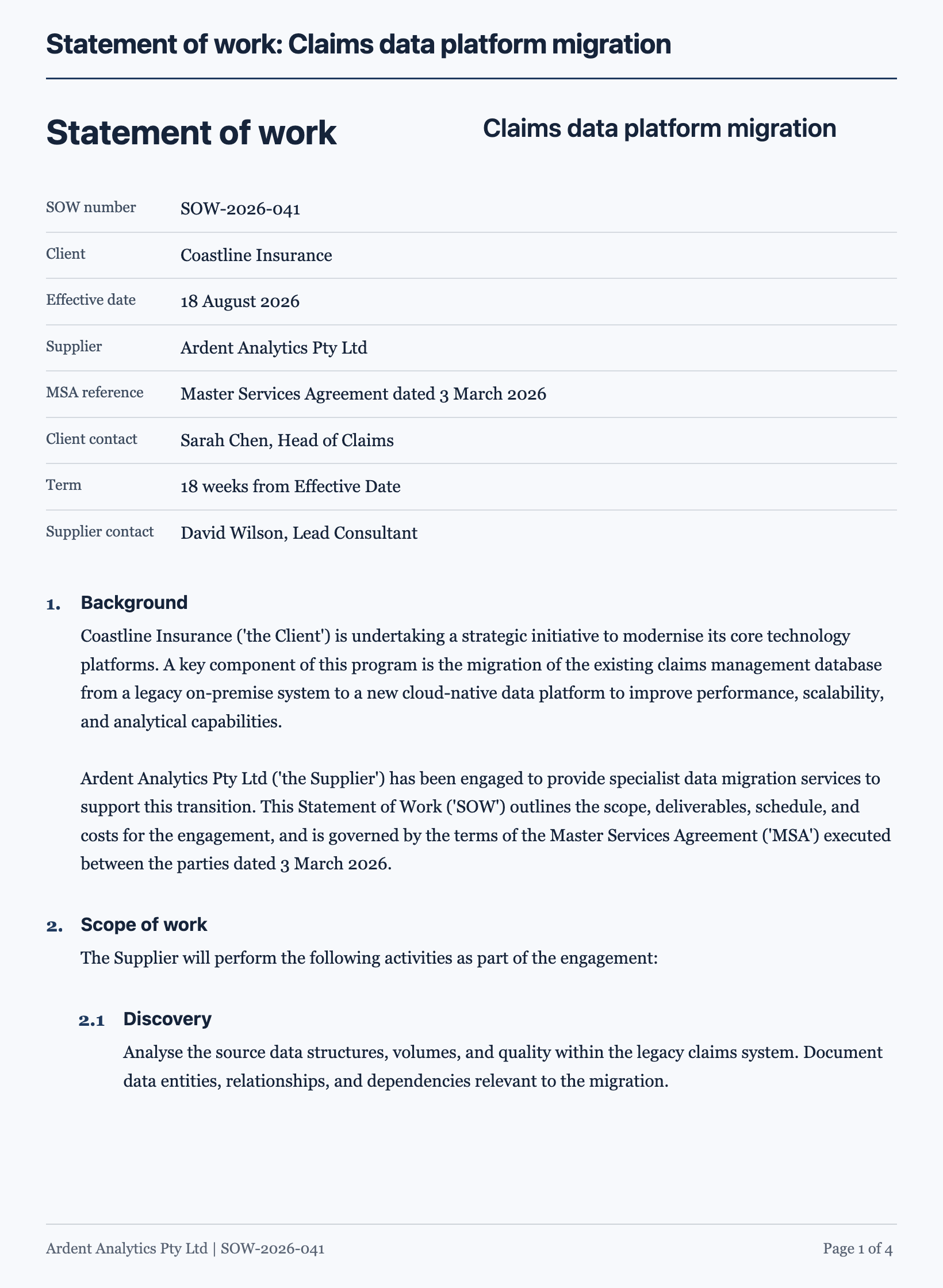 Statement of work template under a master agreementArdent Analytics migrates Coastline Insurance’s claims database to a cloud platform over 18 weeks under SOW-2026-041, governed by a master services agreement dated 3 March 2026. The work is time and materials with four roles priced by the day and a $412,000 estimate before GST, five dated deliverables, ten business days to accept each one, and five assumptions written down before anyone starts.
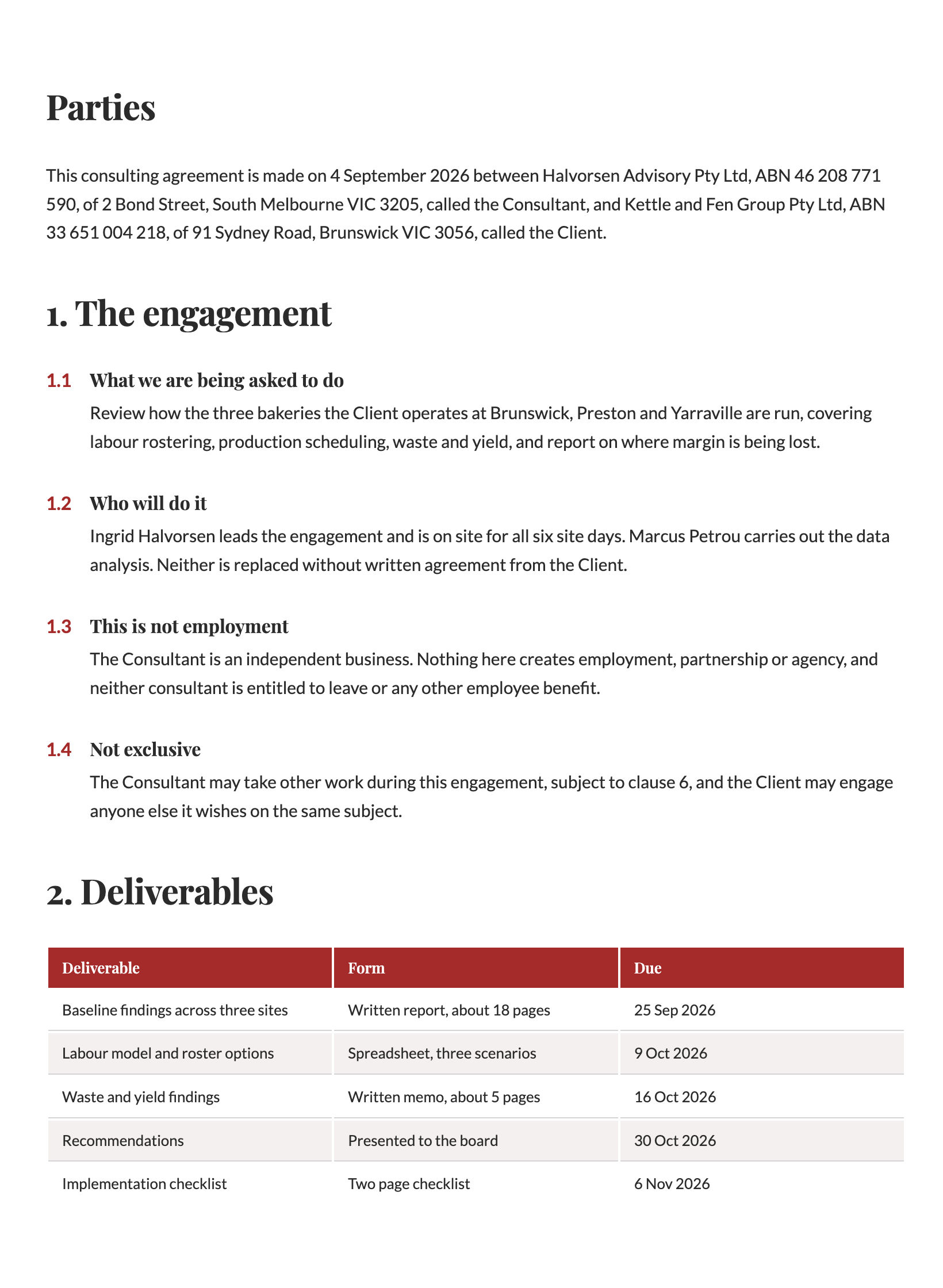 Consulting agreementAn advisory firm reviews three bakeries over seven weeks. What makes this agreement useful is not the fee clause but the two clauses that say what the advice is not.
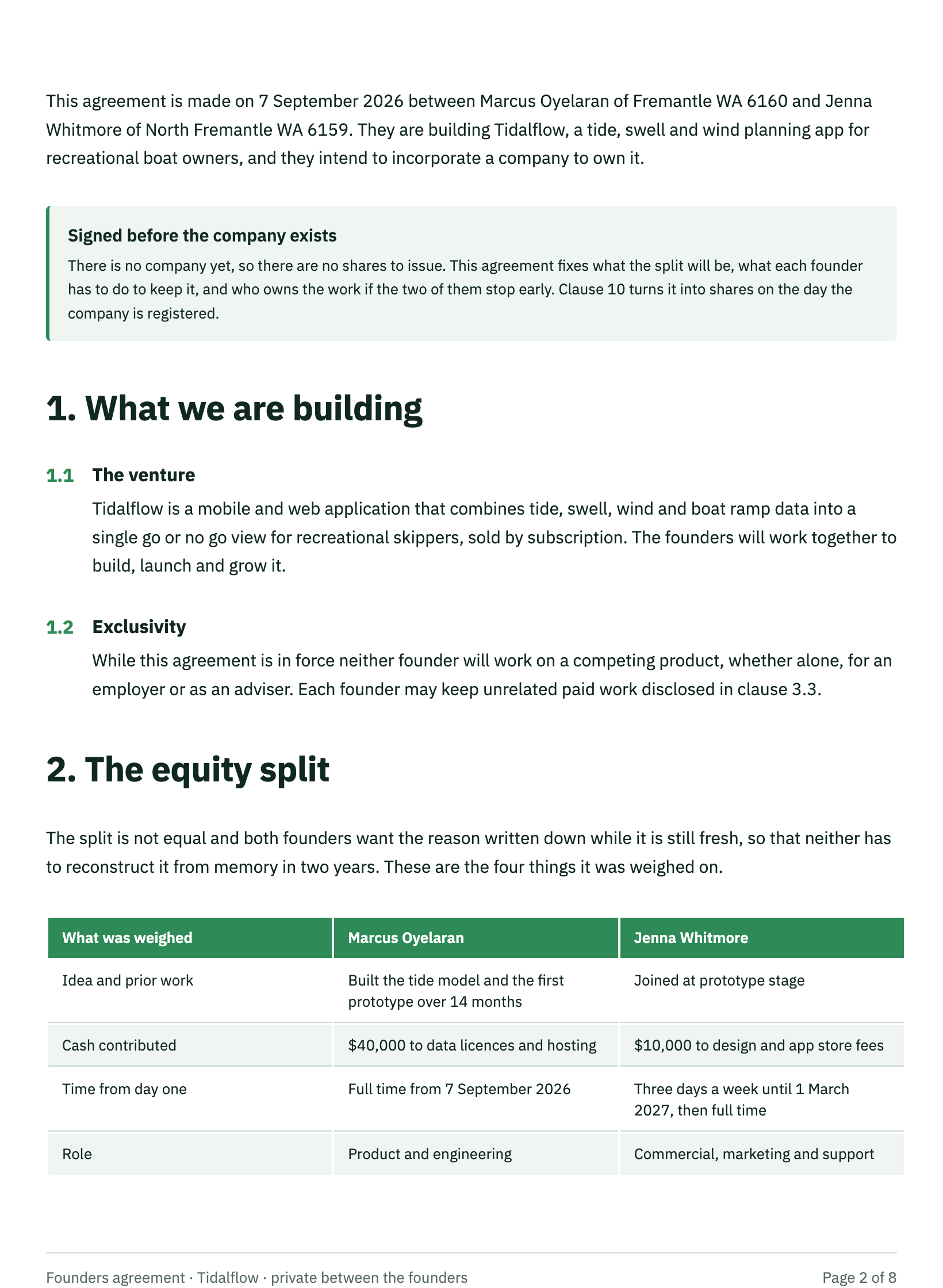 Founders agreement templateTwo people in Fremantle are building a tide and swell planning app and have not registered a company yet. There are no shares to issue, so this agreement fixes the split, records why it is 55/45 while the memory is fresh, and turns itself into shares on the day the company exists.
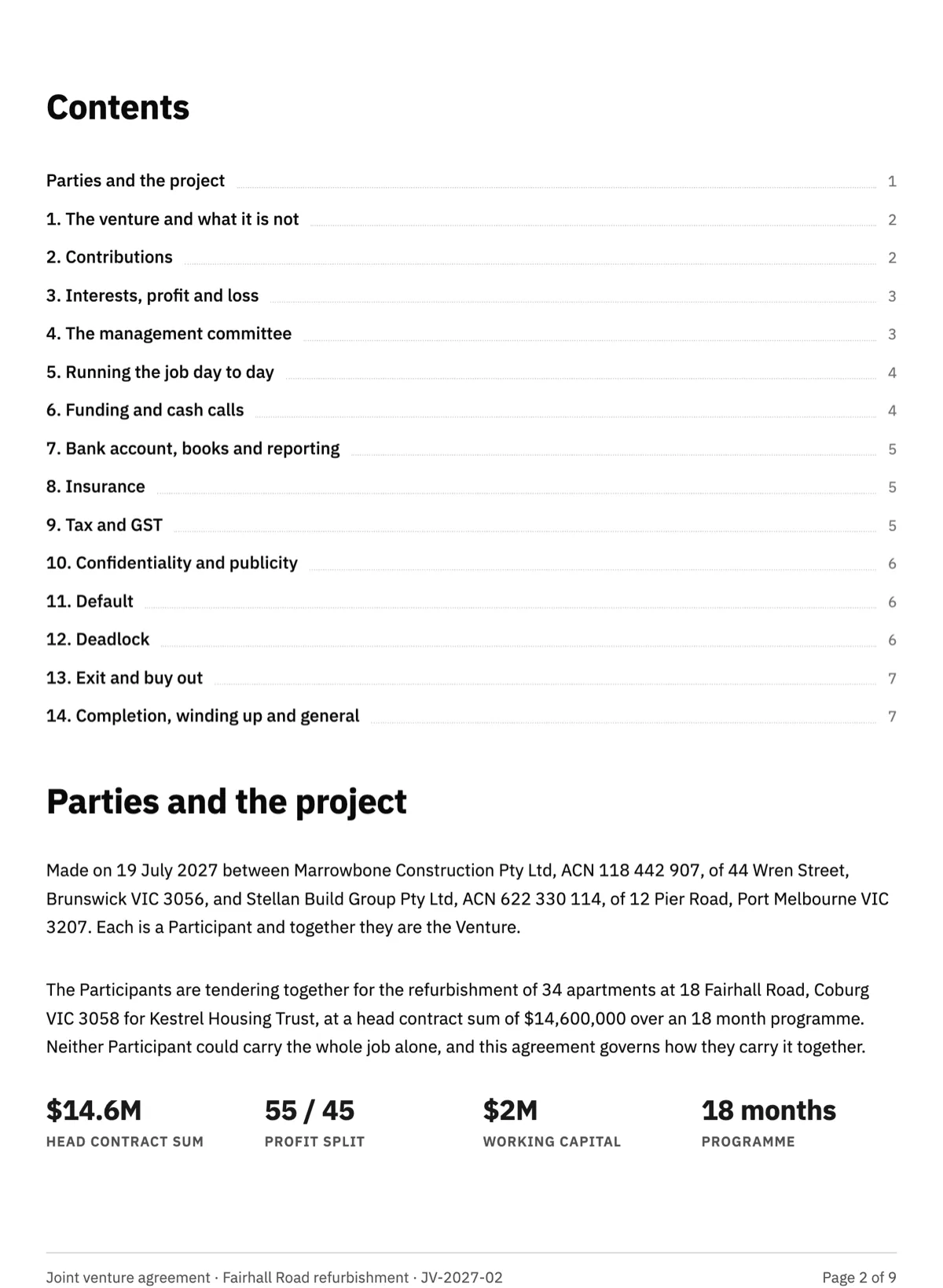 Joint venture agreement template with contributions and splitAn unincorporated joint venture has no company to fall back on, so everything a company structure would supply has to be written down. This one puts two builders together for a single $14.6 million refurbishment, splits it 55/45, and sets out who funds it, who decides, how a deadlock breaks and how either of them gets out.
Questions people ask
What is background IP?
It is intellectual property a party already owned before the contract started, or developed independently of it, such as a developer's libraries, a studio's templates or a consultant's models. Foreground or project IP is what gets created under the contract. Separating the two is what lets an assignment clause work without stripping the maker of its own tools.
Should background IP be listed in a schedule?
Yes, and the list should be agreed at signing rather than produced at delivery. A schedule naming specific components lets the client check what it is not receiving. A schedule describing proprietary tools and methodologies is not a list at all, because the same phrase can later cover anything the maker decides it wants to keep.
What licence does the client need over background IP?
Enough to run, maintain and extend the deliverable without asking again. In practice that means a perpetual, irrevocable, worldwide, non exclusive licence including the right to modify and to sublicense to whoever operates the system. Anything narrower can leave the client unable to hand the work to a different supplier later.
Should the licence survive termination for the client's breach?
Clients should push hard for it. A licence that ends on breach means a payment dispute can switch off a live system, which is a disproportionate remedy. The usual settlement is a licence that survives termination for any reason, with unpaid fees pursued as a debt rather than by withdrawing the right to operate the deliverable.
How is open source handled?
Separately, because it is neither party's background and carries its own conditions. Clients normally require a list of components and their licences before delivery, plus a warranty that nothing has been included on terms that would affect the client's own code. Makers usually ask that the warranty exclude anything the client directed them to use.
Can background IP be added during the project?
It should only be added with written agreement before the material is used. Without that control, a component can become background simply by appearing in a delivery, which moves the boundary after the client has already paid. Requiring prior approval keeps the schedule meaningful for the life of the engagement.
Put the clause in a finished document
The button opens the document generator with a starting description already filled in. Change it to match your own agreement before you run it.
Create a document with OneCraftRelated clauses
- Intellectual property assignment clauseAn intellectual property assignment clause transfers ownership of created work to the client. Sample wording, assign on payment or creation, and moral rights.
- Licence grant clauseA licence grant clause gives permission to use intellectual property without owning it. Sample photo licence wording and the six terms every grant settles.
- Trade secrets clauseA trade secrets clause protects know how that has value because it is secret. Sample wording for a recipe and supplier list, perpetual terms and the US notice.
For everything the document generator can do, see the document maker.
Step by step in the builder: Create a document with AI, then Document builder components.
Written and checked by the OneCraft team. Last checked .