Contract clause
Overtime clause: paid, time off or built into salary
An overtime clause sets out whether work beyond ordinary hours is paid at overtime rates, compensated with time off, or covered by a salary. In Australia it operates on top of the National Employment Standards limit on weekly hours and any modern award, so it can add to award overtime but cannot remove it.
A salary that covers reasonable additional hours sounds tidy until a busy quarter pushes those hours past what the award would have paid for. The overtime clause is where that gap is either measured and paid or quietly left to grow.
Indunil Asanka · Co-founder
4 min read · Published
Sample clause
an employment contract between Numbat Civil, a fictional civil contractor in Bunbury, and a site engineer covered by a modern award and paid an annual salary
5. Hours and Overtime 5.1 The Employee's ordinary hours are 38 hours a week, worked between 6.30 am and 6.00 pm, Monday to Friday. 5.2 The Employee may be asked to work reasonable additional hours, and may refuse additional hours that are unreasonable. 5.3 The salary in clause 6 is paid in satisfaction of the minimum rates, overtime, penalty rates and allowances under the applicable award for up to 6 additional hours a week, averaged over each quarter. 5.4 The Employee must record start and finish times each day in Numbat Civil's timesheet system. 5.5 Within 30 days after each anniversary of the start date, and when employment ends, Numbat Civil will compare the salary paid with the amount the award would have required for the hours recorded, and will pay any shortfall within 14 days. 5.6 Hours above the limit in clause 5.3 are paid at the overtime rates in the award in the next pay cycle.
Sample wording, not legal advice.
Variants
Paid at award overtime rates
Hourly employees and anyone whose work regularly runs past rostered hours, where simplicity and transparency matter most.
The Employee's ordinary hours are those set out in Schedule 1. Any work the Employer requests or approves outside those ordinary hours, or beyond the daily or weekly maximum ordinary hours in the applicable award, is overtime and is paid at the overtime rates in that award. The Employee must record overtime on the timesheet for the pay period in which it is worked.
Time off instead of overtime pay
Employees who prefer flexibility, under an award or agreement that permits time off in lieu.
Where the applicable award or agreement allows it, the Employee may elect in writing, for each occasion, to take paid time off instead of being paid for overtime worked. The time off is calculated and taken in accordance with that award or agreement. Any time off not taken within the period the award or agreement specifies, or by the end of employment, is paid at the overtime rate that applied when the work was done.
Included in salary for an award free role
Senior roles not covered by an award or agreement, where the salary is intended to reward the job rather than the hours.
The Employee is not covered by a modern award or enterprise agreement. The salary compensates the Employee for all hours worked, including reasonable additional hours, and no separate overtime is payable. Additional hours must be reasonable having regard to the Employee's circumstances, the needs of the business and the notice given, and the Employee may refuse hours that are unreasonable.
What to negotiate
Which award and classification apply
Employers sometimes assume a salaried role is award free when it is not. Employees benefit from asking the employer to name the award and classification in the contract, because that decides whether overtime rates, time off or a reconciliation apply at all. Naming it also protects the employer from an underpayment it did not intend.
How many additional hours the salary absorbs
A clause saying the salary covers all hours worked has no ceiling. Employees ask for a stated weekly limit, averaged over a sensible period, with hours above it paid separately. Employers usually agree when the limit reflects the real workload, since it also sets expectations.
When the reconciliation happens
An annual comparison against the award is the minimum under many award arrangements, and employment ending triggers one too. Employees in busy seasonal roles sometimes ask for quarterly checks so a shortfall is caught early. Employers weigh the extra administration against the risk of a large back payment.
The risk of leaving it out
Without an overtime clause the award still applies where it covers the role, so overtime may be payable whether or not the contract mentions it. A salaried employee with no set off wording can end up owed overtime on top of the salary, and the employer has no agreed record or reconciliation to show that the salary already covered it.
Award coverage decides most of the answer
Overtime is work outside the ordinary hours in an award, enterprise agreement or employment contract, including work beyond daily or weekly ordinary hours or outside the spread of hours. The award or agreement sets when overtime rates apply, and some let an employee take time off instead of overtime pay. Separately, the National Employment Standards cap weekly hours at 38 for a full time employee plus reasonable additional hours, and an employee may refuse additional hours that are unreasonable. Time and wages records must be kept for 7 years, so the timesheet obligation in an overtime clause is the employer's own evidence when a question arises.
Salaries that cover overtime
There are two ways a salary can cover award overtime. Some awards contain an annualised wage arrangement with its own rules: the annualised wage must not be less than the employee would have received under the award over the year, it is reviewed every 12 months or when employment ends, outer limits cap the overtime and penalty hours it covers, and any shortfall is paid. Other employers rely on a contractual offsetting arrangement, where the contract says the salary is paid in satisfaction of award entitlements. Either way, the salary has to be tested against the hours actually worked, which is why the reconciliation and the records are the heart of the clause.
Where it sits in a generated document
A generated employment contract puts overtime inside the hours of work clause, ahead of pay, so the salary clause can refer back to it by number. Ordinary hours, the absorbed hours limit and the reconciliation deadline are written as content that can be edited as text. Naming the award and classification in the description matters, because the generated text is written from the description it is given and prints no citations.
Documents that carry this clause
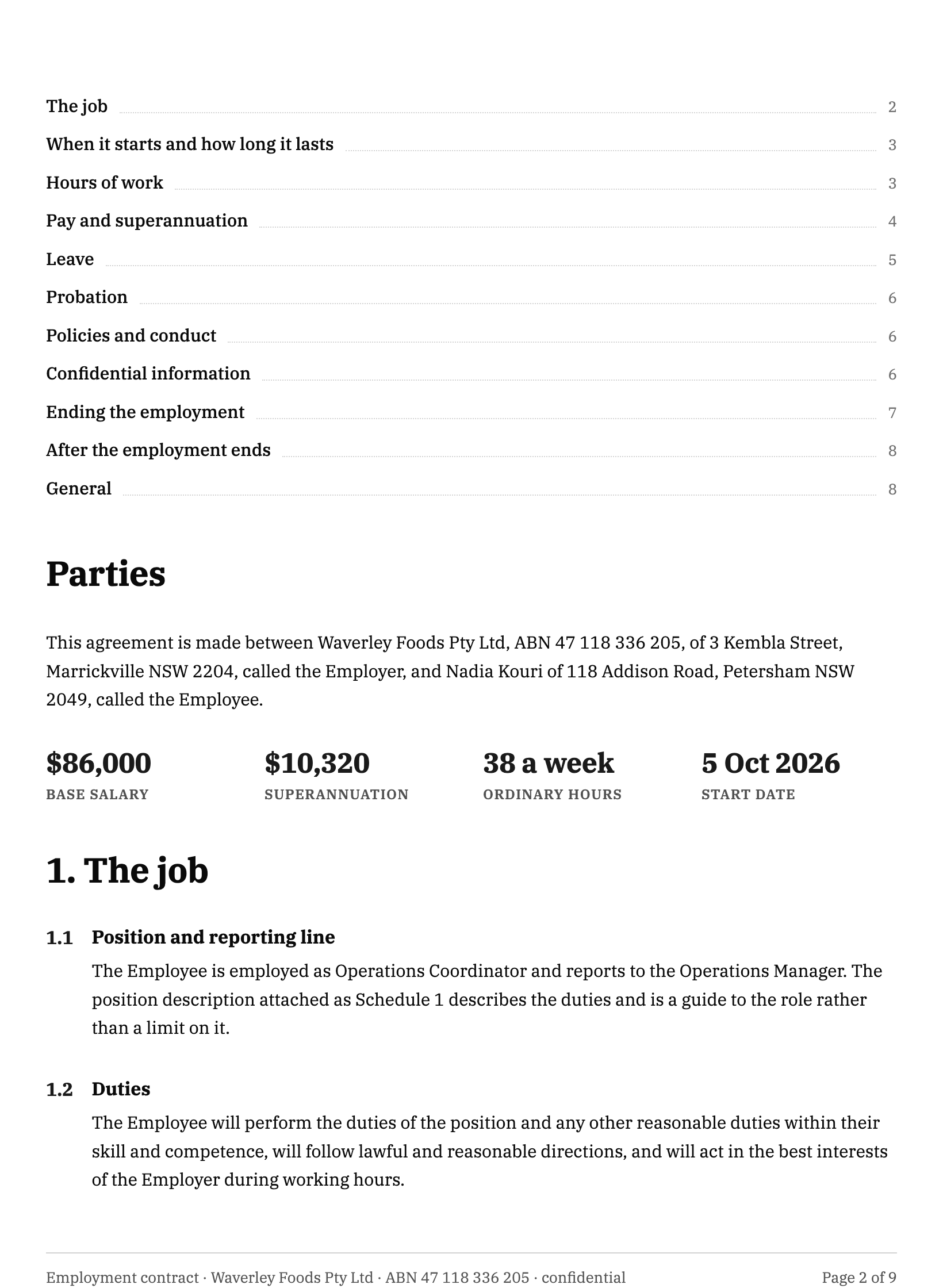 Employment contractA full time ongoing contract for an operations coordinator on $86,000 plus $10,320 of superannuation. Eleven numbered clauses, a leave table drawn from the National Employment Standards, and a notice table that scales with service.
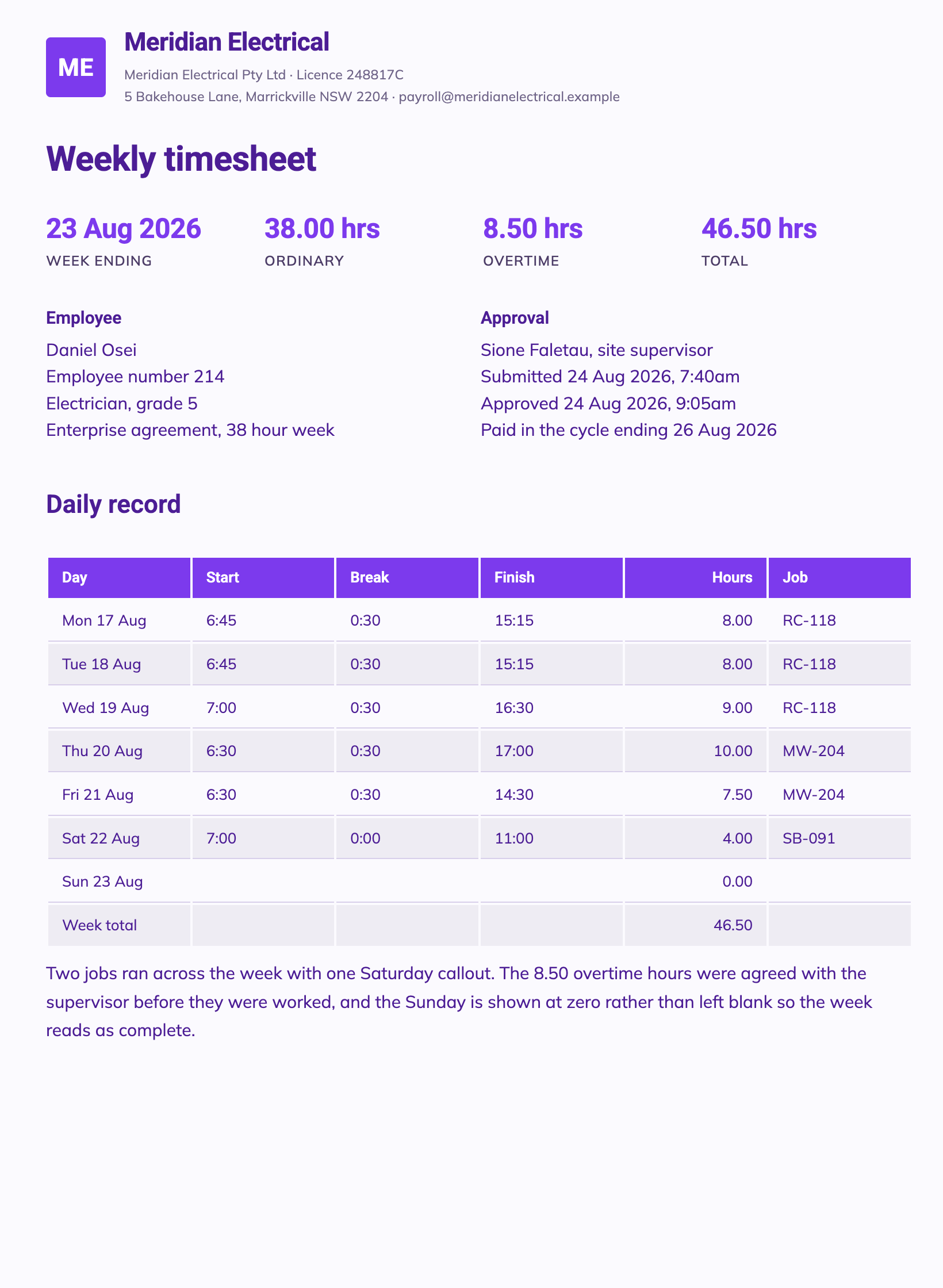 Weekly timesheetAn electrician records a week across two jobs and a Saturday callout. The same 46.50 hours are counted twice, once for the pay run and once for the customers, and the sheet only works if both agree.
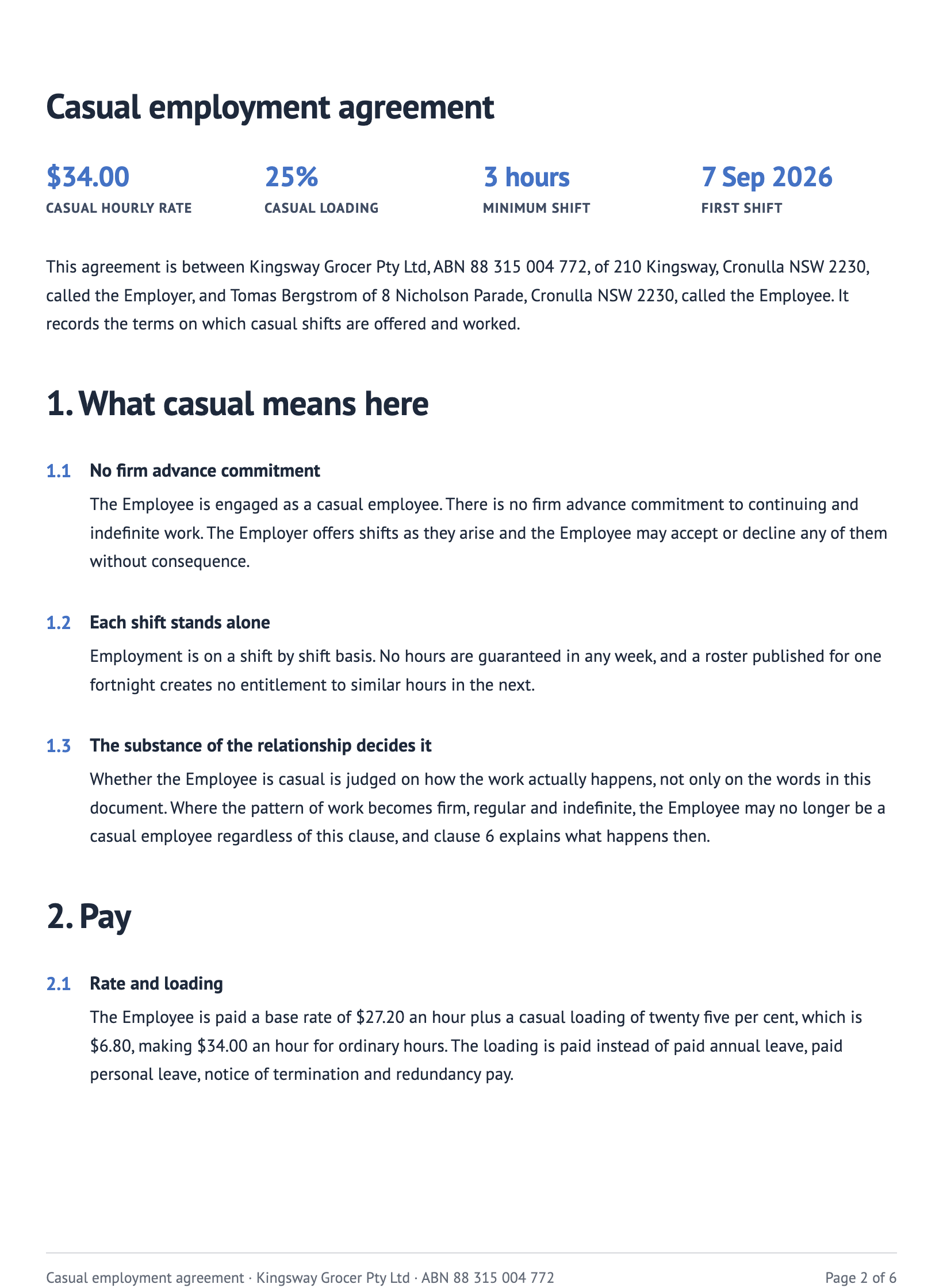 Casual employment agreementA retail assistant is paid $34.00 an hour, which is a base of $27.20 plus a twenty five per cent loading. The agreement shows how every other rate is built from that base, and what the loading is paid instead of.
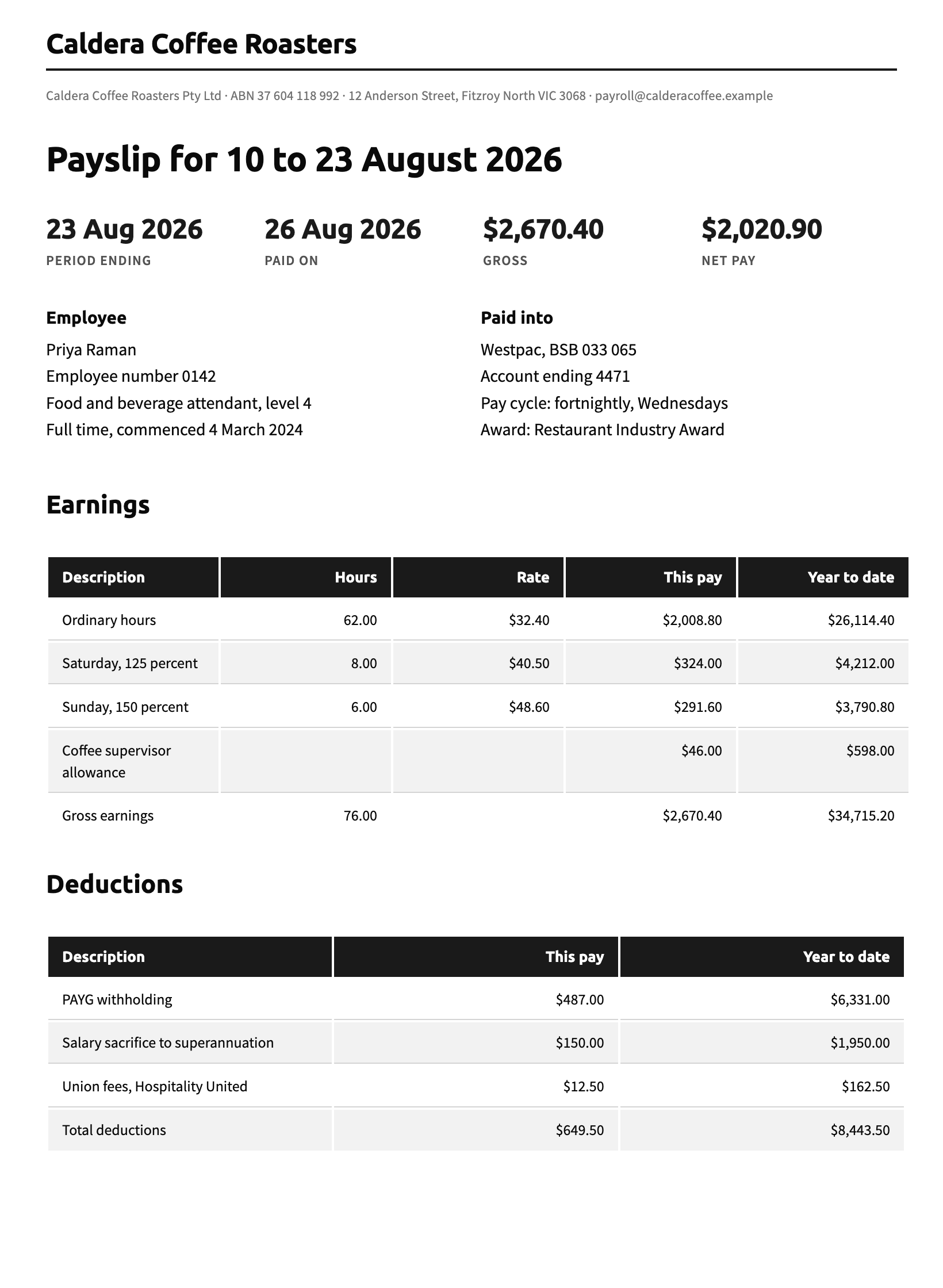 PayslipOne fortnight for a cafe supervisor paid by the hour, with weekend rates, a union deduction and a salary sacrifice. Half of a payslip is legally required; the other half is what stops the questions.
Questions people ask
Does a salaried employee get paid overtime?
It depends on coverage and wording. If an award or agreement covers the role, overtime entitlements still apply unless an annualised wage arrangement or a valid offsetting clause covers them and the salary is enough over the year. An award free employee's salary can include all reasonable hours, provided it meets the minimum wage and standards.
What are reasonable additional hours?
The National Employment Standards allow an employer to request or require hours beyond 38 a week for a full time employee only if they are reasonable. The matters that must be considered include any risk to health and safety, the employee's personal circumstances and family responsibilities, the needs of the workplace, and whether the pay compensates for additional hours.
Can an employer give time off instead of overtime pay?
Where an award or registered agreement applies, only if it allows time off instead of overtime pay, and then on the terms it sets out. The Fair Work Ombudsman calls this time off in lieu. For an award free employee the contract itself decides how additional hours are compensated, within the minimum wage and the National Employment Standards.
What is an annualised wage arrangement?
It is a mechanism in some modern awards that lets an employer pay a fixed annual amount covering entitlements such as overtime, penalties and allowances. The award sets rules, including outer limits on the hours covered, a review at least every 12 months or when employment ends, and payment of any shortfall.
How long must overtime records be kept?
Time and wages records must be kept for 7 years, be readily accessible to a Fair Work Inspector and be legible in English. Recording actual start and finish times is what lets an employer show a salary covered the hours worked, and awards with annualised wage arrangements can require those times to be recorded for each pay period or roster cycle.
Does a contractor get overtime?
Overtime entitlements under awards and the National Employment Standards belong to employees. A genuine independent contractor is paid whatever the contract says for the result or the time. If the arrangement is really employment under the whole of relationship test, the worker may be entitled to the overtime an employee would have received.
Put the clause in a finished document
The button opens the document generator with a starting description already filled in. Change it to match your own agreement before you run it.
Create a document with OneCraftRelated clauses
- Independent contractor clause and the test behind itAn independent contractor clause states the worker is not an employee. Australian sample wording, the whole of relationship test factors, UK and US notes.
- Records clause: what to keep and for how longA records clause sets what a party must record under a contract and how long it keeps it. Australian sample with a 7 year period, statutory minimums, variants.
- Probation period clause in an employment contractA probation period clause sets a trial period, a review and the notice during it. Australian sample wording, extension rules and the minimum employment period.
For everything the document generator can do, see the document maker.
Step by step in the builder: Create a document with AI, then Send a document for signature.
Written and checked by the OneCraft team. Last checked .