Contract clause
Records clause: what to keep and for how long
A records clause requires a party to keep specified records about its performance of a contract, such as invoices, timesheets, payments and compliance documents, in a stated form for a stated period. It exists so that fees, entitlements and obligations can be checked later, often long after the work itself has finished.
Disputes about money are usually decided by whoever kept the better paperwork. A records clause makes sure both parties are keeping it, and that the paperwork still exists when an auditor, a regulator or a court asks for it.
Indunil Asanka · Co-founder
4 min read · Published
Sample clause
a labour hire and cleaning services agreement between Wattleglen Facility Services and the operator of a fictional private hospital in Geelong
21. Records 21.1 Wattleglen must keep complete and accurate records of: (a) every invoice issued and payment received under this agreement; (b) the hours worked by each of its personnel at the Site, and the pay and superannuation provided to them; (c) its insurance certificates and the induction and training records of personnel attending the Site; and (d) any incident at the Site involving its personnel. 21.2 Wattleglen must keep the records in clause 21.1 for at least 7 years after the record is created, or for any longer period required by law. 21.3 Records may be kept electronically, provided they are legible, cannot be altered without leaving a trace, and can be produced in English within 10 business days of a written request from the Principal. 21.4 This clause continues to apply after this agreement ends.
Sample wording, not legal advice.
Variants
Statutory minimum
Both parties are happy for record keeping to follow the law and want the contract to say so without adding to it.
Each party must keep all records relating to this agreement that it is required to keep by any law, including taxation, workplace relations and corporations law, for the period that law requires. Each party must make the records relevant to the other party's obligations under this agreement available for inspection on reasonable written notice, subject to any confidentiality obligation owed to a third party.
Contract term plus years
Claims about the work could arise well after the contract ends, so the period runs from expiry rather than from each record.
The Consultant must keep all working papers, calculations, correspondence and invoices relating to the Services for the Term and for 6 years after this agreement ends. If a claim or dispute concerning the Services is notified before that period expires, the Consultant must keep the relevant records until the claim or dispute is finally resolved, and must not destroy them without the Client's written consent.
Format and location rules
The records hold personal information or must be usable by the customer's own systems.
The Supplier must keep the Records in electronic form in a system located in Australia, with access limited to personnel who need it, and with a log of every change. Records must be capable of export in CSV or PDF format. When a Record is no longer required to be kept under this clause or by law, the Supplier must securely destroy it or, if it contains personal information, destroy or de-identify it.
What to negotiate
How long
Customers pick the longest period they can think of. Suppliers point to the cost of storage and the privacy risk of keeping personal information longer than needed. Aligning the period with the longest statutory period that applies to the records, often 7 years, and extending it only for records tied to an open dispute, is the usual answer.
From when the period runs
A period that runs from the creation of each record ends at different times for different documents. A period running from the end of the contract is easier to administer but keeps early records far longer. Stating the start point expressly avoids both parties assuming the version that suits them.
Access to the records
Keeping records is only useful if the other party can see the relevant ones. Customers ask for production on short notice. Suppliers ask that requests be limited to records relevant to the contract, made a set number of times a year, and subject to confidentiality owed to others. Linking the records clause to the audit clause keeps the two consistent.
The risk of leaving it out
Without the clause a supplier may keep only what the law requires it to keep for its own purposes, and nothing obliges it to keep contract specific records or to produce them. A dispute about hours billed, or a regulator's question about a subcontractor's pay, may then turn on documents that no longer exist.
Statutory periods the clause should respect
Three common Australian retention rules set the floor. The Australian Taxation Office expects most business records to be kept for 5 years, generally from when the record was prepared or obtained or the transaction completed, whichever is later. The Fair Work Ombudsman states that employers must keep time and wages records for 7 years. The Corporations Act 2001 requires a company to keep its financial records for 7 years after the transactions they cover. A contract can require longer periods but cannot shorten these, so a records clause that says 5 years for everything may leave a labour hire supplier short on its wages records.
Keeping records and deleting data
A records clause pulls in the opposite direction to privacy duties. APP 11 requires an entity covered by the Privacy Act to destroy or de-identify personal information it no longer needs, unless the law requires it to be kept. A clause that tells a supplier to keep everything forever therefore creates a risk of its own. The better drafting lists the categories of record, gives each a period tied to a legal or practical reason, and requires secure destruction at the end. Where the contract also has a data return and deletion clause, the two should state which prevails for records that must be retained.
Where it sits in a generated document
A generated labour hire agreement would usually place the records clause near the audit and insurance provisions, with each category of record as its own numbered sub clause. The draft carries whatever period the description gives, written as plain content, so a description that only says keep records gives the draft no period to state. The generated text never prints citations, so a stated retention period should be checked against the ATO and Fair Work guidance before use.
Documents that carry this clause
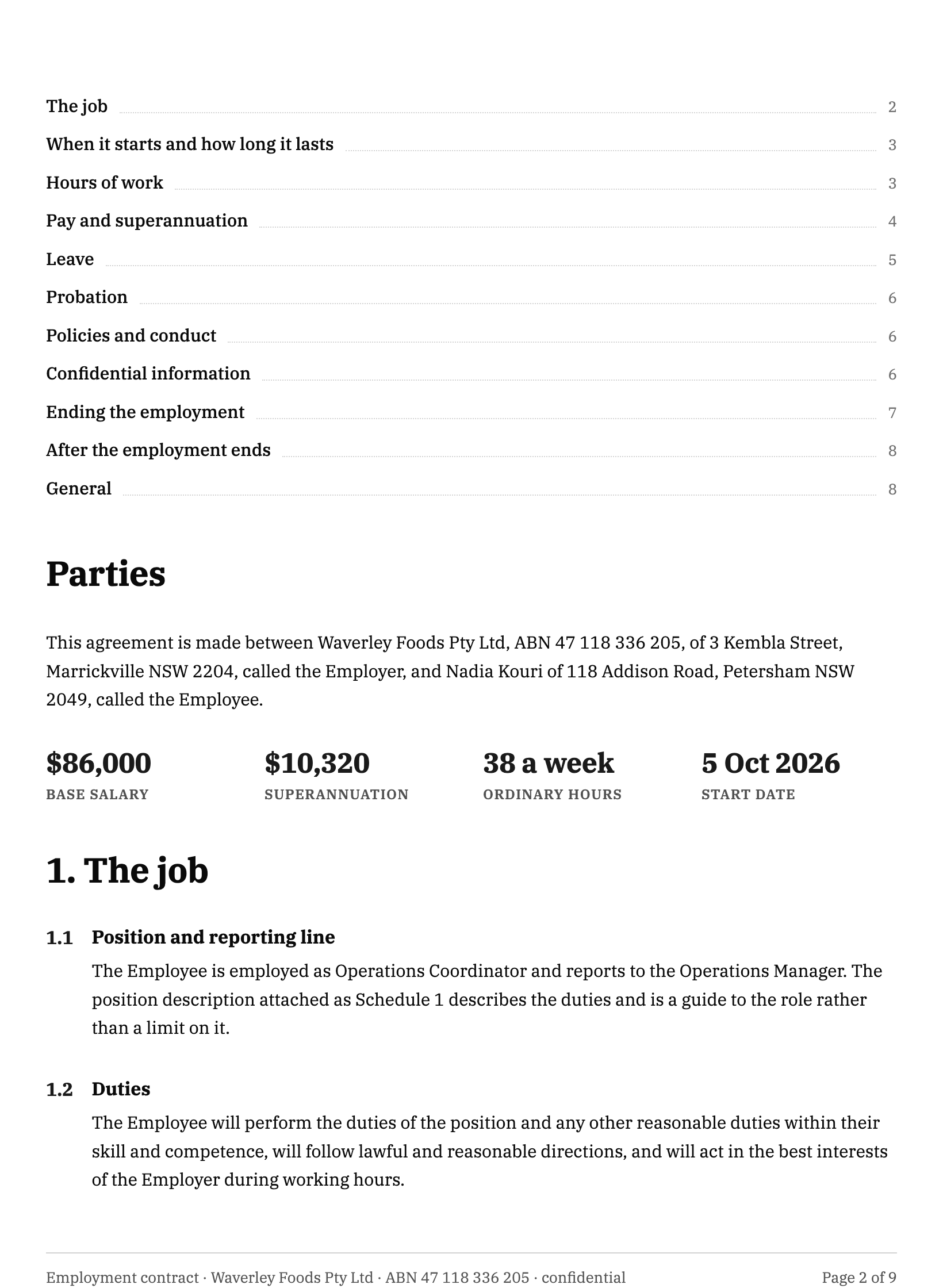 Employment contractA full time ongoing contract for an operations coordinator on $86,000 plus $10,320 of superannuation. Eleven numbered clauses, a leave table drawn from the National Employment Standards, and a notice table that scales with service.
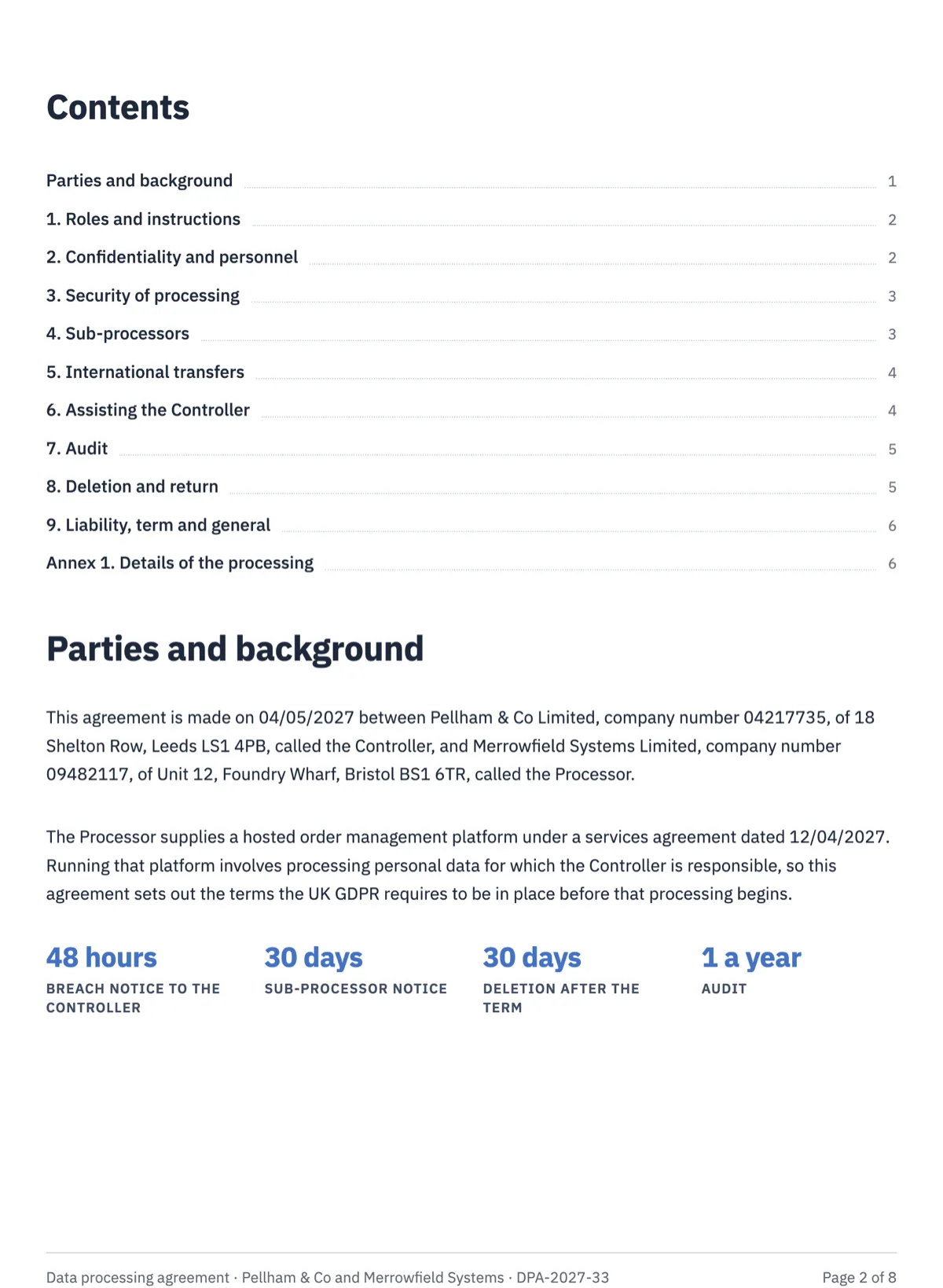 UK data processing agreement template with sub-processorsA data processing agreement is what a UK controller has to have in writing before a processor touches personal data. This one covers a hosted order management platform for a UK retailer, with the processing annex, a table of five named sub-processors and their transfer safeguards, eight security measures, and a breach notice of 48 hours rather than 72.
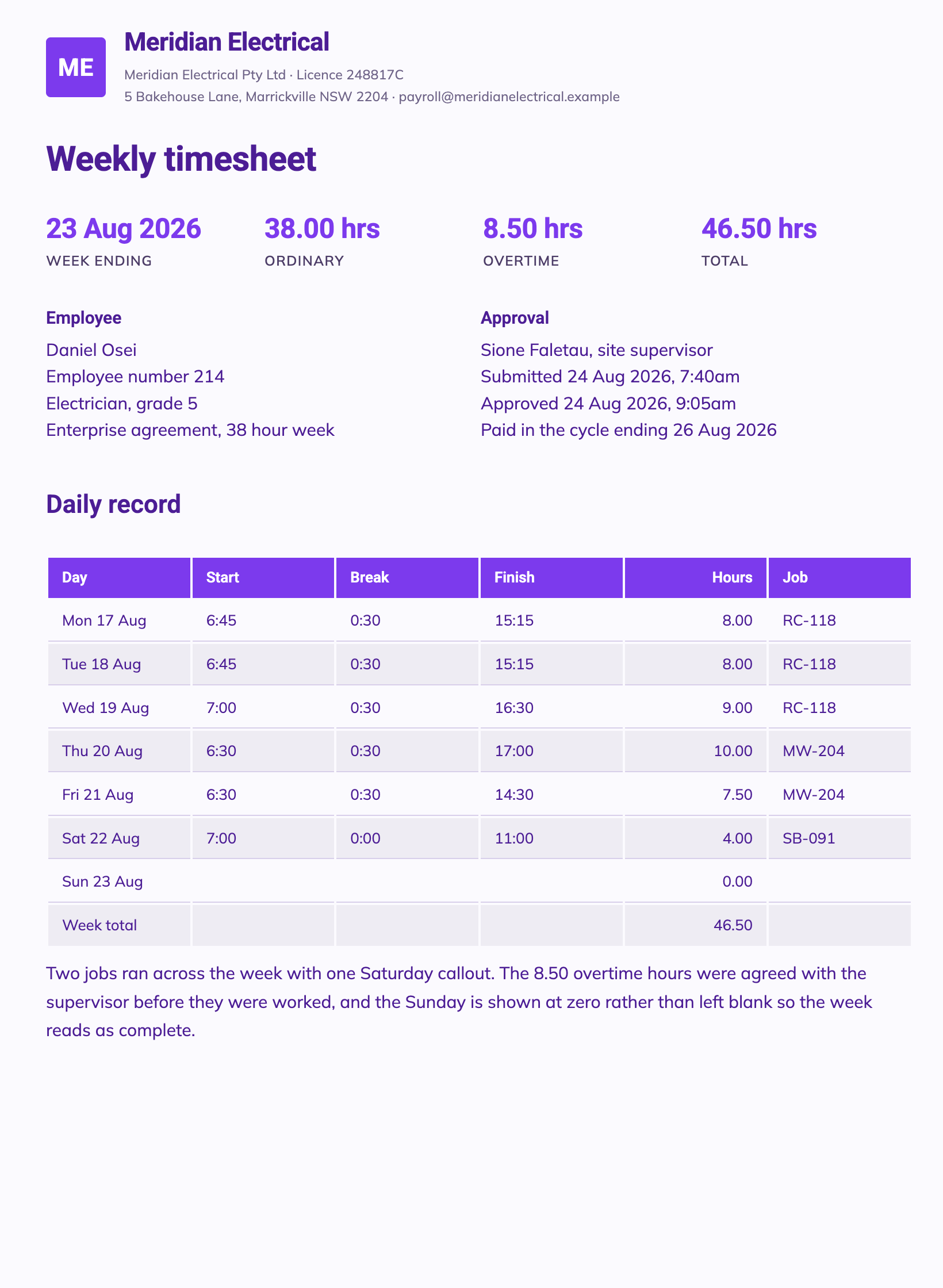 Weekly timesheetAn electrician records a week across two jobs and a Saturday callout. The same 46.50 hours are counted twice, once for the pay run and once for the customers, and the sheet only works if both agree.
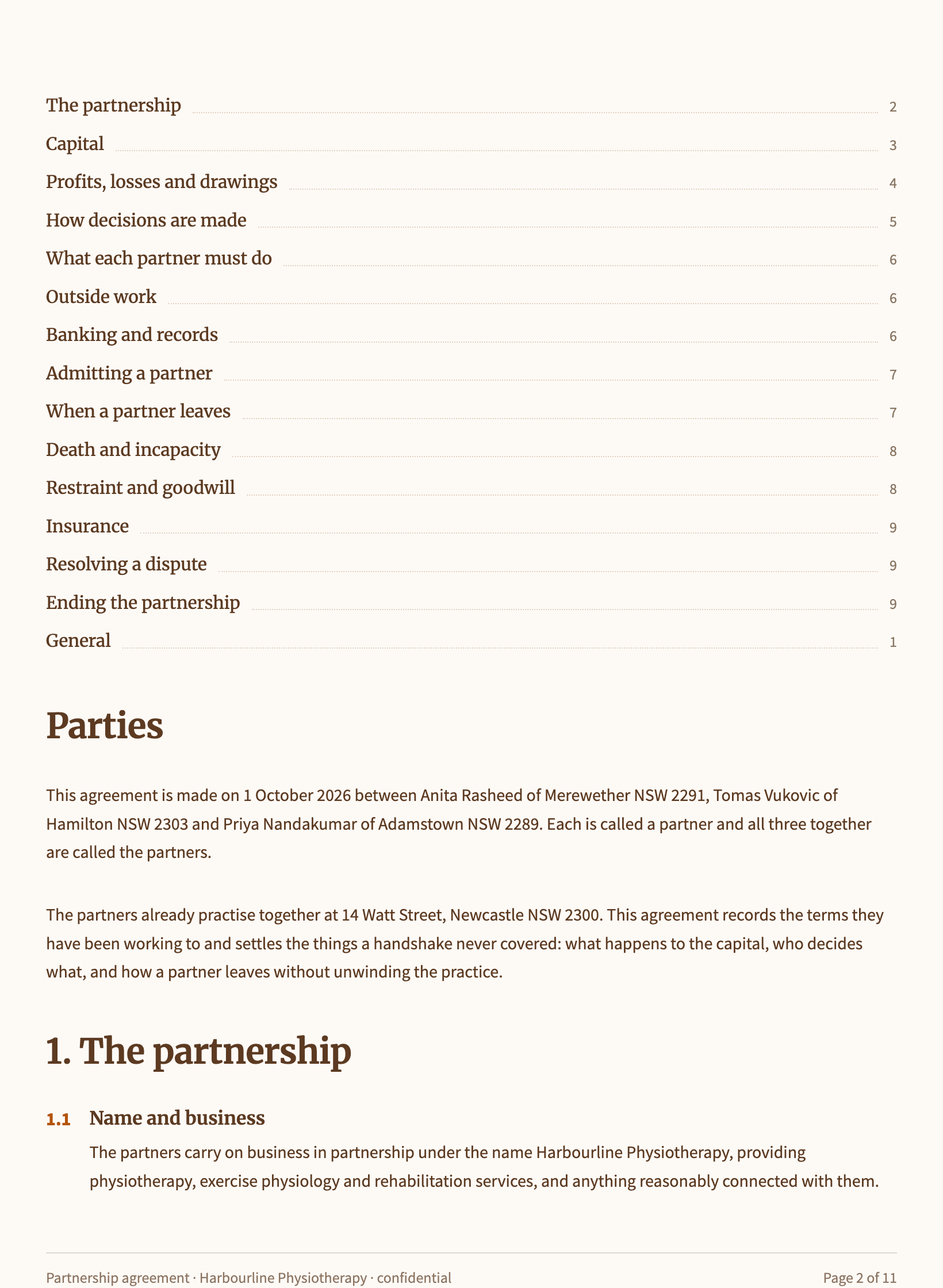 Partnership agreement templateThree physiotherapists have run one Newcastle practice together since 2024 without anything in writing. This agreement records what the handshake never covered: uneven capital sitting beside uneven hours, the six decisions no partner can make alone, and what a leaving partner is owed.
Questions people ask
How long should business records be kept in Australia?
It depends on the record. The ATO expects most tax records to be kept for 5 years. Employers must keep time and wages records for 7 years, and companies must keep financial records for 7 years under the Corporations Act. A contract usually adopts the longest period that applies to the records it covers.
Can records be kept electronically?
Generally yes, provided they are complete, legible and protected against being changed without trace, and can be produced when needed. The clause can set conditions, such as storage in Australia, access controls, a change log and export formats. Scanned copies of paper records are commonly accepted if they are clear and complete.
Does a records clause survive the end of the contract?
It should, and most do. Records are often needed after the contract ends, for tax, a pay claim or a dispute about the final invoice. The clause should say it survives, or be listed in the survival clause, and the retention period should be stated so everyone knows when the duty finally stops.
What records should a services contract require?
Records of what was charged and paid, the time worked where fees or pay depend on hours, evidence of insurance, licences and training, and incidents or complaints. The list should match how the contract is priced and what could be disputed. Asking for records nobody will ever need only adds cost.
Why would a customer care about a supplier's wage records?
In labour hire, cleaning, security and similar arrangements, underpayment by a supplier can become the customer's reputational problem, and sometimes its legal one. Requiring the supplier to keep time and wages records, and to produce them on request, gives the customer a way to check that the people working on its site are paid correctly.
What happens when the retention period ends?
The records should be destroyed securely, and personal information destroyed or de-identified, unless a dispute or legal requirement means they must be kept. A clause that sets a period but says nothing about destruction invites indefinite storage, which increases the privacy risk and the cost without adding any protection.
Put the clause in a finished document
The button opens the document generator with a starting description already filled in. Change it to match your own agreement before you run it.
Create a document with OneCraftRelated clauses
- Data return and deletion clauseA data return and deletion clause sets what happens to customer data when a service ends: export, deletion, backups and a certificate. Sample, steps, variants.
- Audit rights clauseAn audit rights clause lets a customer inspect a supplier's records or systems to check compliance. Sample with a yearly audit on 20 days notice, and variants.
- Overtime clause: paid, time off or built into salaryAn overtime clause says whether extra hours are paid, given as time off or absorbed in salary. Australian sample wording with an annual reconciliation.
For everything the document generator can do, see the document maker.
Step by step in the builder: Create a document with AI, then Document builder components.
Written and checked by the OneCraft team. Last checked .