Contract clause
Severability clause: keeping the contract alive when one term fails
A severability clause says that if a court finds one provision invalid or unenforceable, that provision is removed or read down and the rest of the contract keeps operating. It cannot rescue a term that is the heart of the bargain, and it cannot rewrite a bad clause into a good one; it only tells a court how to cut.
Contracts fail in pieces far more often than they fail whole, and restraints, penalties and one sided terms are the usual casualties. A severability clause decides whether losing one of those pieces takes the rest of the document down with it.
Indunil Asanka · Co-founder
4 min read · Published
Sample clause
an employment agreement between Ironbark Surveying, a fictional land survey practice in Newcastle, and a senior surveyor whose restraint is drafted as a cascade of periods and distances
17. Severability 17.1 If any provision of this Agreement, or its application to any person or circumstance, is invalid, void or unenforceable in any jurisdiction, it is read down in that jurisdiction to the extent necessary to make it valid and enforceable. 17.2 If a provision cannot be read down, the affected words are severed in that jurisdiction, and the remaining provisions continue in full force. 17.3 Clause 12 (Restraint) operates as a series of separate covenants, formed by combining each Restricted Period in clause 12.4 with each Restricted Area in clause 12.5. If a combination is unenforceable, it is severed and the next narrower combination applies. 17.4 This clause does not apply where severance would change the fundamental nature of this Agreement or defeat its essential purpose.
Sample wording, not legal advice.
Variants
Simple severance
A straightforward commercial contract with no restraint and no term likely to be read down.
If any provision of this Agreement is held to be invalid or unenforceable, that provision is severed from this Agreement and the remaining provisions continue to have full force and effect. The invalidity of a provision in one jurisdiction does not affect its validity in any other jurisdiction.
Read down, then sever
Terms that may be too wide rather than wholly bad, such as a liability cap carve out or an indemnity that reaches further than the law allows.
Each provision of this Agreement is to be read down to the extent necessary to be valid and enforceable. If a provision cannot be read down, it is severed to the extent it is invalid or unenforceable, without affecting the remaining provisions. The parties intend that the provision, as read down or severed, gives effect as closely as the law permits to its original commercial purpose.
Good faith replacement
Long term arrangements where losing a pricing or exclusivity term would unbalance the deal and the parties prefer to renegotiate.
If a provision of this Agreement is found invalid or unenforceable, the parties must negotiate in good faith for up to 30 days to agree a valid replacement provision that achieves, as nearly as possible, the same commercial effect. Until a replacement is agreed, the invalid provision is severed and the remaining provisions continue. If no replacement is agreed and severance materially changes either party's position, that party may terminate on 60 days written notice.
What to negotiate
Protecting the essential bargain
A party whose main benefit sits in one clause, a minimum volume or an exclusivity right, does not want the contract to continue without it. Adding a sentence that severance does not apply where it would defeat the agreement's essential purpose, or a termination right if severance materially changes the balance, protects that party without weakening the clause for minor terms.
Read down against blue pencil
Courts traditionally sever by deleting words, not by adding them, often called the blue pencil test. A read down instruction asks the court to interpret a wide provision narrowly first. Parties drafting restraints prefer both: an instruction to read down, and a cascade of separate combinations so that deleting words always leaves a workable narrower covenant.
Which jurisdiction the failure applies in
In a contract performed across countries, a term may be void in one place and fine in another. Wording that limits severance to the jurisdiction where the term fails stops a local rule stripping the provision everywhere, which matters for restraints and data transfer terms in multinational agreements.
The risk of leaving it out
Without the clause, courts still sever invalid terms where they can be removed without changing the nature of the contract, but the outcome is less predictable. The party relying on the contract has to persuade the court that the parties would have wanted the rest to stand, and a court may find the invalid term so bound up with the others that a larger part fails.
How a cascading restraint relies on severance
Australian courts will not rewrite an unreasonable restraint into a reasonable one. Drafters respond by writing several alternative restraints at once, for example twelve, six and three months combined with fifty, twenty five and ten kilometres, and declaring each combination a separate covenant. If the widest combination is too broad, it is severed and the next one is tested. The severability clause is what authorises that process, and the restraint clause must be drafted so each combination makes sense on its own. New South Wales also gives courts a statutory power to read down restraints, which reduces but does not remove the need for the cascade there.
Statutory severance under unfair contract terms law
Section 23 of the Australian Consumer Law makes an unfair term in a standard form consumer or small business contract void, and then says the contract continues to bind the parties if it can operate without that term. That is severance imposed by statute, and it works whether or not the contract contains a severability clause. It also means a supplier cannot rely on a severability clause to justify including a term it expects to be struck out, since proposing an unfair term can now attract a penalty.
Where it sits in a generated document
Severability usually appears with the general clauses at the end of an agreement. A generated agreement numbers its clauses, so a severability clause can point at the restraint clause by number and describe the cascade. The text is produced from the description without citations, so every cross reference and every period and distance in the cascade needs checking against the final numbering.
Documents that carry this clause
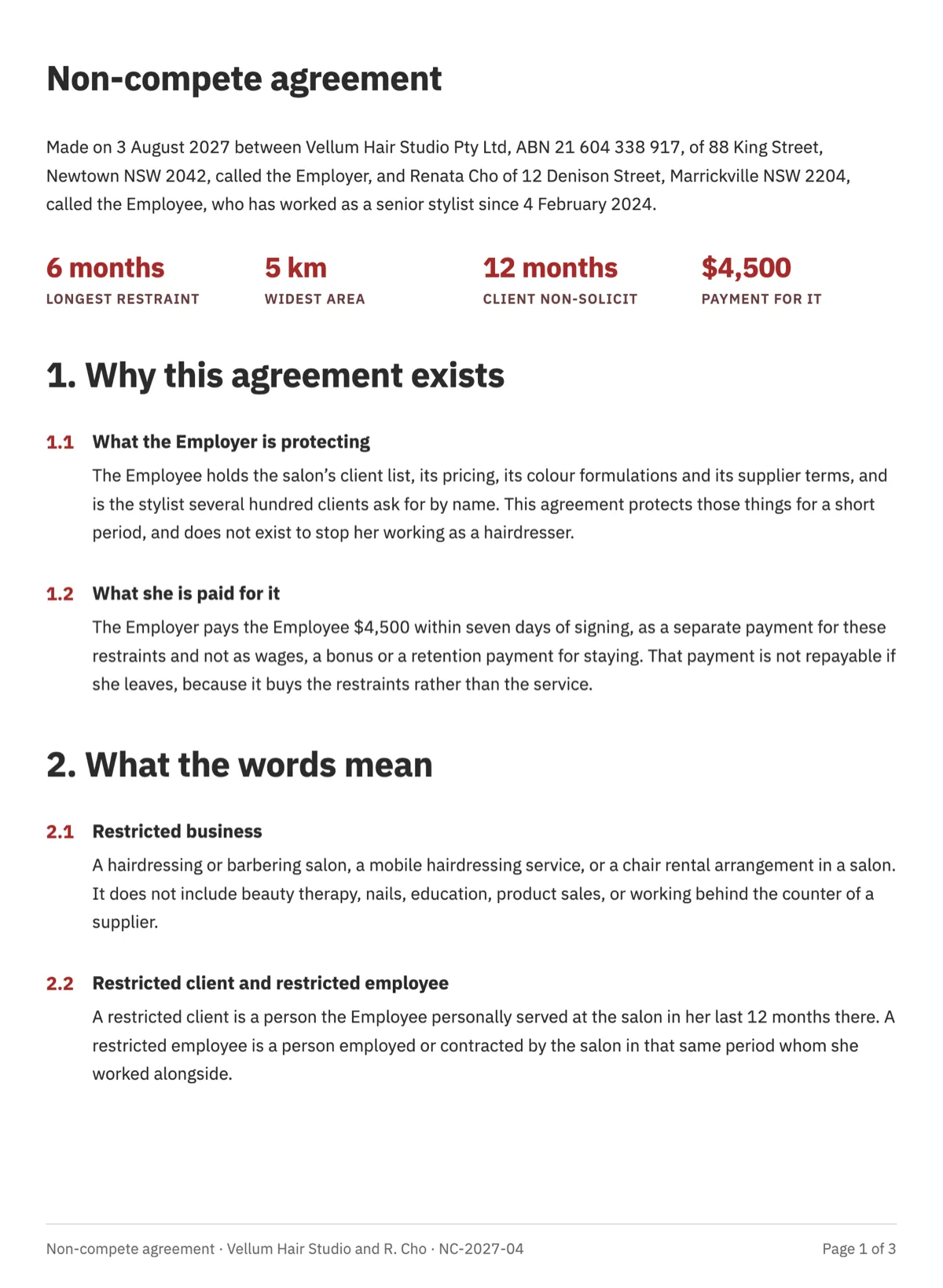 Non-compete agreement template with cascading restraint clausesAn Australian non-compete lives or dies on how it is drafted, because a court will not rewrite one that reaches too far. This one restrains a senior stylist from a competing salon using three separate covenants of falling reach, from 5 kilometres for six months down to 1 kilometre for three, and pays $4,500 for them.
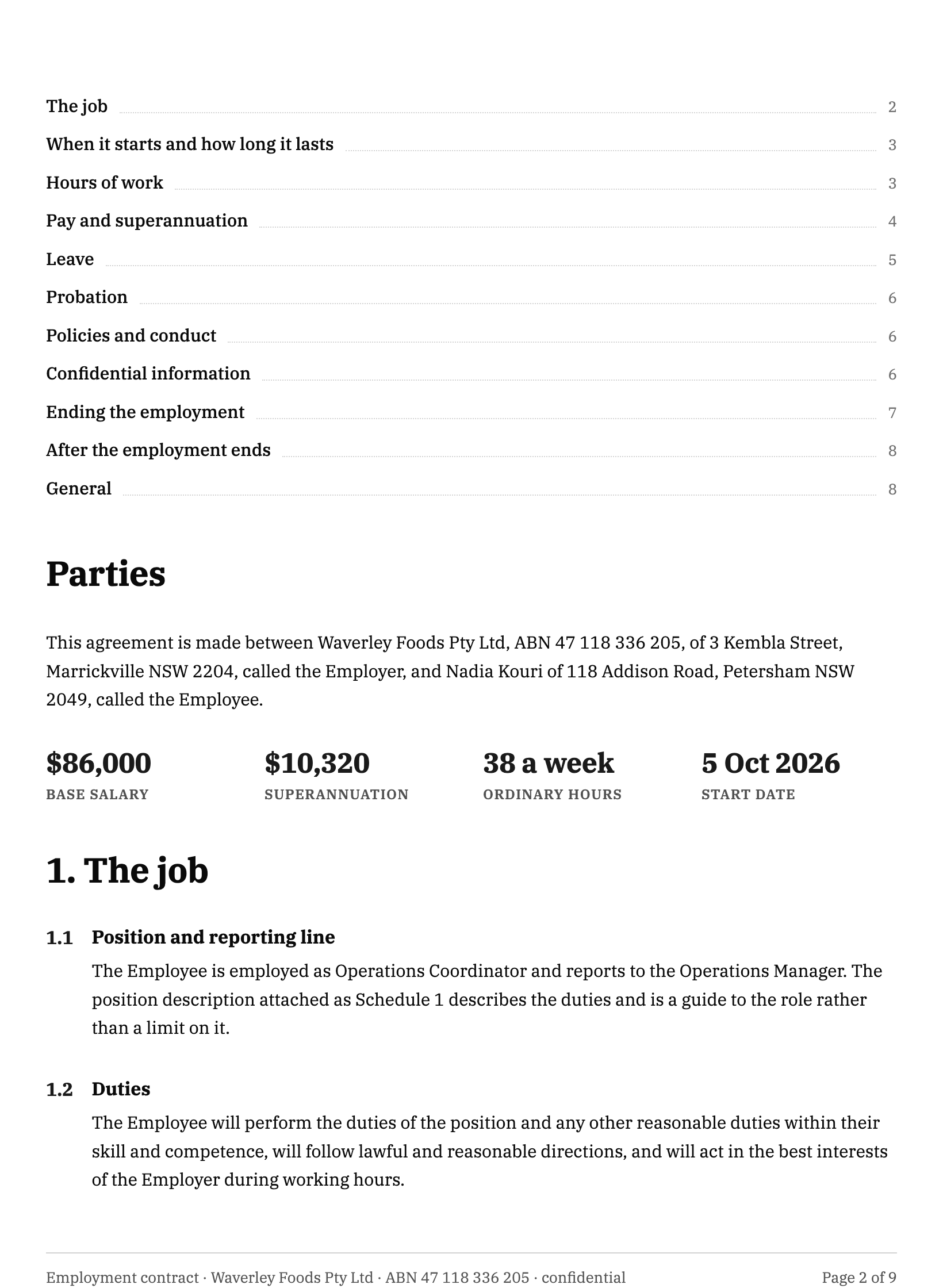 Employment contractA full time ongoing contract for an operations coordinator on $86,000 plus $10,320 of superannuation. Eleven numbered clauses, a leave table drawn from the National Employment Standards, and a notice table that scales with service.
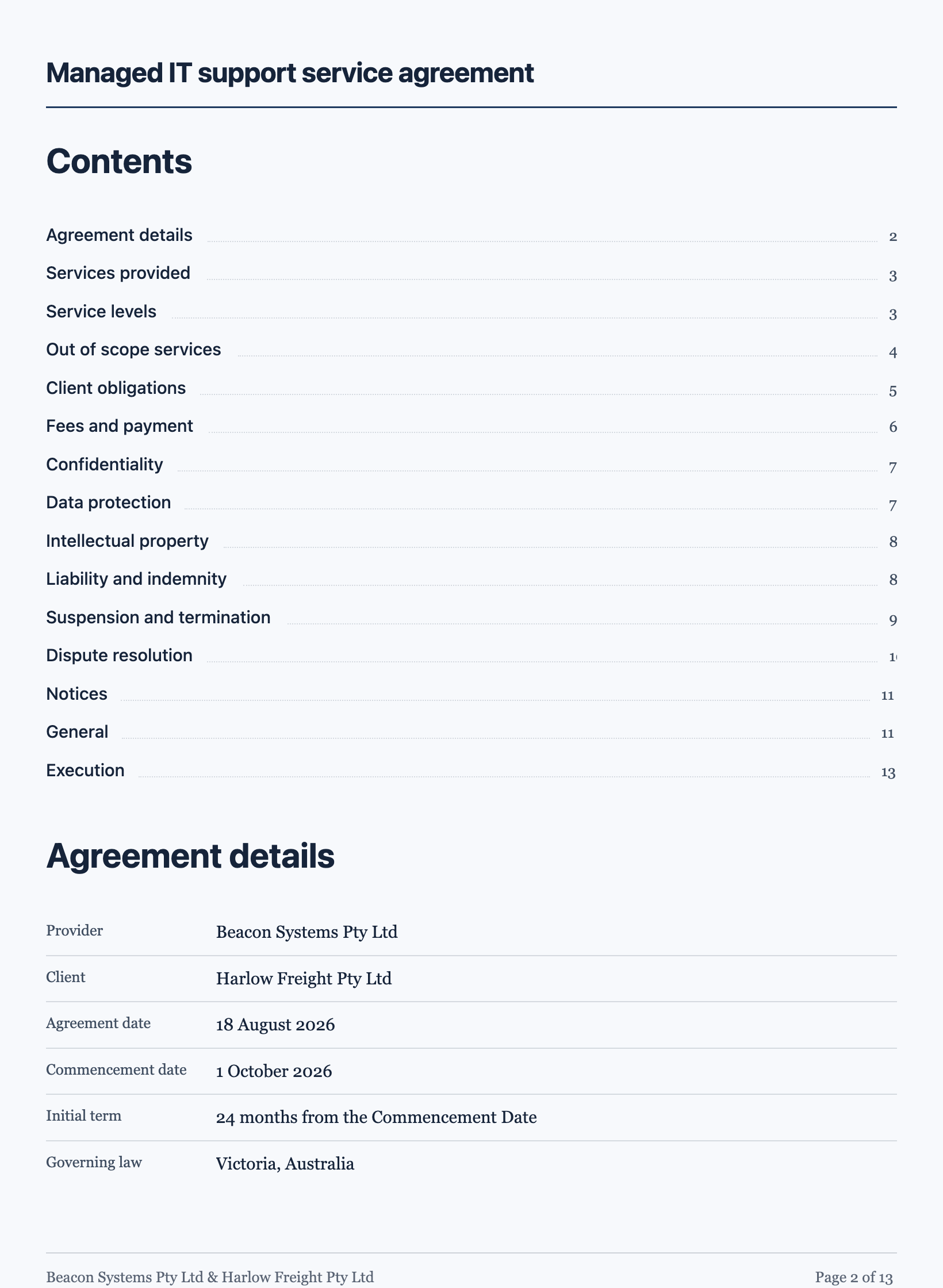 Service agreementBeacon Systems supports Harlow Freight’s IT for an initial 24 months from 1 October 2026 at $8,400 a month plus GST, with 40 hours included and $220 an hour beyond them. Twelve numbered clauses cover the services, a four level severity table, client duties, fees with a CPI adjustment, confidentiality, privacy, IP, a liability cap, termination and a three step dispute ladder.
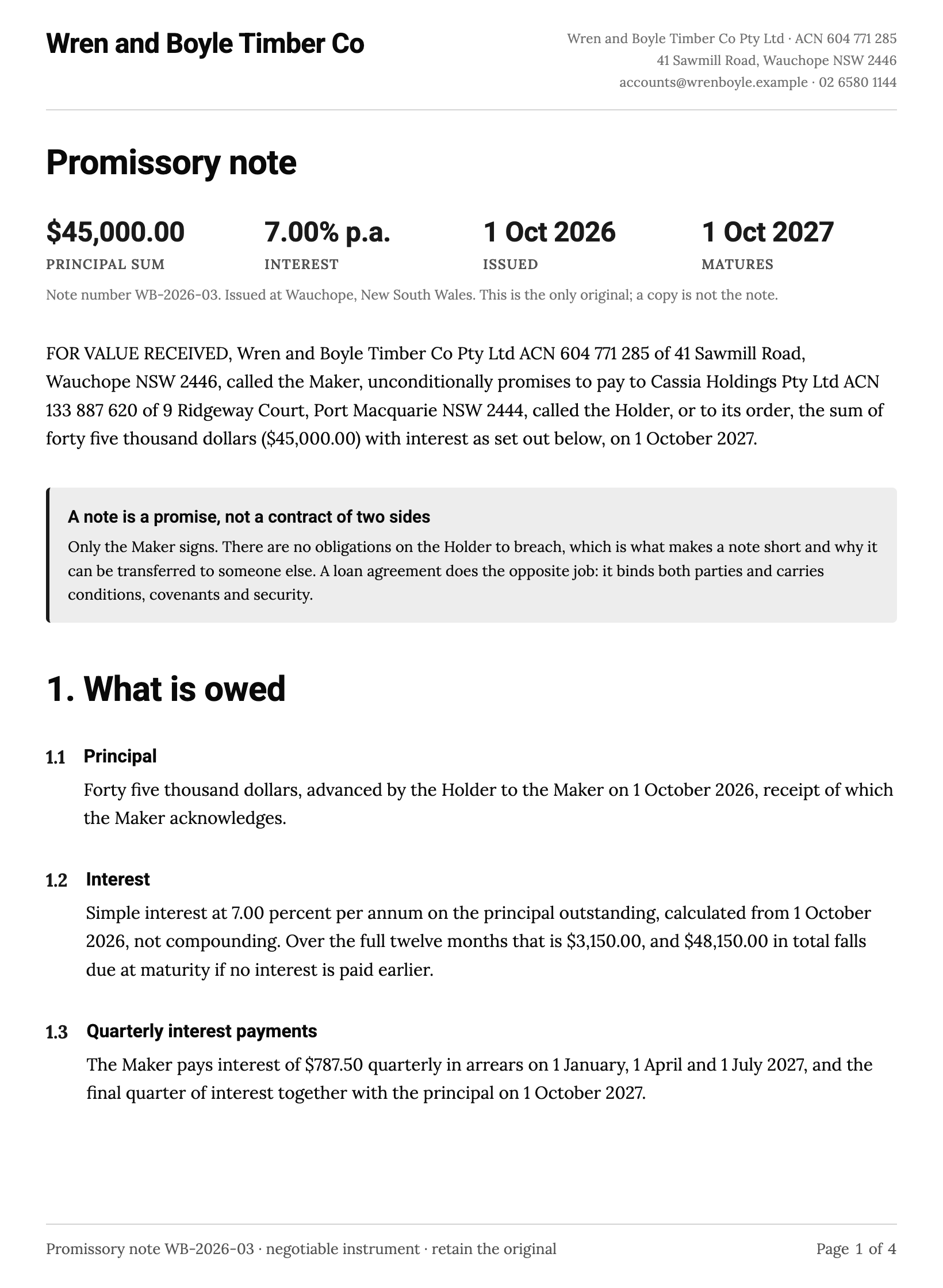 Promissory note templateA timber company owes $45,000 to a private lender and needs one page that says so. No conditions precedent, no covenants, no security. Only the maker signs, which is what keeps a note short and what lets the holder pass it on to somebody else.
Questions people ask
Does every contract need a severability clause?
It is not legally required, and courts can sever without one. It is cheap insurance, though, especially in contracts with restraints, liability exclusions or pricing mechanisms that may be challenged. The clause makes the parties' intention explicit, which is what a court would otherwise have to infer.
Can a severability clause save an unreasonable restraint?
Not by itself. A court will not redraft an unreasonable restraint to make it reasonable. What saves the restraint is drafting alternative covenants that can each stand alone, so that severing the widest leaves a narrower one. The severability clause supports that structure but cannot substitute for it.
What does read down mean?
Reading down means interpreting a provision more narrowly than its words might suggest so that it falls within what the law allows. It differs from severance, which removes words. Many clauses ask for reading down first and severance only if reading down cannot make the provision valid.
What happens if the severed term was central to the deal?
A court may conclude that the contract cannot sensibly operate without it and treat more of the agreement as unenforceable. Parties anticipate this by stating that severance does not apply where it would change the fundamental nature of the agreement, or by giving the disadvantaged party a right to terminate.
Does the clause help with unfair contract terms?
The Australian Consumer Law already severs an unfair term in a standard form consumer or small business contract and keeps the rest binding where it can operate. The severability clause adds little there, and it is no defence to a penalty for proposing or relying on an unfair term.
Is severability the same in the United States?
The concept is the same and the clause is common in US contracts, but courts differ state by state on whether they will reform an overbroad term, strictly delete words, or refuse to enforce a tainted provision entirely. Non compete covenants are where those differences show most sharply.
Put the clause in a finished document
The button opens the document generator with a starting description already filled in. Change it to match your own agreement before you run it.
Create a document with OneCraftRelated clauses
- Entire agreement clause: the written contract is the whole dealAn entire agreement clause says the signed contract is the whole deal. Australian sample wording, non reliance and US integration variants, and the ACL limit.
- Waiver clause: tolerating a breach without giving up the rightA waiver clause says letting a breach slide once does not give up the right to act on it later. Sample lease wording, plus written and single instance variants.
- Restraint of trade clause and how a cascade is builtA restraint of trade clause limits what a person may do after leaving. How an Australian cascading restraint is built, with employment and sale variants.
- Governing law clause: choosing the law that reads the contractA governing law clause picks the law that decides what an Australian contract means. Sample NSW wording, exclusive and non exclusive variants, a split for IP.
For everything the document generator can do, see the document maker.
Step by step in the builder: Create a document with AI, then Document builder components.
Written and checked by the OneCraft team. Last checked .