Contract clause
Governing law clause: choosing the law that reads the contract
A governing law clause names the legal system that decides what the contract means, whether it is valid and what remedies follow a breach. In Australia that means naming a state or territory, not just the country, because contract law, limitation periods and some statutes differ between them. Choosing a law does not by itself choose a court.
A Sydney supplier and a Melbourne client can sign the same words and still face different limitation periods and statutory rules depending on which state's law applies. Two lines at the back of the contract settle that before there is anything to argue about.
Nuwan Madhusanka · Co-founder
4 min read · Published
Sample clause
a services agreement between Wirrina Data Labs, a fictional analytics consultancy in Sydney, and Gumnut Logistics, a freight business headquartered in Melbourne with depots in Brisbane and Perth
24. Governing Law 24.1 This Agreement, and any dispute or claim arising out of or in connection with it or its subject matter or formation, including any non contractual dispute or claim, is governed by the laws in force in New South Wales, Australia. 24.2 The parties agree that the application of the laws of any other place, including under any rule of private international law that would otherwise point to those laws, is excluded to the extent permitted by law. 24.3 Clause 24.1 does not limit the operation of any law of the Commonwealth of Australia, or any law of another State or Territory, that applies to a party or to the performance of this Agreement regardless of the parties' choice. 24.4 Clause 25 (Jurisdiction) sets out the courts in which proceedings may be brought.
Sample wording, not legal advice.
Variants
State law with exclusive jurisdiction
Parties who want certainty that any case will be run in one state, usually where the supplier and its lawyers are based.
This Agreement is governed by the laws in force in Victoria, Australia. Each party irrevocably submits to the exclusive jurisdiction of the courts of Victoria and the courts entitled to hear appeals from them, and waives any right to object to proceedings being brought in those courts, including on the ground that the proceedings have been brought in an inconvenient forum.
State law with non exclusive jurisdiction
A counterparty with assets or operations in several states, where the claimant wants the option to sue where the assets are.
This Agreement is governed by the laws in force in Queensland, Australia. Each party submits to the non exclusive jurisdiction of the courts of Queensland and the courts entitled to hear appeals from them. Nothing in this clause prevents a party from bringing proceedings in any other court of competent jurisdiction, including to enforce a judgment or to seek urgent interim relief.
Country only, for a trans Tasman deal
An Australian supplier contracting with a New Zealand customer that will not accept an Australian state's law.
This Agreement is governed by the laws of New Zealand. The parties agree that the courts of New Zealand have exclusive jurisdiction to determine any dispute arising out of or in connection with this Agreement, and each party agrees not to commence proceedings in any other court, except for urgent interim relief to protect confidential information or intellectual property.
Split law for intellectual property
A licence where the contract is Australian but the licensed rights are registered or exploited in another country.
This Agreement is governed by the laws in force in South Australia. Questions about the validity, ownership, registration or infringement of any Licensed Intellectual Property are determined under the law of the country in which that right is registered or, if unregistered, in which protection is claimed. Clause 18 (Jurisdiction) applies to all other disputes.
What to negotiate
Home law against neutral law
Each side prefers its own state because its lawyers know it and its courts are close. Where neither will give way, parties pick the state where the services are mainly performed, or a neutral state with a large commercial court. Between Australian states the substantive difference is often small, so this point is traded for something else rather than fought over.
Non contractual claims
A clause covering only disputes under this agreement may not catch a misrepresentation claim, a claim in negligence or a statutory claim about how the contract was formed. Adding the words non contractual disputes and formation brings those under the same law, which parties on both sides usually accept once the gap is pointed out.
Mandatory local laws
Choosing another law does not switch off laws that apply regardless, such as the Australian Consumer Law, workplace laws where work is performed, or security of payment legislation in construction. A carve out acknowledging those laws avoids a clause that promises more than it can deliver and reduces the chance of a court treating the choice as an evasion.
The risk of leaving it out
Without a clause a court decides the proper law by looking for the system of law with the closest and most real connection to the contract, weighing where it was made and performed and where the parties are. That exercise costs money before the real dispute starts and can produce an unexpected answer in a contract performed across several states or countries.
Why an Australian contract names a state
Australia has one national consumer law and one corporations law, but contract law is largely state and territory law developed by the courts, and many rules that decide a case are in state statutes. Limitation periods, proportionate liability, deeds and the enforceability of some restraints differ between jurisdictions. Naming New South Wales or Western Australia, rather than Australia, tells a court exactly which set of those rules applies. A clause that says only the laws of Australia forces the court to work out which state's law was meant.
Governing law and jurisdiction are separate choices
A court in Victoria can apply New South Wales law, and a New Zealand court can apply Australian law. The governing law clause picks the rules; the jurisdiction clause picks the court, and the two are usually drafted together. Inside Australia, cross vesting legislation lets a superior court transfer a case to another state's court where that is in the interests of justice, which can move a case away from the court named. Between Australia and New Zealand, the Trans Tasman Proceedings Act 2010 requires an Australian court to stay a proceeding where an exclusive choice of court agreement designates a New Zealand court.
Where it sits in a generated document
Governing law normally comes in the general clauses near the end, immediately before the jurisdiction clause. A generated agreement numbers each clause, so the governing law clause can refer to the jurisdiction clause by number, as the sample does. The document is written from the description alone and prints no citations, so the state named and any statutory carve out should be read against the deal before signing.
Documents that carry this clause
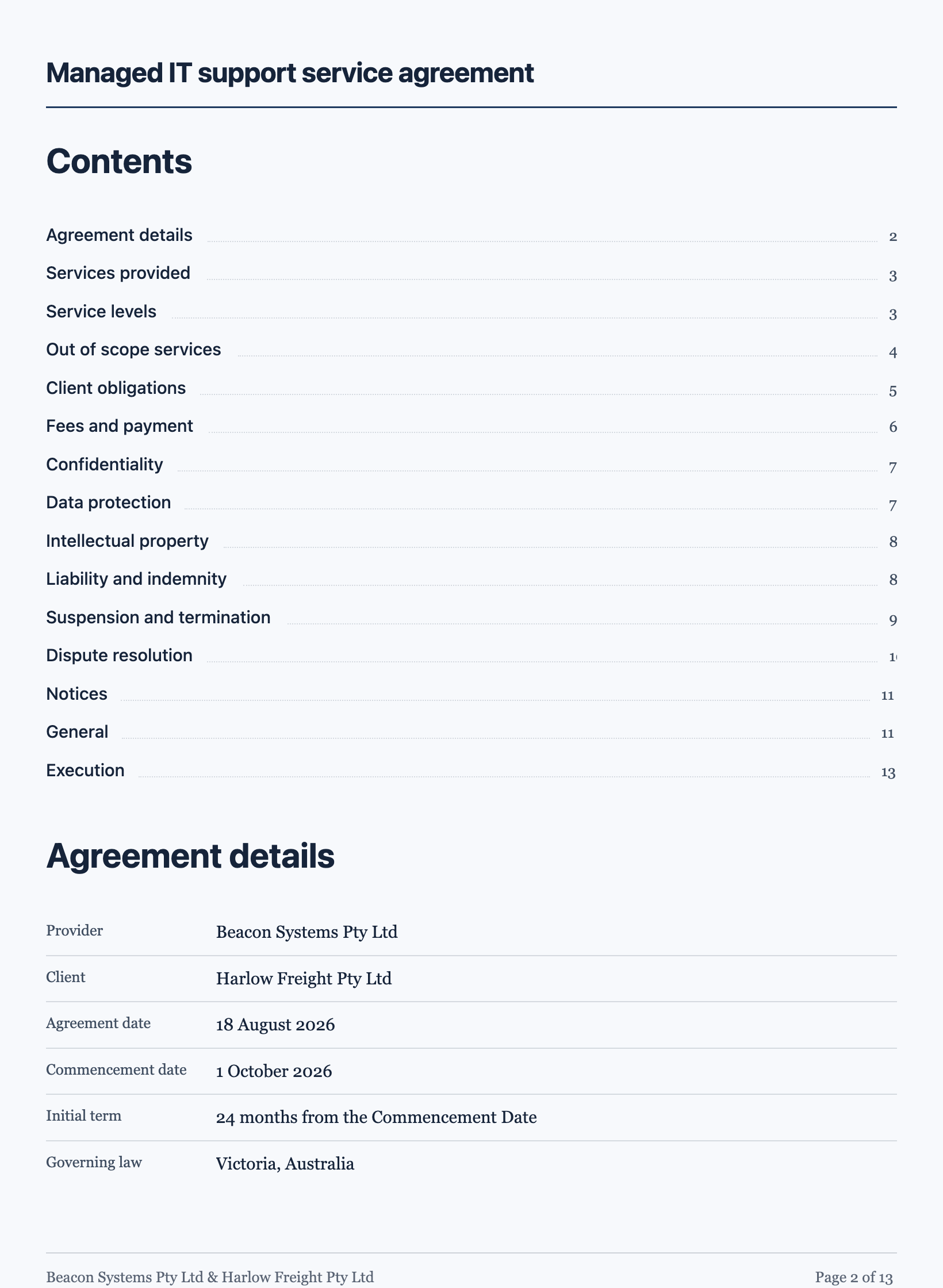 Service agreementBeacon Systems supports Harlow Freight’s IT for an initial 24 months from 1 October 2026 at $8,400 a month plus GST, with 40 hours included and $220 an hour beyond them. Twelve numbered clauses cover the services, a four level severity table, client duties, fees with a CPI adjustment, confidentiality, privacy, IP, a liability cap, termination and a three step dispute ladder.
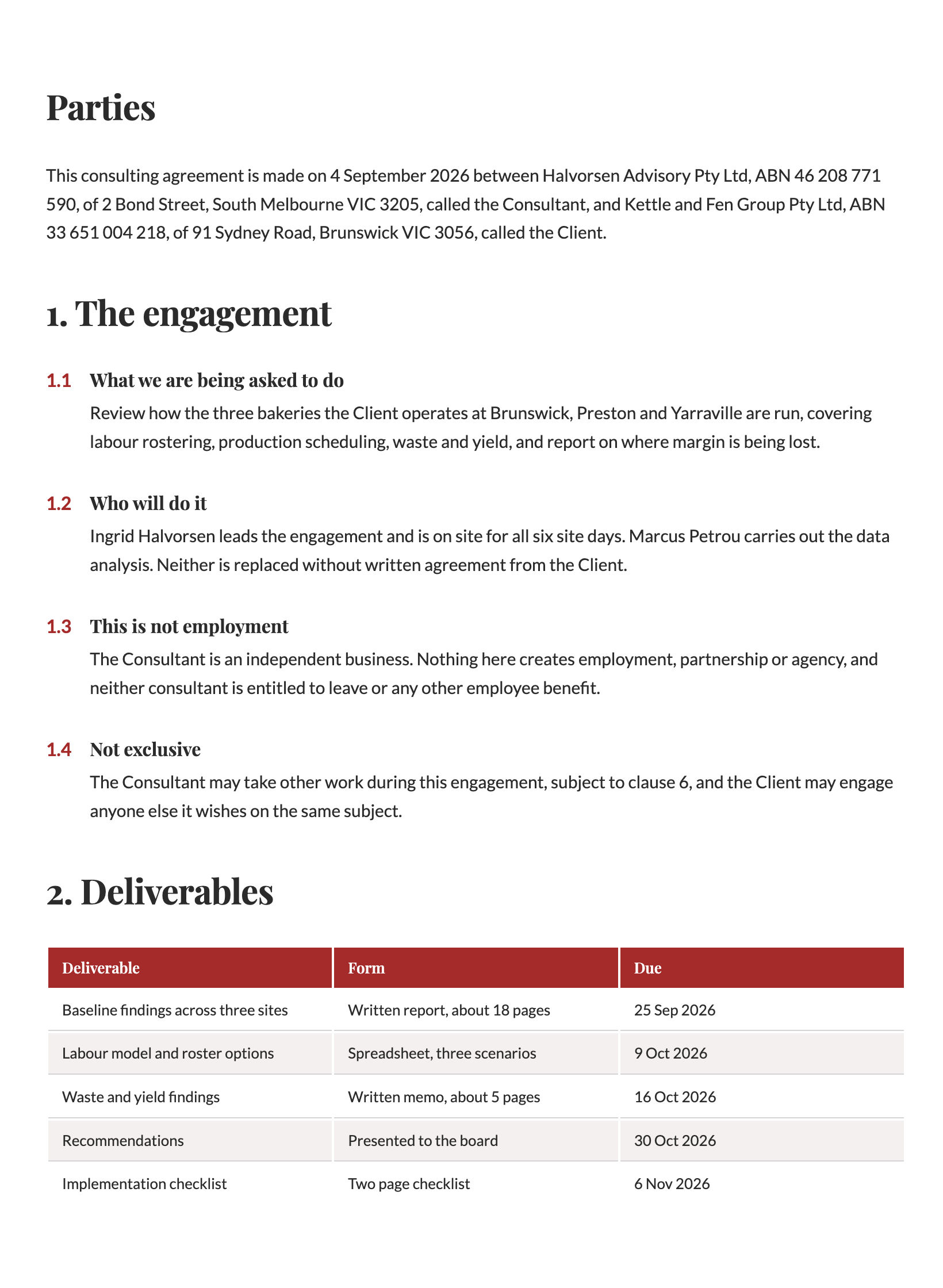 Consulting agreementAn advisory firm reviews three bakeries over seven weeks. What makes this agreement useful is not the fee clause but the two clauses that say what the advice is not.
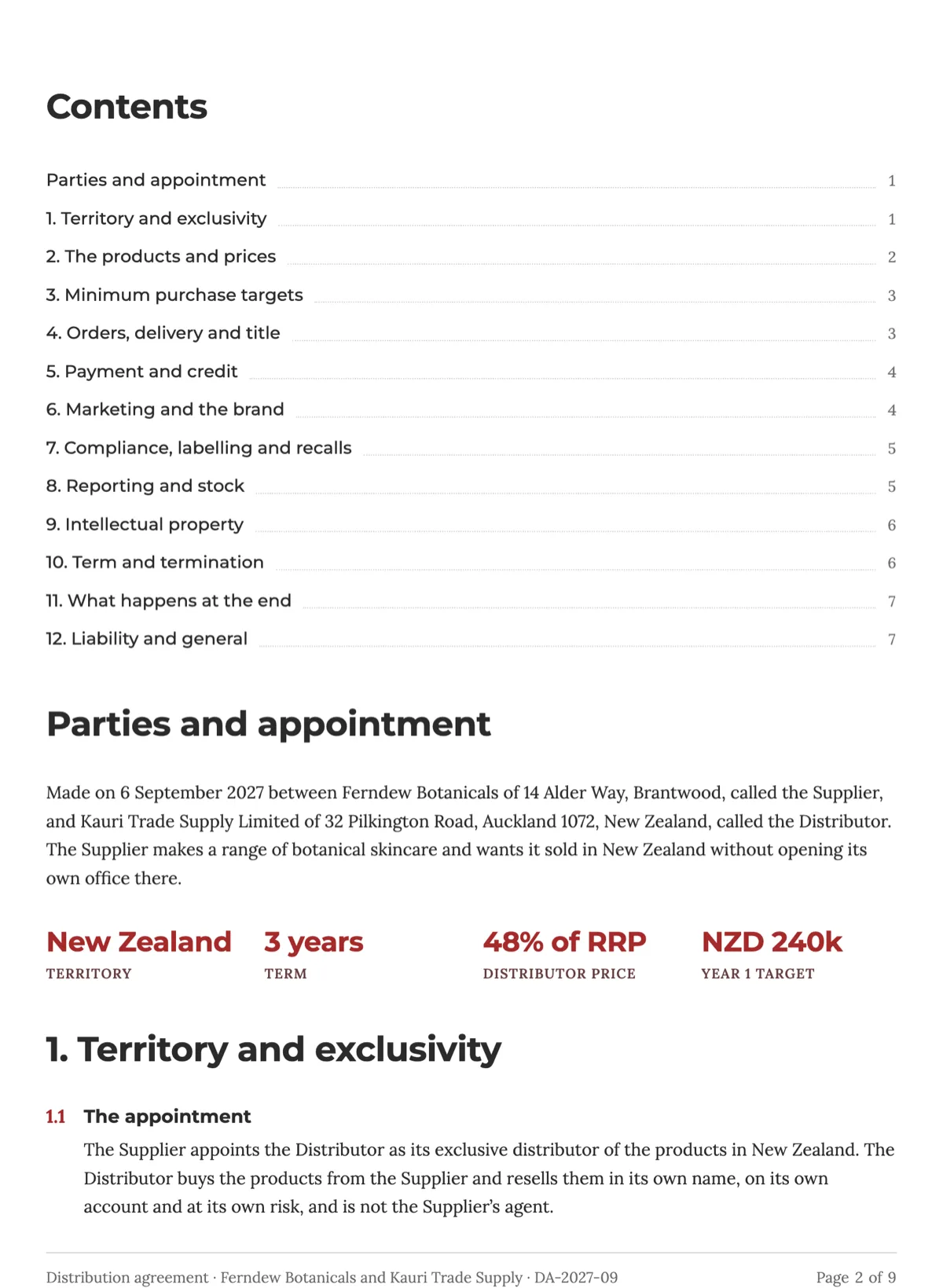 Distribution agreement template with territory and targetsAn exclusive distribution agreement is a trade: a territory in exchange for volume. This one appoints a New Zealand distributor for a skincare range at 48 per cent of recommended retail, with purchase targets rising from NZD 240,000 to NZD 420,000 across three years, and exclusivity that converts to non exclusive if a target is missed by more than 15 per cent.
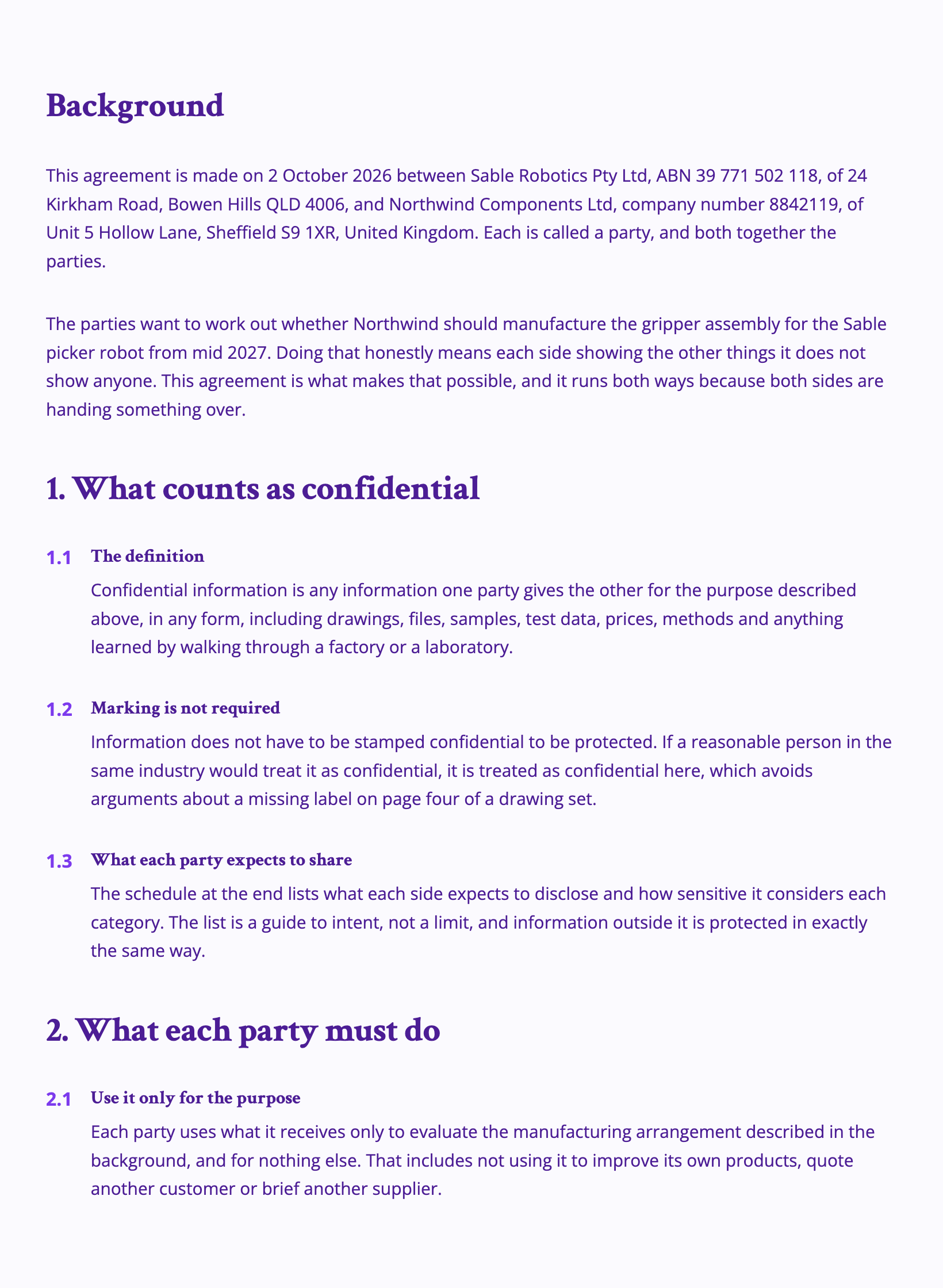 Mutual NDAA robotics company and a British parts maker want to look inside each other before agreeing to anything. Both sides are handing over trade secrets, which is the only real reason to make an NDA mutual.
Questions people ask
Does choosing NSW law mean a case must be heard in NSW?
No. Governing law decides which rules apply, not where the case is heard. A separate jurisdiction clause names the courts. Even an exclusive jurisdiction clause between Australian states can be displaced where a court transfers proceedings under cross vesting legislation in the interests of justice.
Can Australian parties choose foreign law?
Generally yes, where the choice is genuine and made in good faith, and courts usually respect it. The choice does not avoid Australian laws that apply regardless of the parties' agreement, such as the Australian Consumer Law in many consumer and small business dealings, or employment laws for work performed in Australia.
Which state's law should a small business pick?
Usually the state where it is based, its lawyers practise and the work is performed, since that reduces cost if something goes wrong. Where the other party insists on its home state, the practical difference in most commercial contracts is modest, and the concession can be exchanged for a better payment or liability term.
Does the clause cover a misleading conduct claim?
Only if it is drafted to. Wording that covers disputes arising out of or in connection with the agreement, including its formation and non contractual claims, is wide enough to catch most pre contract claims. A narrow clause covering disputes under this agreement may leave those claims to be decided by a different law.
Is a governing law clause needed in an agreement between two Australian businesses?
It is strongly advisable whenever the parties are in different states, or the work is performed somewhere else. Even for two businesses in the same city it costs one sentence and removes a question a court would otherwise have to answer from the facts.
What law applies in an international arbitration seated in Australia?
The International Arbitration Act 1974 gives the UNCITRAL Model Law the force of law, and under the Model Law the tribunal applies the rules of law the parties chose for the substance of the dispute. A clear governing law clause therefore matters just as much in arbitration as in court.
Put the clause in a finished document
The button opens the document generator with a starting description already filled in. Change it to match your own agreement before you run it.
Create a document with OneCraftRelated clauses
- Jurisdiction clause: picking the courts before the disputeA jurisdiction clause names the courts that hear a contract dispute. Australian sample wording with exclusive, non exclusive and asymmetric variants explained.
- Dispute resolution clause: the ladder before anyone goes to courtA dispute resolution clause sets the steps parties must take before suing. Sample three tier ladder with day counts, and negotiation, mediation and arbitration.
- Arbitration clause: a private, binding decision instead of a courtAn arbitration clause sends disputes to a private arbitrator instead of a court. Sample wording with a Sydney seat, plus institutional, ad hoc and US variants.
- Notices clause: how a formal notice is sent and when it landsA notices clause sets how formal notices under a contract are sent and when they count as received. Sample email wording, a deemed receipt table and variants.
For everything the document generator can do, see the document maker.
Step by step in the builder: Create a document with AI, then Document builder components.
Written and checked by the OneCraft team. Last checked .