Contract clause
Jurisdiction clause: picking the courts before the dispute
A jurisdiction clause names the courts in which disputes under a contract will be heard, and says whether those courts are the only permitted forum or one option among several. It is a separate choice from governing law, and its practical effect depends heavily on the word exclusive and on where the other party's assets are.
Winning a judgment is only useful in a court whose orders can reach the losing party's money. Jurisdiction clauses are negotiated with that in mind, which is why lenders and landlords draft them very differently from service providers.
Indunil Asanka · Co-founder
4 min read · Published
Sample clause
an equipment finance agreement between Riverina Plant Finance, a fictional lender in Wagga Wagga, and Coolabah Earthmoving, a contractor with machinery working on projects in Victoria, New South Wales and South Australia
26. Jurisdiction 26.1 Each party irrevocably submits to the non exclusive jurisdiction of the courts of Victoria, Australia, and the courts entitled to hear appeals from them, in respect of any proceedings arising out of or in connection with this Agreement. 26.2 Each party waives any objection to proceedings being brought in those courts, including any claim that the proceedings have been brought in an inconvenient forum. 26.3 Nothing in this clause prevents Riverina Plant Finance from bringing proceedings in any other court of competent jurisdiction, including a court of the place where any Financed Equipment is located, whether or not proceedings are also brought in Victoria. 26.4 A judgment given by a court referred to in this clause may be enforced in any other court. 26.5 This clause is subject to clause 27 (Dispute Resolution), except for proceedings seeking urgent interim relief.
Sample wording, not legal advice.
Variants
Exclusive jurisdiction
Two parties of similar size who want one predictable forum and no race to file first in a friendlier court.
Each party irrevocably submits to the exclusive jurisdiction of the courts of Western Australia and the courts entitled to hear appeals from them for any proceedings arising out of or in connection with this Agreement. Neither party may commence proceedings in any other court, except to enforce a judgment of those courts or to seek urgent interim relief that cannot practically be obtained in them.
Non exclusive jurisdiction
A contract where either party might need to sue where the other is located, and neither wants to be locked out of that option.
Each party submits to the non exclusive jurisdiction of the courts of Tasmania and the courts entitled to hear appeals from them. A party may bring proceedings in any other court of competent jurisdiction. Each party waives any objection to proceedings in the courts of Tasmania on the ground of venue or inconvenient forum.
Asymmetric jurisdiction
Finance and lease documents where the lender needs to pursue assets anywhere but wants the borrower confined to one court.
The Borrower submits to the exclusive jurisdiction of the courts of New South Wales and may bring proceedings only in those courts. The Lender may bring proceedings in the courts of New South Wales or in any other court of competent jurisdiction, and may bring concurrent proceedings in more than one jurisdiction to the extent permitted by law. The Borrower waives any objection to proceedings brought by the Lender on the ground of inconvenient forum.
What to negotiate
Exclusive or non exclusive
Exclusive wording stops forum shopping and gives both parties one court to plan around. Non exclusive wording preserves flexibility to sue where assets are. Parties with assets in one place and a counterparty with assets everywhere tend to prefer non exclusive. Where both sides are in the same state, exclusive is simple and rarely controversial.
One sided options
Asymmetric clauses are standard in lending, where the lender funds the risk and needs enforcement options. In a standard form small business contract, a term limiting only one party's right to sue is listed as an example of a potentially unfair term, so borrowers and tenants on standard terms have room to ask for symmetry.
Interaction with the dispute steps
If the contract requires negotiation or mediation first, the jurisdiction clause should say so, and should carve out urgent interim relief such as an injunction to stop disclosure of confidential information. Otherwise one clause invites immediate proceedings while the other forbids them, and the first court hearing is spent sorting out the contradiction.
The risk of leaving it out
Without a jurisdiction clause a claimant can start proceedings in any court prepared to hear the case, and the defendant must argue that the court is inappropriate. That produces a preliminary fight over forum, the chance of parallel cases in two places, and for cross border contracts real doubt about whether a judgment will be recognised where the losing party holds assets.
What exclusive really achieves inside Australia
Between Australian courts, an exclusive jurisdiction clause is influential but not absolute. The cross vesting scheme lets a superior court transfer a proceeding to another state's court where that is in the interests of justice, and the parties' agreed forum is an important factor rather than the end of the question. In practice courts give real weight to the bargain, so a party that ignores an exclusive clause usually faces a transfer or stay application and a costs argument. For interstate contracts the clause still earns its place, it simply works as a strong presumption.
Cross border clauses and enforcement
For contracts that cross borders the question becomes whether the chosen court's judgment will be enforced where the assets are. Between Australia and New Zealand, the Trans Tasman Proceedings Act 2010 makes an Australian court stay proceedings where an exclusive choice of court agreement designates a New Zealand court, subject to limited exceptions, and judgments move between the two countries under a registration scheme. Further afield, the Hague Convention on Choice of Court Agreements supports exclusive clauses among its parties, and arbitration is often chosen instead because arbitral awards are enforceable in far more countries under the New York Convention.
Where it sits in a generated document
Jurisdiction follows governing law among the general clauses. In a generated agreement the clauses are numbered, so a jurisdiction clause can state that it is subject to the dispute resolution clause by number and carve out urgent relief. The draft is written from the description and cites no legislation, so asking for exclusive, non exclusive or asymmetric wording by name gives the clearest result, and the choice still needs checking.
Documents that carry this clause
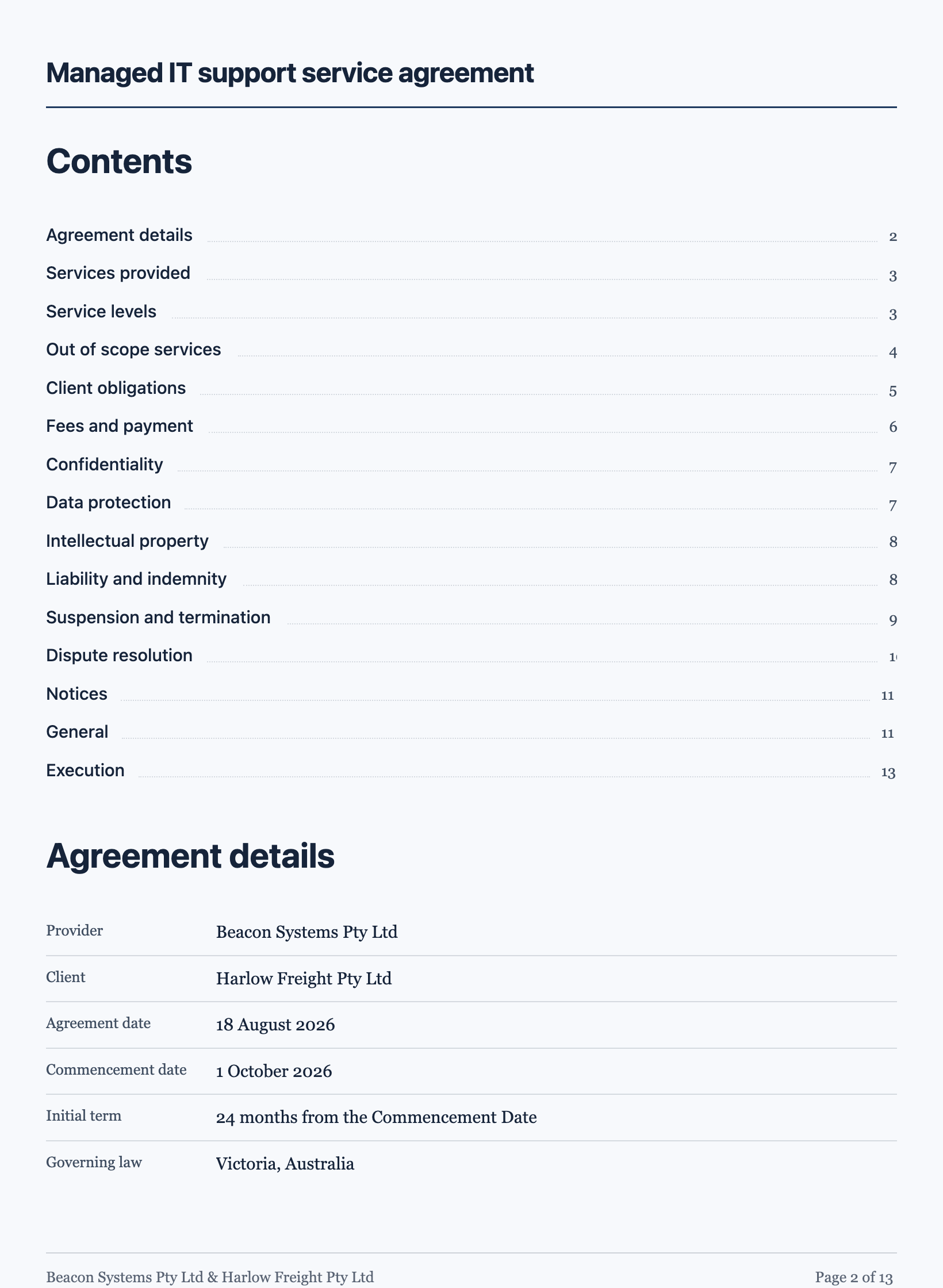 Service agreementBeacon Systems supports Harlow Freight’s IT for an initial 24 months from 1 October 2026 at $8,400 a month plus GST, with 40 hours included and $220 an hour beyond them. Twelve numbered clauses cover the services, a four level severity table, client duties, fees with a CPI adjustment, confidentiality, privacy, IP, a liability cap, termination and a three step dispute ladder.
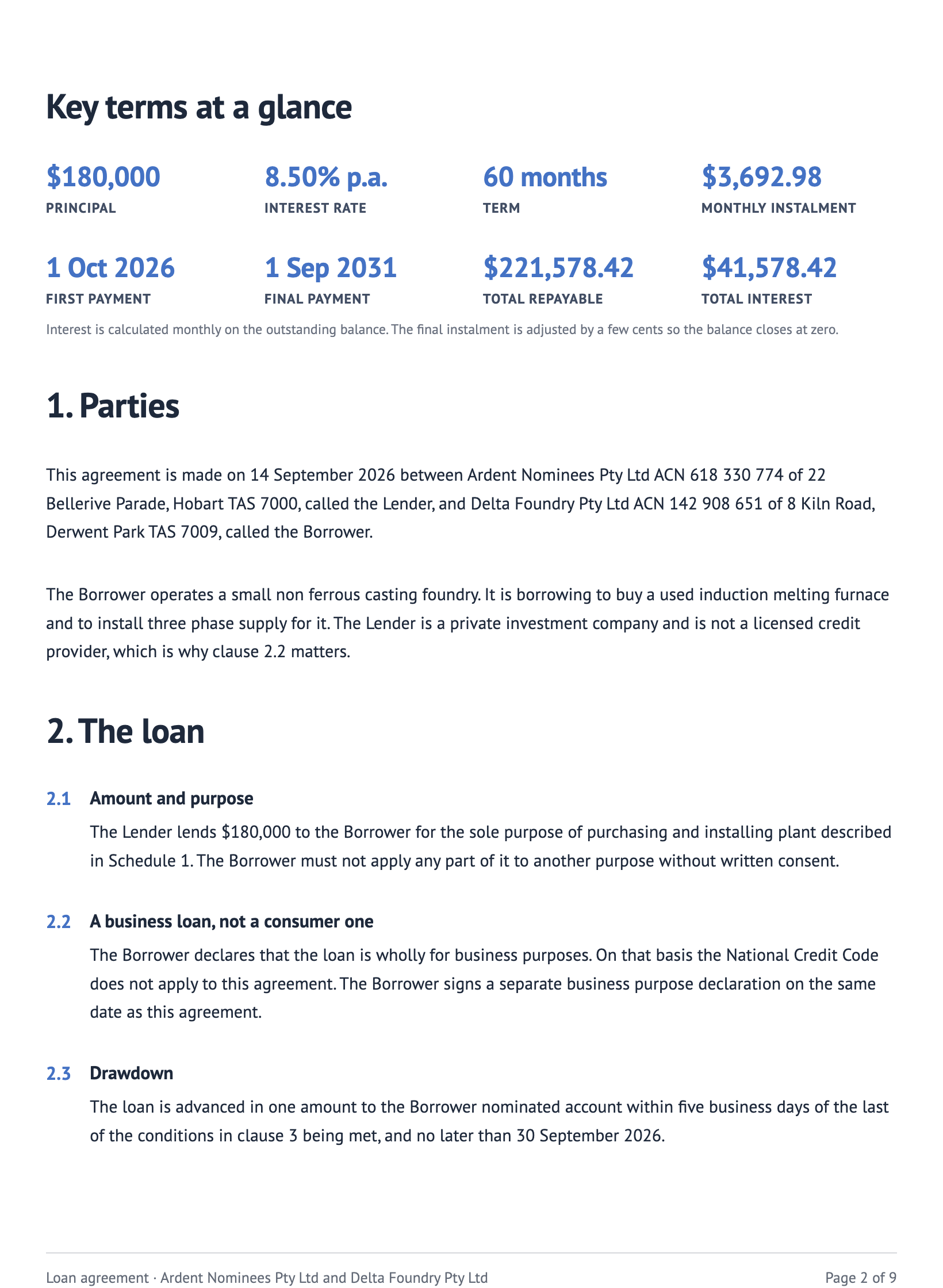 Loan agreement templateA Tasmanian foundry is borrowing $180,000 from a private investment company to buy a used induction furnace. The lender is not a bank, so everything a bank would take for granted has to be written down: what has to happen before the money moves, what is registered over what, and how long the borrower gets to fix a default.
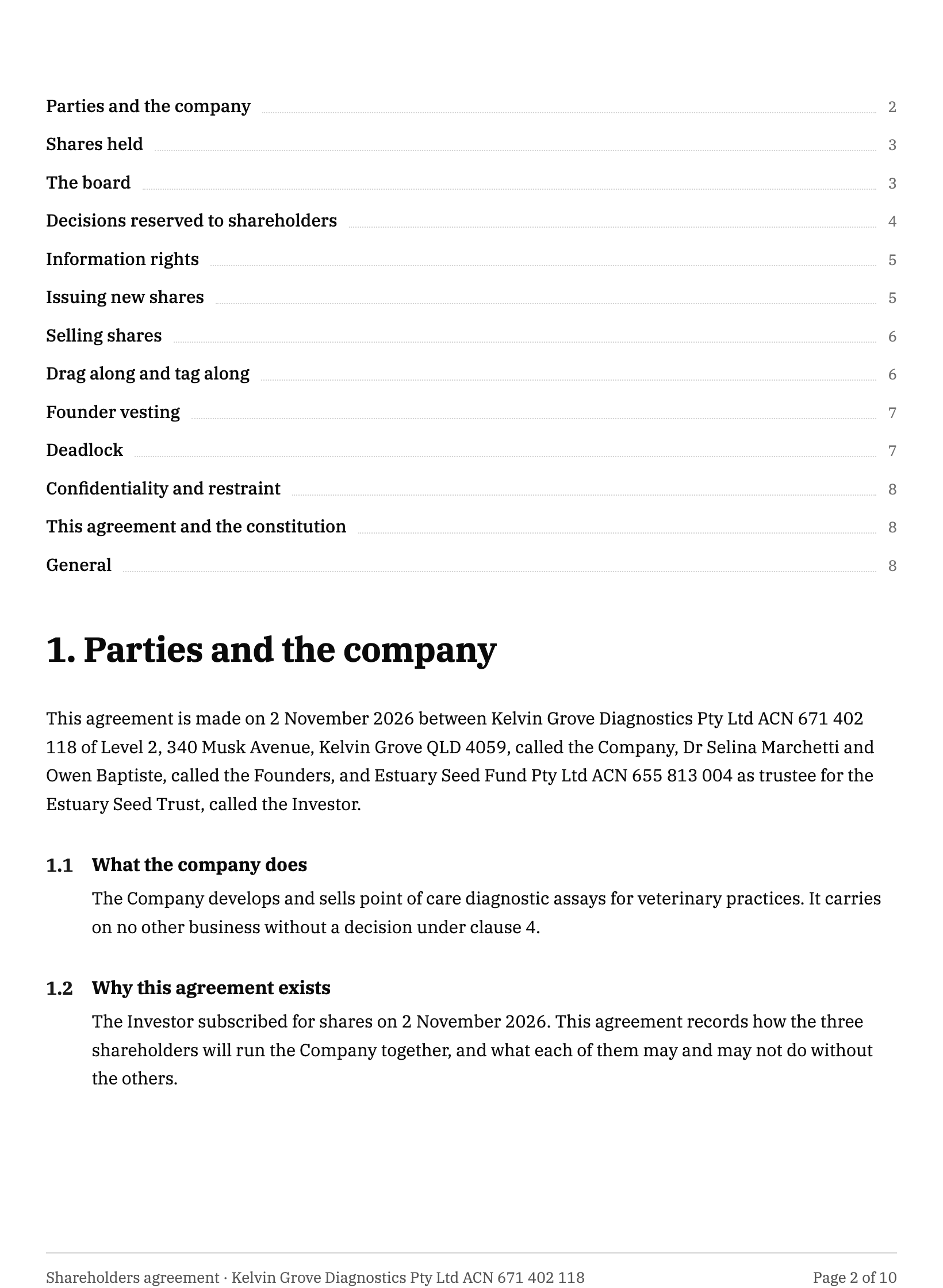 Shareholders agreement templateA veterinary diagnostics company has just taken $1.5 million from one seed fund. The founders keep 80 percent between them, so the whole agreement turns on a single number: the 75 percent consent threshold that puts the investor on one side of every decision that matters.
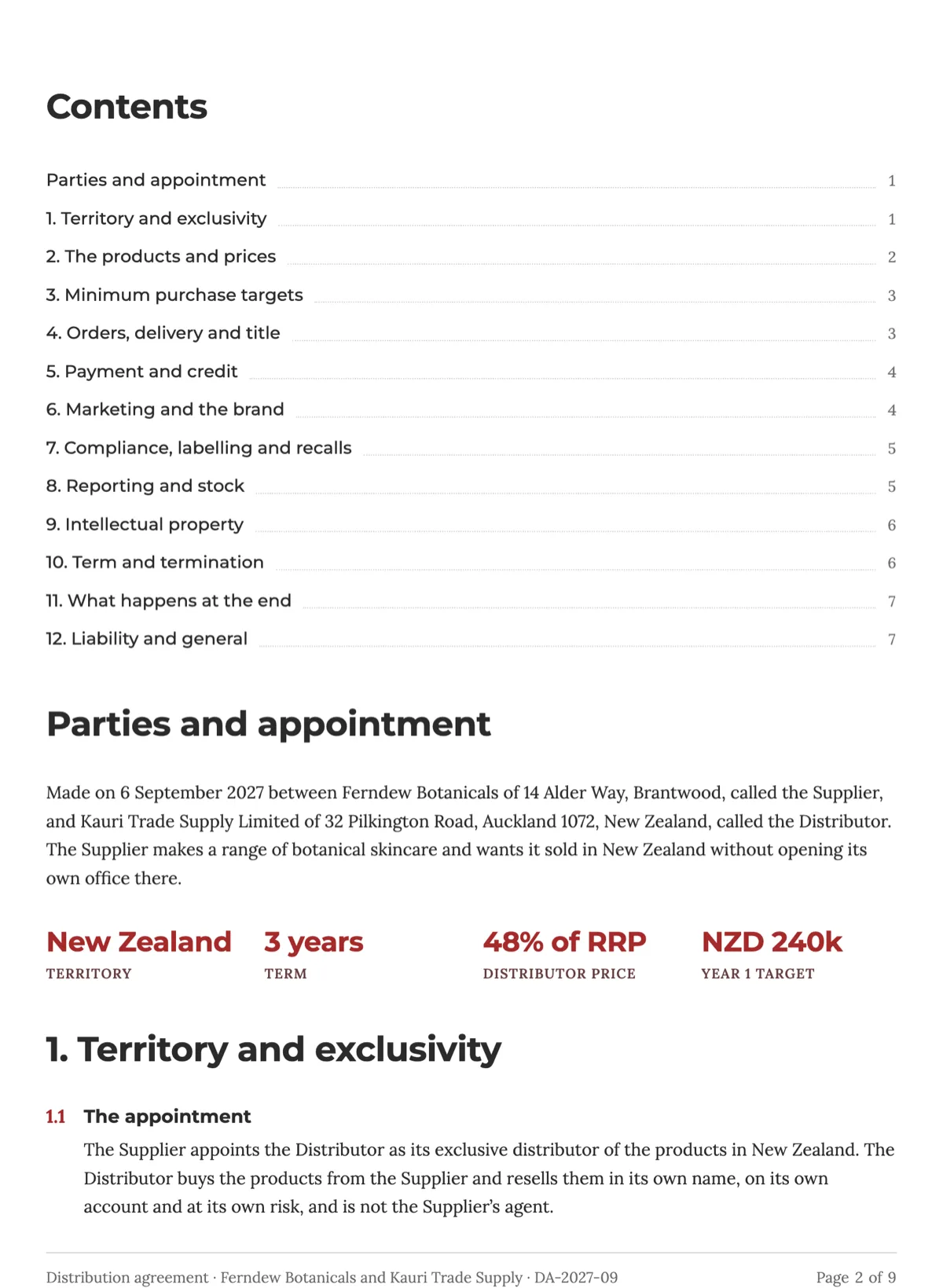 Distribution agreement template with territory and targetsAn exclusive distribution agreement is a trade: a territory in exchange for volume. This one appoints a New Zealand distributor for a skincare range at 48 per cent of recommended retail, with purchase targets rising from NZD 240,000 to NZD 420,000 across three years, and exclusivity that converts to non exclusive if a target is missed by more than 15 per cent.
Questions people ask
What is the difference between exclusive and non exclusive jurisdiction?
Exclusive jurisdiction means the parties agree to sue only in the named courts. Non exclusive jurisdiction means each party accepts those courts but may also sue elsewhere. The first gives certainty about the forum; the second gives flexibility to bring proceedings where the other party or its assets happen to be.
Can a court ignore an exclusive jurisdiction clause?
It can decline to enforce it in limited circumstances, and within Australia a case can be transferred between state courts under cross vesting legislation in the interests of justice. Courts nonetheless give significant weight to the parties' agreement, so a party suing in breach of the clause usually faces a stay or transfer application.
Are asymmetric jurisdiction clauses fair?
In negotiated finance documents they are accepted practice because the lender needs to chase assets. In a standard form consumer or small business contract, a term limiting only one party's right to sue is one of the examples the Australian Consumer Law gives of a term that may be unfair, so symmetry is worth requesting.
Does a jurisdiction clause stop arbitration?
The two can coexist if drafted together, for example courts having jurisdiction to support an arbitration or to grant urgent relief. A contract with an arbitration clause and a broad exclusive jurisdiction clause pointing to courts for all disputes creates a conflict that will be litigated, so one must be expressly subject to the other.
Should the clause mention appeal courts?
It is common and sensible to add the courts entitled to hear appeals from the named courts, so that a submission to the Supreme Court of a state also covers its Court of Appeal and the High Court. Without it, a party could argue that the submission extended only to first instance proceedings.
Which courts should a New Zealand deal name?
Parties commonly choose the home courts of whichever side has the stronger bargaining position, or the courts where enforcement is most likely to be needed. The Trans Tasman Proceedings Act 2010 gives exclusive choice of court agreements designating New Zealand courts real force in Australian proceedings, which makes either choice workable.
Put the clause in a finished document
The button opens the document generator with a starting description already filled in. Change it to match your own agreement before you run it.
Create a document with OneCraftRelated clauses
- Governing law clause: choosing the law that reads the contractA governing law clause picks the law that decides what an Australian contract means. Sample NSW wording, exclusive and non exclusive variants, a split for IP.
- Arbitration clause: a private, binding decision instead of a courtAn arbitration clause sends disputes to a private arbitrator instead of a court. Sample wording with a Sydney seat, plus institutional, ad hoc and US variants.
- Dispute resolution clause: the ladder before anyone goes to courtA dispute resolution clause sets the steps parties must take before suing. Sample three tier ladder with day counts, and negotiation, mediation and arbitration.
For everything the document generator can do, see the document maker.
Step by step in the builder: Create a document with AI, then Document builder components.
Written and checked by the OneCraft team. Last checked .