Contract clause
Arbitration clause: a private, binding decision instead of a court
An arbitration clause is an agreement that disputes will be decided by private arbitrators rather than a court, with the decision, called an award, binding on the parties. The clause should name the seat, the rules, the number of arbitrators and the language, because each choice changes how the process runs and where the award can be challenged.
Arbitration is chosen for three reasons: a neutral forum between parties from different countries, a decision maker with industry expertise, and privacy. A badly drafted clause can lose all three and add a court fight about what the clause meant.
Nuwan Madhusanka · Co-founder
4 min read · Published
Sample clause
a distribution agreement between Yellowbox Irrigation, a fictional Australian manufacturer of drip irrigation controllers, and Paddyfield Agritech, a distributor based in Singapore selling into South East Asia
31. Arbitration 31.1 Any dispute, controversy or claim arising out of, relating to or in connection with this Agreement, including any question about its existence, validity or termination, must be resolved by arbitration administered by the Australian Centre for International Commercial Arbitration under the ACICA Arbitration Rules in force at the date the arbitration starts. 31.2 The seat of arbitration is Sydney, Australia. 31.3 The tribunal consists of one arbitrator. 31.4 The language of the arbitration is English. 31.5 The award is final and binding on the parties, and judgment on it may be entered in any court having jurisdiction. 31.6 Nothing in this clause prevents a party from seeking urgent interim relief from a court of competent jurisdiction. 31.7 This clause is governed by the laws in force in New South Wales.
Sample wording, not legal advice.
Variants
Institutional arbitration with three arbitrators
High value disputes where each party wants to nominate one member of the tribunal.
Any dispute arising out of or in connection with this Agreement must be referred to and finally resolved by arbitration administered by the Australian Centre for International Commercial Arbitration in accordance with its Arbitration Rules. The seat is Melbourne. The tribunal consists of three arbitrators, one nominated by each party and the presiding arbitrator chosen by the two party nominated arbitrators. The language is English.
Ad hoc arbitration under UNCITRAL rules
Parties who want a published procedural framework without paying an institution to administer the case.
Any dispute arising out of or relating to this Agreement must be settled by arbitration in accordance with the UNCITRAL Arbitration Rules. The appointing authority is the Australian Centre for International Commercial Arbitration. The number of arbitrators is one. The place of arbitration is Brisbane, Australia. The language to be used in the arbitral proceedings is English. The award is final and binding.
United States consumer arbitration
A US business contracting with consumers, where the Federal Arbitration Act supports arbitration and the clause must be conspicuous.
PLEASE READ CAREFULLY. You and the Company agree that any dispute arising from these Terms will be resolved by binding individual arbitration under the Federal Arbitration Act, and not in court, except that either party may bring an individual claim in small claims court. You may opt out of this arbitration agreement by written notice sent within 30 days after first accepting these Terms. Arbitration fees for consumer claims are paid by the Company.
What to negotiate
The seat
The seat is the legal home of the arbitration. Its courts supervise the process and hear any challenge to the award, and its arbitration law fills gaps. Parties choose a seat with a supportive arbitration law and courts, often a neutral one where neither party is based. Sydney, Melbourne, Singapore and London are common choices in Asia Pacific deals.
Cost against appeal rights
Arbitration can cost more than litigation for smaller claims because the parties pay the arbitrators and the venue. In exchange it usually offers very limited grounds to set aside an award. Parties with modest likely claims prefer a single arbitrator, expedited procedures, or court for claims below a threshold.
Confidentiality
Arbitration is private, but privacy and confidentiality are not the same. Under the International Arbitration Act 1974, confidentiality provisions apply unless the parties opt out in writing. Other laws and rules differ, so a party that needs the existence and outcome of a dispute kept secret should say so expressly in the clause.
The risk of leaving it out
Without an arbitration clause disputes go to court, which is public and national. For a purely domestic contract that may be fine. For a cross border contract, a court judgment may be hard to enforce where the other party's assets are, whereas an arbitral award can be enforced in the many countries that are party to the New York Convention.
The law behind an Australian seat
For international commercial arbitration seated in Australia, the International Arbitration Act 1974 gives the UNCITRAL Model Law on International Commercial Arbitration the force of law, and where the Model Law applies, state arbitration laws do not. Domestic arbitrations are governed by each state's commercial arbitration act, which is also based on the Model Law. The Act also gives effect to the New York Convention, so a foreign award can be enforced in an Australian court as if it were a judgment, with enforcement refused only on limited grounds such as incapacity, invalidity of the arbitration agreement or lack of proper notice.
Clauses that cause trouble
The recurring problems are easy to avoid. A clause naming an institution that does not exist, or rules the named institution does not administer, invites a court application before the dispute even starts. A clause that says disputes may be referred to arbitration can be read as optional. A contract with an arbitration clause and a separate exclusive court jurisdiction clause, neither subject to the other, creates a conflict that has to be litigated. And a multi tier clause that leads into arbitration needs clear deadlines, otherwise a party can argue arbitration was started too early.
Where it sits in a generated document
An arbitration clause normally replaces or overrides the jurisdiction clause in the general provisions. A generated agreement numbers each clause and sub clause, so seat, rules, tribunal size and language can each be stated as a separate sub clause, which makes gaps easy to spot. Institution and rule names come from the description and nothing is cited, so the exact names need confirming with the institution before the agreement is signed.
Documents that carry this clause
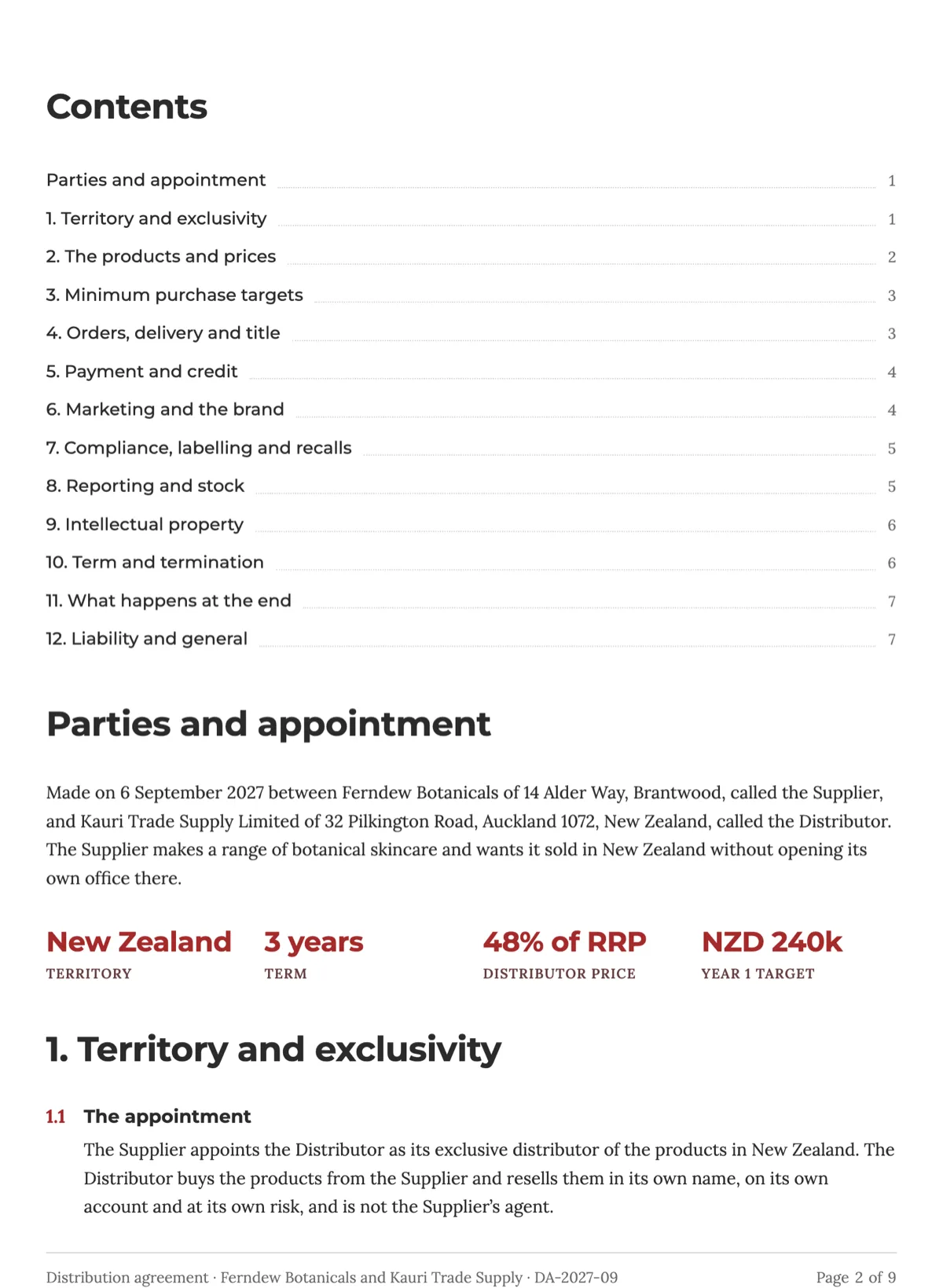 Distribution agreement template with territory and targetsAn exclusive distribution agreement is a trade: a territory in exchange for volume. This one appoints a New Zealand distributor for a skincare range at 48 per cent of recommended retail, with purchase targets rising from NZD 240,000 to NZD 420,000 across three years, and exclusivity that converts to non exclusive if a target is missed by more than 15 per cent.
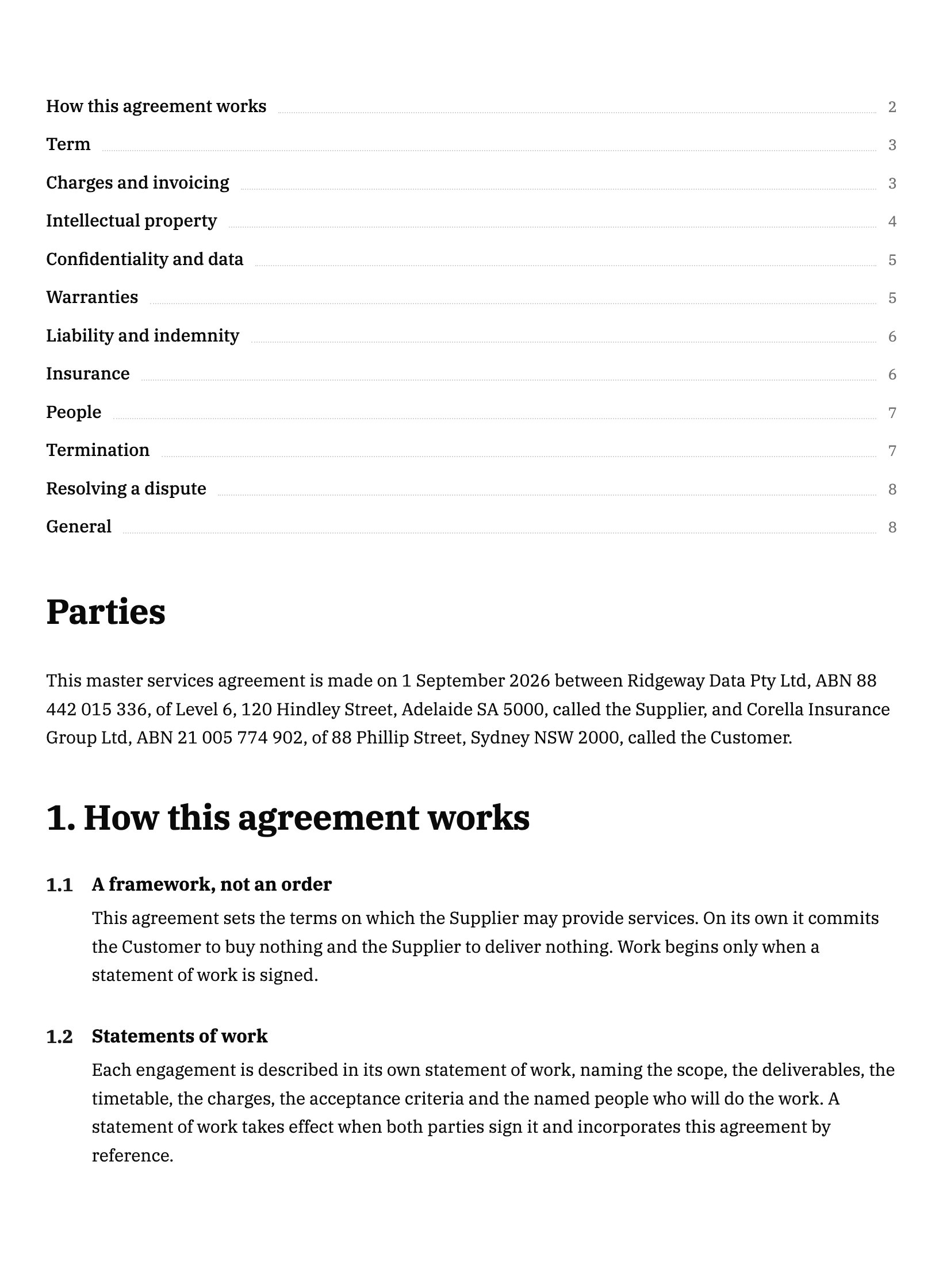 Master services agreementA data consultancy and an insurer sign this once and then buy work under it for three years. It is the rare contract whose whole purpose is to make the next twenty contracts short.
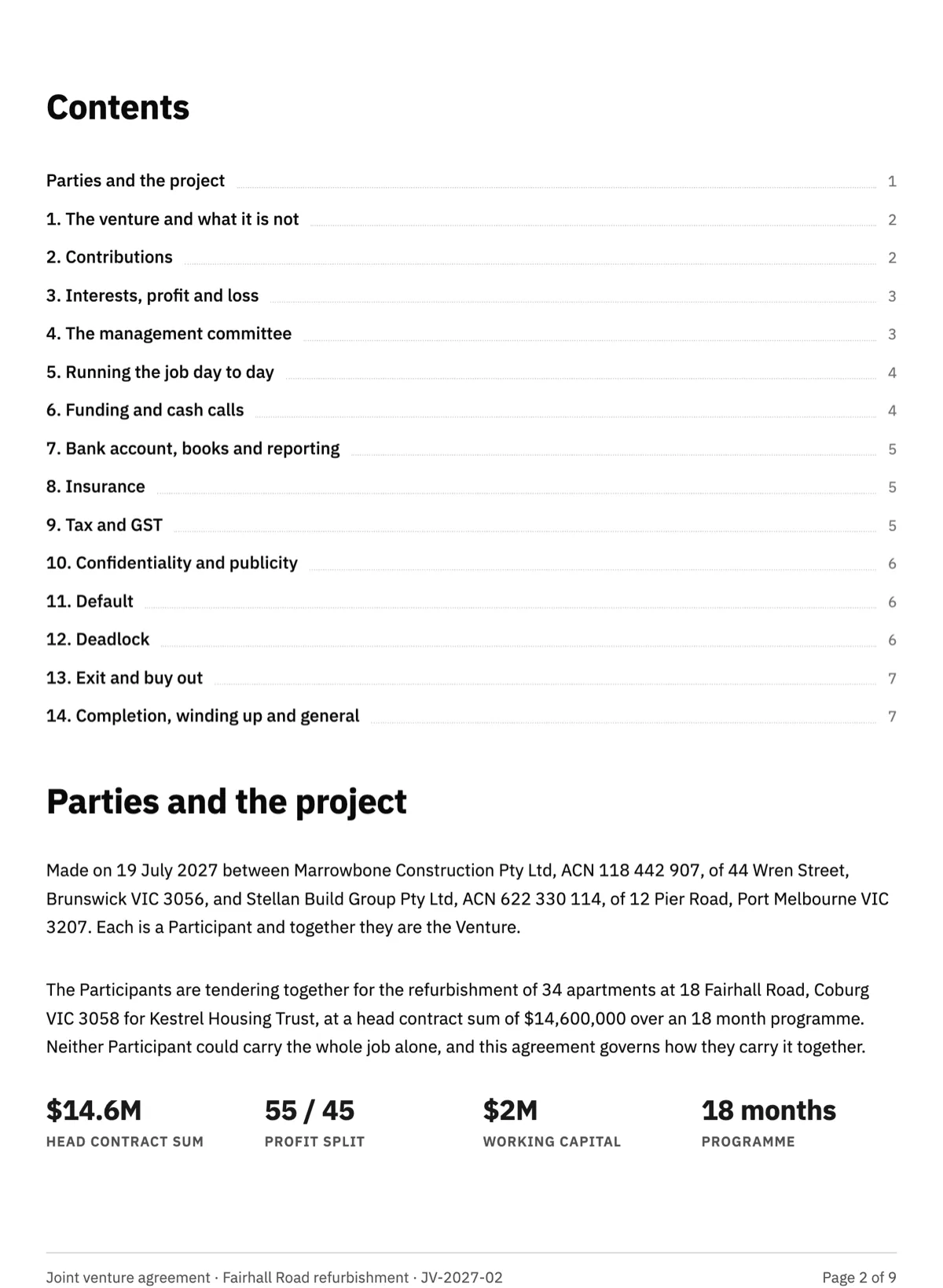 Joint venture agreement template with contributions and splitAn unincorporated joint venture has no company to fall back on, so everything a company structure would supply has to be written down. This one puts two builders together for a single $14.6 million refurbishment, splits it 55/45, and sets out who funds it, who decides, how a deadlock breaks and how either of them gets out.
Questions people ask
Can an arbitration award be appealed in Australia?
Only on narrow grounds. Under the Model Law applied by the International Arbitration Act 1974, an award can be set aside for matters such as invalidity of the arbitration agreement, lack of proper notice, excess of the tribunal's mandate or conflict with public policy. There is no general appeal on the merits in international arbitration.
Is arbitration cheaper than going to court?
Not necessarily. Parties pay the arbitrators, the institution and the venue, which courts do not charge. Arbitration can still save money through a faster timetable, a single hearing and very limited appeals. Expedited procedures and a sole arbitrator bring the cost down for smaller commercial disputes.
What is the difference between seat and venue?
The seat is the legal place of the arbitration, which decides the supervising courts and the procedural law. The venue is where hearings physically happen. An arbitration seated in Sydney can hold hearings in Singapore or by video, and remains a Sydney arbitration for legal purposes.
Are arbitration proceedings confidential?
Hearings are private, but confidentiality depends on the law and rules chosen. The International Arbitration Act 1974 applies confidentiality provisions unless the parties agree in writing that they will not apply. Parties wanting certainty should include an express confidentiality obligation in the clause itself.
Can a consumer be forced to arbitrate in Australia?
Arbitration clauses in consumer contracts are uncommon in Australia and a term limiting a consumer's right to sue in a standard form contract may be examined as potentially unfair under the Australian Consumer Law. In the United States, by contrast, consumer arbitration clauses are widespread and generally enforced under the Federal Arbitration Act.
Why say the clause is governed by a particular law?
An arbitration agreement is treated as separate from the main contract, so its validity can be tested under a different law. Naming the law of the arbitration agreement, usually the law of the seat, removes a preliminary argument that can otherwise delay the start of the arbitration.
Put the clause in a finished document
The button opens the document generator with a starting description already filled in. Change it to match your own agreement before you run it.
Create a document with OneCraftRelated clauses
- Dispute resolution clause: the ladder before anyone goes to courtA dispute resolution clause sets the steps parties must take before suing. Sample three tier ladder with day counts, and negotiation, mediation and arbitration.
- Mediation clause: a required attempt at settlement before litigationA mediation clause requires parties to try mediation before court and sets how the mediator is chosen and paid. Australian sample wording and three variants.
- Governing law clause: choosing the law that reads the contractA governing law clause picks the law that decides what an Australian contract means. Sample NSW wording, exclusive and non exclusive variants, a split for IP.
- Jurisdiction clause: picking the courts before the disputeA jurisdiction clause names the courts that hear a contract dispute. Australian sample wording with exclusive, non exclusive and asymmetric variants explained.
For everything the document generator can do, see the document maker.
Step by step in the builder: Create a document with AI, then Document builder components.
Written and checked by the OneCraft team. Last checked .