Contract clause
Mediation clause: a required attempt at settlement before litigation
A mediation clause obliges the parties to attempt mediation before starting court proceedings, and sets the practical terms: how the mediator is chosen, where and when the mediation happens, who pays, and when the obligation ends. The mediator helps the parties negotiate but decides nothing, so the process is binding only if a settlement is signed.
A mediation clause only works if it can be started on a bad day, when one party does not want to cooperate. The mechanics of appointment, timing and cost are therefore the whole clause, not the fine print.
Indunil Asanka · Co-founder
4 min read · Published
Sample clause
a shareholders agreement between the three founders of Lantana Clinics, a fictional group of physiotherapy practices on the Sunshine Coast, drafted with the expectation that disagreements about expansion will arise
30. Mediation 30.1 If a Dispute is not resolved under clause 29 within 15 Business Days, any Shareholder may by written notice refer it to mediation administered by the Coastal Mediation Centre under its mediation guidelines current at the date of the notice. 30.2 The mediator is the person the parties to the Dispute agree within 5 Business Days of the notice or, failing agreement, the person nominated by the Coastal Mediation Centre. 30.3 The mediation must start within 21 days of the mediator's appointment and be held on the Sunshine Coast or by video conference. 30.4 The mediator's fees and venue costs are shared equally by the parties to the Dispute. Each party bears its own legal costs. 30.5 Each party must attend through a representative with authority to settle. 30.6 If the Dispute is not resolved within 20 Business Days of the mediation starting, any party may end the mediation by written notice.
Sample wording, not legal advice.
Variants
Mediator agreed, or appointed by a professional body
Parties who want flexibility to choose someone with industry experience, with a fallback if they cannot agree.
The parties must appoint a mediator agreed between them within 10 Business Days of a referral notice. If they do not agree, either party may ask the president for the time being of the law society of the State in which the Agreement was signed, or that person's nominee, to appoint an accredited mediator. The parties must accept the appointment and must sign the mediator's standard terms of engagement.
Time capped mediation
A supplier chasing a significant claim that will accept a mediation step but not an open ended delay.
The mediation must be held within 30 days of the mediator's appointment and must not last more than one day unless the parties agree otherwise in writing. If the dispute is not settled by the end of the mediation, or if no mediation has taken place within 45 days of the referral notice for any reason other than the default of the referring party, either party may commence proceedings.
Confidential mediation with a settlement formality
Disputes involving reputations, customers or staff, where the parties want the discussion kept out of any later case.
The mediation is confidential. Statements made and documents produced for it are without prejudice and may not be disclosed or used in any proceedings, except to prove a settlement. No settlement is binding unless it is recorded in writing and signed by each party or its authorised representative. The mediator may not be called as a witness in any proceedings about the dispute.
What to negotiate
Who picks the mediator
Naming a mediator in the contract rarely works because people retire or conflict out. A nominating body is more durable. Parties negotiate which body, whether the mediator must have industry experience, and how long they have to agree before the fallback applies. Five to ten business days is the usual window before the nominator steps in.
Cost sharing
Equal sharing of the mediator's fees is standard and keeps the process neutral. A party with far fewer resources sometimes asks the other to fund the mediator and recover half only if the dispute proceeds, which removes cost as a reason to refuse. Legal costs are almost always borne by each side.
Authority to settle
A mediation attended by someone who must ring head office for every offer rarely settles. Requiring attendance by a person with authority to settle, sometimes within a stated amount, is a common and reasonable request. Larger organisations push back on unlimited authority, so the practical compromise names a senior role rather than a dollar figure.
The risk of leaving it out
Without a mediation clause a party can still suggest mediation, and courts often order it, but nothing obliges the other side to attend before proceedings begin. The parties then spend money on pleadings and discovery before anyone has tested a settlement, and a court ordered mediation happens later, when positions and costs have both hardened.
What a mediator does and does not do
A mediator is a neutral third party who helps the parties identify the issues, explore options and negotiate. The Attorney General's Department classes mediation as a facilitative process, alongside conciliation and facilitated negotiation, as distinct from advisory processes such as expert appraisal and determinative ones such as arbitration. That distinction drives the drafting. Because the mediator imposes no outcome, the clause has to deal with how the process starts, who attends and when it stops, and it has to require any settlement to be written and signed, since an agreement reached in principle late in the day is easy to dispute next morning.
Institutional rules or bespoke terms
A clause can adopt an institution's published guidelines, which fill gaps about preparation, confidentiality and the mediator's role, or it can set every term itself. ACICA, for example, publishes Mediation Rules and a model mediation clause alongside its arbitration services. Adopting rules keeps the contract short and gives an administrator who can nudge a slow party. Bespoke terms suit small disputes where institutional fees are disproportionate. Either way the contract should say which version of any rules applies, usually those current at the date of referral.
Where it sits in a generated document
Mediation usually follows the negotiation steps inside a dispute resolution section, or stands as its own clause in partnership and shareholder agreements. A generated document numbers each clause, so the mediation clause can refer back to the negotiation clause that precedes it. The appointment body, the timeframes and the cost split all come from the description, and the draft carries no citations to any rules it names.
Documents that carry this clause
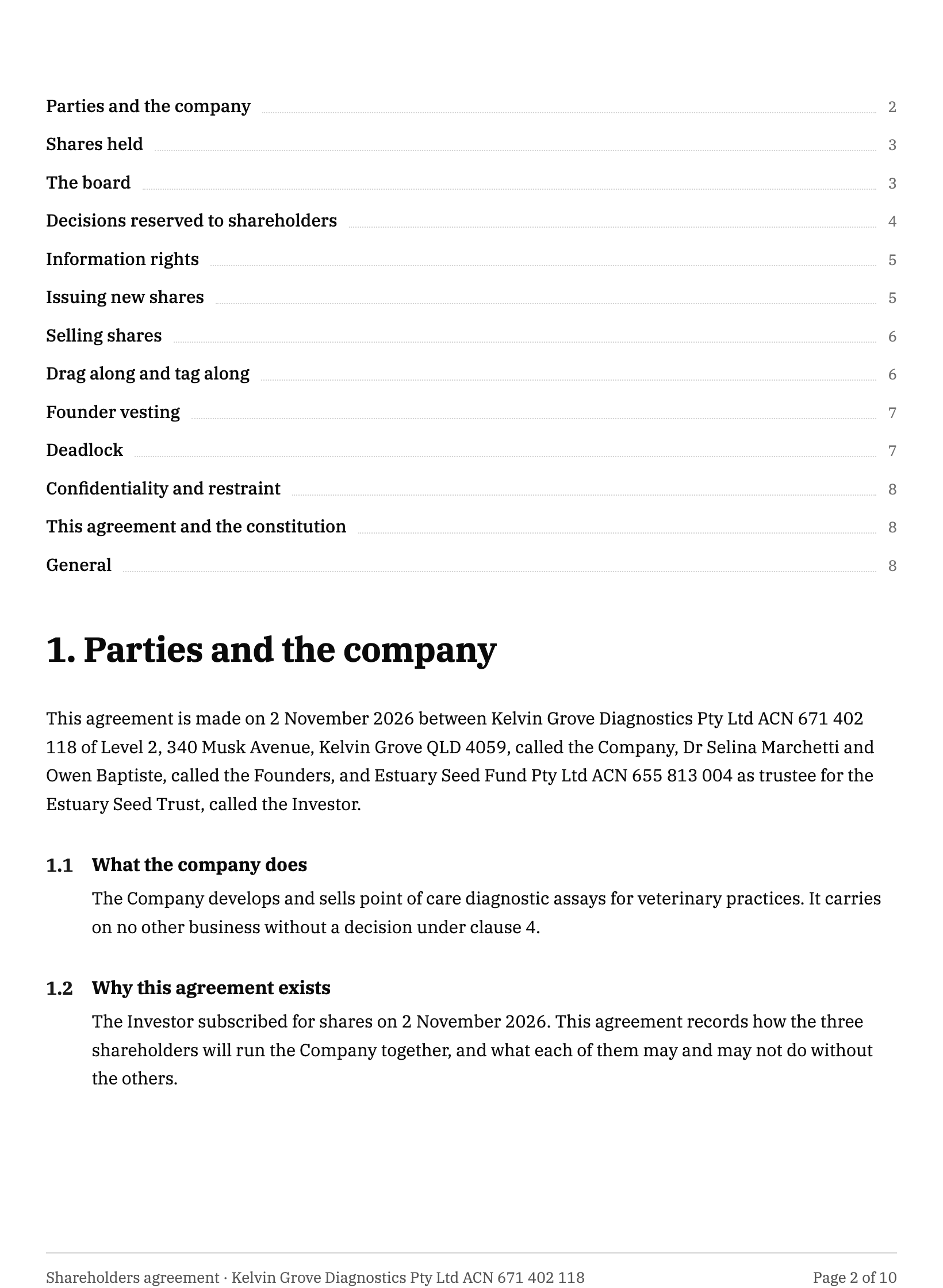 Shareholders agreement templateA veterinary diagnostics company has just taken $1.5 million from one seed fund. The founders keep 80 percent between them, so the whole agreement turns on a single number: the 75 percent consent threshold that puts the investor on one side of every decision that matters.
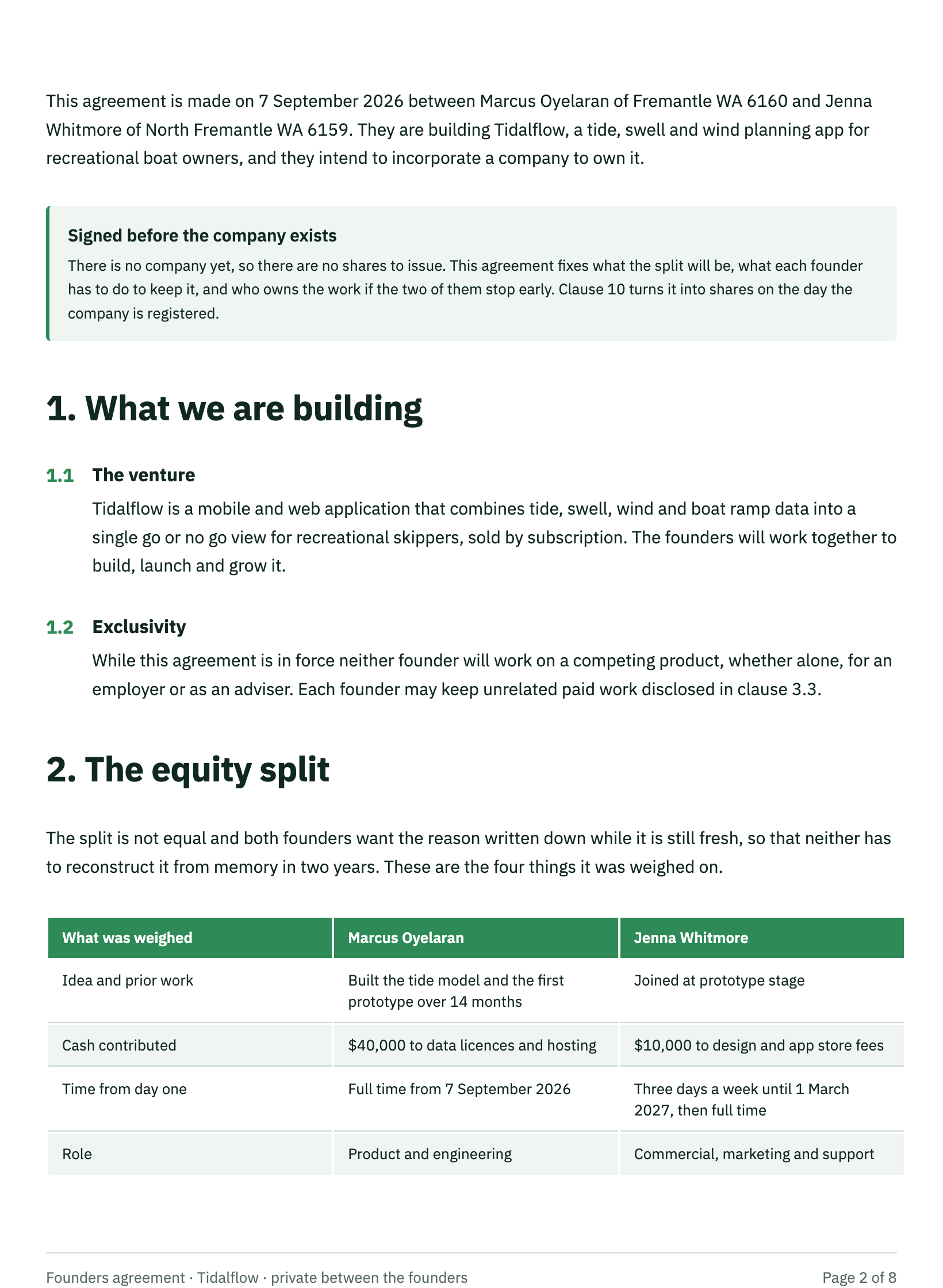 Founders agreement templateTwo people in Fremantle are building a tide and swell planning app and have not registered a company yet. There are no shares to issue, so this agreement fixes the split, records why it is 55/45 while the memory is fresh, and turns itself into shares on the day the company exists.
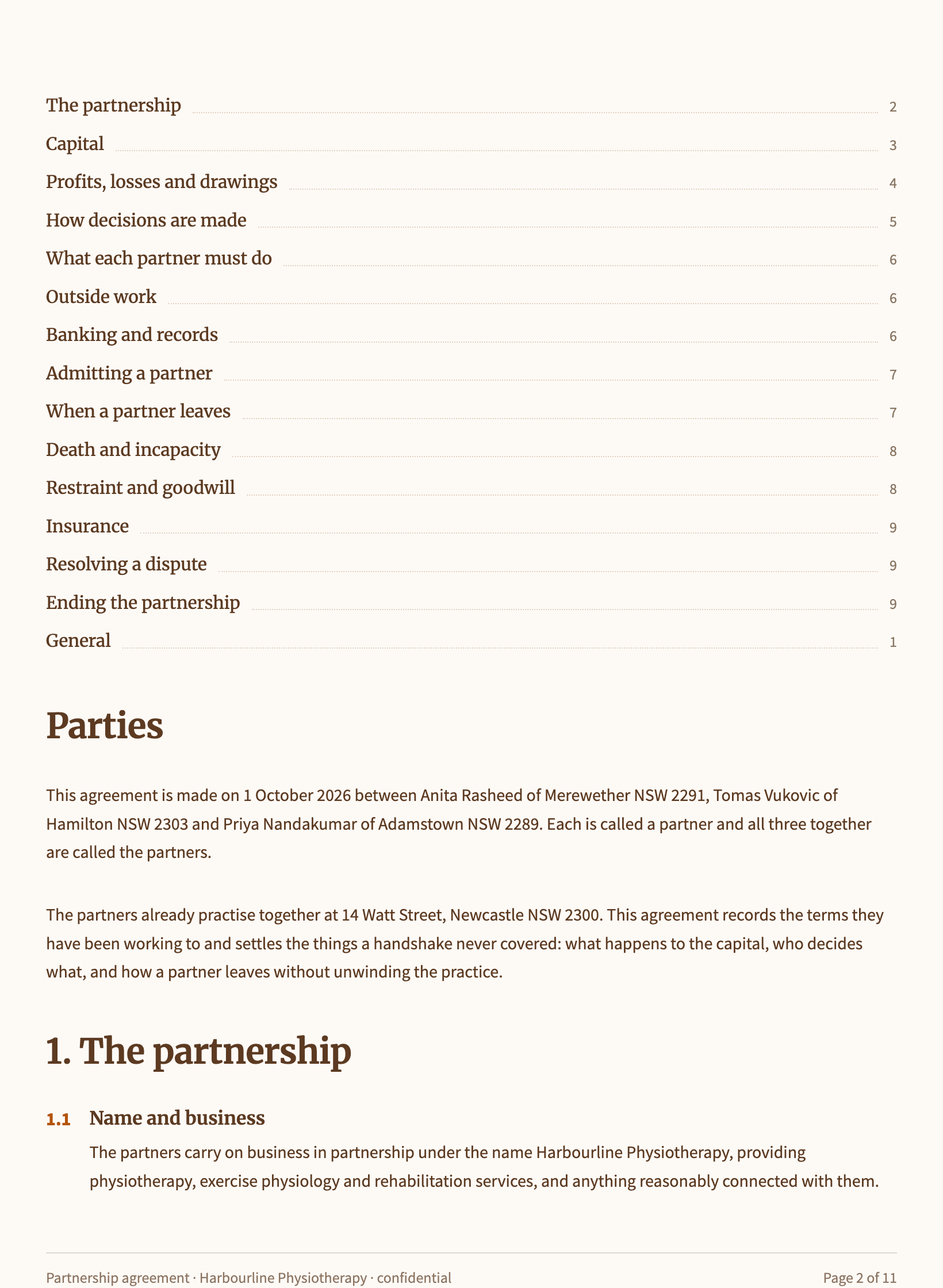 Partnership agreement templateThree physiotherapists have run one Newcastle practice together since 2024 without anything in writing. This agreement records what the handshake never covered: uneven capital sitting beside uneven hours, the six decisions no partner can make alone, and what a leaving partner is owed.
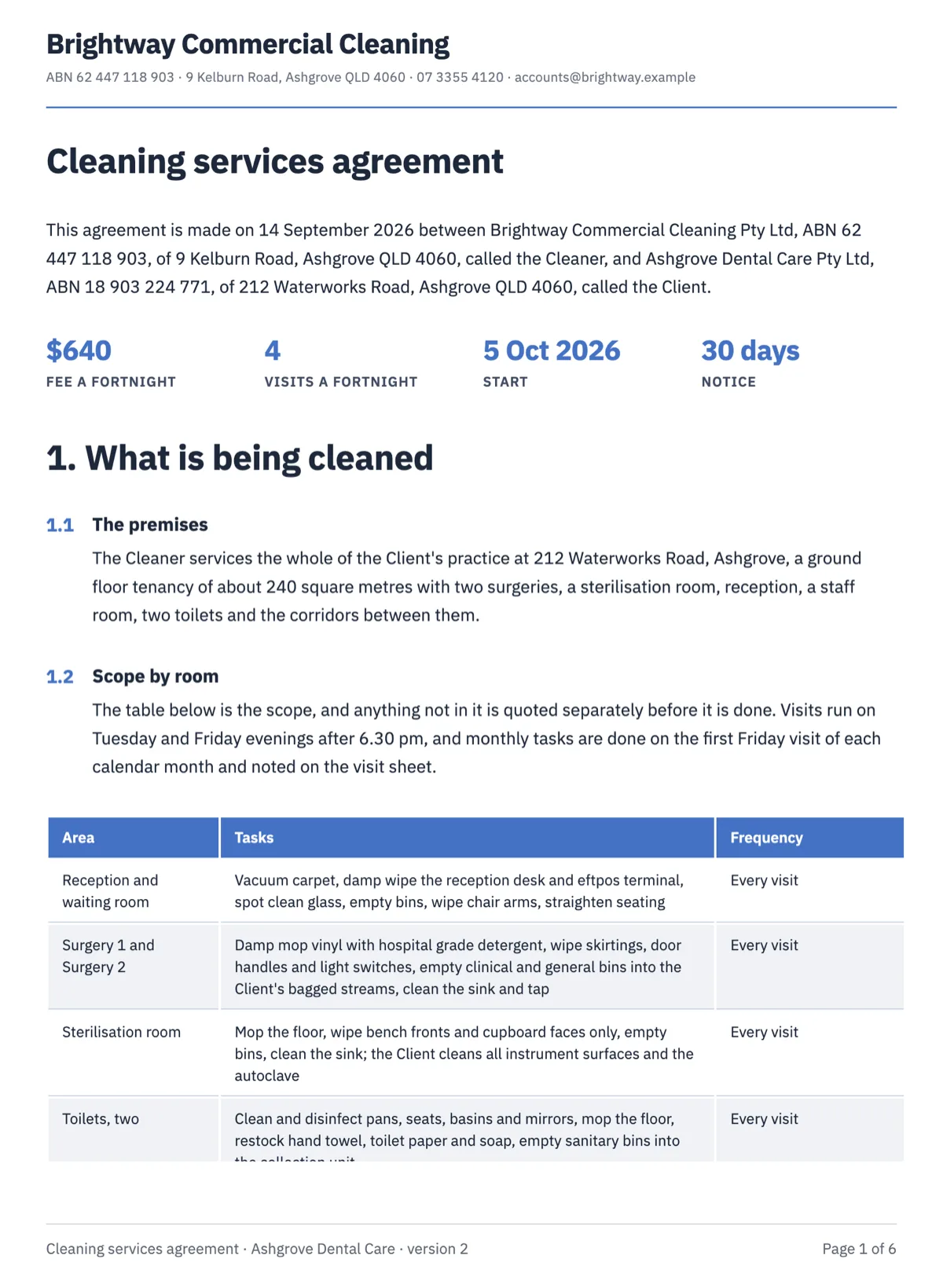 Cleaning services agreement template with a room by room scope tableAlmost every argument about commercial cleaning is an argument about what was in the scope, so this agreement puts the scope in a table with a room, a task list and a frequency on every line. It then settles what a dental practice worries about: who holds the keys, who has been police checked, and what the consumables cost.
Questions people ask
Is mediation binding?
The process is not; the result can be. A mediator cannot impose an outcome, so either party may walk away without settling. If the parties reach agreement and sign terms of settlement, those terms are an enforceable contract. That is why clauses require any settlement to be written and signed before it binds.
Can a court force a party to mediate under the clause?
A court can stay proceedings brought before a sufficiently certain mediation step has been completed, which in practice sends the parties to mediation. It will not force anyone to settle. Courts in several Australian jurisdictions also have their own powers to refer proceedings to mediation, with or without the parties' consent.
How much does a commercial mediation cost?
Mediator fees vary widely with experience and the length of the session, and venue costs add to them, while legal representation is usually the largest expense. Because costs are shared and a one day mediation is far shorter than a trial, mediation is usually a fraction of the cost of litigating the same dispute.
Should lawyers attend the mediation?
Parties may attend with or without lawyers unless the clause or the mediator's terms say otherwise. For complex or high value disputes, legal advice during the session helps parties test offers against their prospects. Some clauses require notice if a party intends to bring lawyers, so the other side can do the same.
What happens if one party refuses to attend?
The clause should make that failure count as the end of the step, so the other party can proceed to court. A time capped variant does this by allowing proceedings once a stated period passes without a mediation for reasons other than the referring party's default. Without such wording, refusal can create a stalemate.
Is what is said at mediation confidential?
Statements made in a genuine attempt to settle are generally protected as without prejudice, and mediators' terms usually add confidentiality obligations. A clause that states confidentiality expressly, and prevents the mediator being called as a witness, removes doubt about whether admissions made in the session can later be used.
Put the clause in a finished document
The button opens the document generator with a starting description already filled in. Change it to match your own agreement before you run it.
Create a document with OneCraftRelated clauses
- Dispute resolution clause: the ladder before anyone goes to courtA dispute resolution clause sets the steps parties must take before suing. Sample three tier ladder with day counts, and negotiation, mediation and arbitration.
- Arbitration clause: a private, binding decision instead of a courtAn arbitration clause sends disputes to a private arbitrator instead of a court. Sample wording with a Sydney seat, plus institutional, ad hoc and US variants.
- Governing law clause: choosing the law that reads the contractA governing law clause picks the law that decides what an Australian contract means. Sample NSW wording, exclusive and non exclusive variants, a split for IP.
For everything the document generator can do, see the document maker.
Step by step in the builder: Create a document with AI, then Document builder components.
Written and checked by the OneCraft team. Last checked .