Contract clause
Dispute resolution clause: the ladder before anyone goes to court
A dispute resolution clause sets out the steps the parties must follow when they disagree, in order and with deadlines, before either can start court proceedings. A typical ladder escalates from the people running the contract to senior executives, then to mediation, and sometimes ends in arbitration or expert determination instead of a court.
Most contract disputes are settled by people who know the project, provided someone makes them sit down before lawyers are briefed. A tiered clause forces that conversation to happen early and on a timetable, while keeping the door open for urgent court orders.
Nuwan Madhusanka · Co-founder
4 min read · Published
Sample clause
a three year managed IT services agreement between Paperbark Systems, a fictional managed services provider in Hobart, and the Derwent Valley Credit Union, which outsources its help desk and network monitoring
28. Dispute Resolution 28.1 A party claiming that a Dispute has arisen must give the other a Dispute Notice describing the Dispute and the outcome it seeks. 28.2 The parties must resolve the Dispute in the following order: Tier 1, Contract Managers: meet within 5 Business Days of the Dispute Notice and try to resolve it within 10 Business Days. Tier 2, Chief Executives: if Tier 1 fails, meet within a further 10 Business Days. Tier 3, Mediation: if Tier 2 fails, refer the Dispute to mediation under clause 29, to start within 20 Business Days. 28.3 A party may not commence court proceedings about a Dispute until Tier 3 has ended without resolution, except to seek urgent interim relief. 28.4 Each party must continue to perform this Agreement while a Dispute is being resolved. 28.5 Anything said or produced for the purpose of resolving a Dispute under this clause is without prejudice and may not be used in later proceedings.
Sample wording, not legal advice.
Variants
Tiered negotiation only
Small or short contracts where the cost of a mediator is out of proportion to what is likely to be in dispute.
If a dispute arises, either party may give written notice to the other. Within 10 Business Days of that notice, the parties' nominated representatives must meet and try in good faith to resolve it. If it is not resolved within a further 10 Business Days, each party's most senior executive must meet within 10 Business Days. If the dispute remains unresolved after that meeting, either party may commence proceedings.
Negotiation then mediation
Ongoing commercial relationships where both parties want a facilitated attempt at settlement before litigation.
Any dispute must first be referred to senior representatives of each party, who must meet within 10 Business Days of written notice. If the dispute is not resolved within 20 Business Days of that notice, either party may refer it to mediation. The mediation must be conducted in Australia by a mediator agreed by the parties or, failing agreement within 5 Business Days, appointed by an independent dispute resolution body. Neither party may commence proceedings until the mediation has ended.
Negotiation, mediation, then arbitration
Cross border or confidential disputes where the parties want a binding private decision rather than a public court judgment.
A dispute not resolved within 20 Business Days of written notice must be referred to mediation. If it is not resolved within 30 Business Days after the mediator is appointed, either party may refer it to arbitration by a single arbitrator seated in Sydney under the ACICA Arbitration Rules. The arbitrator's award is final and binding on the parties. Nothing in this clause prevents a party seeking urgent interim relief from a court.
Expert determination for technical disputes
Contracts where many likely disputes turn on a measurement, a valuation or whether software meets a specification.
A Technical Dispute must be referred to an independent expert with at least ten years experience in the relevant field, agreed by the parties or appointed by the president of the relevant professional body. The expert acts as an expert and not as an arbitrator, must decide within 30 Business Days of appointment, and the determination is final and binding except for manifest error. All other disputes follow clause 28.
What to negotiate
Day counts that actually end
A ladder with no deadlines lets a reluctant party stall indefinitely. Each tier should end on a fixed number of days, and the clause should say what happens if the other side does not turn up. Suppliers owed money prefer short tiers; customers holding a defect claim prefer longer ones. Totals of 40 to 60 business days are common.
Carve outs for urgent relief and debts
Nobody should have to mediate before stopping a leak of confidential information. The standard carve out allows urgent interim relief at any time. Suppliers also ask to exclude undisputed invoices from the ladder, so a debt recovery claim is not delayed by a process meant for genuine disagreements.
Keep performing
Customers want the supplier to keep delivering during a dispute, and suppliers want to keep being paid. A continued performance obligation usually applies to both, with an exception for suspension rights already in the contract, such as suspension after non payment of an undisputed amount.
The risk of leaving it out
Without a clause either party can go straight to court or to a lawyer's letter, which tends to harden positions and make the dispute expensive before its merits are understood. In the Federal Court and the Federal Circuit and Family Court, applicants must still file a statement of the genuine steps taken to resolve the dispute, so skipping the conversation carries its own cost.
Why tiers work
The people managing a contract know the facts but are often too invested to compromise; senior executives are further away and can weigh the relationship against the amount in dispute. A mediator adds structure and a neutral voice. Each tier costs more than the one before, so the ladder filters out disputes that can be settled cheaply and leaves only the hard ones for a binding process. The Attorney General's Department describes alternative dispute resolution as facilitative, advisory or determinative, and a well built ladder moves through those types in order. The ladder also produces a paper trail: each notice and meeting shows who tried to settle and when, which matters later for costs.
Making the clause enforceable
Courts will generally hold parties to a dispute resolution clause and stay proceedings started in breach of it, but only if the process is certain enough to follow. That means a clear trigger notice, identified participants or a mechanism for appointing them, fixed time limits and a defined end point after which proceedings may begin. An obligation to negotiate in good faith, with those boundaries, is enforceable; a vague promise to attempt amicable resolution is much weaker. The Civil Dispute Resolution Act 2011 separately requires a genuine steps statement when federal court proceedings are filed.
Where it sits in a generated document
A dispute ladder is easier to follow as numbered tiers than as a paragraph, and a generated agreement writes clauses and sub clauses with their own numbers, so each tier and each deadline gets a reference. The day counts come from the description and nothing is cited, so they should be added up and checked against the jurisdiction clause before signing.
Documents that carry this clause
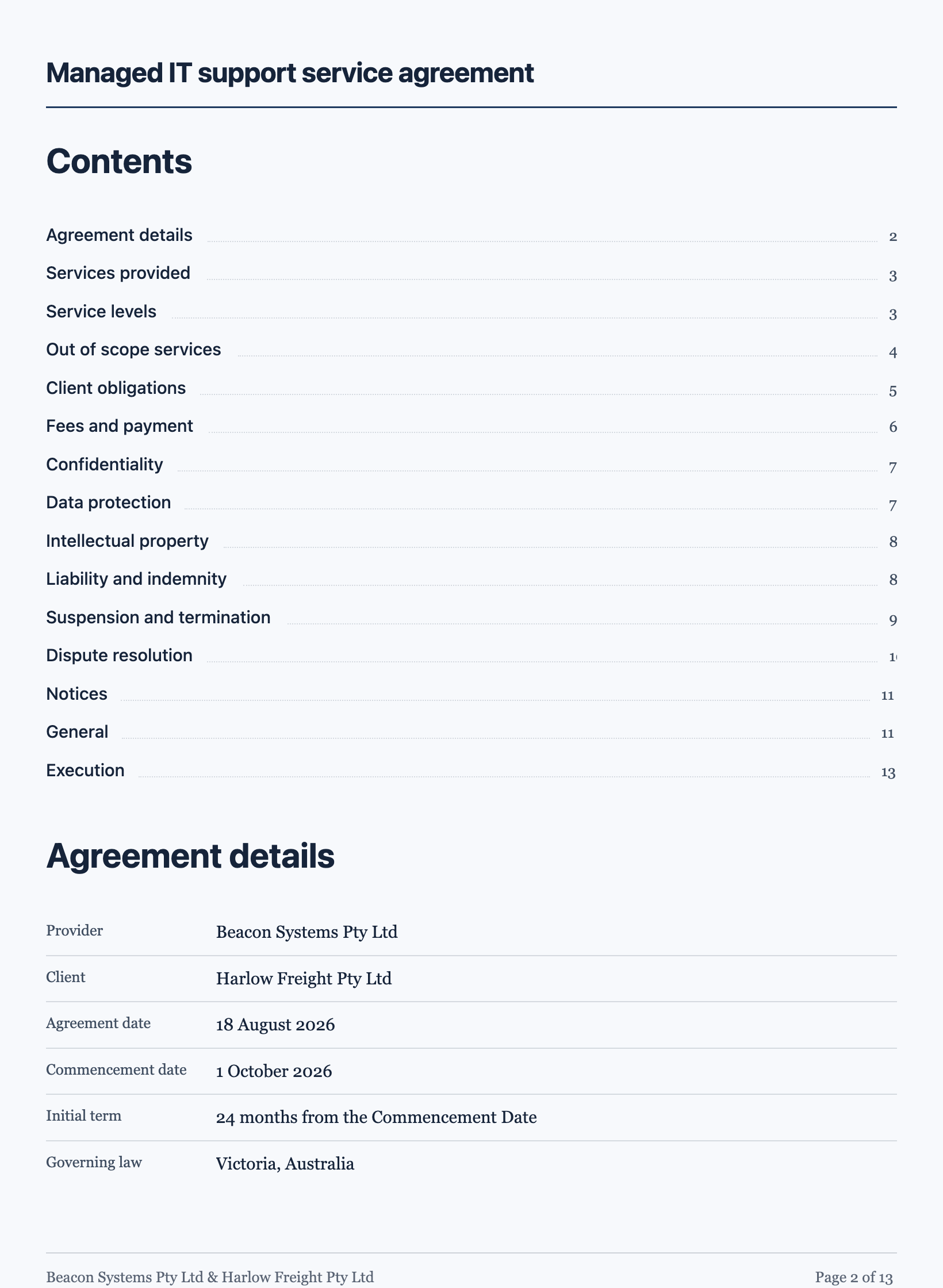 Service agreementBeacon Systems supports Harlow Freight’s IT for an initial 24 months from 1 October 2026 at $8,400 a month plus GST, with 40 hours included and $220 an hour beyond them. Twelve numbered clauses cover the services, a four level severity table, client duties, fees with a CPI adjustment, confidentiality, privacy, IP, a liability cap, termination and a three step dispute ladder.
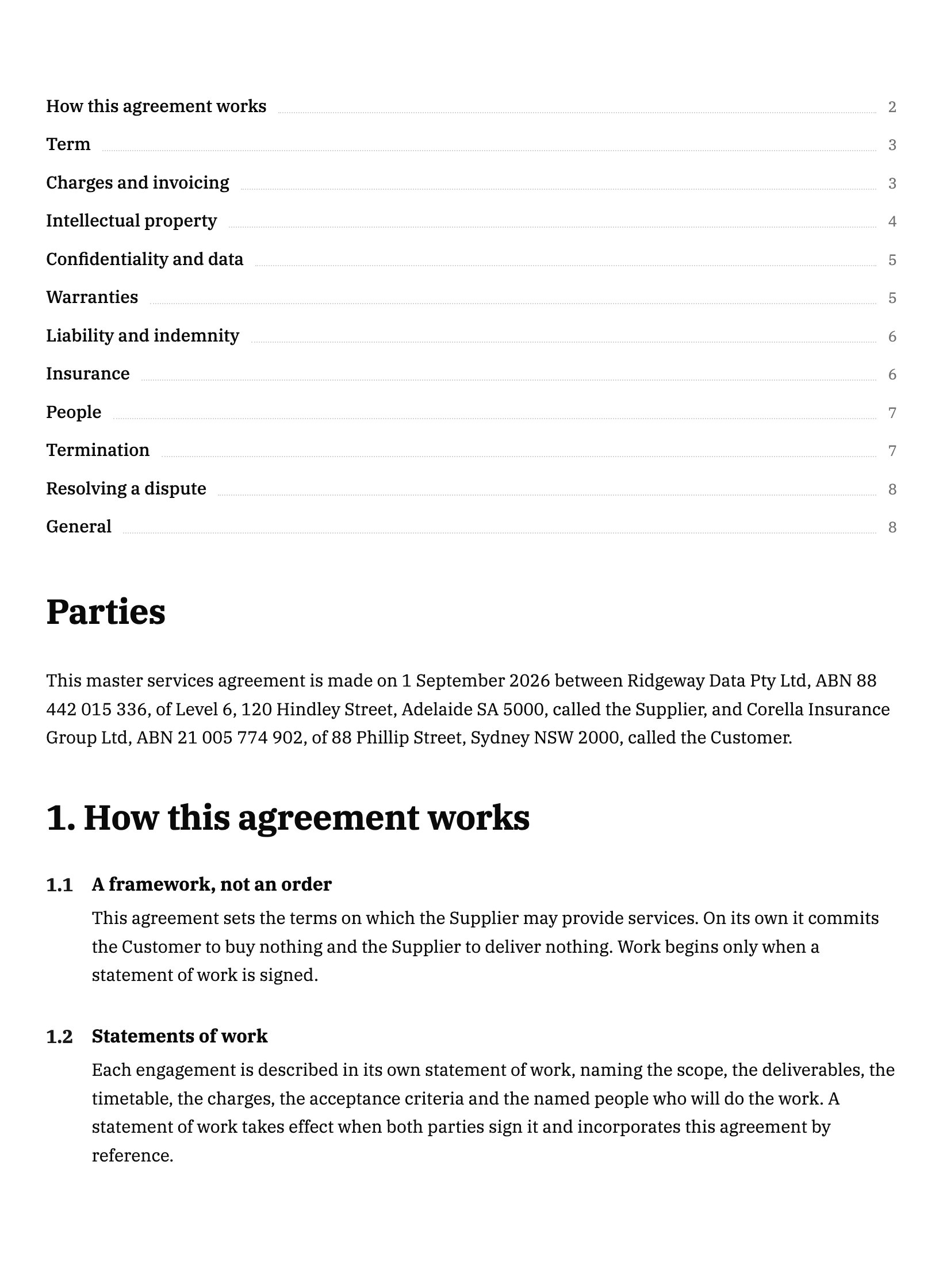 Master services agreementA data consultancy and an insurer sign this once and then buy work under it for three years. It is the rare contract whose whole purpose is to make the next twenty contracts short.
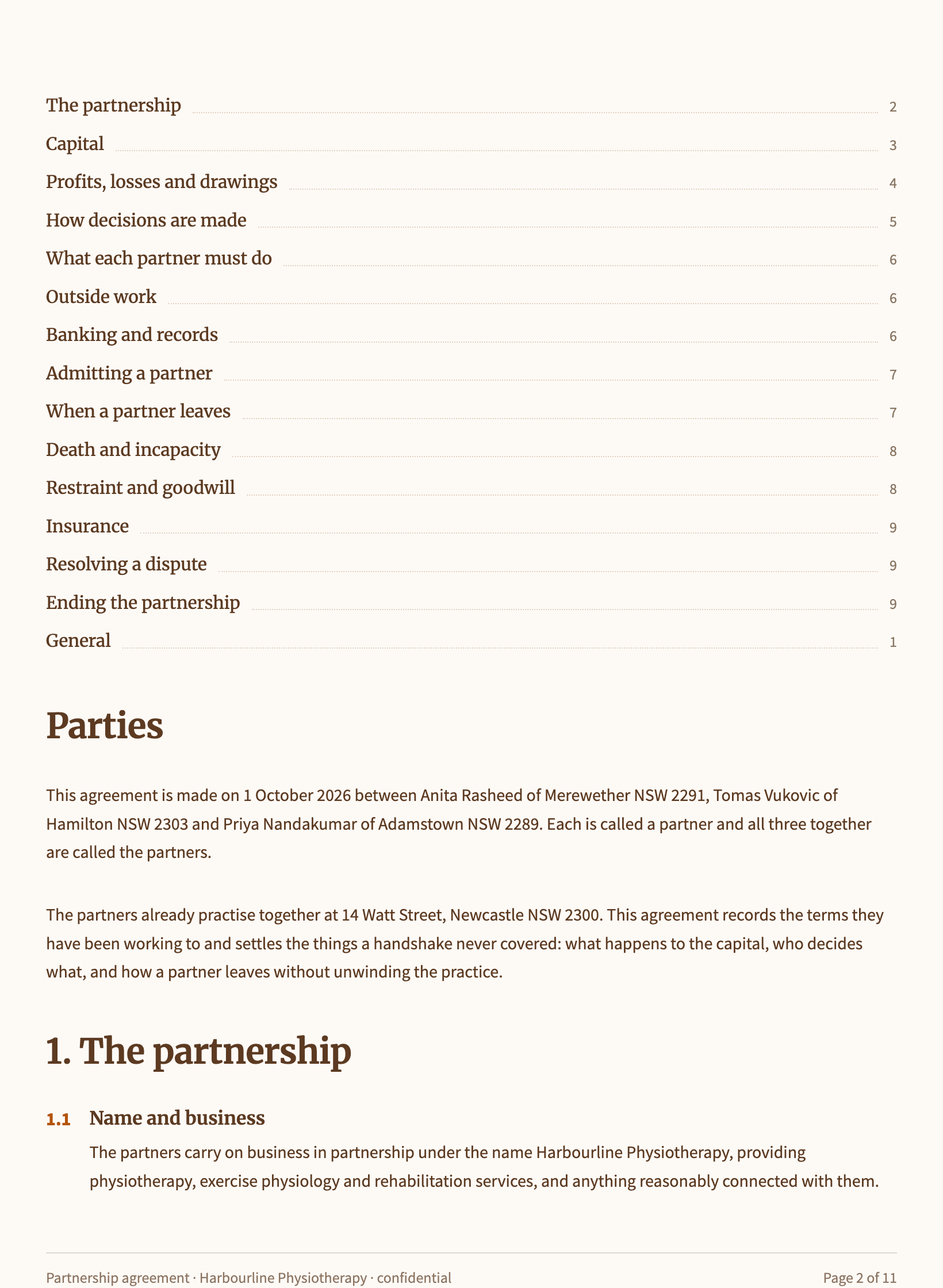 Partnership agreement templateThree physiotherapists have run one Newcastle practice together since 2024 without anything in writing. This agreement records what the handshake never covered: uneven capital sitting beside uneven hours, the six decisions no partner can make alone, and what a leaving partner is owed.
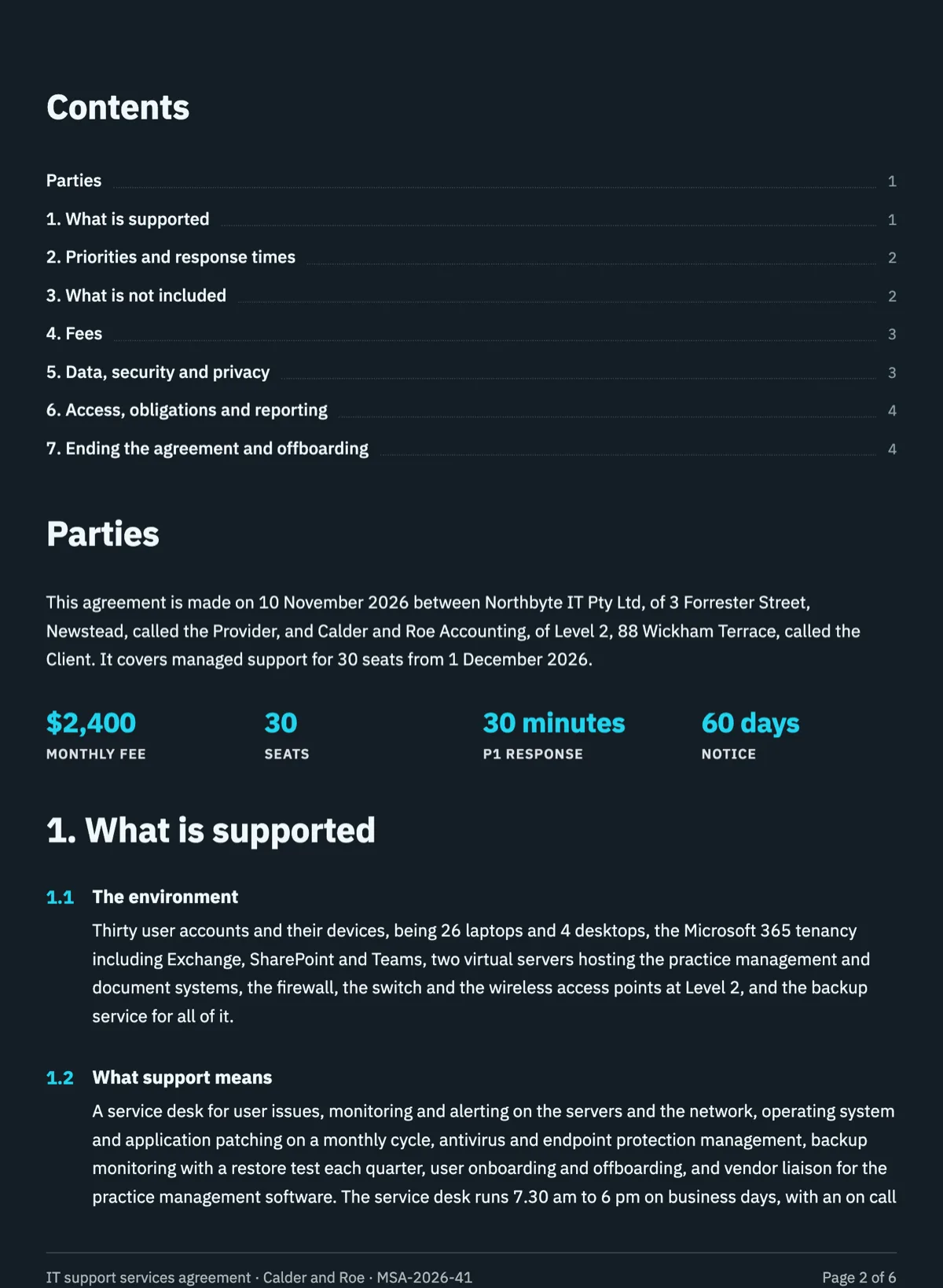 IT support services agreement with response times by priorityManaged support is sold on a monthly fee and judged on how fast the phone gets answered when nobody can work. This agreement grades every ticket into four priorities with a published response and resolution target, credits the fee when the target is missed, and writes down exactly what the provider hands back on the way out.
Questions people ask
Are tiered dispute resolution clauses enforceable in Australia?
Generally yes, where the steps are sufficiently certain. Courts have stayed proceedings brought before the agreed process was completed. Certainty comes from a defined trigger, named participants or an appointment mechanism, fixed time limits and a clear point at which the process ends and litigation may start.
Can a party skip the tiers for an urgent injunction?
Only if the clause allows it, and almost all do. An urgent interim relief carve out lets a party ask a court to stop an imminent harm, such as disclosure of confidential information or removal of equipment, without first completing negotiation or mediation. The substantive dispute still goes through the ladder.
What is a genuine steps statement?
A document an applicant must file when starting civil proceedings in the Federal Court or the Federal Circuit and Family Court, setting out the steps taken to resolve the dispute or why none were taken. A contractual dispute ladder, followed properly, produces exactly the record that statement asks for.
Should expert determination be part of the ladder?
It suits disputes about a number or a technical fact, such as a valuation, a measurement or whether a system meets a specification. It is faster and cheaper than arbitration but gives limited grounds for challenge, so parties usually confine it to defined technical disputes and send everything else through the ordinary ladder.
Does the ladder apply to unpaid invoices?
Unless the clause says otherwise, a customer can invoke it to delay payment by claiming a dispute. Suppliers commonly exclude claims for undisputed amounts, or require the undisputed part of an invoice to be paid while the ladder runs, so the process deals with real disagreements rather than cash flow.
How long should the whole process take?
Enough time to be useful, not enough to become a tactic. Commercial ladders often run 40 to 60 business days from notice to the end of mediation. Shorter periods suit simple supply contracts; longer ones suit complex projects where gathering documents for a mediation genuinely takes weeks.
Put the clause in a finished document
The button opens the document generator with a starting description already filled in. Change it to match your own agreement before you run it.
Create a document with OneCraftRelated clauses
- Mediation clause: a required attempt at settlement before litigationA mediation clause requires parties to try mediation before court and sets how the mediator is chosen and paid. Australian sample wording and three variants.
- Arbitration clause: a private, binding decision instead of a courtAn arbitration clause sends disputes to a private arbitrator instead of a court. Sample wording with a Sydney seat, plus institutional, ad hoc and US variants.
- Jurisdiction clause: picking the courts before the disputeA jurisdiction clause names the courts that hear a contract dispute. Australian sample wording with exclusive, non exclusive and asymmetric variants explained.
- Notices clause: how a formal notice is sent and when it landsA notices clause sets how formal notices under a contract are sent and when they count as received. Sample email wording, a deemed receipt table and variants.
For everything the document generator can do, see the document maker.
Step by step in the builder: Create a document with AI, then Document builder components.
Written and checked by the OneCraft team. Last checked .