Contract clause
Most favoured customer clause: promising the best price
A most favoured customer clause is a promise that no comparable customer is charged less for the same thing during the term. It defines which customers count as comparable, how a lower price is detected, and what the buyer receives when one is found, usually a rebate or a reduction going forward.
A buyer asks for this clause to stop shopping every year. A supplier gives it and quietly loses the ability to discount anywhere else, which is why the definition of comparable does all the work.
Indunil Asanka · Co-founder
4 min read · Published
Sample clause
a three year software licence between a fictional regional council and Tanner Civic Systems, a vendor that also sells to larger metropolitan councils
9. Pricing commitment 9.1 Tanner Civic Systems warrants that the Licence Fees are no higher than the fees it charges any Comparable Customer for the same Modules at the same user tier during the Term. 9.2 Comparable Customer means an Australian local government body licensing the same Modules within twenty per cent (20%) of the Customer's user numbers, under a term of at least three years, without any implementation or professional services bundled into the fee. 9.3 Tanner Civic Systems must notify the Customer in writing within twenty (20) business days of entering into an agreement with a Comparable Customer at a lower fee, stating the lower fee and the date it took effect. 9.4 Where clause 9.3 applies, the Licence Fees reduce to the lower fee from the date the lower fee took effect, and Tanner Civic Systems must credit the difference already paid against the next invoice. 9.5 Once in each twelve month period the Customer may require a statutory declaration from a director of Tanner Civic Systems confirming compliance with clause 9.1.
Sample wording, not legal advice.
Variants
Comparable customers only, tightly defined
The supplier sells to very different buyers and cannot expose its whole price list to one of them.
The commitment in this clause applies only to a customer that licenses the same modules, at the same volume tier, on a term of equal or greater length, in the same country, and without any bundled services. A price offered to a customer that differs in any of those respects is not a comparable price and does not trigger this clause. The Supplier is not required to disclose the identity of any customer or the terms of any other agreement.
Prospective adjustment rather than a rebate
The supplier can accept future price alignment but not a repayment of revenue already recognised.
If the Supplier charges a Comparable Customer a lower fee, the Customer's fees reduce to that lower fee from the first day of the next billing period after the Supplier gives notice. No credit, rebate or repayment is payable for any earlier period. The Supplier must give notice within twenty (20) business days of the lower fee taking effect, and the Customer's only remedy for a failure to notify is the reduction backdated to that date.
Audit backed
The buyer is a public body that has to be able to demonstrate compliance rather than take a warranty on trust.
Once in each twelve month period the Customer may appoint an independent auditor, bound by confidentiality, to verify compliance with this clause. The auditor may inspect the Supplier's pricing records for comparable agreements and may report only whether a lower fee has been charged and, if so, the amount of the difference. The auditor must not disclose customer identities. The Customer bears the cost of the audit unless a breach is found, in which case the Supplier bears it.
What to negotiate
What comparable means
This is the whole clause. A supplier wants comparability defined by module, volume tier, term length, country and whether services are bundled. A buyer wants it defined loosely enough to catch real discounts. Every element the supplier adds narrows the promise, and a definition with five elements often catches nothing at all.
Rebate or prospective reduction
Buyers ask for money back from the date the lower price started. Suppliers resist repaying revenue already reported and offer alignment going forward. The usual settlement is a prospective reduction with a credit limited to the period since the supplier should have given notice, which rewards prompt disclosure.
How compliance is verified
A bare warranty is unverifiable, and a full audit of a supplier's price list is more than most suppliers will give. An annual statutory declaration by a director is the middle ground, cheap to produce and uncomfortable enough to be meaningful. Public buyers who need more usually accept a narrowly scoped independent audit.
The risk of leaving it out
Without the clause a buyer has no contractual answer when it learns a similar organisation pays less for the same product, other than to renegotiate or go to market. For many buyers that is acceptable, since the alternative is a clause that is hard to police. The real cost of omission is that annual price benchmarking becomes the only protection.
The competition law question
Price parity promises attract regulatory attention because of what they do to a market rather than what they do to the parties. A network of such commitments can hold prices up, since a supplier that cannot discount to one buyer without repricing others has little reason to discount at all. In Australia the Competition and Consumer Act 2010 prohibits conduct that substantially lessens competition, and the Australian Competition and Consumer Commission has examined parity arrangements in several sectors. European regulators have gone further on wide parity clauses in online platforms. A single clause between two ordinary commercial parties is a very different thing from a market wide practice, but the direction of travel is worth knowing before asking for one.
Common mistakes
Comparability is left undefined, so the promise either catches everything or nothing depending on who is arguing. The clause requires disclosure of another customer's terms, which the supplier cannot lawfully give. It has no notification duty, so the buyer only discovers a breach by accident. And it survives after the term, which turns a pricing commitment into an open ended audit right the supplier never intended to grant.
Where it sits in a generated document
A pricing commitment belongs beside the fee schedule, not in the general clauses, because it defines a warranty about the numbers in that schedule. Generated master agreements number the clauses, so the definition of a comparable customer can sit as its own sub clause and be referenced by the notification and rebate mechanics beneath it. The pricing sheet is produced as a separate document from the same builder, with the tiers set out in a table.
Documents that carry this clause
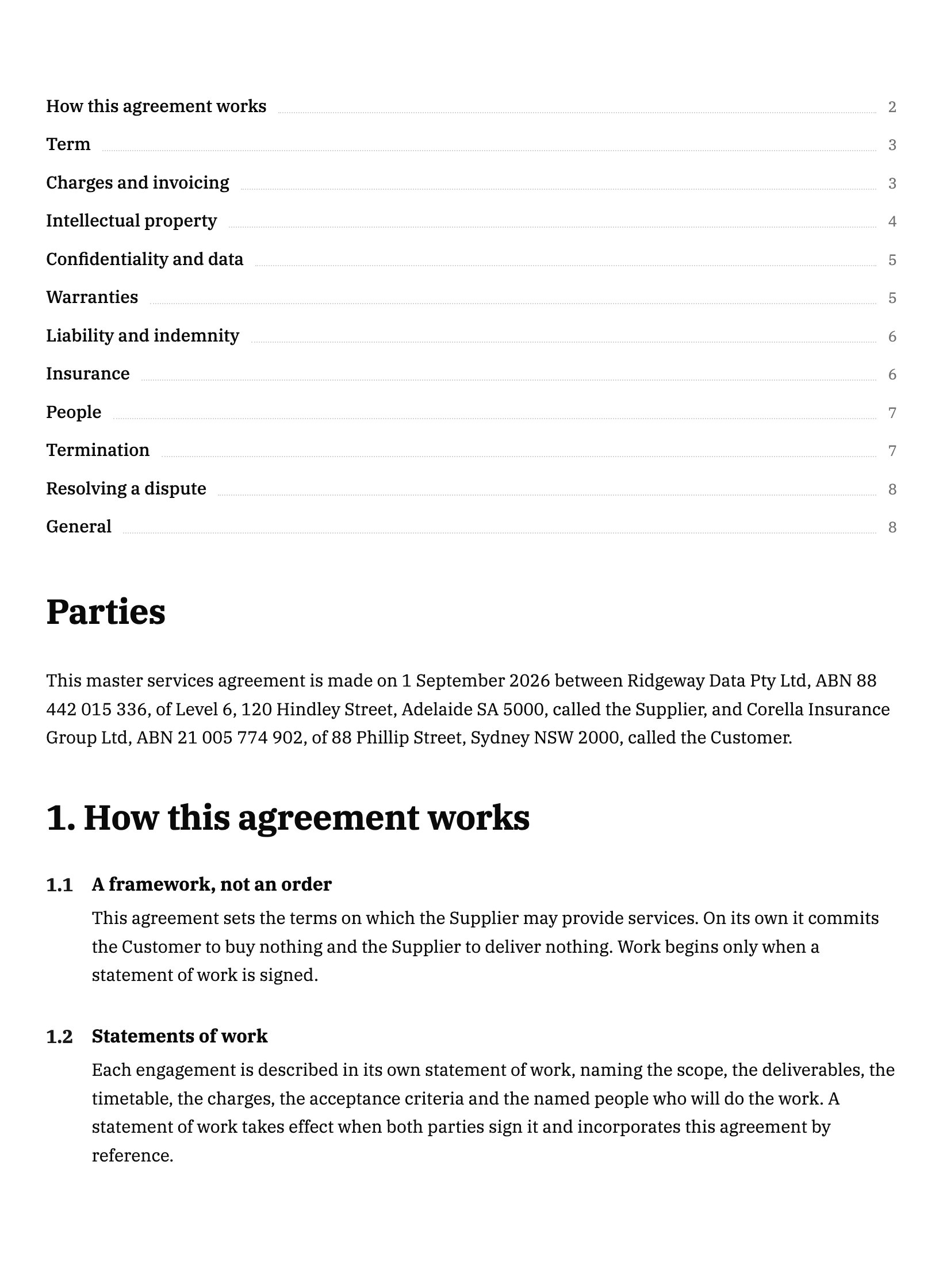 Master services agreementA data consultancy and an insurer sign this once and then buy work under it for three years. It is the rare contract whose whole purpose is to make the next twenty contracts short.
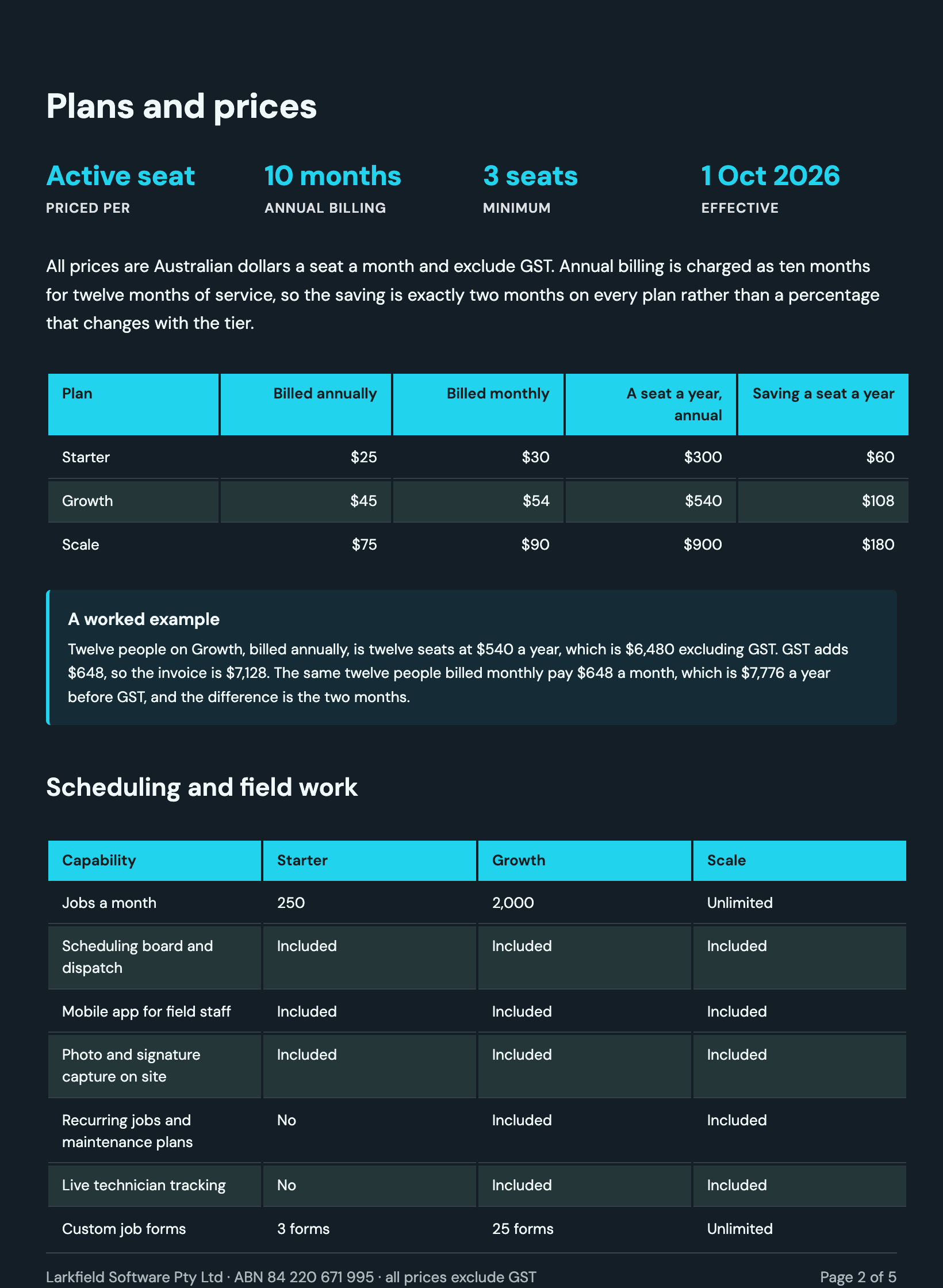 Pricing sheetThree plans, priced per seat, where annual billing is ten months for twelve months of service on every tier. Twelve people on Growth is $6,480 a year before tax, and the sheet shows the working rather than a percentage.
Questions people ask
Is a most favoured customer clause legal in Australia?
Between two commercial parties it is generally a lawful contract term. The competition risk arises from scale and effect rather than from the wording, since a network of parity commitments across a market can reduce the incentive to discount. Conduct that substantially lessens competition is prohibited under the Competition and Consumer Act 2010, which is the framework to check against.
What does comparable customer mean?
Whatever the clause defines it to mean, which is why the definition is the negotiation. Common elements are the same product modules, a similar volume or user tier, an equal or longer term, the same country, and no bundled services. Each element the supplier adds makes the promise narrower, and five elements can make it unusable.
Can the buyer see the supplier's other contracts?
No, and asking for that usually stops the negotiation. A supplier cannot disclose another customer's pricing without breaching its own confidentiality obligations. The workable alternatives are a director statutory declaration each year or an independent audit that reports only whether a lower price exists and by how much, without naming anyone.
Should the remedy be a rebate or a price reduction?
Suppliers prefer a reduction going forward, because a rebate claws back revenue already reported. Buyers want the difference from the date the lower price began. The common compromise reduces the price prospectively and credits the period from when the supplier should have notified, which gives the supplier a reason to disclose promptly.
Do these clauses actually get enforced?
Rarely, because a buyer usually cannot see what others pay. Their value is deterrent and informational: the supplier has to think before discounting, and the annual declaration creates a moment where somebody senior confirms the position. Buyers who want a real check pair the clause with an audit right rather than relying on the warranty.
How long should the commitment last?
The term of the agreement and no longer. A commitment that survives termination leaves the supplier exposed to an audit about a customer it no longer supplies. If the buyer wants protection on a renewal, deal with it in the renewal clause, where the price is being set again, rather than by extending this one.
Put the clause in a finished document
The button opens the document generator with a starting description already filled in. Change it to match your own agreement before you run it.
Create a document with OneCraftRelated clauses
- Price adjustment clause: moving a price after signingA price adjustment clause lets a price move after signing and says how. Australian sample wording with notice and an exit right, plus three variants to compare.
- Payment terms clause: when the money is actually dueA payment terms clause fixes when an invoice falls due and how it is paid. Australian sample wording, net 30 and seven day variants, and what to negotiate.
- Set off clause: deducting what the other side owesA set off clause lets one party deduct what the other owes it from what it owes. Australian sample wording, a no set off variant, and the insolvency position.
For everything the document generator can do, see the document maker.
Step by step in the builder: Create a document with AI, then Every document component and when to use it.
Written and checked by the OneCraft team. Last checked .