Contract clause
Price adjustment clause: moving a price after signing
A price adjustment clause lets a rate change during the term without a new contract. It says what may move the price, by how much, how much notice the customer gets, and what the customer may do if the new price does not suit, which is usually to leave without penalty.
A multi year contract at a fixed rate is a bet on costs, and one side always loses it. An adjustment clause replaces the bet with a procedure.
Nuwan Madhusanka · Co-founder
4 min read · Published
Sample clause
a three year commercial cleaning contract between Northgate Cleaning and the body corporate of a mid rise office building in Perth
7. Price review 7.1 The Rates in the Rate Schedule are fixed for the first twelve (12) months from the Commencement Date. 7.2 After that period, Northgate Cleaning may adjust the Rates once in each twelve month period by giving the Client at least sixty (60) days written notice before the adjustment takes effect. 7.3 A notice under clause 7.2 must state the current Rate, the proposed Rate, the date it takes effect, and the reason for the adjustment. 7.4 A single adjustment under clause 7.2 must not increase any Rate by more than five per cent (5%). 7.5 If an adjustment takes effect, the Client may terminate this Agreement by written notice given within thirty (30) days of the notice under clause 7.2, effective on the date the new Rate would begin. The Client is liable for Services performed before that date at the previous Rates. 7.6 No adjustment applies to Services already performed or to a fixed price quoted for a specific task before the notice was given.
Sample wording, not legal advice.
Variants
Fixed annual percentage
Both sides want certainty and neither wants to argue about an index or a cost breakdown every year.
On each anniversary of the Commencement Date the Rates increase by three per cent (3%), without the need for a notice. The Supplier may not increase the Rates on any other basis during the Term. If the Supplier wishes to increase the Rates by more than three per cent in any year, it must propose a variation in writing, and the Rates do not change unless the Client agrees in writing to that variation.
Cost pass through for named inputs
One or two input costs dominate the price and neither party can forecast them.
The Supplier may increase the Rates to pass through an increase in the cost of the Named Inputs listed in Schedule 3, being award wages for cleaning staff and consumables purchased for the Site. An increase under this clause must not exceed the proportion of the Rate attributable to the affected Named Input, and the Supplier must provide written evidence of the cost increase with its notice. No other cost increase may be passed through.
Review with agreement required
The customer will not accept any unilateral movement and is prepared to renegotiate annually.
Either party may give written notice requesting a review of the Rates no earlier than ten (10) months after the Commencement Date and no more than once in each twelve month period. The parties must meet within twenty (20) business days of the notice and negotiate in good faith. The Rates do not change unless both parties sign a written variation. If no variation is signed, the existing Rates continue for a further twelve months.
What to negotiate
The cap
Customers want a stated ceiling on any single increase. Suppliers want room for a year when costs move sharply. The usual landing point is a cap on the routine adjustment, with a separate and narrower right to pass through a named cost that is evidenced, so an unusual year does not need a general uncapped right.
Notice and the exit right
The exit right is what makes a unilateral adjustment acceptable, and its length decides whether it is real. Thirty days to accept or leave, against sixty days notice of the change, is workable. A fourteen day window on a contract that takes three months to retender is an exit right on paper only.
Work already quoted
Suppliers sometimes forget to carve out fixed price work already quoted, and customers always notice. The clean position is that an adjustment applies only to services performed after it takes effect and never to a task already quoted at a fixed amount, which removes the most common source of a disputed first invoice after a review.
The risk of leaving it out
Without an adjustment clause the rate is fixed for the whole term, and the supplier either absorbs rising costs or starts looking for reasons to end the contract early. Customers often prefer that outcome until the third year, when the supplier is losing money on the job and service quality becomes the negotiation instead of price.
Unilateral variation and unfair terms
A right for one party to change the price at will, in a standard form contract with a consumer or small business, is one of the examples the unfair contract terms regime specifically has in view. Three features push a clause toward the safe side: the increase is limited, the customer is told before it applies, and the customer can end the contract without penalty if it does not suit. A clause with all three is a procedure. A clause with none of them is a discretion, and a discretion is what gets struck out.
Common mistakes
The clause allows an adjustment but never says when the new rate takes effect, so the first adjusted invoice is disputed. It sets a cap in percentage terms without saying whether the cap compounds year on year. It gives an exit right without saying who bears transition costs. And it says nothing about a decrease, which matters in a falling market when a customer asks why an index linked clause only ever moves one way.
Where it sits in a generated document
Price review sits next to the fee clause and refers to the rate table rather than repeating numbers, which is what keeps the two from drifting apart. A generated service agreement is classified as numbered in structure, so the review mechanism, the cap and the exit right each get their own sub number and a notice letter can cite clause 7.5 exactly. The rate table itself is generated as a table block in the same document.
Documents that carry this clause
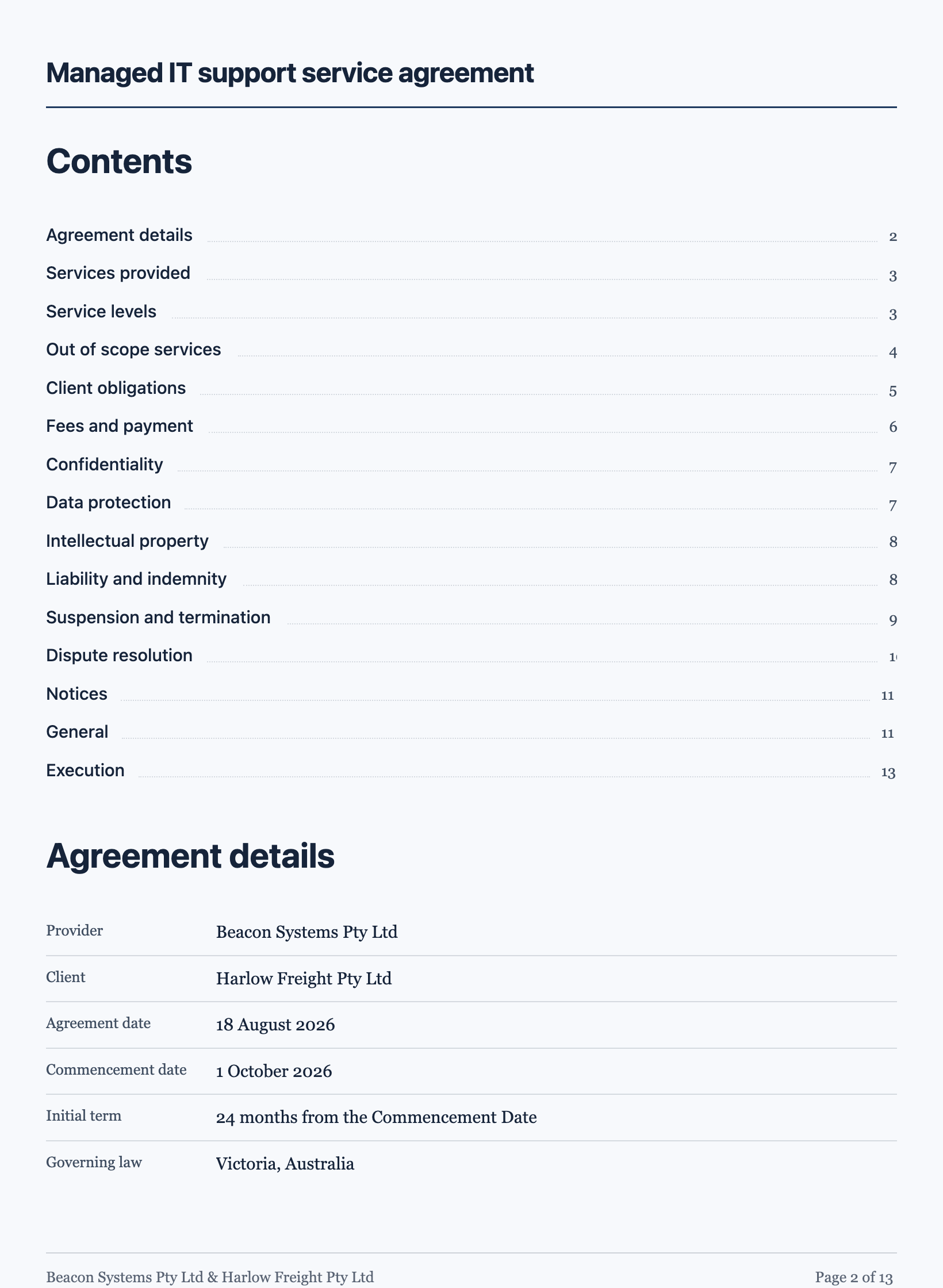 Service agreementBeacon Systems supports Harlow Freight’s IT for an initial 24 months from 1 October 2026 at $8,400 a month plus GST, with 40 hours included and $220 an hour beyond them. Twelve numbered clauses cover the services, a four level severity table, client duties, fees with a CPI adjustment, confidentiality, privacy, IP, a liability cap, termination and a three step dispute ladder.
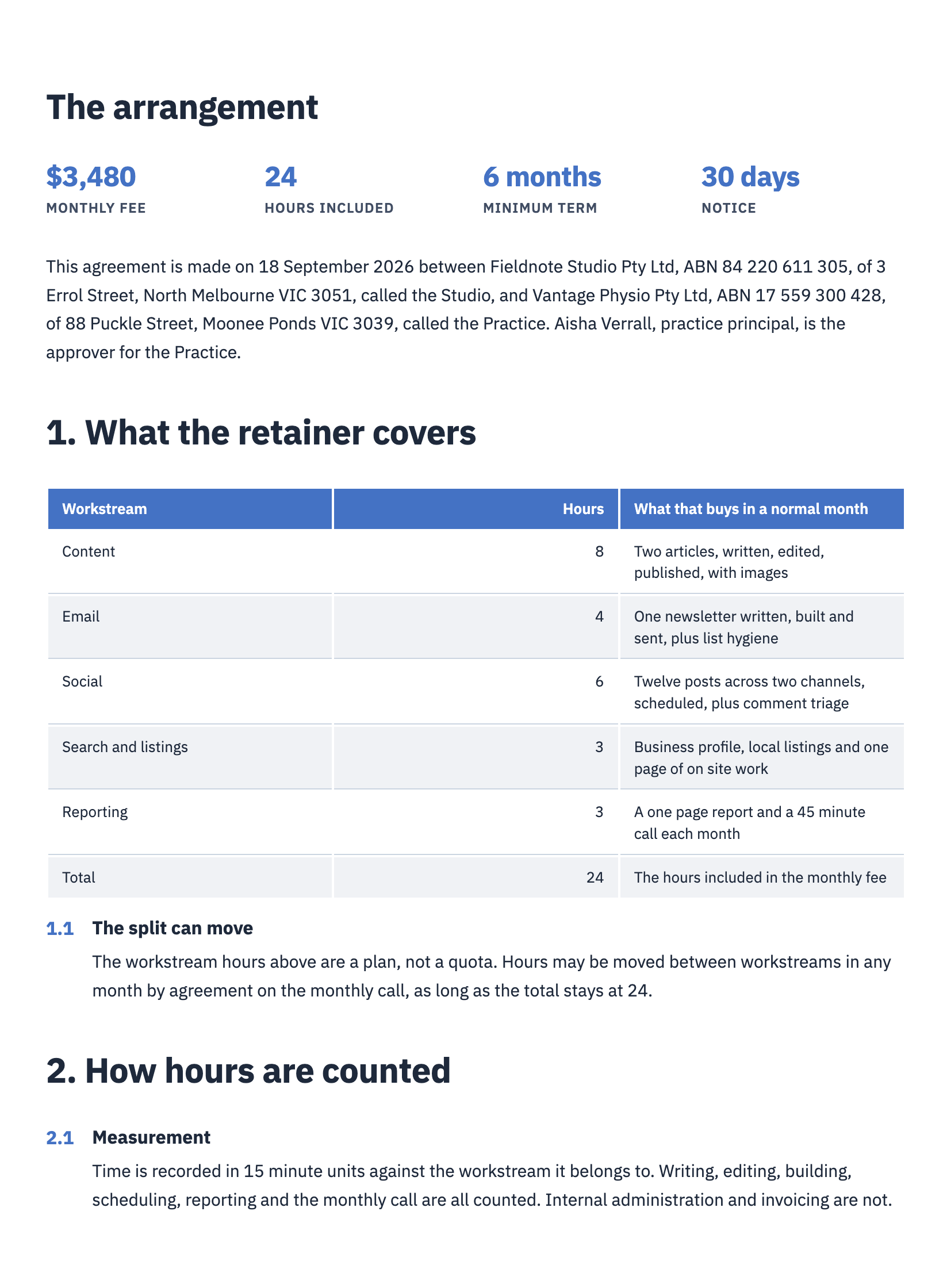 Monthly retainer agreementA studio sells a physio practice twenty four hours a month. Almost every clause exists to answer one question that ordinary contracts duck: what happens to the hours nobody used.
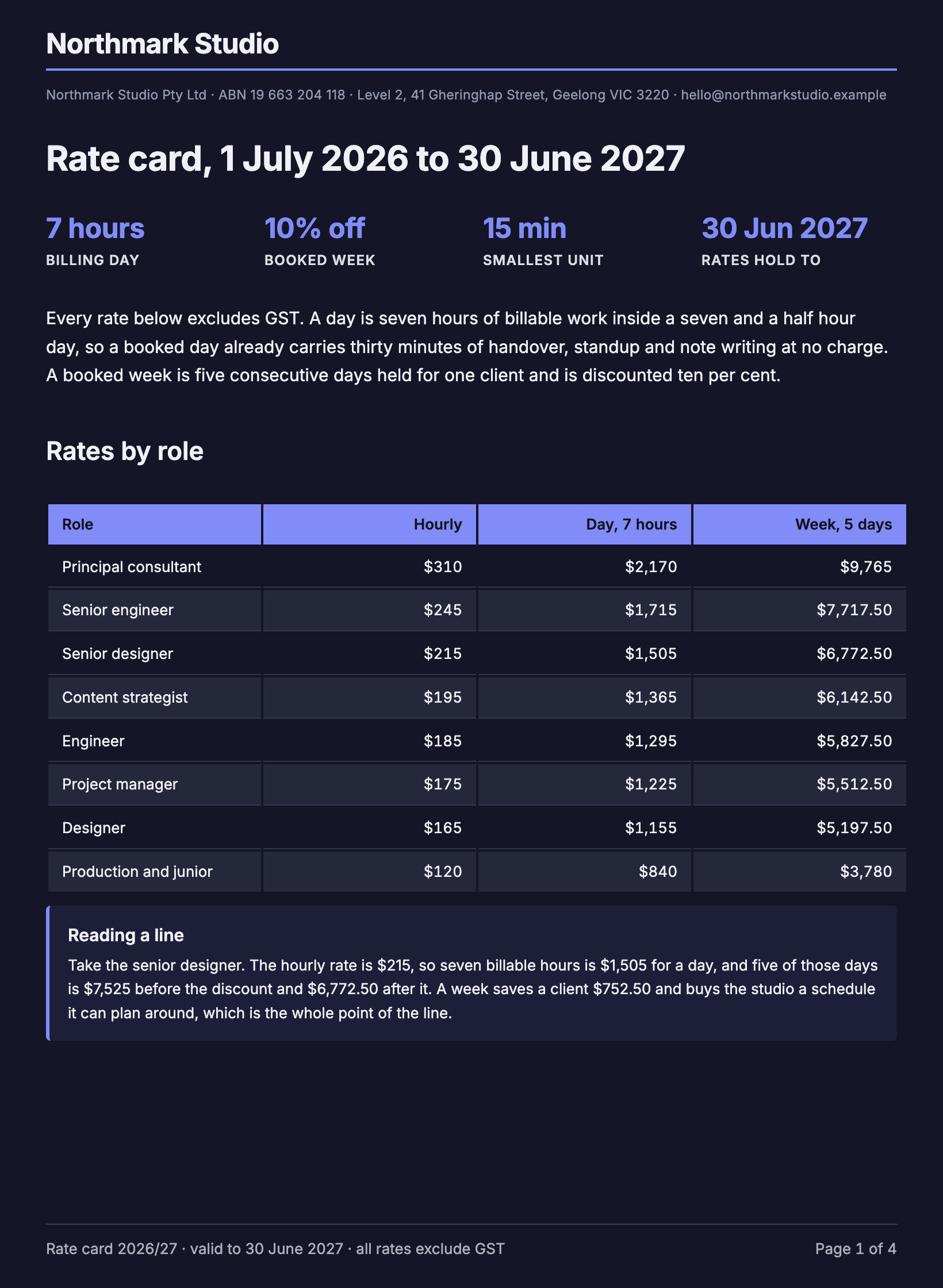 Rate cardA studio publishes what each role costs by hour, by day and by booked week, then explains the arithmetic between them. A day is seven billable hours inside a seven and a half hour day, and a booked week is ten per cent off five of those.
Questions people ask
Can a supplier increase prices without the customer agreeing?
Only if the contract gives that right and the right is exercised the way the clause describes. A unilateral increase with no clause behind it is an offer to vary, which the customer can refuse while holding the supplier to the old rate. Where the clause does exist, the notice requirements in it have to be followed exactly.
Should the clause allow decreases as well?
If the adjustment is tied to an index or an input cost, symmetry is easier to defend and costs little, because most indices rise over a long term anyway. A clause that only ever moves up is the first thing a customer points at when arguing the term is unfair, and the concession usually buys a higher cap.
How much notice is reasonable for a price increase?
Long enough for the customer to decide whether to stay, which depends on how hard the service is to replace. Thirty days suits a simple supply, sixty to ninety days suits a contract with a real transition cost. The notice period and the exit window should be set together, since one is useless without the other.
Is a cap on increases normal?
In small business and consumer contracts it is close to expected, and in commercial contracts it is common on the routine annual adjustment. Suppliers who want headroom usually accept a cap on the general right and negotiate a separate narrow pass through for a named cost, supported by evidence, instead of resisting the cap.
What is the difference between a price adjustment and a variation?
An adjustment changes the rate for the same scope under a mechanism already in the contract. A variation changes the scope, the deliverables or the terms, and needs both parties to agree. Confusing them is how a supplier ends up treating extra work as a price rise, which the customer will reject.
Can a fixed price quote be adjusted under this clause?
It should not be, and the clause should say so. A customer who accepted a fixed amount for a defined task has priced that task, and moving it later reads as bad faith even where the wording arguably allows it. Carve out quoted work and apply the adjustment only to ongoing rates.
Put the clause in a finished document
The button opens the document generator with a starting description already filled in. Change it to match your own agreement before you run it.
Create a document with OneCraftRelated clauses
- CPI escalation clause: the formula and the sample wordingA CPI escalation clause raises a price automatically with the consumer price index. Australian sample wording, the formula worked through, and four variants.
- Currency clause: which currency, and who carries the exchange riskA currency clause says which currency a contract is paid in and who carries exchange movement. Sample wording for a cross border engagement and three variants.
- Most favoured customer clause: promising the best priceA most favoured customer clause promises nobody else gets a better price. Sample wording with a rebate mechanism, three variants and the competition law risk.
For everything the document generator can do, see the document maker.
Step by step in the builder: Create a document with AI, then Every document component and when to use it.
Written and checked by the OneCraft team. Last checked .