Contract clause
Currency clause: which currency, and who carries the exchange risk
A currency clause names the currency amounts are stated in, the currency they must be paid in, and who bears the difference when the rate moves between the two. It also allocates bank charges, which on small international invoices often cost more than the exchange movement itself.
A cross border invoice can be paid in full and still arrive short. The clause decides whose problem that is before the first transfer rather than after it.
Nuwan Madhusanka · Co-founder
4 min read · Published
Sample clause
a twelve month design retainer between Ashgrove Studio in Sydney and a Singapore based logistics company paying from a Singapore bank account
7. Currency and payment method 7.1 All amounts in this Agreement are stated in Australian dollars and are payable in Australian dollars. 7.2 The Client must pay each invoice by international transfer to the account nominated in the Details Schedule, so that the full invoiced amount in Australian dollars is credited to that account. 7.3 The Client bears all bank charges, correspondent bank fees and conversion costs associated with a payment. If a payment is credited short of the invoiced amount because of a charge or a conversion, the shortfall remains payable and Ashgrove Studio may include it on the next invoice. 7.4 A change in the exchange rate between the Client's currency and Australian dollars does not change any amount payable under this Agreement. 7.5 If the Client asks to pay in Singapore dollars, Ashgrove Studio may agree in writing and must state the rate it will apply and the date that rate is taken from. That agreement applies only to the invoice named in it.
Sample wording, not legal advice.
Variants
Rate fixed at signing
The customer budgets in its own currency and needs a number that does not move during the term.
The Fees are stated in Australian dollars and are payable in United States dollars, converted at the rate of exchange recorded in the Details Schedule, being the rate published by the Reserve Bank of Australia on the Commencement Date. That rate applies for the whole Term regardless of any later movement. If the published rate moves more than fifteen per cent (15%) against the recorded rate, either party may give notice requiring the parties to negotiate a revised rate in good faith within twenty (20) business days.
Rate on the invoice date
Both parties accept the market rate and want each invoice priced when it is issued.
Where an invoice is issued in a currency other than the currency in which the Fees are stated, the amount is converted at the rate published by the Reserve Bank of Australia on the business day before the invoice date, and the invoice must state the rate applied and that date. The converted amount is the amount payable, and no adjustment is made for any movement between the invoice date and the date payment is received.
Rate on the payment date, supplier protected
The supplier will not carry any exchange movement and the customer accepts the risk of a moving rate.
The Customer must pay each invoice so that the Supplier receives the full invoiced amount in Australian dollars on the payment date. The Customer bears the risk of any movement in the exchange rate between the invoice date and the payment date, and bears all conversion and transfer costs. If the amount received is less than the invoiced amount for any reason other than an error by the Supplier, the difference is a debt due and payable on demand.
What to negotiate
Which currency the price is stated in
Each side wants its own, because whoever is paid in a foreign currency carries the movement. The deciding factor is usually where the costs sit. A supplier paying Australian wages should be paid in Australian dollars, and a customer that insists otherwise is really asking for a hedging service priced into the rate.
Which rate and whose source
Naming a published source and a date removes most of the argument. A central bank published rate on the business day before the invoice date is easy to verify and hard to game. A clause that says the prevailing market rate leaves the supplier choosing from a spread of quotes, which a customer will eventually query.
Bank charges
On small invoices the correspondent bank fee can exceed the exchange movement. Suppliers ask that the full invoiced amount must be credited, which pushes every fee to the payer. Customers accept it when the amounts are small and resist on large transfers, where the usual compromise splits the charges at each end.
The risk of leaving it out
With no currency clause the parties may have agreed a number without agreeing what it means. The supplier invoices in its own currency, the customer converts at a rate of its choosing, and the amount credited is short by the fees. Recovering the difference is a small claim nobody pursues, so it simply becomes a discount the supplier never agreed to.
How exchange risk actually lands
Exchange risk in a contract is not really about forecasting. It is about who has to fund a gap they cannot control, and for how long. A supplier invoicing monthly in its own currency carries almost none. A supplier quoting a fixed price in a foreign currency for a project delivered over two years carries all of it, and often prices it at zero because the risk is invisible at signing. Naming the currency of payment, the rate source and the conversion date turns an open position into a number both parties can see.
Common mistakes
The contract states a dollar amount without saying which dollar, which matters when parties sit in Australia, Singapore, the United States and Canada. The rate source is described loosely, so two conversions differ. Bank charges go unmentioned, so every invoice is paid slightly short. And a hedged fixed rate is agreed with no release valve, so a large movement leaves one side performing at a loss with nothing in the clause to reopen.
Where it sits in a generated document
Currency belongs with the fee clause, because it qualifies every figure in it, and it should be restated in the invoice rather than assumed. A generated cross border retainer writes the currency into the fee clause, the payment clause and the fee table, so nothing in the document carries a bare number. Generated invoices for the same engagement print the currency beside each amount as written content.
Documents that carry this clause
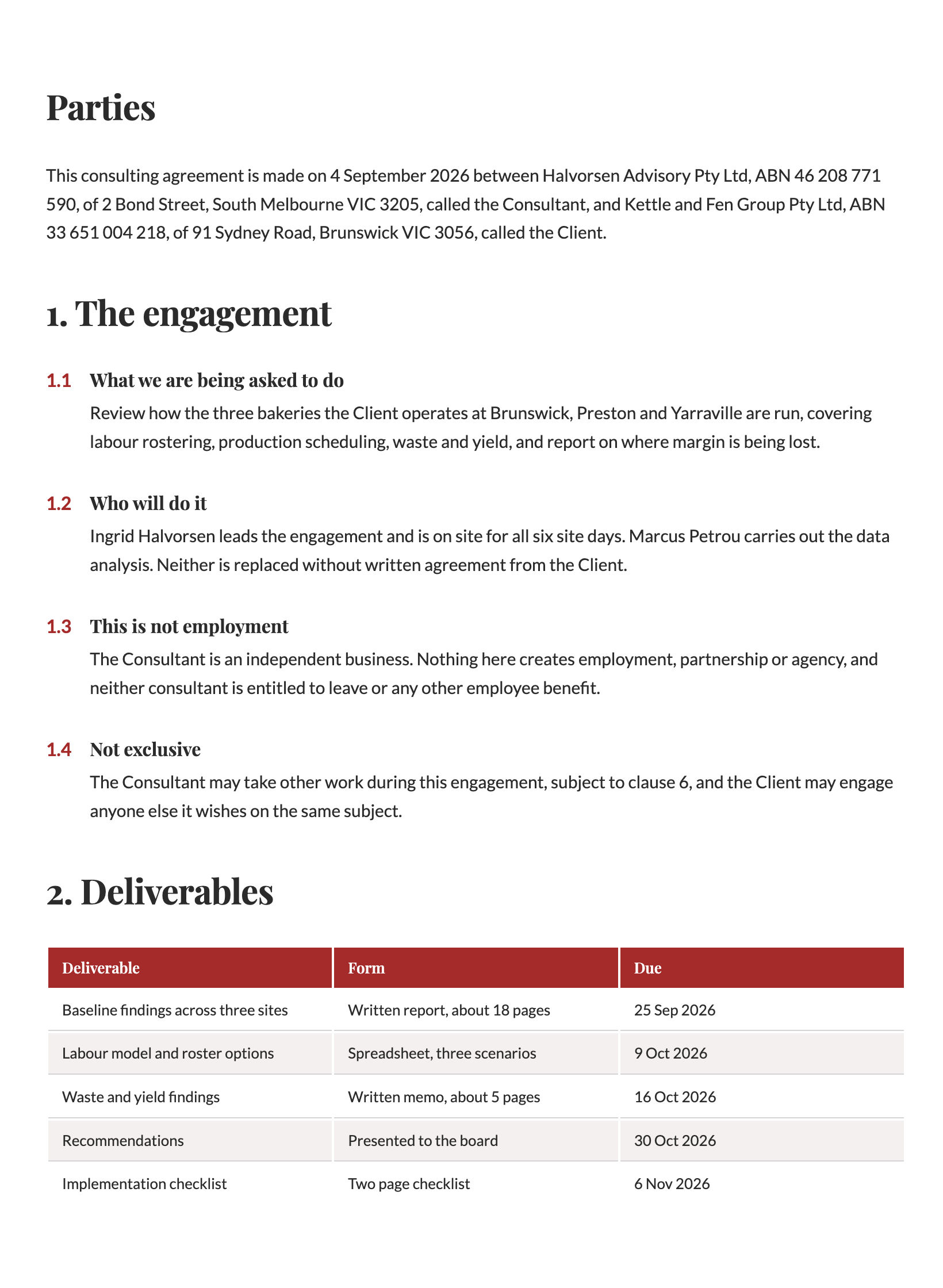 Consulting agreementAn advisory firm reviews three bakeries over seven weeks. What makes this agreement useful is not the fee clause but the two clauses that say what the advice is not.
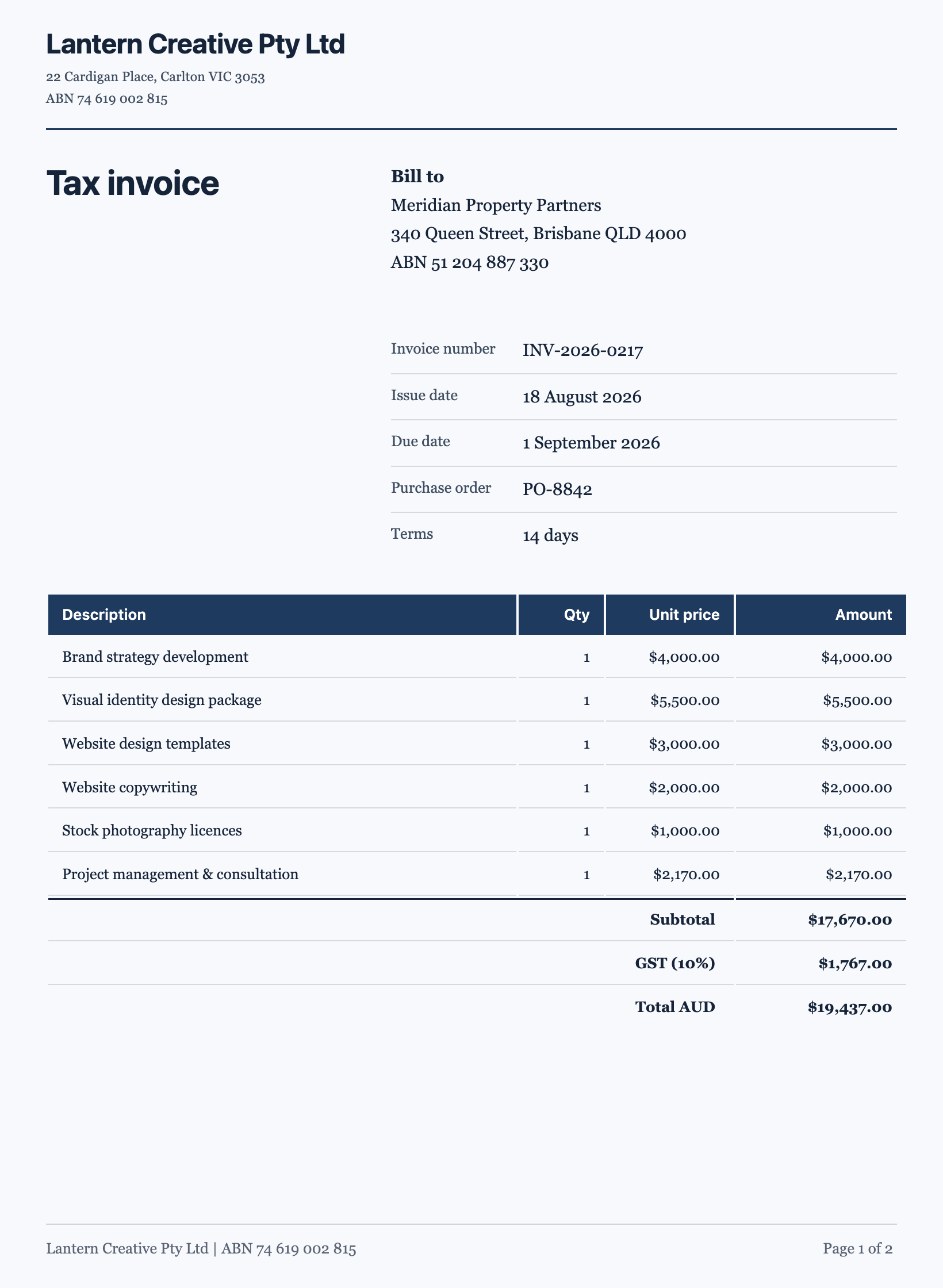 Tax invoice template with GST, terms and a due dateLantern Creative bills Meridian Property Partners $19,437 for six branding and website lines. Both ABNs are printed, the buyer’s purchase order PO-8842 is quoted, and the due date is 14 days after issue. Everything an accounts payable team checks before paying sits in one block above the table, and the bank details sit under it.
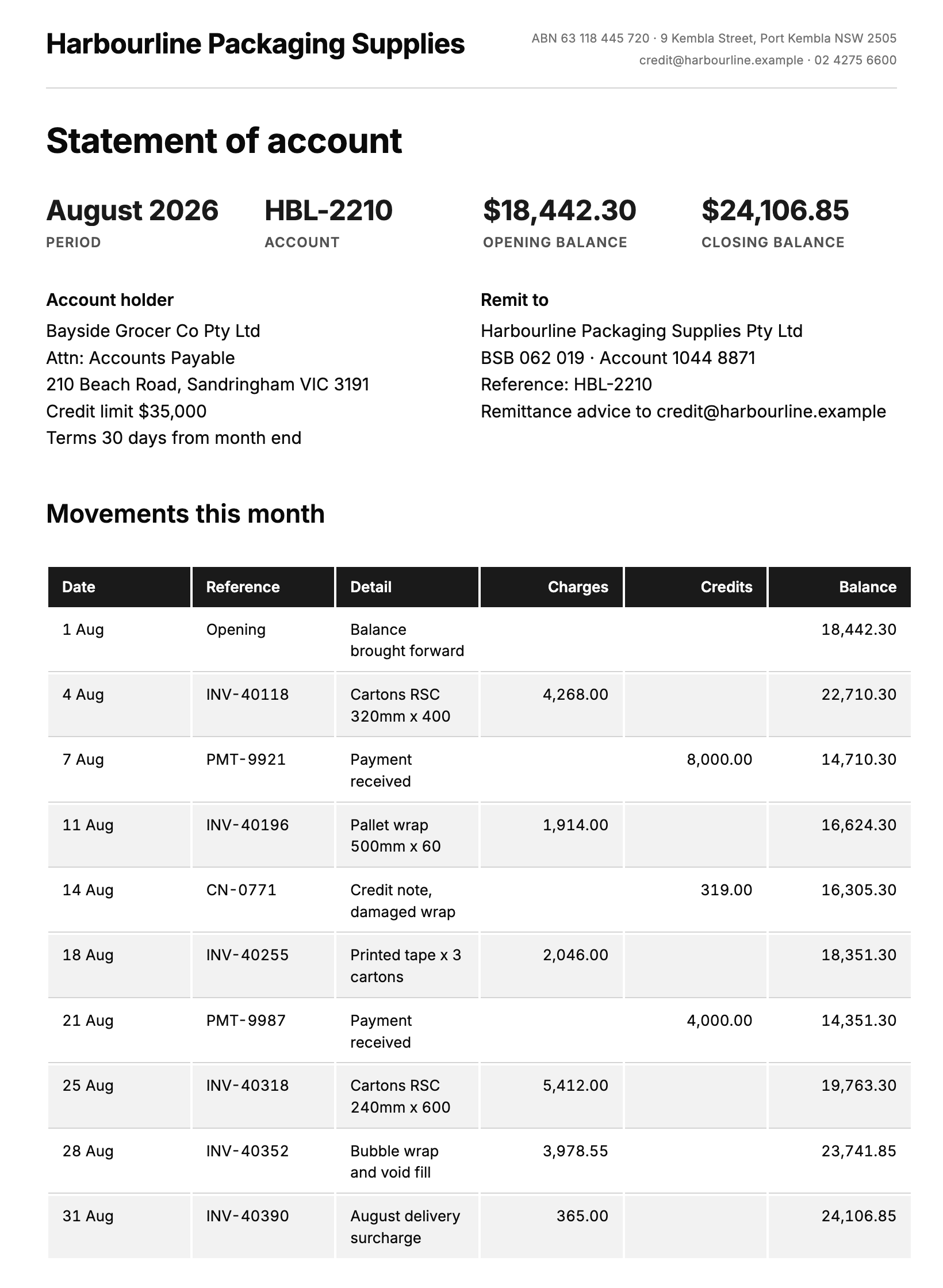 Statement of accountA packaging supplier sends this to a grocer on the last day of the month. It settles nothing on its own; it exists so two ledgers can be made to agree before anybody chases anybody.
Questions people ask
Which currency should an Australian supplier invoice in?
Australian dollars, if its costs are in Australian dollars, because that removes the exchange position entirely. Quoting in a customer's currency is a commercial concession and should be priced as one. If a foreign currency is unavoidable, name the rate source and the conversion date rather than leaving the conversion to whoever transfers the money.
Who pays international bank fees?
Whoever the clause says. Suppliers usually require that the full invoiced amount is credited to their account, which pushes intermediary and conversion fees to the payer. Customers on large transfers often negotiate a split at each end. Silence means the supplier absorbs fees on every payment, which on small monthly invoices is a real percentage.
Should the exchange rate be fixed for the whole term?
Only with a release valve. A fixed rate gives both sides certainty and turns into a problem when the market moves sharply, because one party is then performing at a loss. A common structure fixes the rate and lets either party call for a renegotiation once the published rate moves beyond a stated percentage.
What rate source should the clause name?
A published rate from a central bank or another verifiable source, taken on a stated day such as the business day before the invoice date. Avoid the prevailing market rate, since the payer can choose from a spread of quotes and the payee cannot check which was used. Require the rate and the date on the invoice.
Does a currency clause affect the tax treatment?
The tax rules apply in the local currency, so amounts in a foreign currency have to be converted for reporting whatever the contract says. The clause cannot change that, and it should not try. Keeping currency in the payment section and tax in its own clause avoids a document that appears to set its own tax rules.
What happens if a payment arrives short?
Say that the shortfall remains payable and may be added to the next invoice. Without that, the supplier has to raise a separate claim for an amount too small to chase, and the practice becomes established across the term. One sentence turns a recurring loss into a line item the customer can see and fix.
Put the clause in a finished document
The button opens the document generator with a starting description already filled in. Change it to match your own agreement before you run it.
Create a document with OneCraftRelated clauses
- Payment terms clause: when the money is actually dueA payment terms clause fixes when an invoice falls due and how it is paid. Australian sample wording, net 30 and seven day variants, and what to negotiate.
- Price adjustment clause: moving a price after signingA price adjustment clause lets a price move after signing and says how. Australian sample wording with notice and an exit right, plus three variants to compare.
- CPI escalation clause: the formula and the sample wordingA CPI escalation clause raises a price automatically with the consumer price index. Australian sample wording, the formula worked through, and four variants.
For everything the document generator can do, see the document maker.
Step by step in the builder: Create a document with AI, then Every document component and when to use it.
Written and checked by the OneCraft team. Last checked .