Contract clause
CPI escalation clause: the formula and the sample wording
A CPI escalation clause increases an amount automatically in line with the consumer price index, so the price keeps its value without either party negotiating. It names the index, the city or national series, the two quarters compared, and what happens in the unusual case where the index falls or is not published.
An index linked increase looks mechanical and still produces disputes, almost always because the clause names the index loosely. The fix is to name the series, the quarters and the arithmetic.
Indunil Asanka · Co-founder
4 min read · Published
Sample clause
a five year lease of a small Brisbane office suite between Harbour Lane Holdings as lessor and a two person accounting firm as lessee
6. CPI review 6.1 On each anniversary of the Commencement Date (each a Review Date), the Annual Rent is adjusted in accordance with this clause. 6.2 The adjusted Annual Rent equals the Annual Rent payable immediately before the Review Date, multiplied by the Index Number for the Current Quarter and divided by the Index Number for the Base Quarter. 6.3 Index Number means the number published for the All Groups Consumer Price Index for Brisbane by the Australian Bureau of Statistics. 6.4 Current Quarter means the last completed quarter before the Review Date for which an Index Number has been published. Base Quarter means the corresponding quarter twelve months earlier. 6.5 If the adjusted Annual Rent calculated under clause 6.2 is less than the Annual Rent payable before the Review Date, the Annual Rent does not change. 6.6 If the series in clause 6.3 stops being published, the parties must use the series the Australian Bureau of Statistics nominates as its replacement.
Sample wording, not legal advice.
Variants
CPI plus a fixed margin
The lessor or supplier believes its own costs rise faster than the general index.
On each Review Date the Annual Fee is adjusted by multiplying it by the Index Number for the Current Quarter, dividing by the Index Number for the Base Quarter, and then adding a further one per cent (1%) of the result. The parties acknowledge that the additional margin reflects costs the Supplier incurs that the Index does not track. No other increase applies in the same twelve month period.
CPI with a floor and a cap
Both sides want the index to do the work but neither will accept an unbounded outcome.
The adjustment on each Review Date is the percentage movement in the Index between the Base Quarter and the Current Quarter, subject to a minimum increase of two per cent (2%) and a maximum increase of five per cent (5%). If the movement in the Index is negative, the minimum increase applies. The parties agree that the floor and the cap are a commercial allocation of inflation risk and not an estimate of any loss.
United Kingdom note on which index
The contract is governed by English law, where the retail prices index and the consumer prices index both remain in commercial use.
The Rent is reviewed on each Review Date by reference to the All Items Consumer Prices Index published by the Office for National Statistics. The parties record that they have chosen the consumer prices index rather than the retail prices index, that the two series move differently, and that no substitution of one for the other may be made without a written variation. If publication of the chosen index ceases, the parties must agree a replacement index in writing.
United States note on the series
The contract is with a United States party and the index has to be identified to a specific published series.
Base Rent shall be adjusted annually by the percentage change in the Consumer Price Index for All Urban Consumers, United States city average, all items, not seasonally adjusted, as published by the Bureau of Labor Statistics. The comparison shall be between the index for the month three months before the adjustment date and the index for the same month in the prior year. In no event shall Base Rent decrease as a result of this adjustment.
What to negotiate
Which index and which city
A capital city series and the national series can move by a noticeable margin in the same year. Lessors usually propose the local city series, lessees the national one, and the honest answer is whichever better matches the cost being tracked. Whatever is chosen, name it in full so no substitution is possible later.
What happens when the index falls
Most commercial clauses use a ratchet, so the amount never decreases. Tenants and customers argue that an index linked mechanism should work in both directions. The usual settlement keeps the ratchet and trades it for a lower cap, because a lessor will rarely sign a lease whose rent can go backwards.
Publication lag
Quarterly index numbers are published weeks after the quarter closes, so a review on the first of the month cannot use that quarter. Drafting around it is simple: use the last completed quarter for which a number has been published. Leaving the lag unaddressed produces a review that cannot be calculated on its own terms.
The risk of leaving it out
Without an escalation mechanism a long agreement holds its price in nominal terms, so its real value falls every year and the party receiving the money starts looking for other ways to recover the difference. The alternative to a formula is an annual negotiation, which costs both sides time and puts the whole relationship on the table once a year rather than a single number.
How the arithmetic works
The formula is a ratio, not a percentage. Take the amount payable now, multiply by the index number for the recent quarter, divide by the index number for the same quarter a year earlier. As an illustration only, if an index stood at 100.0 in the base quarter and 103.2 in the current quarter, an annual rent of forty thousand dollars becomes forty one thousand two hundred and eighty dollars. Published index numbers must be read off the relevant series before any real review, because rounding and revisions both shift the answer.
Common mistakes
The clause says adjusted by CPI without naming a series, so two spreadsheets produce two answers. It compares quarters that have no published number yet. It omits a replacement index provision, which matters because statistical agencies do retire series. And the review date and the invoicing cycle fall on different days, so one invoice each year is part at the old amount and part at the new one with nothing in the clause to apportion it.
Where it sits in a generated document
In a lease or a long service agreement the review clause sits inside the rent or fee section and refers back to the amount defined there. Generated agreements are structured as numbered clauses, so the formula, the definitions of the two quarters and the ratchet each become a sub clause, and the definitions stay beside the arithmetic that uses them. The worked example is best kept in a schedule rather than in the clause itself.
Documents that carry this clause
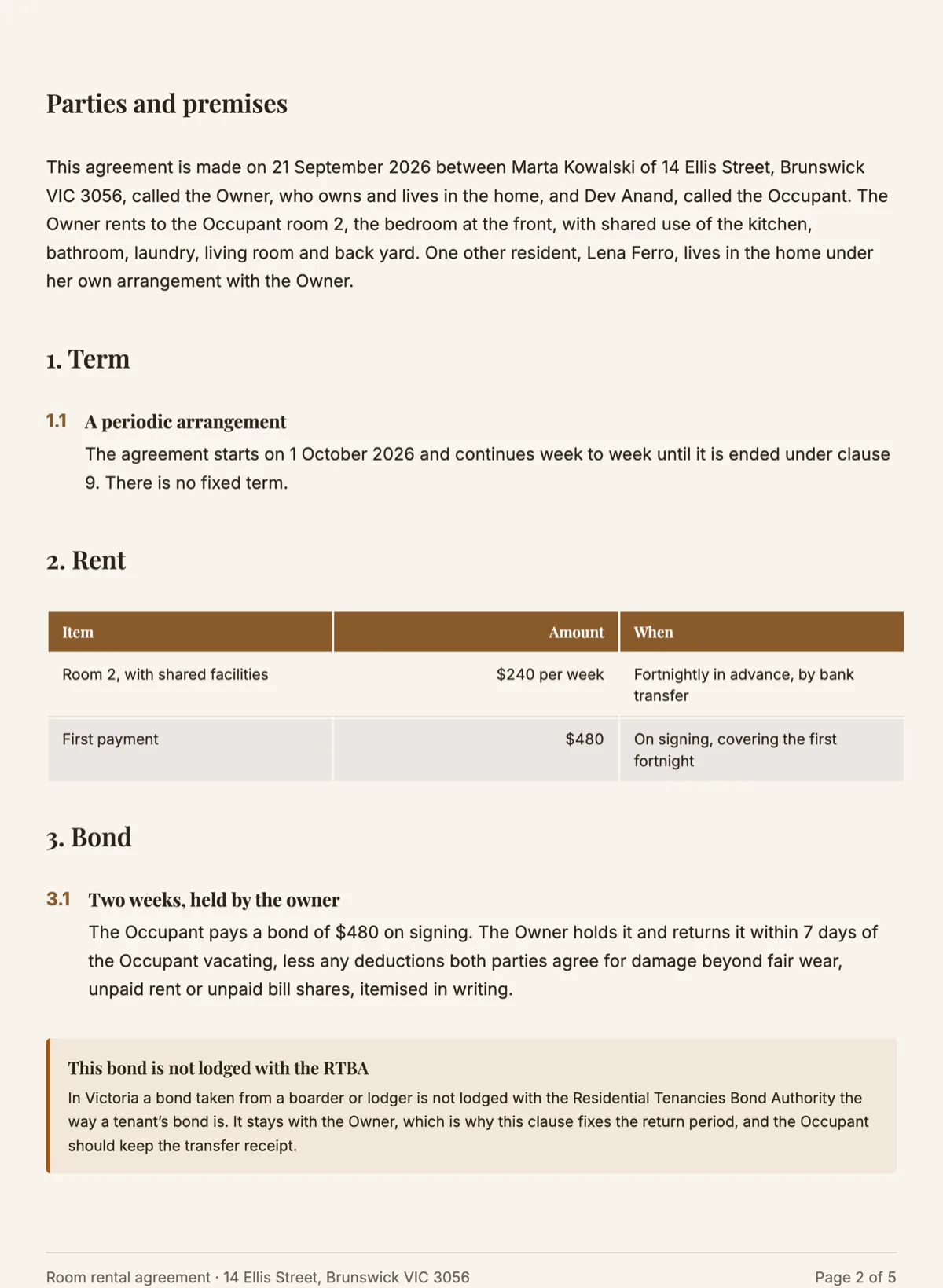 Room rental agreement template for one room in a shared homeRenting a room is not the same as renting a house, and most templates copy a residential lease and hope. This one is written for one room with shared kitchen and bathroom, prices the bills split, lists the rules that matter, and says plainly that the occupant is a boarder or lodger and what that changes.
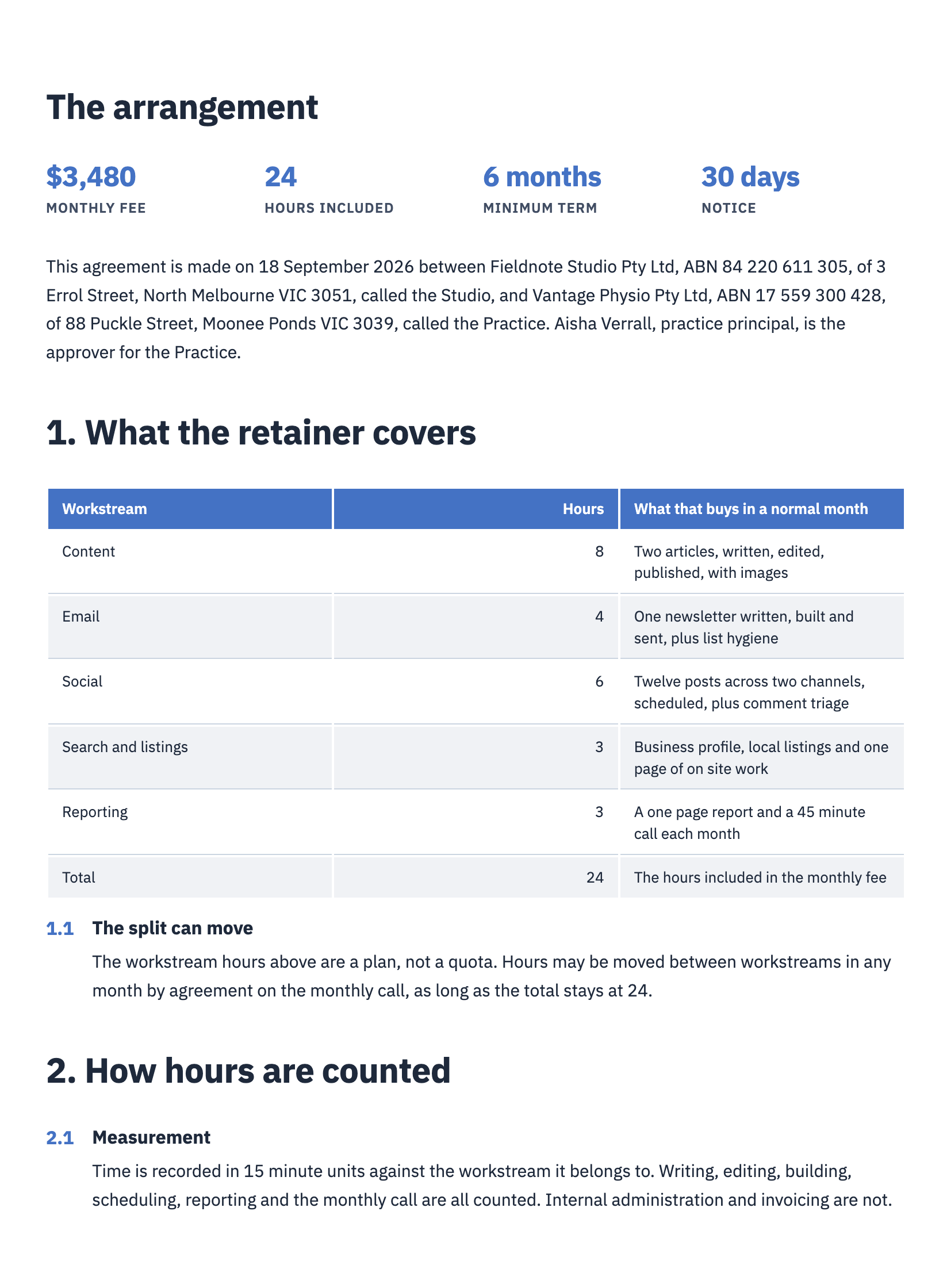 Monthly retainer agreementA studio sells a physio practice twenty four hours a month. Almost every clause exists to answer one question that ordinary contracts duck: what happens to the hours nobody used.
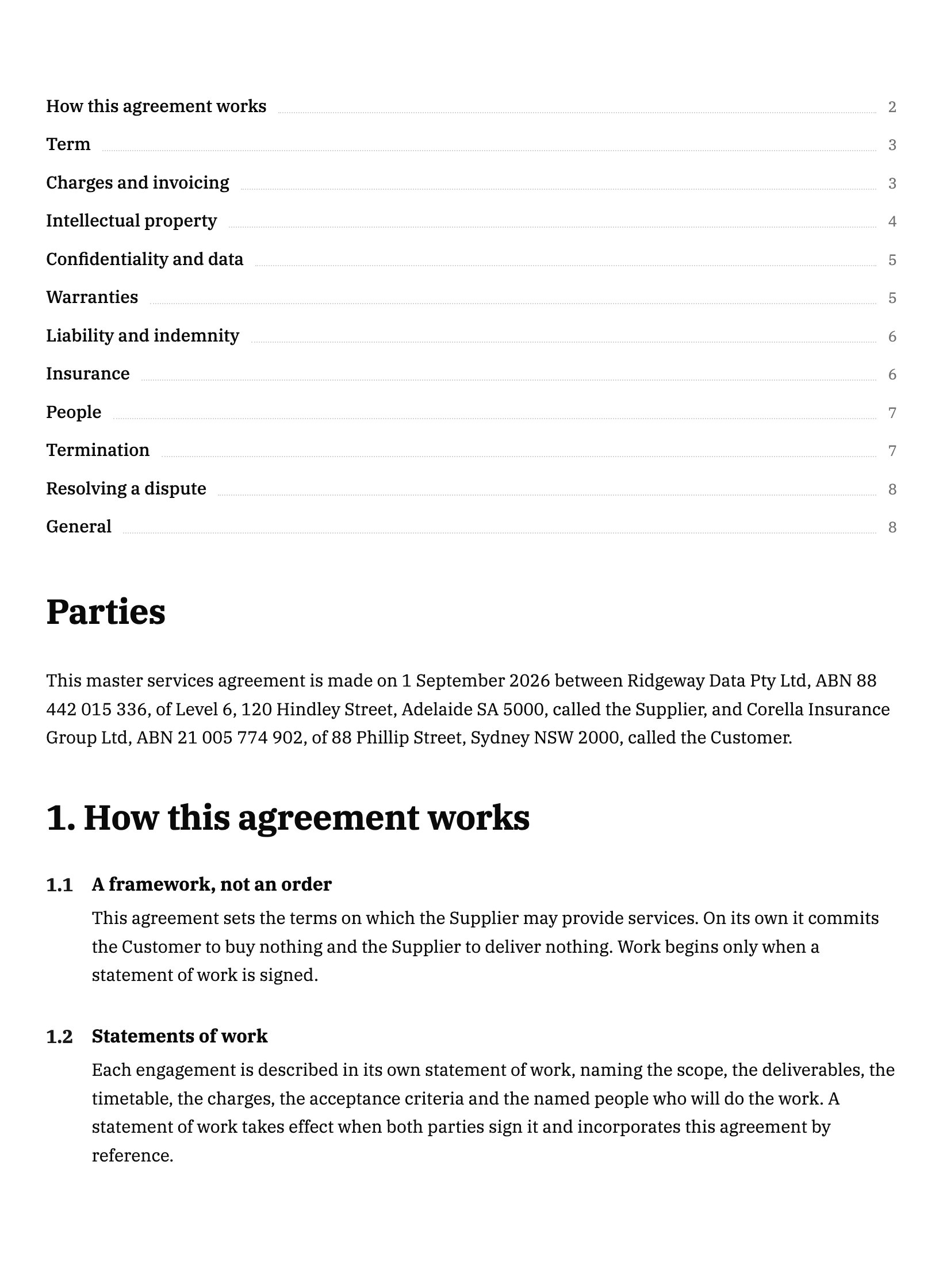 Master services agreementA data consultancy and an insurer sign this once and then buy work under it for three years. It is the rare contract whose whole purpose is to make the next twenty contracts short.
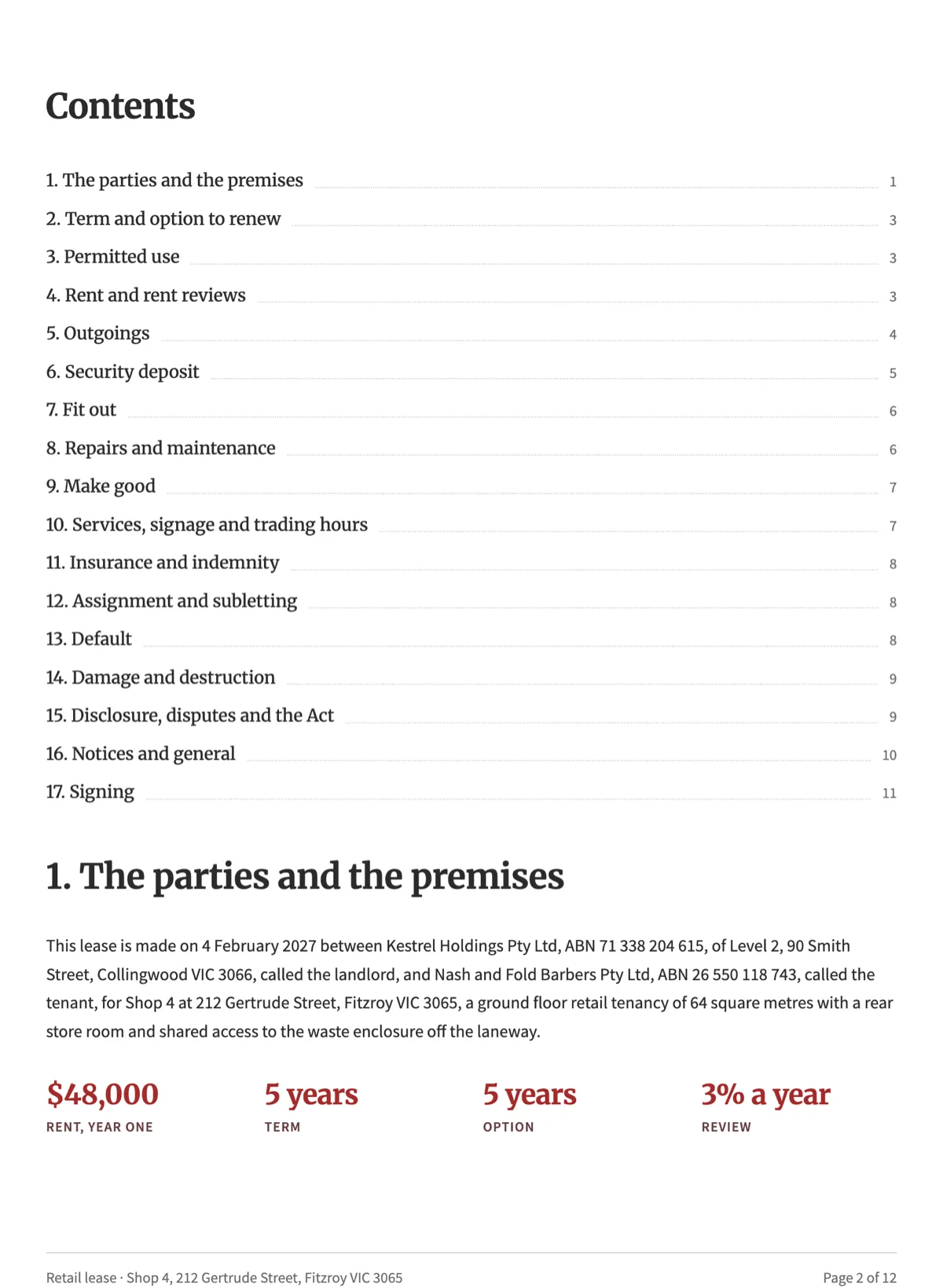 Commercial lease agreement template with outgoings and fit out termsA retail lease is decided by three numbers and two clauses: the rent, the review, the outgoings, the fit out contribution and the make good. This 12 page Victorian lease sets all five out in the open, including the outgoings the landlord is not allowed to recover at all.
Questions people ask
Which CPI series should an Australian contract name?
Name the exact series, usually the All Groups consumer price index for a nominated capital city or the weighted average of eight capital cities, as published by the Australian Bureau of Statistics. A clause that just says CPI leaves room for two different calculations, and the difference between a city series and the national series in one year can be material.
What if the consumer price index goes down?
It depends entirely on the clause. Most commercial agreements include a ratchet saying the amount does not decrease, so a negative movement leaves the price unchanged. Without a ratchet the formula applies in both directions. Australia has had quarters of negative movement, so this is not a theoretical question in a five year contract.
How is the CPI increase calculated?
Multiply the current amount by the index number for the recent comparison quarter and divide by the index number for the same quarter twelve months earlier. Working with published index numbers rather than headline percentage figures avoids rounding disputes, because the reported annual rate is itself a rounded derivation of those numbers.
Can a lease use CPI and a market review together?
Yes, and many do. A common structure applies an index review in most years and a market review at one or two set points in the term, often with a ratchet so the market review cannot lower the rent. The important drafting detail is that the two mechanisms never apply in the same year.
Which quarter should the clause compare?
The last quarter for which a number has actually been published before the review date, against the same quarter a year earlier. Index numbers appear several weeks after a quarter closes, so a clause that names the quarter ending immediately before the review date may be uncalculable on the day it is meant to operate.
Is a CPI clause fair to a small business tenant?
An index linked increase is generally easier to defend than a unilateral right to raise the price, because neither party controls the index. The features that attract attention are a ratchet combined with a high floor, or an index review stacked on top of a separate percentage rise in the same year. Retail lease legislation in several states also regulates review mechanisms.
Put the clause in a finished document
The button opens the document generator with a starting description already filled in. Change it to match your own agreement before you run it.
Create a document with OneCraftRelated clauses
- Price adjustment clause: moving a price after signingA price adjustment clause lets a price move after signing and says how. Australian sample wording with notice and an exit right, plus three variants to compare.
- Currency clause: which currency, and who carries the exchange riskA currency clause says which currency a contract is paid in and who carries exchange movement. Sample wording for a cross border engagement and three variants.
- GST clause: saying whether the price includes GSTA GST clause says whether amounts include GST and who pays it. Australian sample wording, a gross up variant, adjustment events and reimbursed expenses.
- Most favoured customer clause: promising the best priceA most favoured customer clause promises nobody else gets a better price. Sample wording with a rebate mechanism, three variants and the competition law risk.
For everything the document generator can do, see the document maker.
Step by step in the builder: Create a document with AI, then Every document component and when to use it.
Written and checked by the OneCraft team. Last checked .