Contract clause
GST clause: saying whether the price includes GST
A GST clause says whether the amounts in a contract include goods and services tax, and if they do not, who pays the tax on top. It also handles the paperwork, because a recipient cannot claim a credit without a tax invoice, and it deals with later changes to the amount.
A price written without a tax position is a price that is ten per cent wrong to somebody. The clause exists to put the argument before the first invoice instead of after it.
Nuwan Madhusanka · Co-founder
4 min read · Published
Sample clause
a twelve month advisory engagement between Fernhill Consulting, a registered Australian supplier, and a manufacturing client that is also registered
11. GST 11.1 Words used in this clause that are defined in the GST law have the meaning given to them in that law. 11.2 Unless expressly stated otherwise, every amount payable under this Agreement is exclusive of GST. 11.3 If a supply made under this Agreement is a taxable supply, the recipient must pay to the supplier, in addition to the consideration for that supply, an additional amount equal to the GST payable on it. 11.4 The additional amount under clause 11.3 is payable at the same time as the consideration, and the supplier must give the recipient a tax invoice for the supply before it becomes payable. 11.5 If an adjustment event occurs in relation to a supply made under this Agreement, the supplier must give the recipient an adjustment note within ten (10) business days, and any resulting payment or refund must be made within ten (10) business days of that note. 11.6 If a party must reimburse a cost incurred by the other party, the amount reimbursed is reduced by any input tax credit the other party is entitled to claim for that cost.
Sample wording, not legal advice.
Variants
GST inclusive pricing for consumers
The customer is a member of the public, so the advertised figure must be the total payable.
All prices stated in this Agreement and in the Supplier's price list are inclusive of GST. The Supplier must not add any further amount for GST to a price quoted to the Customer. If the rate of GST changes during the Term, the Supplier may adjust its prices so that the amount it retains after GST is unchanged, and must give the Customer at least thirty (30) days written notice before the adjusted prices take effect.
Silent on registration, with a warranty
The customer wants certainty that the supplier really is registered before it pays a gross up amount.
The Supplier warrants that it is registered for GST and must notify the Client within five (5) business days if its registration ends. The Client is not obliged to pay an amount for GST under this Agreement unless the Supplier has provided a valid tax invoice quoting its Australian Business Number. If the Supplier is not registered, the amounts in the Fee Schedule are the total amounts payable and no additional amount is payable for GST.
United Kingdom and New Zealand equivalents
The same document is used across jurisdictions with a comparable transaction tax.
Where this Agreement is governed by the law of England and Wales, references to GST are read as references to value added tax chargeable under the Value Added Tax Act 1994, and the Supplier must issue a valid VAT invoice before any amount for VAT is payable. Where this Agreement is governed by New Zealand law, references to GST are read as references to goods and services tax under the Goods and Services Tax Act 1985, and the rate applicable at the time of supply applies.
What to negotiate
Exclusive or inclusive
Business to business contracts are almost always drafted exclusive of GST, because both parties net out the tax. Consumer facing prices have to be inclusive. The failure mode is a contract that uses both, an exclusive general clause and an inclusive figure in a schedule, which is a genuine ambiguity rather than a stylistic one.
When the gross up is payable
Suppliers want the tax at the same time as the fee. Recipients want it only once a valid tax invoice has arrived, because the credit depends on that document. Tying the additional amount to the tax invoice satisfies both, and it also gives the recipient a reason to chase the paperwork rather than the supplier.
Reimbursed expenses
Reimbursing a cost at its full amount when the other party can claim a credit for the tax overpays it. The standard fix reduces the reimbursement by any input tax credit available. Suppliers sometimes resist because it looks like a deduction, but the arithmetic is neutral.
The risk of leaving it out
If the contract is silent, an agreed price is usually read as including any tax the supplier has to pay, so a supplier that expected to add ten per cent discovers the ten per cent came out of its margin. On a long contract that is a material loss, and the only remedy is an argument about what the parties intended, which is a poor substitute for one sentence in the document.
What the tax law requires of the paperwork
The credit side of the system runs on documents. A recipient generally needs a valid tax invoice from the supplier before claiming an input tax credit, and the Australian Taxation Office sets out what such an invoice has to show, including the supplier identity, the Australian Business Number, the date, a description of what was supplied and the amount of tax. When an amount changes after the fact, an adjustment note does the same job for the correction. A contract clause cannot change any of that, which is why the clause obliges the supplier to produce the documents rather than trying to redefine them.
Common mistakes
The clause says amounts are exclusive of GST and the fee schedule prints a figure that was calculated as a total. The clause grosses up but never mentions tax invoices, so the recipient pays the tax and cannot claim it. Adjustment events are ignored, so a credit note leaves the tax unfixed. And expense reimbursement is drafted at full cost, which quietly overpays whichever party is claiming the credits.
Where it sits in a generated document
Tax wording belongs late, with the general clauses, and it should be the only place in the document that discusses tax. A generated consulting agreement puts it in the numbered general section and keeps the fee clause free of tax language, which is what stops the two contradicting each other. Amounts appear as written content in both the agreement and any generated invoice, and neither document prints a citation for the tax rules it follows.
Documents that carry this clause
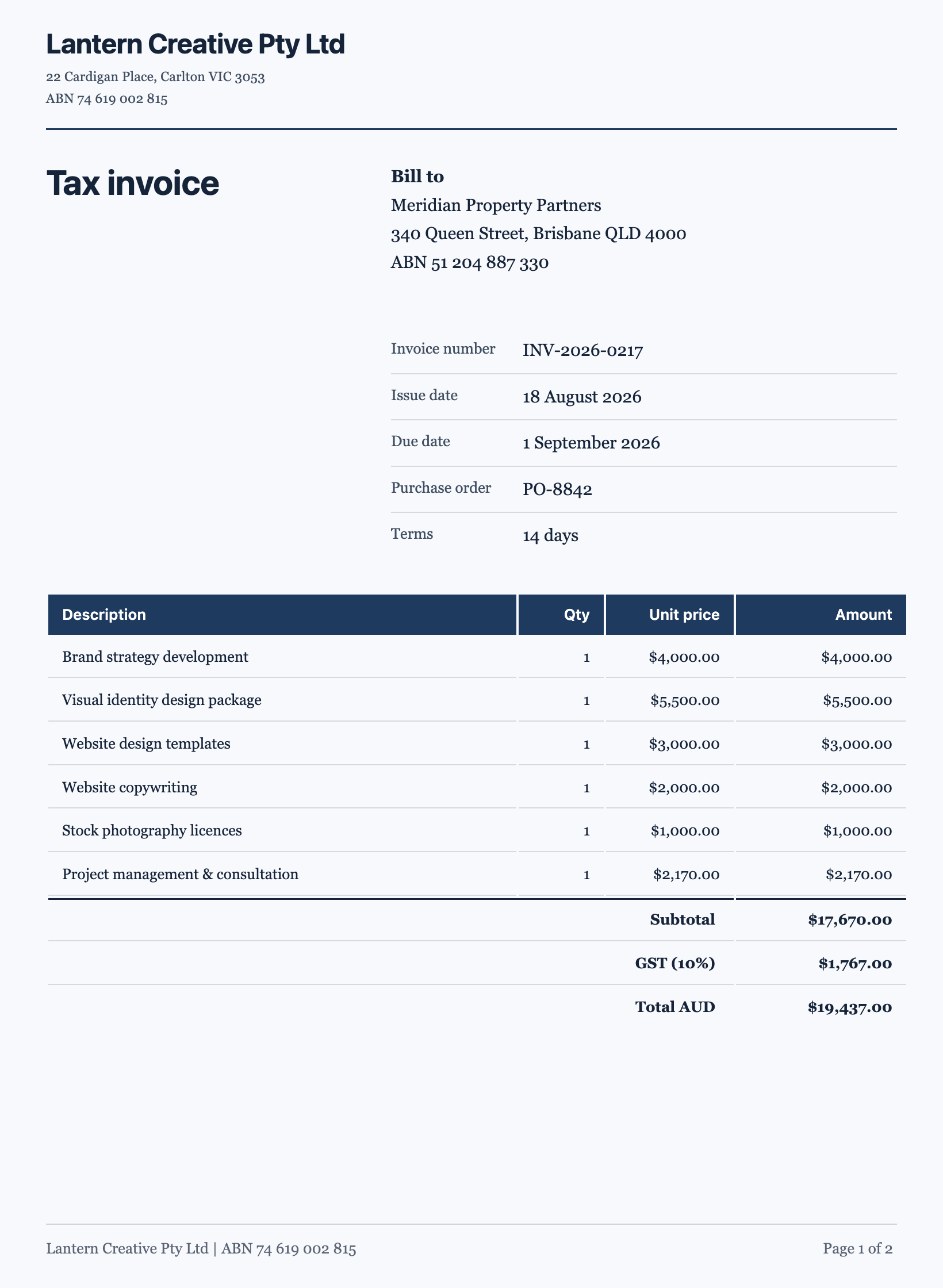 Tax invoice template with GST, terms and a due dateLantern Creative bills Meridian Property Partners $19,437 for six branding and website lines. Both ABNs are printed, the buyer’s purchase order PO-8842 is quoted, and the due date is 14 days after issue. Everything an accounts payable team checks before paying sits in one block above the table, and the bank details sit under it.
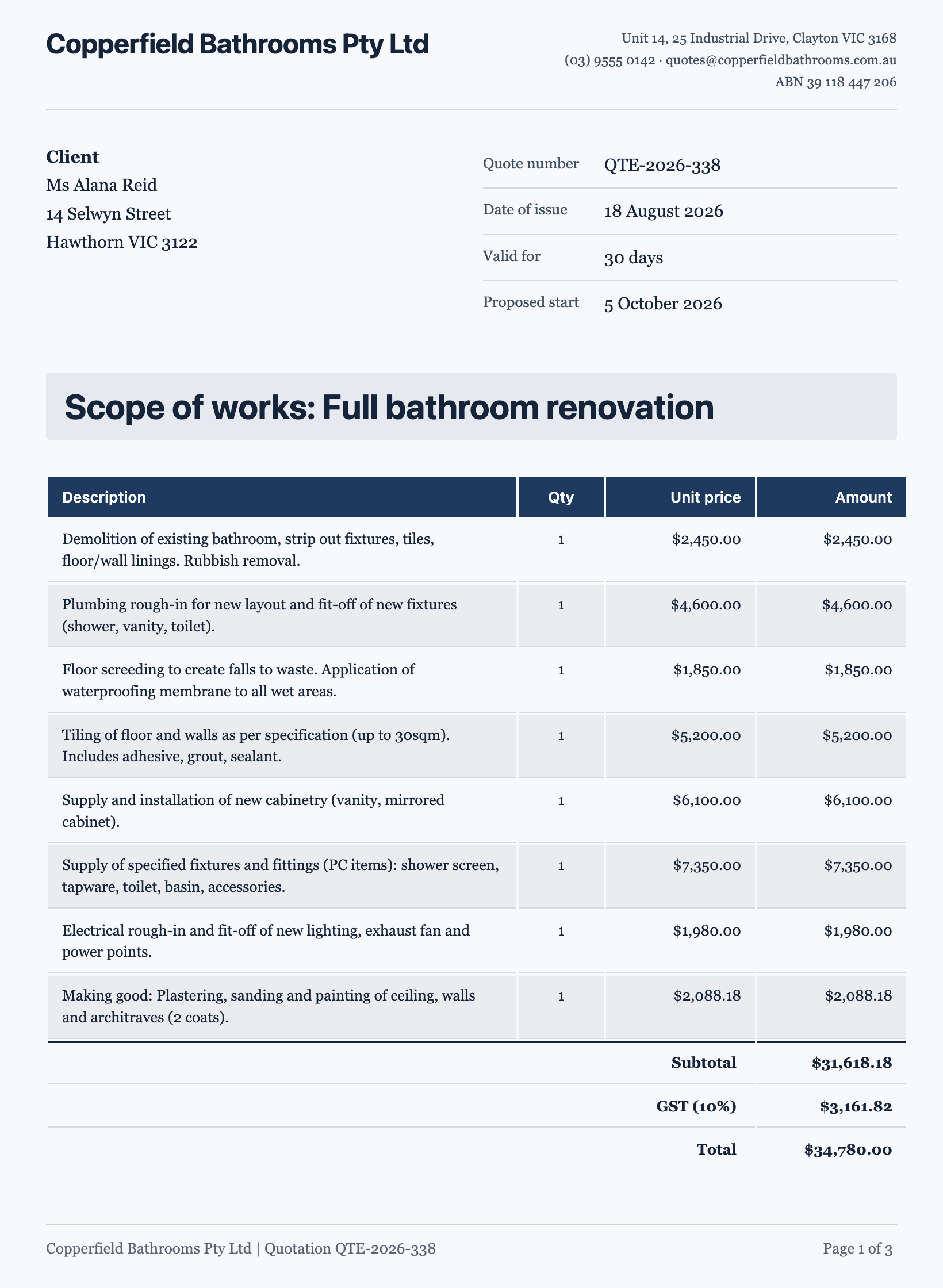 Quotation template priced trade by tradeCopperfield Bathrooms quotes Alana Reid $34,780 including GST for a full bathroom renovation at 14 Selwyn Street, Hawthorn. Eight trades are priced as separate lines, the tiles are a provisional sum, the job runs four weeks from 5 October, and the payment schedule takes 10 per cent on acceptance, 50 per cent when tiling is done and 40 per cent at practical completion.
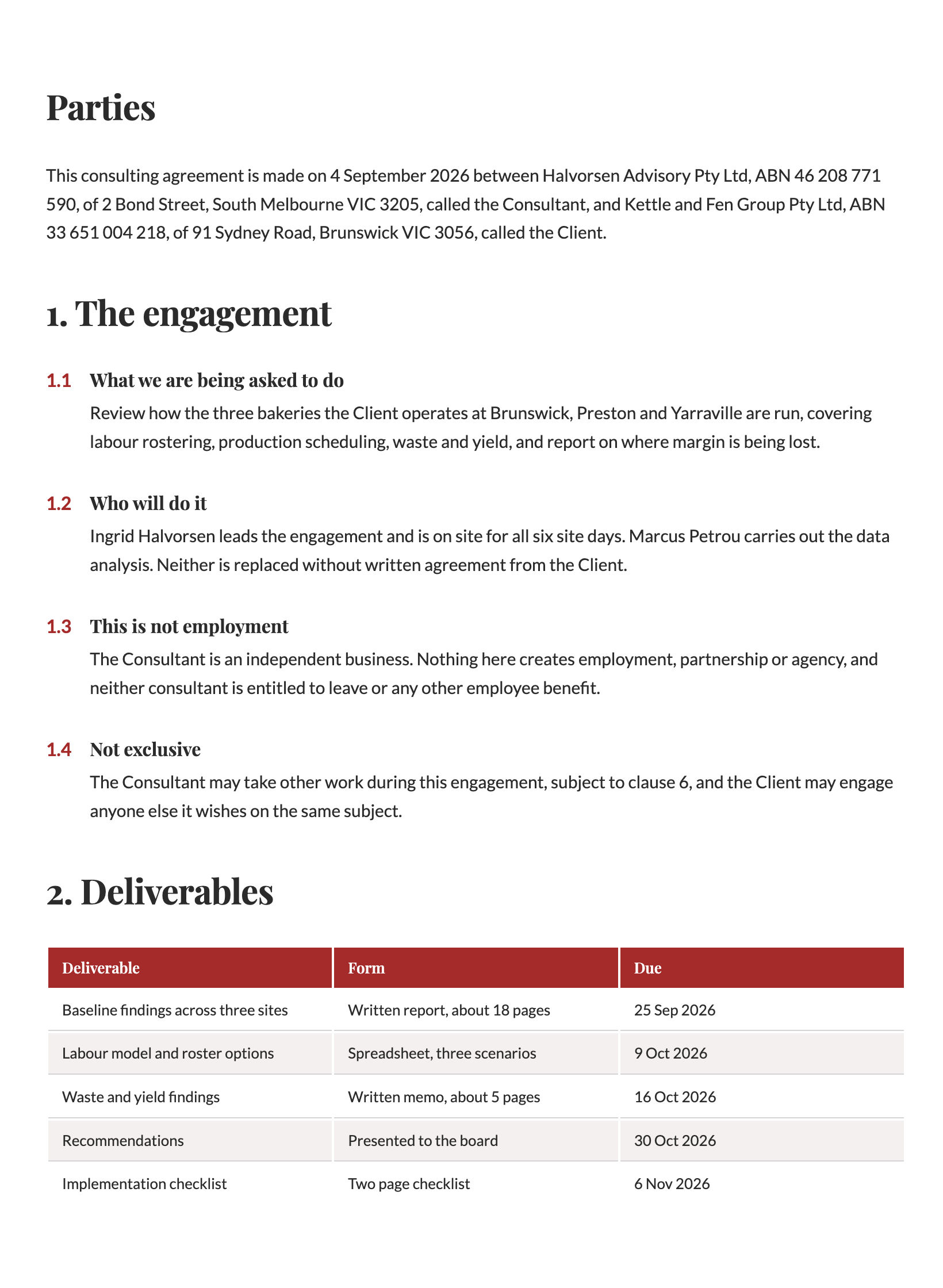 Consulting agreementAn advisory firm reviews three bakeries over seven weeks. What makes this agreement useful is not the fee clause but the two clauses that say what the advice is not.
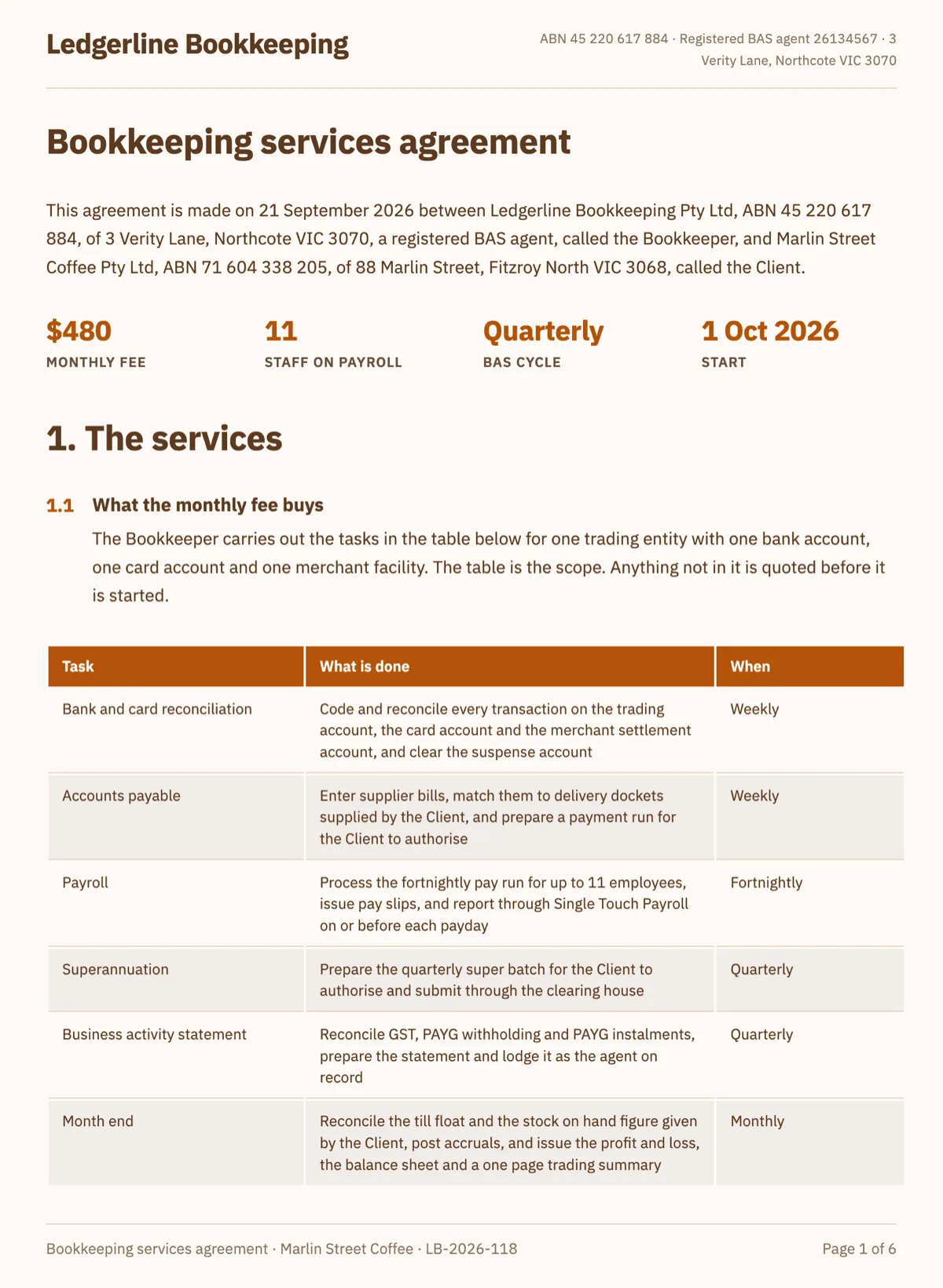 Bookkeeping services agreement with a monthly scope tableBookkeeping goes wrong when nobody wrote down which tasks are monthly, which are weekly, and who has to hand over what before a statement can be lodged. This agreement settles all three in a scope table and a lodgement calendar, then prices the whole year so the cafe can see what it is committing to.
Questions people ask
Should a contract price be stated inclusive or exclusive of GST?
Exclusive for business to business work, because both sides account for the tax and the net figure is what they are negotiating. Inclusive when the customer is a consumer, since the total payable has to be the advertised figure. What matters most is that the contract does one of the two consistently, including in every schedule.
What happens if a contract is silent about GST?
An agreed price is generally treated as covering any tax the supplier has to remit, so the supplier absorbs it. That is the opposite of what most suppliers assume. On a long or high value contract the difference is significant, and recovering it afterwards depends on persuading the other side about intention rather than pointing at wording.
Can a supplier add GST later if it registers mid contract?
Only if the clause allows it. A well drafted exclusive of GST clause covers the situation, because it says an additional amount is payable on any taxable supply, which begins when the supplier becomes registered. A contract that quoted a total amount on the basis that the supplier was not registered generally will not support a later increase.
Does the clause need to mention tax invoices?
Yes. The recipient's ability to claim an input tax credit depends on holding a valid tax invoice, so making the additional amount payable only after one is provided aligns the payment with the paperwork. It also gives the recipient a practical lever, because the supplier wants the payment and controls the document.
How should reimbursed expenses be handled?
Reduce the reimbursement by any input tax credit the party incurring the cost can claim, then apply the ordinary tax treatment to the reimbursed amount as part of the supply. Reimbursing the full invoiced cost of an expense the other party can claim back is a straightforward overpayment that nobody notices until an audit.
What is an adjustment event?
A change after the fact to a supply or its price, such as a cancellation, a return or a discount, which means the tax originally reported is wrong. The supplier issues an adjustment note and the difference is paid or refunded. A contract clause should set a time limit for the note, because the recipient cannot correct its position without it.
Put the clause in a finished document
The button opens the document generator with a starting description already filled in. Change it to match your own agreement before you run it.
Create a document with OneCraftRelated clauses
- Invoicing clause: when invoices go out and what they must showAn invoicing clause says when invoices go out and what they must show to be payable. Australian sample wording, the tax invoice checklist and three variants.
- Expenses clause: which costs the client repaysAn expenses clause says which costs the client repays on top of the fee and how they are evidenced. Sample wording with a monthly cap, plus three variants.
- Payment terms clause: when the money is actually dueA payment terms clause fixes when an invoice falls due and how it is paid. Australian sample wording, net 30 and seven day variants, and what to negotiate.
For everything the document generator can do, see the document maker.
Step by step in the builder: Create a document with AI, then Every document component and when to use it.
Written and checked by the OneCraft team. Last checked .