Contract clause
Expenses clause: which costs the client repays
An expenses clause says which out of pocket costs a client pays on top of the fee, what evidence the supplier must produce, and what needs approval first. It usually separates costs incurred for the client, such as travel or third party licences, from the supplier's own cost of doing business.
Nobody argues about the fee on the first invoice. They argue about the flight, the parking and the stock photography licence, because nothing in the contract said who was paying for those.
Indunil Asanka · Co-founder
4 min read · Published
Sample clause
a six month change management engagement between Fernhill Consulting and a regional health service with sites in three towns
6. Expenses 6.1 The Client must reimburse Fernhill Consulting for the expenses listed in clause 6.2 that it reasonably incurs in performing the Services, at cost and without any markup. 6.2 Reimbursable Expenses are travel between Sites, accommodation where an overnight stay is required, parking, and any third party licence or subscription the Client has approved in writing. 6.3 Fernhill Consulting must provide a receipt or other evidence of payment for each Reimbursable Expense with the invoice that claims it. 6.4 Reimbursable Expenses must not exceed two thousand dollars ($2,000) in any calendar month unless the Client has approved the excess in writing before the expense is incurred. 6.5 The Client is not liable for any other cost of Fernhill Consulting, including office costs, insurance, staff travel to its own premises, professional subscriptions and software it uses generally. 6.6 An amount reimbursed under this clause is reduced by any input tax credit Fernhill Consulting is entitled to claim for the expense.
Sample wording, not legal advice.
Variants
Expenses included in the fee
The client wants one predictable number and the work involves little travel.
The Fee is inclusive of all costs the Supplier incurs in performing the Services, including travel, accommodation, communications and materials. The Client is not liable to reimburse any expense. If the Client requests work at a location more than one hundred kilometres from the Supplier's principal place of business, the parties must agree the treatment of travel costs in writing before that work begins, and no travel cost is payable without that agreement.
Pre approval for everything
The client has a procurement process and will not pay an expense that never passed through it.
The Client is liable to reimburse an expense only if the Supplier obtained the Client's written approval for that expense before incurring it, and the claim is supported by a receipt. An approval request must state the nature of the expense, the estimated amount and the reason it is necessary. The Client must respond to a request within three (3) business days. An expense incurred without approval is borne by the Supplier, whether or not it was reasonable.
Per diem
Frequent short trips make receipt collection more expensive than the amounts involved.
For each day on which the Supplier's personnel work at a Site more than fifty kilometres from their usual place of work, the Client must pay a daily allowance of one hundred and eighty dollars ($180) covering meals, local transport and incidental costs. No receipts are required for the allowance. Accommodation and long distance travel are reimbursed separately at cost on production of a receipt. The allowance is reviewed once in each twelve month period.
What to negotiate
The line between cost and overhead
Suppliers treat anything spent on the engagement as reimbursable. Clients treat anything the supplier needs to run its business as overhead already priced into the rate. Naming the reimbursable categories, then stating expressly that everything else is the supplier's cost, settles it faster than a general reasonableness test.
The cap and who approves an overrun
A monthly cap with written approval above it gives the client control without a request for every taxi. The negotiation is the response time on approvals, because a supplier that has to wait a week cannot book a flight at a sensible fare. Three business days is a common answer.
Markup and third party costs
Agencies often add a handling percentage to a bought in cost. Clients accept it when it is disclosed as a stated percentage on a stated category and reject it when it appears as cost plus in general terms. The clean version quotes at cost for travel and a named percentage for production purchases.
The risk of leaving it out
With no expenses clause the fee is the whole entitlement, so a supplier who drives four hours to a site absorbs the trip. Suppliers who invoice anyway are making a claim the contract does not support, which the client can simply refuse. Both outcomes cost more in goodwill than the sentence would have taken to write.
Evidence and record keeping
A reimbursement claim is a document exercise on both sides. The client needs enough detail to book the cost correctly and to substantiate its own deduction, and the Australian Taxation Office publishes what records a business has to keep for expenses it claims. Requiring a receipt with the invoice rather than on request is the small drafting change that keeps this simple, because receipts collected months later are the ones that never appear. Where the expense carries tax, reducing the reimbursement by any credit the supplier can claim keeps the arithmetic neutral.
Common mistakes
The clause reimburses reasonable expenses without saying which categories qualify, so reasonableness is argued invoice by invoice. It sets a cap per engagement rather than per month, so the cap is exhausted in week three. It says nothing about approval turnaround, which makes the approval requirement unworkable for travel. And it leaves the tax treatment out, so the client reimburses a gross amount the supplier has already recovered.
Where it sits in a generated document
Expenses sit directly after the fee clause, because the fee clause should state that the fee excludes the amounts this clause covers. In a generated consulting agreement the categories are written as a numbered sub clause rather than a loose list, which makes them quotable in an invoice query. Where an engagement runs long enough to need a monthly claim form, the same generator produces the expense report as a separate document with its own table.
Documents that carry this clause
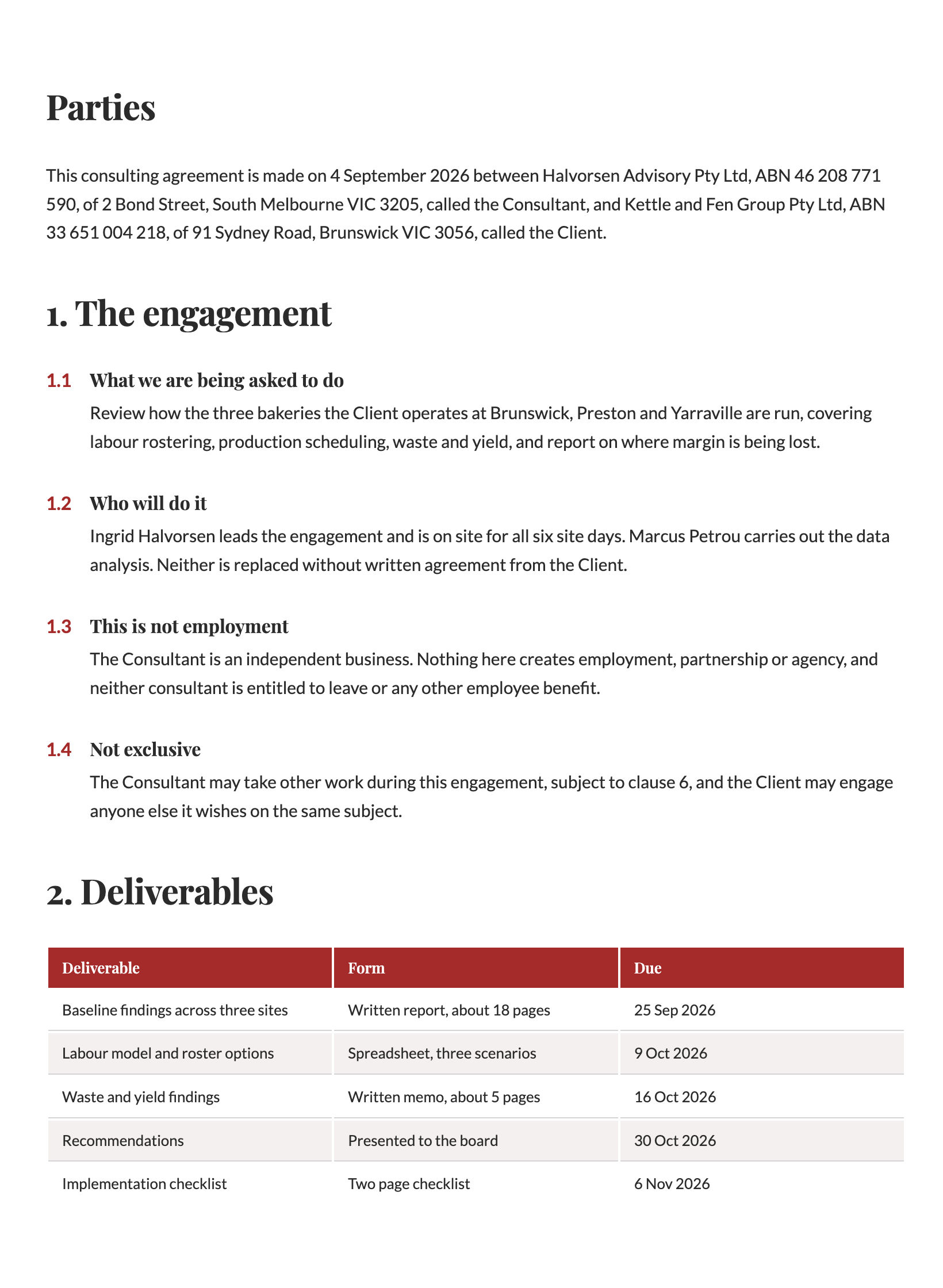 Consulting agreementAn advisory firm reviews three bakeries over seven weeks. What makes this agreement useful is not the fee clause but the two clauses that say what the advice is not.
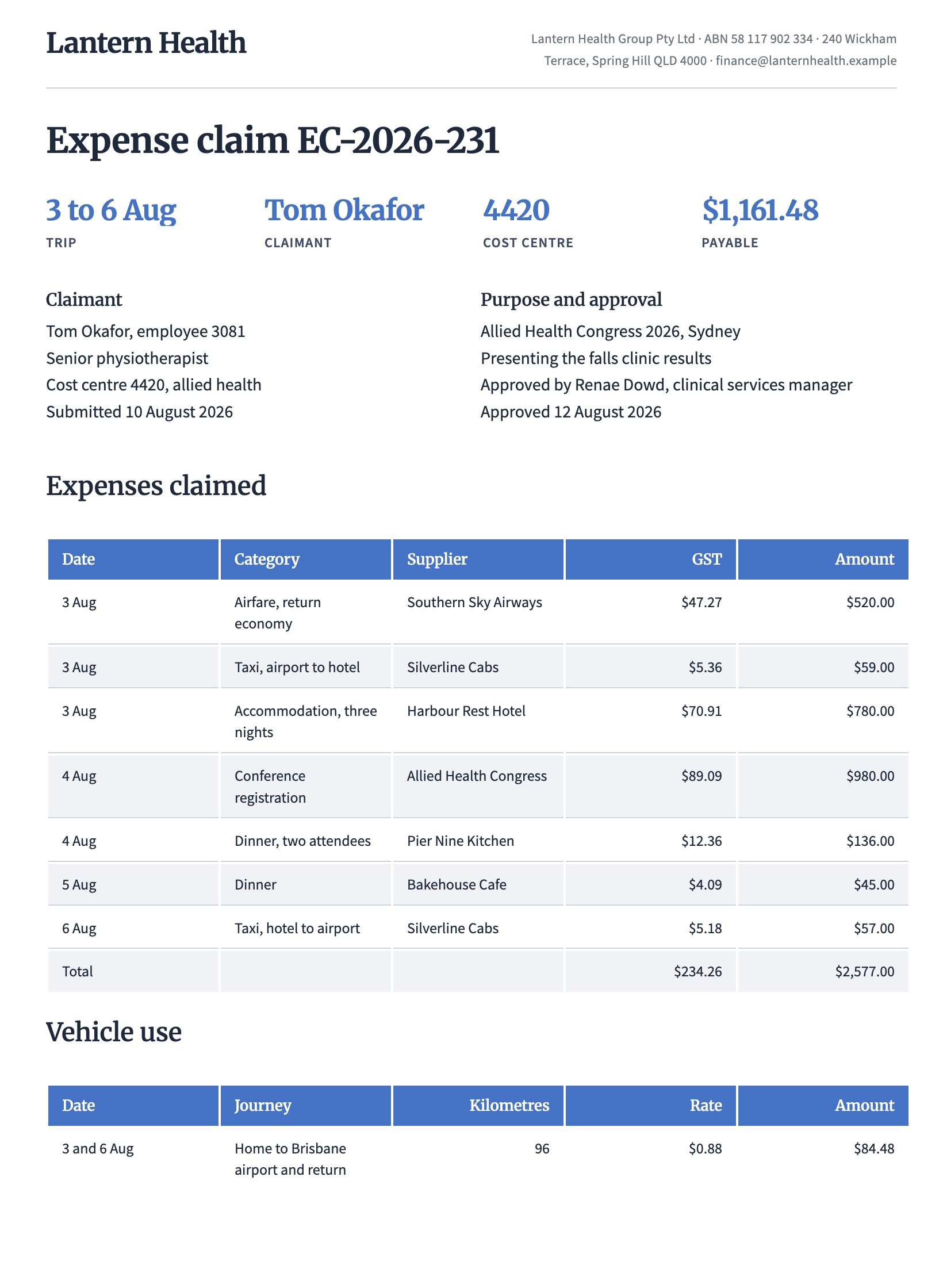 Expense reportA physiotherapist claims back four days at a conference. The interesting part is not the total but the subtraction: the trip cost one number and the reimbursement is a smaller one.
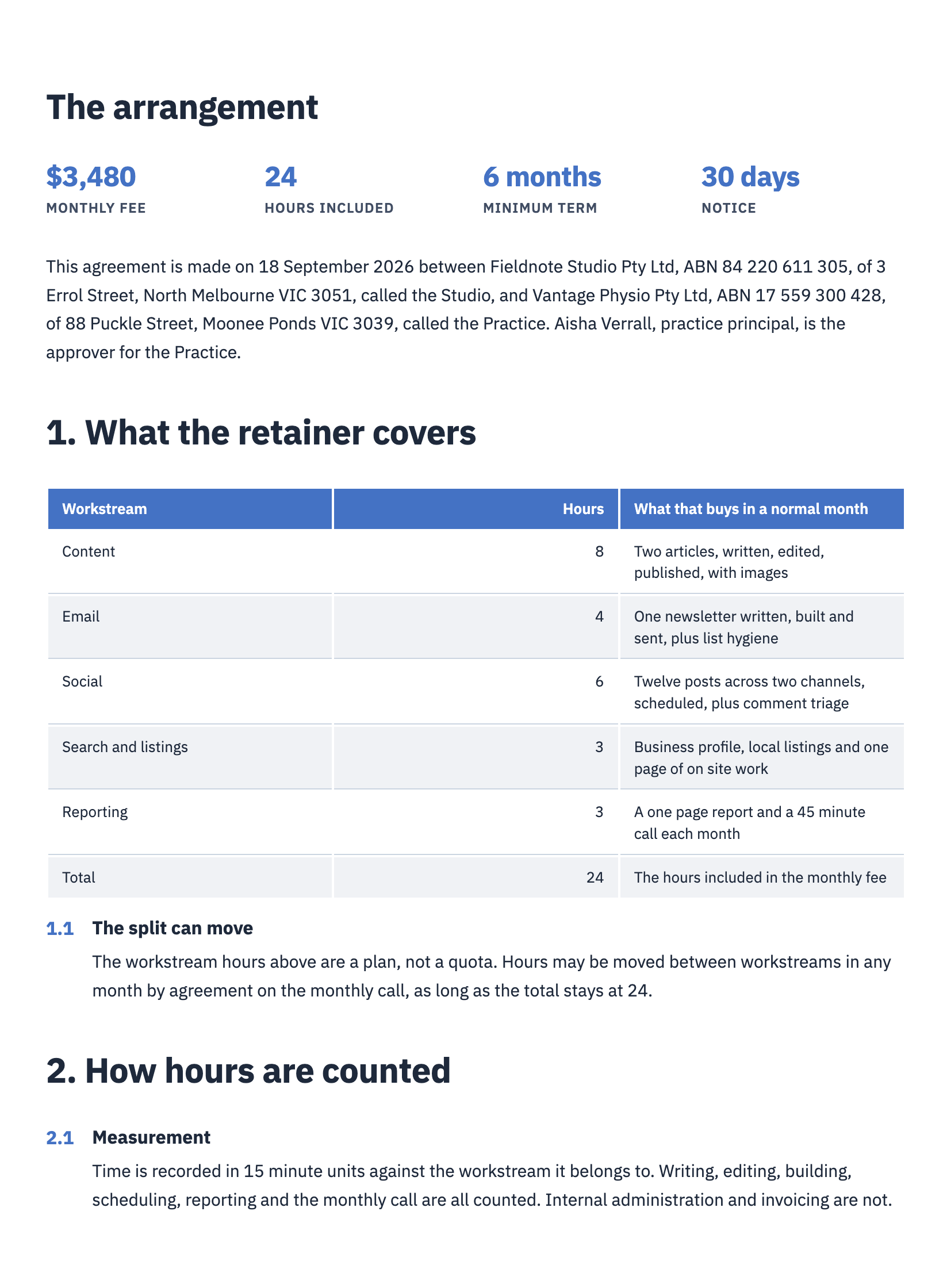 Monthly retainer agreementA studio sells a physio practice twenty four hours a month. Almost every clause exists to answer one question that ordinary contracts duck: what happens to the hours nobody used.
Questions people ask
Should expenses be billed at cost or with a markup?
At cost for travel and incidentals, because a markup on a flight is hard to justify and easy to notice. A stated handling percentage on bought in production costs is accepted in some industries, provided the clause names the percentage and the categories. Cost plus written as a general principle is usually struck out.
What counts as a reimbursable expense?
Whatever the clause lists. The workable test is whether the cost exists only because of this engagement. A flight to the client's regional site does. A project manager's laptop, professional membership and office rent do not, since they would be incurred anyway and are already inside the rate the client is paying.
Does the client need receipts for every expense?
For reimbursement at cost, yes, and requiring them with the claiming invoice rather than on request avoids months of chasing. A per diem allowance is the exception, since the point of a daily rate is that no receipts are collected. Mixing the two without saying which applies to what produces double claims.
How should GST on expenses be handled?
Reduce the reimbursement by any input tax credit the supplier can claim on the expense, then treat the reimbursed amount as part of the taxable supply under the tax clause. Reimbursing the full invoiced cost of an expense the supplier has already recovered tax on overpays it, and the error usually survives until an audit.
Can a supplier claim travel time as well as travel cost?
Only if the contract says so, and it is a separate question from expenses. Travel time is chargeable work or it is not, so it belongs in the fee clause, often at a reduced hourly rate or capped per day. Claiming it under an expenses clause that talks about costs will be rejected.
Is a monthly cap better than an overall cap?
For an engagement of any length, yes. A total cap gets consumed early and then every later trip needs an approval, which is the opposite of what the cap was for. A monthly figure with written approval above it keeps the routine costs flowing and puts a real decision in front of the client only when the pattern changes.
Put the clause in a finished document
The button opens the document generator with a starting description already filled in. Change it to match your own agreement before you run it.
Create a document with OneCraftRelated clauses
- Invoicing clause: when invoices go out and what they must showAn invoicing clause says when invoices go out and what they must show to be payable. Australian sample wording, the tax invoice checklist and three variants.
- GST clause: saying whether the price includes GSTA GST clause says whether amounts include GST and who pays it. Australian sample wording, a gross up variant, adjustment events and reimbursed expenses.
- Currency clause: which currency, and who carries the exchange riskA currency clause says which currency a contract is paid in and who carries exchange movement. Sample wording for a cross border engagement and three variants.
For everything the document generator can do, see the document maker.
Step by step in the builder: Create a document with AI, then Every document component and when to use it.
Written and checked by the OneCraft team. Last checked .