Contract clause
Reporting obligations clause: what the supplier must tell you, and when
A reporting obligations clause requires one party, usually the supplier, to give the other regular reports on progress, performance, spend and risk, in a set form and by a set date. It turns information the customer would otherwise have to chase into a contractual deliverable that can be missed and enforced.
Most customers learn that a project is in trouble from a report that arrived late or said nothing. A reporting clause fixes the contents and the deadline, so bad news surfaces while there is still time to act on it.
Nuwan Madhusanka · Co-founder
4 min read · Published
Sample clause
a digital marketing retainer between Wirrah Growth Co, a fictional agency, and a regional credit union running a twelve month member campaign
11. Reporting 11.1 By the fifth business day of each month, the Agency must give the Client a written Monthly Report covering the previous month. 11.2 Each Monthly Report must set out: (a) hours worked by role against the retainer allowance; (b) progress against each Milestone in Schedule 2, with any date at risk; (c) media spend against budget, with each platform's invoices attached; (d) campaign results against the measures in Schedule 3; and (e) any risk, issue or complaint that may affect the Services, with the action proposed. 11.3 The Agency must notify the Client within 2 business days of becoming aware of any matter likely to delay a Milestone by more than 10 business days or to push spend more than 10 percent over budget, without waiting for the next Monthly Report. 11.4 The parties must meet within 5 business days after each Monthly Report is delivered to review it. 11.5 Each Monthly Report is Confidential Information of both parties.
Sample wording, not legal advice.
Variants
Report at each milestone
Fixed price projects where monthly reporting adds cost without insight and progress is measured by deliverables.
Within 3 business days after completing each Milestone, the Supplier must give the Customer a Milestone Report stating the Deliverables completed, the acceptance tests passed or outstanding, any change requests raised during the Milestone and the forecast date for the next Milestone. The Customer need not pay the Milestone Payment until the Milestone Report has been delivered, and a late report does not shorten the time the Customer has to decide on acceptance.
Reports on request, with a cap
Short or low value services where both sides want to avoid a standing reporting burden.
The Supplier must give the Customer a written report on the status of the Services within 5 business days after a written request. The Customer may request one report in any calendar month without charge, and must pay for the time reasonably spent preparing any further report at the rates in Schedule 1. Each report must state the work completed since the last report, the work outstanding and any matter that may affect the price or timetable.
Supply chain compliance reporting
Customers that must report on their own supply chains, such as entities preparing modern slavery statements.
By 31 July each year the Supplier must give the Customer a written statement describing the steps it took during the previous financial year to identify and address risks of modern slavery in its operations and in the supply chain for the Goods, including any incident identified and the action taken. The Supplier must also provide any further information the Customer reasonably requests to prepare its own statement under the Modern Slavery Act 2018 (Cth).
What to negotiate
Contents that inform rather than decorate
Customers ask for everything that might be interesting, and suppliers point out that every extra page is billable time. The practical answer is a short list tied to the contract's own measures: hours or spend against budget, progress against dated milestones, results against agreed indicators, and open risks. Anything beyond that can be requested separately when a real need arises.
Early warning between reports
A monthly report is too slow for a problem that appears on the second day of the month. Customers ask for a duty to flag material issues at once, and suppliers ask for an objective trigger so they are not in breach over a judgement call. Thresholds such as a delay over ten business days or an overspend above a stated percentage settle both concerns.
What a late or inaccurate report costs
Reporting is often treated as a soft obligation with no consequence. Customers that rely on reports to approve invoices or to report upstream ask that payment depend on the report, or that repeated failures count as a material breach. Suppliers resist linking cash flow to paperwork, and often agree instead to a short cure period after written notice of a late report.
The risk of leaving it out
Without the clause the customer depends on goodwill and on whatever the supplier chooses to share, with no contractual basis to insist on figures, dates or risk information. Trouble then tends to surface at invoice time or at a missed milestone, when the options for recovery are narrowest and the relationship is already strained.
Report contents, as a checklist
A monthly services report usually needs five parts, and listing them in the clause stops every report being redesigned from scratch. First, effort or cost: hours by role or spend by category against budget. Second, progress: each milestone with its baseline date, current forecast and status. Third, results: the measures the contract actually uses, such as service levels, conversion figures or defects closed. Fourth, risks and issues, each with an owner and a proposed action. Fifth, decisions needed from the customer, with the date each is needed by. That last item is the one most often missing, and it is the one that protects a supplier if a later delay is blamed on it.
Reporting a customer needs for its own obligations
Some reporting exists because the customer must report to someone else. Under the Modern Slavery Act 2018, entities with annual consolidated revenue of at least $100 million prepare annual statements setting out their actions to assess and address modern slavery risks in their operations and supply chains, and those statements are published on a government register. Such customers commonly pass a reporting duty down to their suppliers. Accuracy matters as much as timeliness: a report that misstates progress or results can expose a supplier to a misleading conduct claim under the Australian Consumer Law, separately from any breach of contract.
Where it sits in a generated document
In a generated services agreement the reporting clause usually follows the description of the services and comes before fees, with the report contents written as lettered items so each can be referred to later. Deadlines such as the fifth business day are written as content rather than left as blanks. Where the parties also want a report layout, the description can ask for a schedule with a table of headings, which keeps the obligation and the template in one document.
Documents that carry this clause
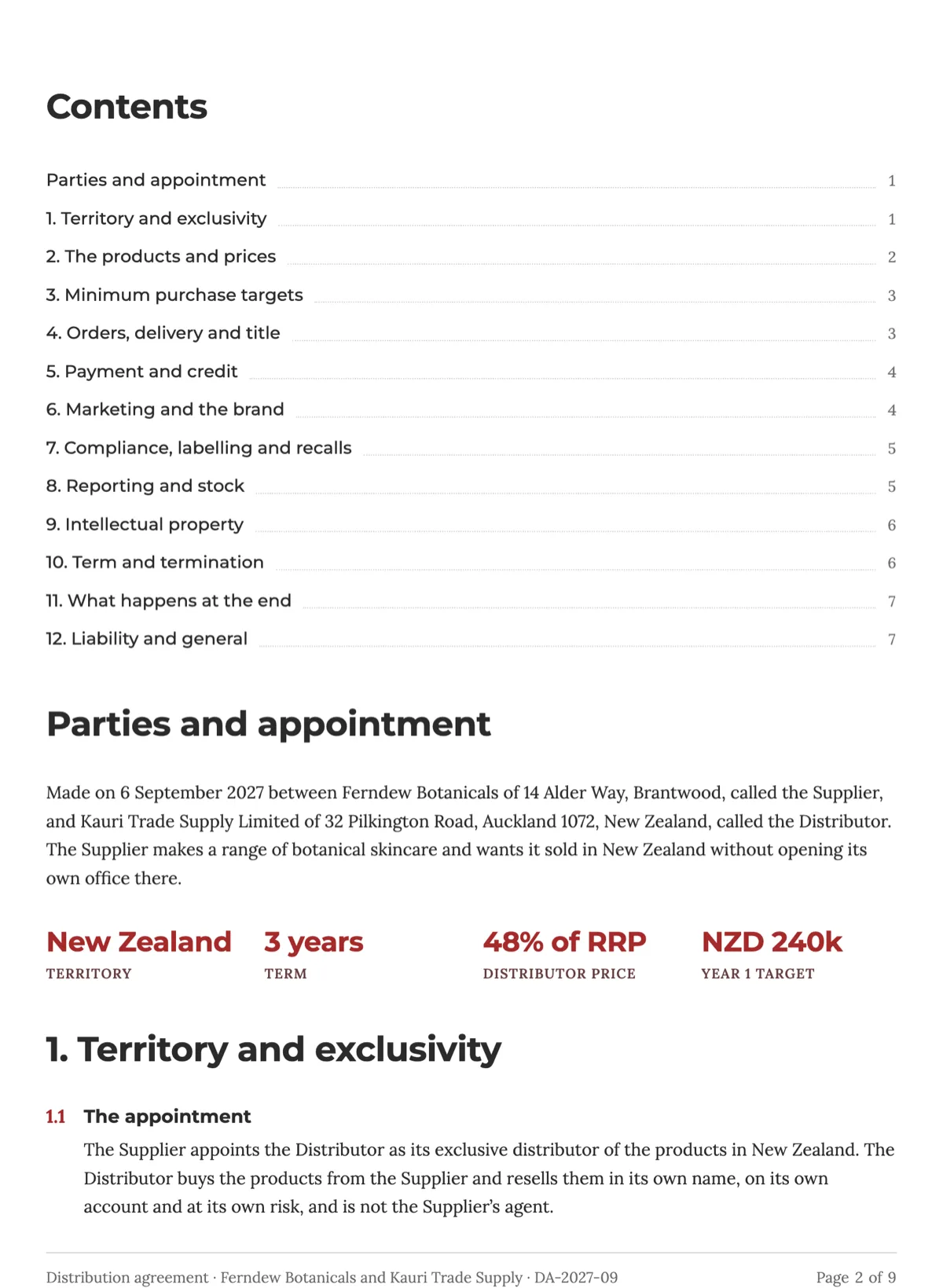 Distribution agreement template with territory and targetsAn exclusive distribution agreement is a trade: a territory in exchange for volume. This one appoints a New Zealand distributor for a skincare range at 48 per cent of recommended retail, with purchase targets rising from NZD 240,000 to NZD 420,000 across three years, and exclusivity that converts to non exclusive if a target is missed by more than 15 per cent.
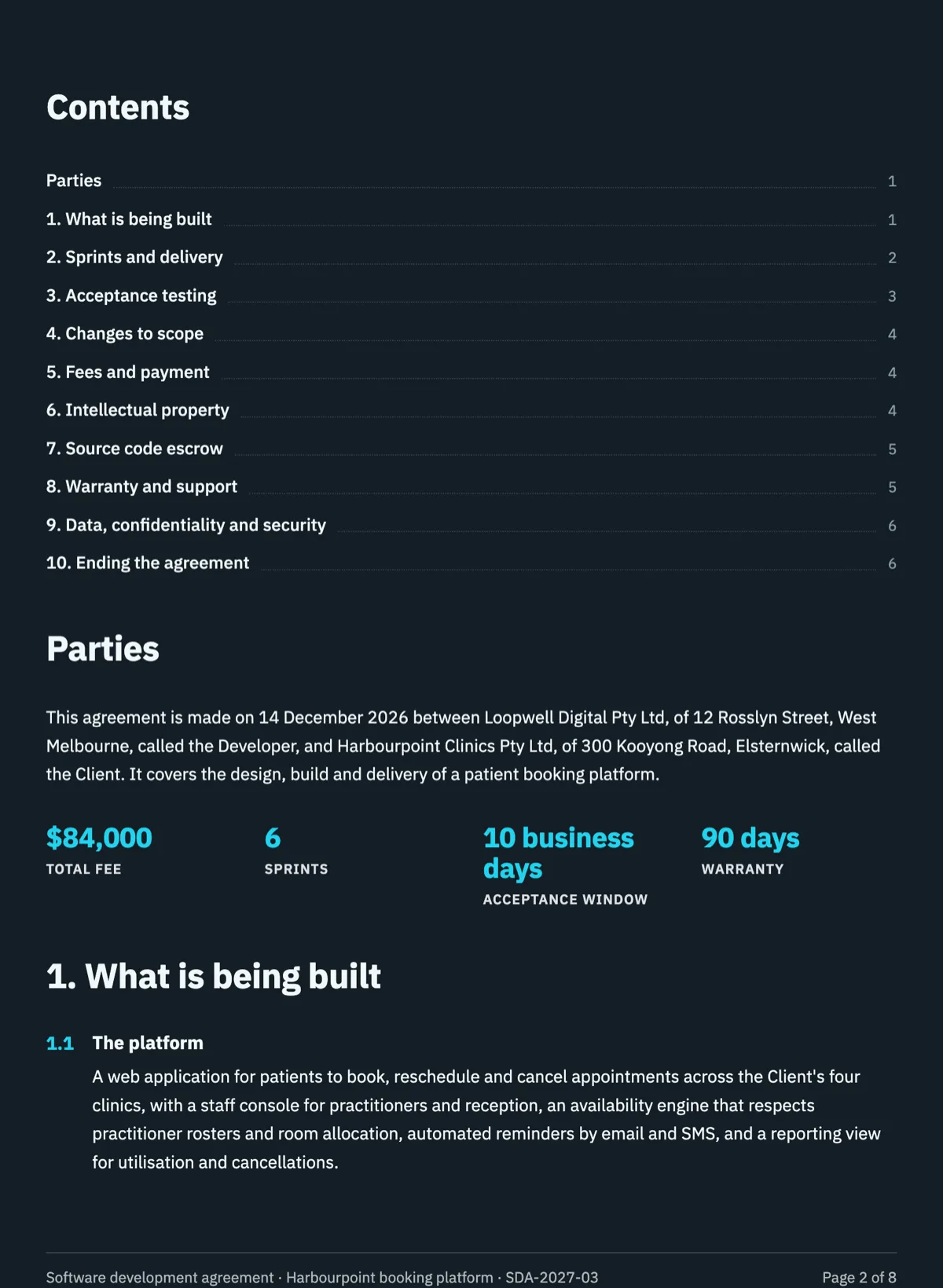 Software development agreement with sprints and an acceptance testCustom software goes wrong in the space between delivered and accepted, where one side thinks a sprint is finished and the other is still writing a list. This agreement fixes a ten business day acceptance window against criteria written before the sprint started, and assigns the intellectual property sprint by sprint as each invoice is paid.
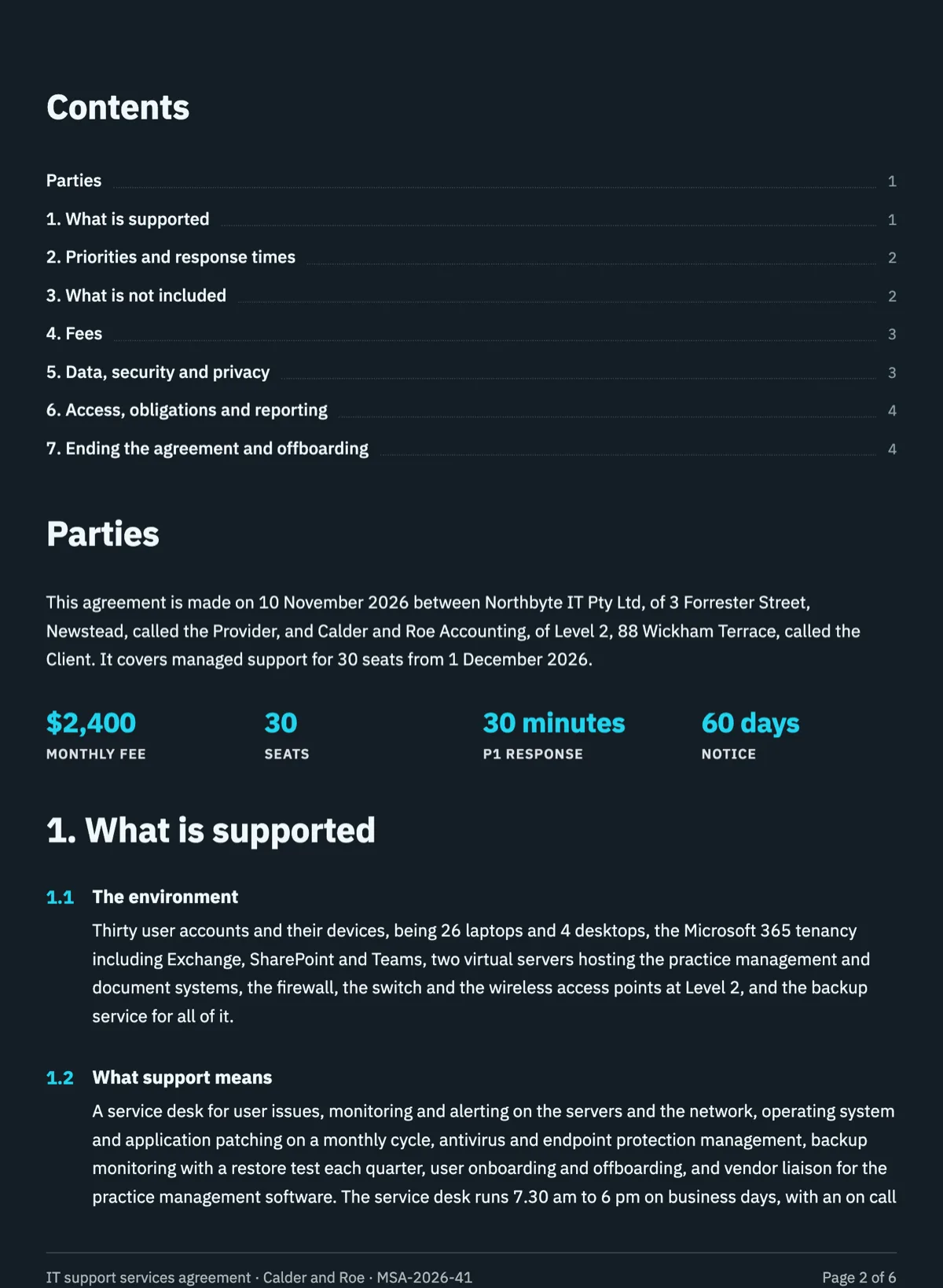 IT support services agreement with response times by priorityManaged support is sold on a monthly fee and judged on how fast the phone gets answered when nobody can work. This agreement grades every ticket into four priorities with a published response and resolution target, credits the fee when the target is missed, and writes down exactly what the provider hands back on the way out.
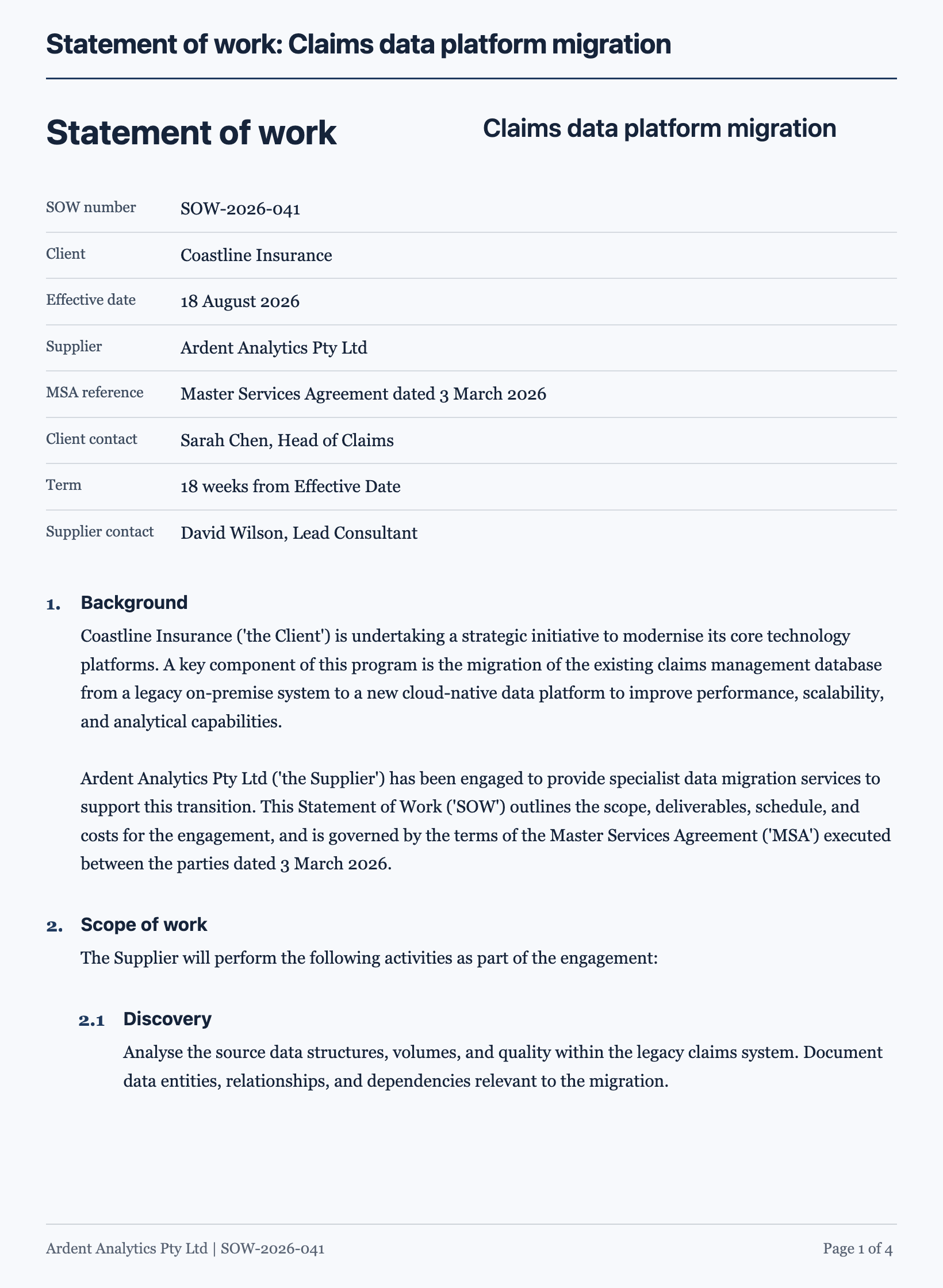 Statement of work template under a master agreementArdent Analytics migrates Coastline Insurance’s claims database to a cloud platform over 18 weeks under SOW-2026-041, governed by a master services agreement dated 3 March 2026. The work is time and materials with four roles priced by the day and a $412,000 estimate before GST, five dated deliverables, ten business days to accept each one, and five assumptions written down before anyone starts.
Questions people ask
How often should a supplier report?
Monthly suits most ongoing services and time and materials projects, because it lines up with invoicing. Weekly reporting is common during intensive phases such as a migration or a launch, and reporting at each milestone suits fixed price work. The frequency should match how quickly a problem could become expensive, rather than a habit carried over from another contract.
Can payment be withheld until a report is delivered?
It can if the contract says so, and some customers make the monthly report a condition of paying the matching invoice. Suppliers usually resist, since it ties cash flow to paperwork. A middle position keeps payment unconditional but treats repeated late reports, after written notice and a short cure period, as a breach that can support termination.
How is a reporting clause different from an audit clause?
A reporting clause obliges the supplier to push information to the customer in a set form on a set timetable. An audit clause lets the customer pull information by inspecting records, systems or premises to test whether what was reported is true. Significant contracts usually carry both, with audits used sparingly to verify the regular reports.
Should reports be treated as confidential?
Usually, and for both parties. A report can reveal the supplier's rates, staffing and methods as well as the customer's results and plans. Stating that each report is confidential information of both parties avoids arguing about whose information it is, while still letting the customer share the figures it needs for its own board or regulator.
What makes an early warning obligation workable?
An objective trigger. A duty to report anything significant invites a dispute about what was significant. Thresholds such as a forecast delay of more than ten business days, spend more than ten percent over budget, or any complaint from a regulator or a member of the public give the supplier a clear line and the customer a reliable signal.
Do reporting obligations continue after the contract ends?
Only where the contract says so. A final report covering the last period, open risks and handover items is often due shortly after termination or expiry, and compliance reporting can run to the end of the financial year in which the contract ended. Naming the reporting clause in the survival provision keeps those obligations enforceable.
Put the clause in a finished document
The button opens the document generator with a starting description already filled in. Change it to match your own agreement before you run it.
Create a document with OneCraftRelated clauses
- Audit rights clauseAn audit rights clause lets a customer inspect a supplier's records or systems to check compliance. Sample with a yearly audit on 20 days notice, and variants.
- Standard of care clause: how good the work has to beA standard of care clause sets the quality bar for work. Australian sample wording, due care and skill, best and reasonable endeavours, and fitness for purpose.
- Service level clause: turning good service into numbersA service level clause sets the measurable standards a service must meet. Sample uptime and response wording with a metrics table, and three variants.
For everything the document generator can do, see the document maker.
Step by step in the builder: Create a document with AI, then Document builder components.
Written and checked by the OneCraft team. Last checked .