Contract clause
Standard of care clause: how good the work has to be
A standard of care clause states the quality of skill and effort a supplier must bring to the work, measured against a described benchmark such as a competent professional in the same field. It sets the test for breach when nothing is promised about the result, only about the way the work is done.
Most service disputes are not about whether work was done but whether it was done well enough. The standard of care clause is the ruler that question is measured against, and the words chosen move the answer considerably.
Indunil Asanka · Co-founder
4 min read · Published
Sample clause
a structural engineering services agreement between Coolibah Consulting Engineers, a fictional firm, and a developer adding two storeys to an office building in Townsville
5. Standard of Care 5.1 The Consultant must perform the Services with the degree of skill, care and diligence reasonably expected of a competent structural engineer experienced in services of a similar scope, size and complexity. 5.2 The Consultant must perform the Services in accordance with the Brief, all applicable laws, and the codes and standards listed in Schedule 3 as in force at the date of this agreement. 5.3 The Consultant does not warrant that the Services will achieve any particular outcome unless that outcome is stated as a warranty in clause 11. 5.4 Nothing in this clause excludes, restricts or modifies any consumer guarantee under the Australian Consumer Law that cannot lawfully be excluded, restricted or modified. 5.5 If the Consultant becomes aware that it cannot meet the standard in clause 5.1 for any part of the Services, it must promptly notify the Client in writing.
Sample wording, not legal advice.
Variants
Reasonable care and skill, short form
Lower risk services where one sentence is enough and the parties are content to track the standard the law already implies.
The Supplier must perform the Services with reasonable care and skill, in a timely and professional manner, and in accordance with good industry practice for services of that kind in Australia. The Supplier must ensure the Services are performed by personnel who hold the qualifications, licences and experience appropriate to the tasks they perform.
Best endeavours for an uncertain outcome
Work where the result depends partly on a third party, such as obtaining a development approval or a grant.
The Consultant must use its best endeavours to obtain the Development Approval by 30 November 2027, including preparing and lodging a complete application, responding to each request for information from the Council within 10 business days, and attending every meeting the Council requests. The Consultant is not required to appeal a refusal, act unlawfully or incur costs not provided for in Schedule 1, and does not warrant that the Development Approval will be granted.
Fitness for a stated purpose
Design and construct or equipment supply where the customer relies entirely on the supplier to produce something that works.
The Contractor must design, supply and install the Cool Room so that it is fit for the purpose stated in Schedule 1, being the continuous storage of pharmaceutical products between 2 and 8 degrees Celsius at the stated ambient conditions. The Contractor acknowledges that the Owner has made that purpose known and relies on the Contractor's skill and judgement, and this obligation applies in addition to the Contractor's duty to exercise due care and skill.
What to negotiate
Reasonable care or fitness for purpose
A reasonable care standard is breached only if the supplier fell below what a competent practitioner would have done. Fitness for purpose is breached if the result does not work, however carefully it was produced. Customers prefer the second for design and construct work, while consultants prefer the first, because professional indemnity cover is usually written around negligence and may not respond to a guarantee of outcome.
Best, reasonable or all reasonable endeavours
These phrases are not interchangeable. Best endeavours is generally read as requiring a party to take all reasonable steps available to reach the goal, sometimes at cost to itself, while reasonable endeavours lets a party weigh its own commercial interests. Because each phrase is read in context, listing the specific steps expected gives far more certainty than the adjective alone.
Whose benchmark applies
A standard tied to a generally competent practitioner is lower than one tied to a specialist experienced in projects of similar size and complexity. Customers who chose a firm for its specialism ask for the higher benchmark. Suppliers accept it where the scope is well defined and resist it where the brief is loose, since the higher test then applies to work nobody fully specified.
The risk of leaving it out
Without the clause the customer relies on implied standards: the Australian Consumer Law guarantee that services to a consumer, as that Act defines the term, are rendered with due care and skill, and an implied term of reasonable care in many commercial contracts. Those give no benchmark, no named codes and no duty to warn, so each quality complaint becomes an argument about expectations.
The statutory floor underneath the clause
Australian law already imposes a minimum. Section 60 of the Australian Consumer Law guarantees that services supplied to a consumer are rendered with due care and skill, and section 61 adds guarantees of fitness for a disclosed purpose where the consumer relies on the supplier. The consumer definition reaches many small business purchases, and the guarantees cannot be contracted out of, although liability can be limited for some supplies not ordinarily acquired for personal or household use. In the United Kingdom, section 49 of the Consumer Rights Act 2015 and section 13 of the Supply of Goods and Services Act 1982 imply a term of reasonable care and skill. A contractual standard builds on those floors by naming the benchmark, the codes and the process.
Care standards and insurance
Professional indemnity policies are generally written to respond to liability arising from negligence in professional work. An obligation that goes further, such as a promise that a design will be fit for purpose or that a result will be achieved, can fall outside that cover and leave the supplier carrying the gap itself. That is why consultants tend to negotiate fitness for purpose out of their agreements or confine it to measurable performance criteria, and why customers who need an outcome guarantee often seek it from the contractor who builds the thing rather than the designer.
Where it sits in a generated document
A generated consulting agreement usually states the standard of care directly after the scope of services and before warranties and the liability cap, because both depend on it. The codes and standards the work must follow are best named in the description, so they can be listed in a schedule. The document is written in a legal register, and any statutory section in a draft still needs checking, since generated text does not print its sources.
Documents that carry this clause
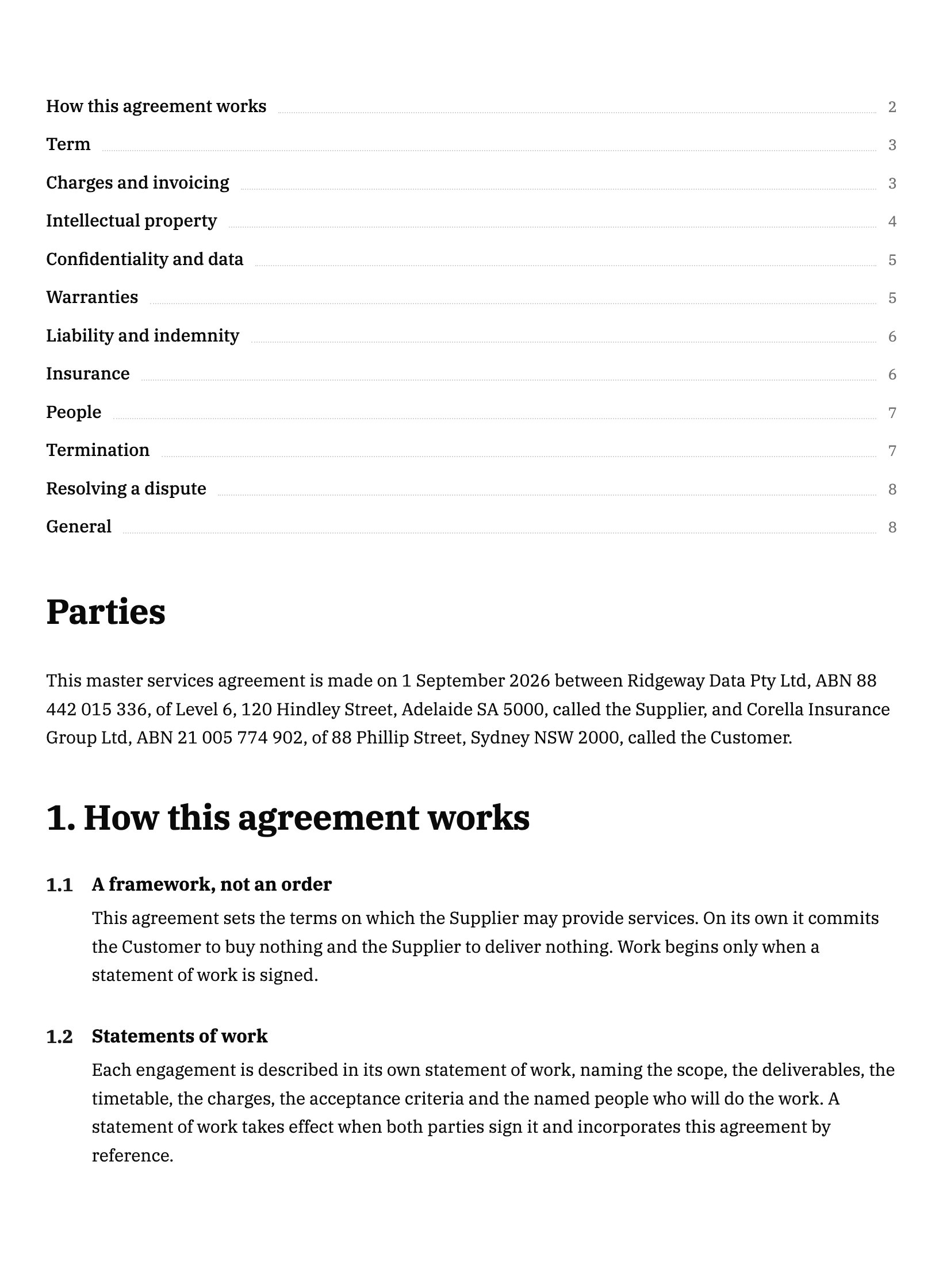 Master services agreementA data consultancy and an insurer sign this once and then buy work under it for three years. It is the rare contract whose whole purpose is to make the next twenty contracts short.
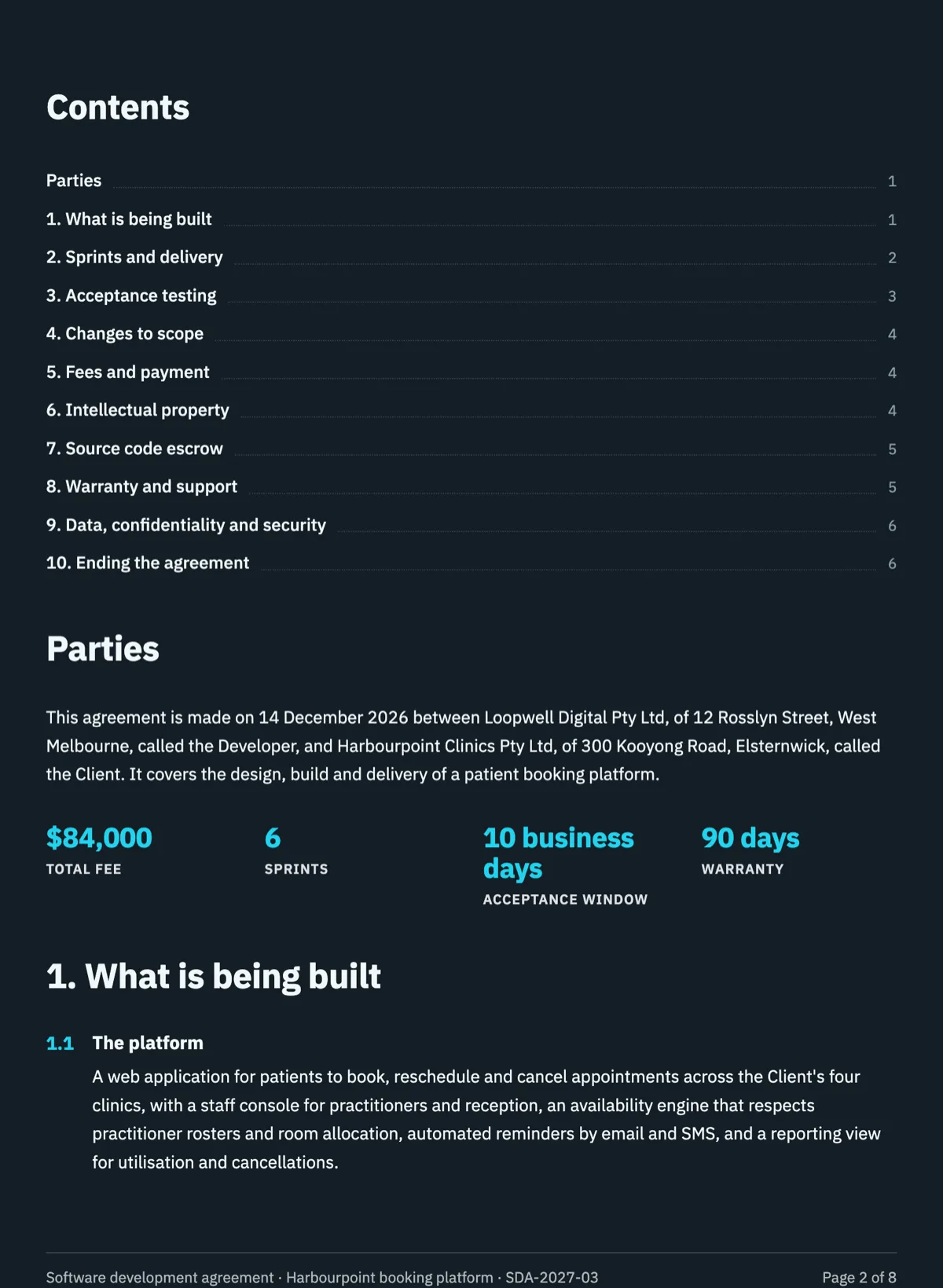 Software development agreement with sprints and an acceptance testCustom software goes wrong in the space between delivered and accepted, where one side thinks a sprint is finished and the other is still writing a list. This agreement fixes a ten business day acceptance window against criteria written before the sprint started, and assigns the intellectual property sprint by sprint as each invoice is paid.
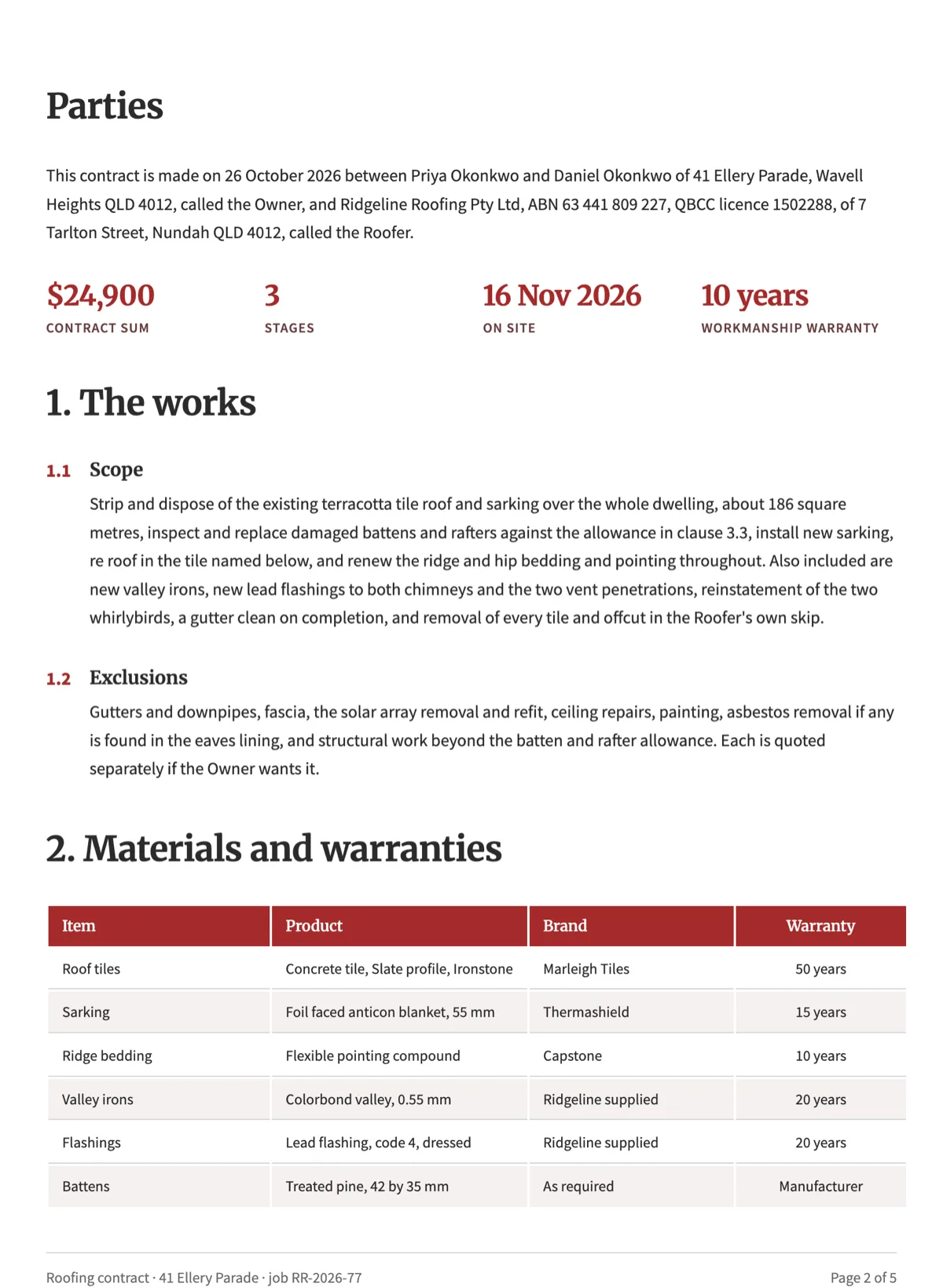 Roofing contract template with a materials table and a weather ruleA roof replacement is the one job where the house is open to the sky at the end of the day, so the clause that matters most is the one about closing it. This contract limits how much roof can be stripped at once, names every product with its warranty years, and says who pays when water gets in.
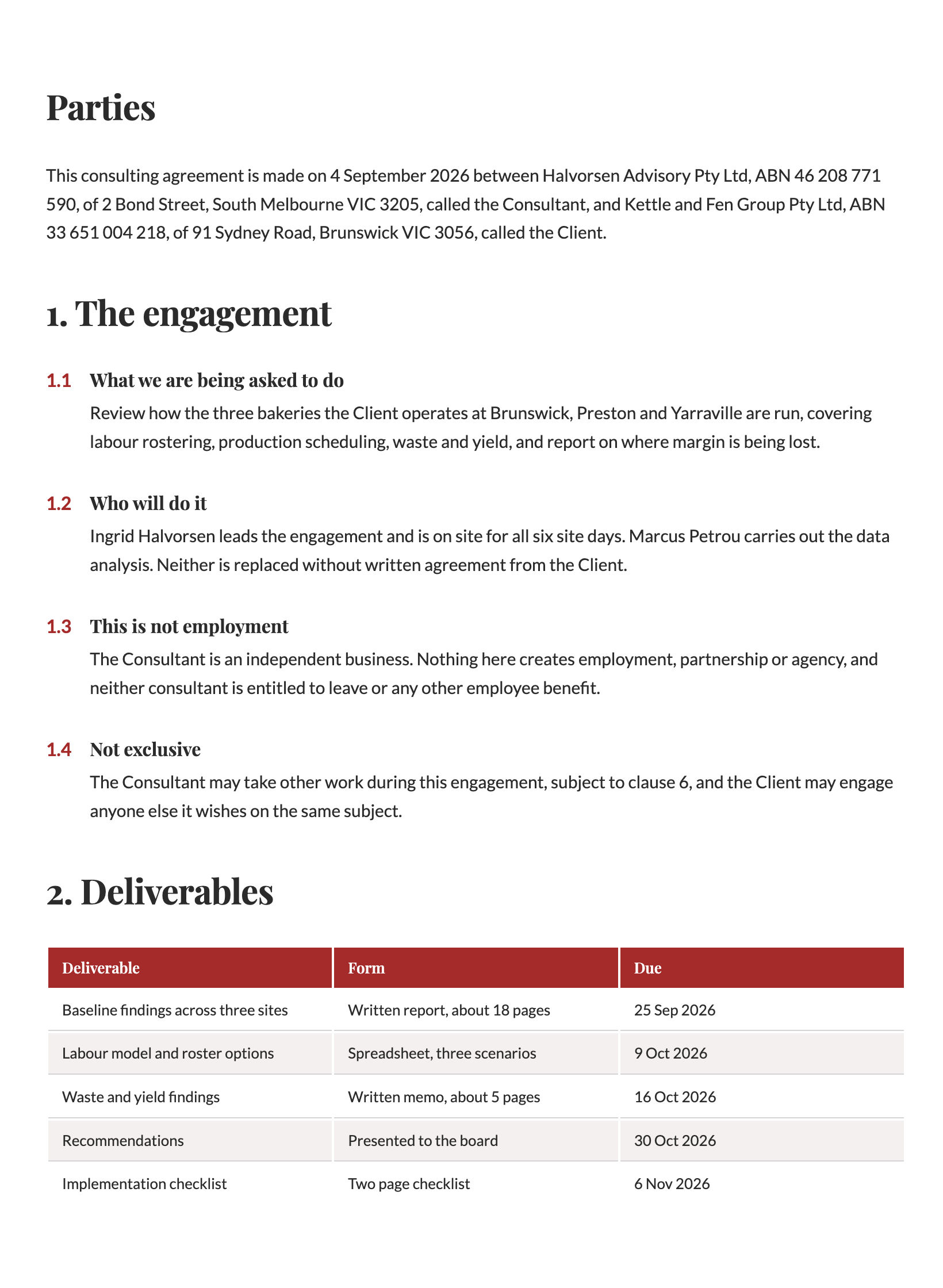 Consulting agreementAn advisory firm reviews three bakeries over seven weeks. What makes this agreement useful is not the fee clause but the two clauses that say what the advice is not.
Questions people ask
What is the difference between due care and skill and fitness for purpose?
Due care and skill is a promise about how the work is done: the supplier meets the standard of a competent practitioner. Fitness for purpose is a promise about the result: the finished thing does what it was meant to do. A supplier can take great care and still breach a fitness for purpose obligation if the outcome fails.
Is best endeavours stronger than reasonable endeavours?
Generally yes. Best endeavours is usually read as requiring a party to take all reasonable steps open to it to reach the goal, even at some cost to its own interests, whereas reasonable endeavours allows it to balance the goal against its commercial position. Both are read in context, so listing the expected steps is the surest way to give either phrase content.
Can a contract exclude the consumer guarantee of due care and skill?
No. The Australian Consumer Law guarantees cannot be excluded, restricted or modified by contract, and a term that tries can be void. For supplies not ordinarily acquired for personal, domestic or household use, a supplier can in some cases limit its liability to supplying the services again or paying for that. Well drafted clauses say so expressly.
What benchmark should a professional services contract use?
Commonly a competent practitioner experienced in work of similar scope, size and complexity. That is higher than a generally competent practitioner and reflects why the client chose the firm. It works best alongside a clear brief, because a high benchmark applied to a vague scope can make almost any disagreement about quality look like a breach.
Does a standard of care clause guarantee a result?
Not on its own. A care standard is breached only if the work fell below the required level of skill and diligence. Where the customer needs an outcome, such as a system that meets a performance figure or a room that holds a set temperature, that should be stated separately as a warranty or a fitness for purpose obligation with measurable criteria.
Should the supplier have to warn when it cannot meet the standard?
It is a sensible addition. A duty to notify promptly when part of the work cannot be done to the agreed standard, perhaps because information is missing or the brief is unrealistic, lets the customer adjust the scope or the timetable. It also protects the supplier, which can later show that it raised the problem when it first arose.
Put the clause in a finished document
The button opens the document generator with a starting description already filled in. Change it to match your own agreement before you run it.
Create a document with OneCraftRelated clauses
- Warranty clause: promising a standard and backing itA warranty clause promises a fact is true or that work meets a standard. Australian sample wording for a ninety day defects warranty, variants and remedies.
- Disclaimer of warranties clause: what can and cannot be excludedA disclaimer of warranties clause removes implied warranties as far as the law allows. Australian sample wording with the consumer guarantees carve out.
- Reporting obligations clause: what the supplier must tell you, and whenA reporting obligations clause sets what a supplier reports, how often and in what form. Sample monthly report wording, a contents checklist and three variants.
For everything the document generator can do, see the document maker.
Step by step in the builder: Create a document with AI, then Document builder components.
Written and checked by the OneCraft team. Last checked .