Contract clause
Service level clause: turning good service into numbers
A service level clause sets measurable standards a service must meet, such as availability, response time and resolution time, together with how each is measured, over what period, and what is excluded. Without the measurement rules a target is a promise nobody can prove was broken, which is why the definitions matter as much as the numbers.
A promise of reliable support means whatever the unhappy party wants it to mean. A service level clause replaces that with a target, a measuring window and a report, so both sides can see from the same data whether the service is working.
Nuwan Madhusanka · Co-founder
4 min read · Published
Sample clause
a hosted booking platform agreement between Wombat Hollow Software, a fictional software company in Canberra, and Sandstone Physio Group, which runs appointment bookings for nine clinics through the platform
12. Service Levels 12.1 Wombat Hollow Software must meet the Service Levels below in each calendar month. Availability: 99.5% of minutes in the month, measured by external monitoring at one minute intervals. Severity 1 response: within 30 minutes, 24 hours a day. Severity 1 resolution or workaround: within 4 hours. Severity 2 response: within 2 Business Hours. Severity 3 response: within 1 Business Day. 12.2 Response means a named support engineer has contacted Sandstone Physio Group about the incident; an automated acknowledgement is not a response. 12.3 Downtime excludes Scheduled Maintenance notified at least 5 Business Days in advance and performed between 10 pm and 5 am local time, and outages caused by Sandstone Physio Group's own systems. 12.4 Wombat Hollow Software must provide a monthly service report within 10 Business Days of each month end. 12.5 Clause 13 (Service Credits) applies if a Service Level is not met.
Sample wording, not legal advice.
Variants
Uptime only
Simple hosting or subscription services where support is best efforts and only availability is contractually important.
The Provider must ensure the Service is Available for at least 99.9 percent of the minutes in each calendar month, excluding Scheduled Maintenance. The Service is Available when users can log in and complete the core functions listed in Schedule 1. Availability is measured by the Provider's monitoring tool and reported to the Customer on request.
Response and resolution
Managed IT and maintenance services where the value lies in how quickly problems are dealt with rather than uptime.
The Provider must respond to and resolve Incidents within the times in Schedule 3 according to their priority. The Customer assigns the priority when logging an Incident, and the Provider may raise it but may only lower it with the Customer's agreement. Resolution times stop while the Provider is waiting on information or access that the Customer must supply, provided the Provider has requested it in writing.
Availability with detailed exclusions
A supplier relying on third party cloud infrastructure that wants its promise limited to failures within its control.
Availability is calculated as total minutes in the month less Downtime, divided by total minutes. Downtime excludes periods caused by Scheduled Maintenance, emergency security patches notified as soon as practicable, the Customer's equipment or internet connection, suspension under clause 9, or a Force Majeure Event. Downtime of less than five consecutive minutes is not counted.
What to negotiate
What counts as down
A platform that loads but cannot take a payment is not really available. Customers want availability defined by the core functions they use, measured from outside the supplier's network. Suppliers prefer a simple login test and their own monitoring. A short list of core functions, tested by an independent monitoring service, is a common middle ground.
Exclusions and maintenance windows
Every excluded minute raises the effective availability. Customers push for maintenance windows outside business hours, a cap on monthly maintenance, advance notice, and no exclusion for third party hosting failures the supplier chose. Suppliers need emergency patching excluded and ask for outages caused by the customer to be excluded.
Measurement window
A monthly window hides a four hour outage during the busiest day. Customers sometimes add a separate target for any single outage, or measure business hours availability separately. Suppliers resist per incident measures but accept a critical incident rule, such as any outage longer than a stated period counting as a service level failure.
The risk of leaving it out
Without service levels the supplier's obligation is usually to provide the service with due care and skill and within a reasonable time. That standard is hard to measure, so poor service rarely amounts to a provable breach until it becomes serious. The customer has little leverage for improvement, and the supplier has no clear line showing it has performed.
What a metrics table should hold
Each service level needs four things: the metric, the target, the measurement method and the measurement period. Availability is usually a percentage of minutes in a month. Response and resolution times are usually set by severity, with severity defined by business impact rather than technical cause. The table should state business hours and time zone, whether clocks stop while waiting on the customer, and which tool produces the data. For reference, 99.5 percent monthly availability allows roughly three and a half hours of downtime in a thirty day month, and 99.9 percent allows about forty three minutes.
Service levels and the underlying legal standard
Service levels do not replace the general obligations that apply to the service. Where the Australian Consumer Law applies, services supplied to a consumer carry guarantees that they will be rendered with due care and skill and be reasonably fit for any purpose made known, and those guarantees cannot be excluded by contract. In business contracts the service levels usually sit alongside a warranty of reasonable care and skill. Public sector contract suites, such as the Commonwealth Contracting Suite and the UK Model Services Contract, show how service levels, reports and remedies are commonly structured in larger arrangements.
Where it sits in a generated document
A service level clause reads best as short operative wording plus a metrics table. The document builder offers a table block, and a generated services agreement numbers its clauses, so the operative clause can point to the table and to the service credits clause by number. Targets and measurement rules come from the description with nothing cited, so each number needs checking against what the supplier can actually monitor.
Documents that carry this clause
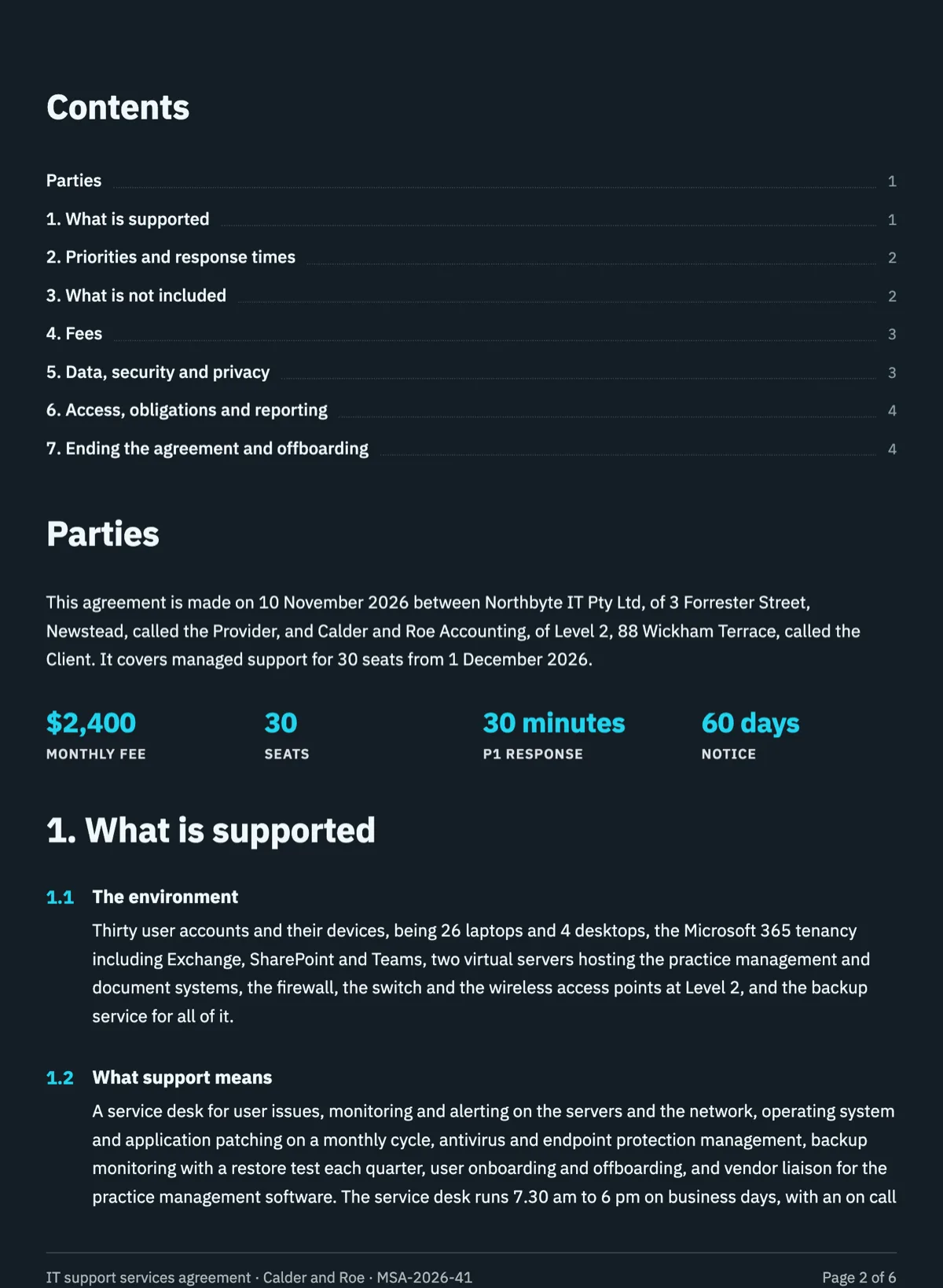 IT support services agreement with response times by priorityManaged support is sold on a monthly fee and judged on how fast the phone gets answered when nobody can work. This agreement grades every ticket into four priorities with a published response and resolution target, credits the fee when the target is missed, and writes down exactly what the provider hands back on the way out.
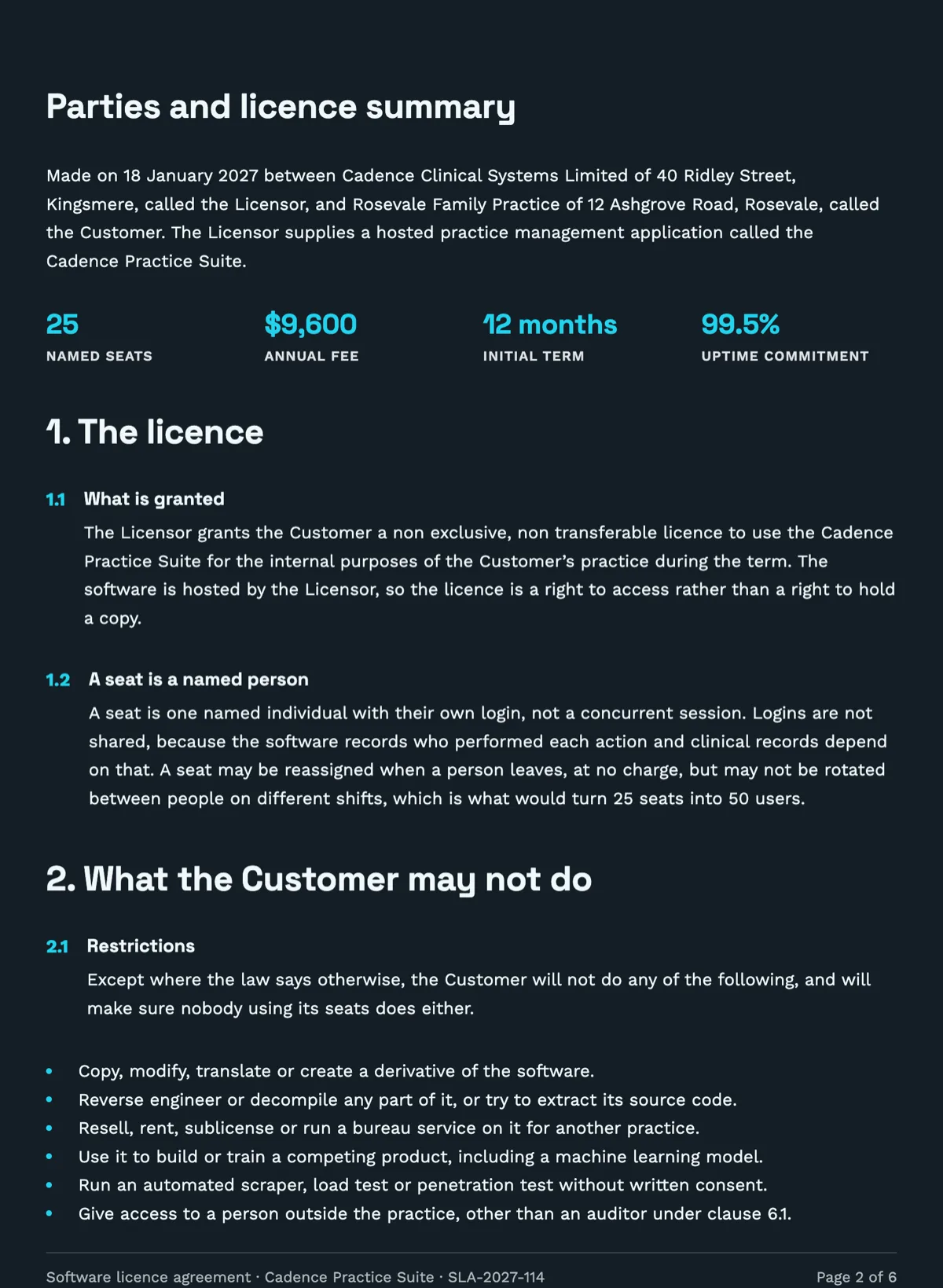 Software licence agreement template with seats, term and supportA software licence agreement has to answer three questions before anything else: what a seat is, what happens when the software is down, and who gets the data at the end. This one licenses a hosted practice management suite to a medical practice for 25 named users at $9,600 a year, with a support table, uptime credits and a 30 day export.
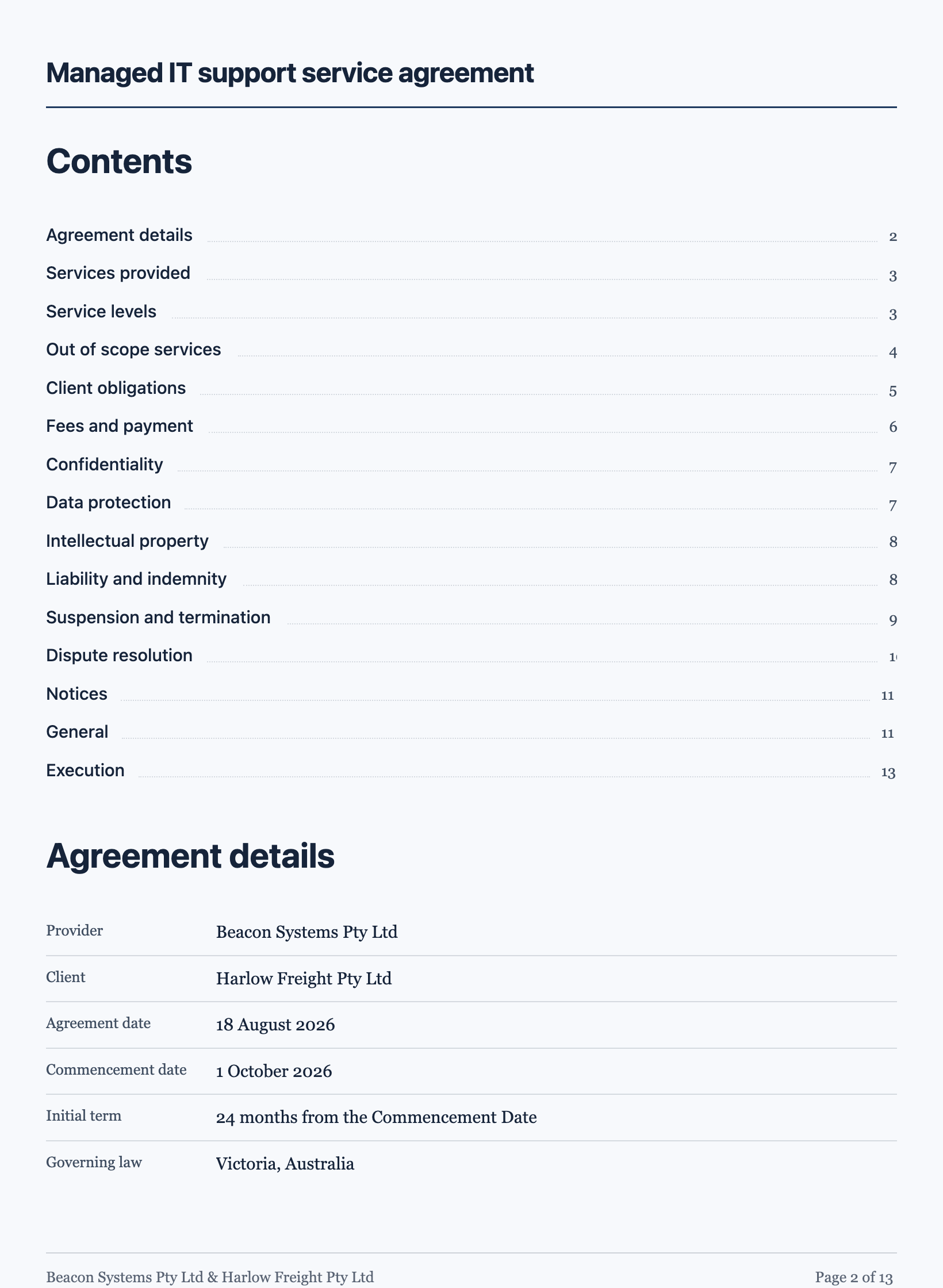 Service agreementBeacon Systems supports Harlow Freight’s IT for an initial 24 months from 1 October 2026 at $8,400 a month plus GST, with 40 hours included and $220 an hour beyond them. Twelve numbered clauses cover the services, a four level severity table, client duties, fees with a CPI adjustment, confidentiality, privacy, IP, a liability cap, termination and a three step dispute ladder.
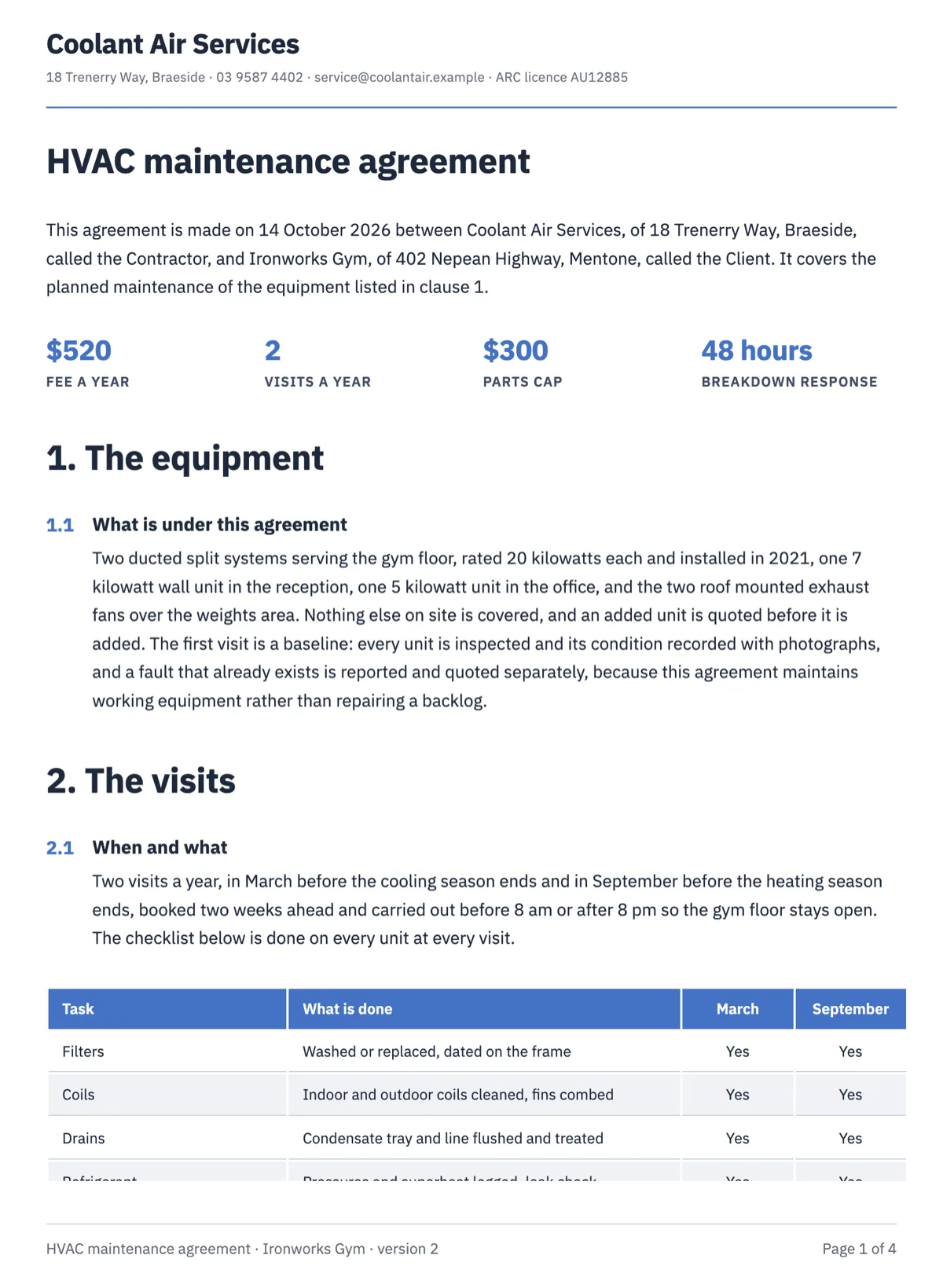 HVAC maintenance agreement with a visit checklist and a parts capPlanned maintenance contracts usually fail in the gap between the scheduled visit and the breakdown nobody priced. This one fixes the checklist for both visits, sets a 48 hour response, and gives the contractor a $300 ceiling to fix small things on the spot instead of booking a second trip.
Questions people ask
What is a reasonable uptime target?
It depends on the service and price. Business software commonly commits to between 99.5 and 99.9 percent monthly availability. The gap is significant: 99.5 percent allows about three and a half hours of downtime in a thirty day month, while 99.9 percent allows about forty three minutes. Higher targets usually cost more.
What is the difference between response time and resolution time?
Response time measures how quickly the supplier engages with an incident, ideally a person rather than an automated reply. Resolution time measures how quickly the incident is fixed or a workaround restores service. Both are usually set by severity, and resolution targets are often expressed as targets rather than guarantees.
Who measures the service levels?
Usually the supplier, using its monitoring and ticketing tools, with the data reported monthly. Customers with critical dependence may ask for independent external monitoring, access to the raw data, or a right to audit the reporting. The contract should say which source prevails if the two sets of data disagree.
Is missing a service level a breach of contract?
It depends on the drafting. Some clauses make service levels binding obligations, so a miss is a breach. Others treat them as targets whose only consequence is a service credit. Many contracts combine the two, with credits for ordinary misses and a termination right for repeated or severe failures.
Should planned maintenance count as downtime?
Usually not, if it is notified in advance and performed in an agreed window. Customers limit the exclusion by capping monthly maintenance hours, requiring notice of several business days and fixing the window outside business hours. Emergency maintenance is more contentious and is often counted unless it addresses a security threat.
Do service levels need a report?
Without one, neither party can easily show whether targets were met. A monthly report listing availability, incidents by severity, response and resolution times, and any credits due gives both parties the same evidence and supports a regular review meeting. The reporting obligation should have its own deadline.
Put the clause in a finished document
The button opens the document generator with a starting description already filled in. Change it to match your own agreement before you run it.
Create a document with OneCraftRelated clauses
- Service credits clause: what a missed service level costs the supplierA service credits clause sets the fee reduction a customer receives when a service level is missed. Sample credit table, percentage and fixed amount variants.
- Acceptance testing clause: deciding when the work is doneAn acceptance testing clause sets how a deliverable is tested and when it counts as accepted. Sample 10 day test wording, deemed acceptance and staged variants.
- Reporting obligations clause: what the supplier must tell you, and whenA reporting obligations clause sets what a supplier reports, how often and in what form. Sample monthly report wording, a contents checklist and three variants.
- Cure period clauseA cure period clause gives a party time to fix a breach before termination. Sample wording, tiered periods, repeat breach rules and what to negotiate.
For everything the document generator can do, see the document maker.
Step by step in the builder: Create a document with AI, then Document builder components.
Written and checked by the OneCraft team. Last checked .