Contract clause
Service credits clause: what a missed service level costs the supplier
A service credits clause sets the reduction in fees a customer receives when a supplier misses an agreed service level, usually on a sliding scale tied to how badly the target was missed, under a monthly cap. It also decides how credits are claimed, whether they are the customer's only remedy, and when repeated failures give a right to terminate.
Service credits are the price adjustment that makes service levels bite without a lawsuit. How they are sized, capped and claimed decides whether they motivate the supplier or simply become a small discount the supplier budgets for.
Indunil Asanka · Co-founder
4 min read · Published
Sample clause
a cloud practice management subscription between Quokka Cloud Services, a fictional software provider in Perth, and Riverstone Dental Partners, which pays a monthly fee for twelve surgeries across four practices
13. Service Credits 13.1 If Availability in a month falls below the Service Level in clause 12, Riverstone Dental Partners is entitled to a Service Credit calculated as a percentage of the Monthly Fee for that month: 99.0% to below 99.5%: 5% 98.0% to below 99.0%: 10% 95.0% to below 98.0%: 15% Below 95.0%: 25% 13.2 Service Credits are calculated from the monthly service report and applied automatically to the next invoice. Riverstone Dental Partners does not need to make a claim. 13.3 Total Service Credits in any month are capped at 25% of the Monthly Fee. 13.4 The parties agree that Service Credits are a reasonable pre estimate of the reduced value of the Services and are not a penalty. 13.5 Service Credits do not limit Riverstone Dental Partners' right to terminate under clause 22.3 if Availability is below 95.0% in any two months in a rolling six month period.
Sample wording, not legal advice.
Variants
Percentage of the monthly fee
Subscription and managed services with a stable monthly charge, where credits should scale with what the customer pays.
For each Priority 1 Incident not resolved within the Resolution Time, the Customer is entitled to a credit of 2 percent of the Monthly Service Charge, and for each further four hours the Incident remains unresolved, a further 2 percent. Credits for a month must not exceed 20 percent of the Monthly Service Charge for that month and are deducted from the following month's invoice.
Fixed amount per failure
Services with variable monthly fees, or where each failure has a fairly consistent cost to the customer regardless of the bill.
For each day on which the Contractor fails to complete a scheduled service visit within the agreed window, the Client is entitled to a service credit of $350. Service credits in a calendar month must not exceed $3,500. The Contractor must show accrued service credits as a deduction on the invoice for the month in which the failures occurred.
Credits as the sole remedy, claimed on request
Low cost, standardised services where the supplier cannot price uncapped exposure for downtime.
Service Credits are the Customer's sole and exclusive remedy for any failure to meet the Service Levels. To receive a Service Credit, the Customer must submit a claim within 30 days after the end of the month in which the failure occurred, identifying the affected period. Unclaimed Service Credits lapse. Service Credits are not redeemable for cash and are forfeited if this Agreement ends.
What to negotiate
Sole remedy or not
Suppliers want credits to be the only consequence of missing a service level, which caps their exposure. Customers want to keep damages claims and termination rights for serious failures. A frequent compromise makes credits the sole financial remedy for ordinary misses, preserves termination for repeated or severe failures, and excludes breaches such as data loss from the sole remedy wording.
Automatic or claimed
Requiring a claim within a short window means many credits are never collected, which suits suppliers. Customers ask for credits to be calculated from the supplier's own report and applied automatically. Suppliers generally agree once the monthly report is reliable, since automatic credits also reduce administrative disputes.
Size of the cap
A cap of 5 percent of the monthly fee rarely changes behaviour; a cap of 25 to 50 percent can. Customers argue for a meaningful cap tied to critical services. Suppliers accept higher caps for core availability metrics and lower caps for secondary measures such as report delivery.
The risk of leaving it out
Without service credits a missed service level leaves the customer with a general damages claim, which requires proving loss caused by the failure, often difficult for intermittent outages. The supplier faces uncertain exposure in principle but little practical pressure, because the cost of pursuing a claim usually exceeds what any single outage cost the customer.
Credits and the penalty rule
Because credits reduce the price when an obligation is not met, suppliers sometimes argue they are penalties. The risk is usually modest where credits are framed as a price adjustment for a lower value service, sized in proportion to the reduction in value, and capped. In Australia the penalty doctrine asks whether an amount is out of all proportion to the legitimate interest being protected. In the United Kingdom, the Supreme Court in Cavendish Square Holding v Makdessi in 2015 asked whether a provision imposes a detriment out of all proportion to a legitimate interest. Credit tables built from the reduced value of the service fit comfortably inside both tests.
Designing a credit table that works
Good tables share several features. Bands are wide enough that measurement noise does not flip a month between bands. The first band starts at a real failure, not a rounding difference. Credits rise faster as failures worsen, since a badly degraded month costs the customer more than a slightly degraded one. Critical services carry higher weightings than secondary ones, and repeated failure triggers a stronger remedy than more credit. Large public sector models, such as the UK Model Services Contract, pair service credits with a separate, stronger remedy for critical service failures.
Where it sits in a generated document
Service credits follow the service level clause and point back to it. A generated services agreement numbers each clause and can hold the bands in a table block, so the credit table, the cap and the termination trigger each get their own reference. Percentages and dollar amounts are written from the description, with no citations, and should be checked against the monthly fee.
Documents that carry this clause
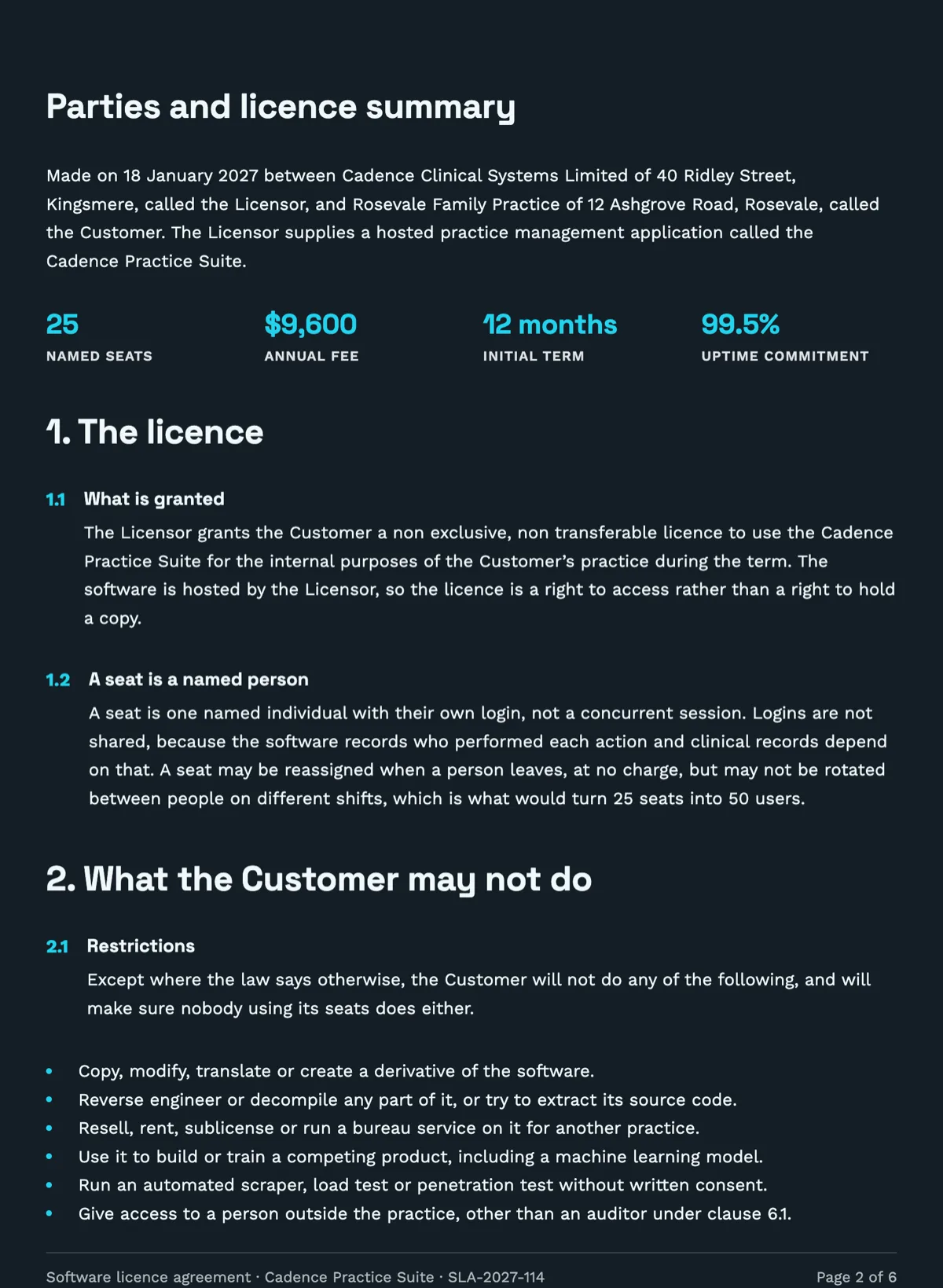 Software licence agreement template with seats, term and supportA software licence agreement has to answer three questions before anything else: what a seat is, what happens when the software is down, and who gets the data at the end. This one licenses a hosted practice management suite to a medical practice for 25 named users at $9,600 a year, with a support table, uptime credits and a 30 day export.
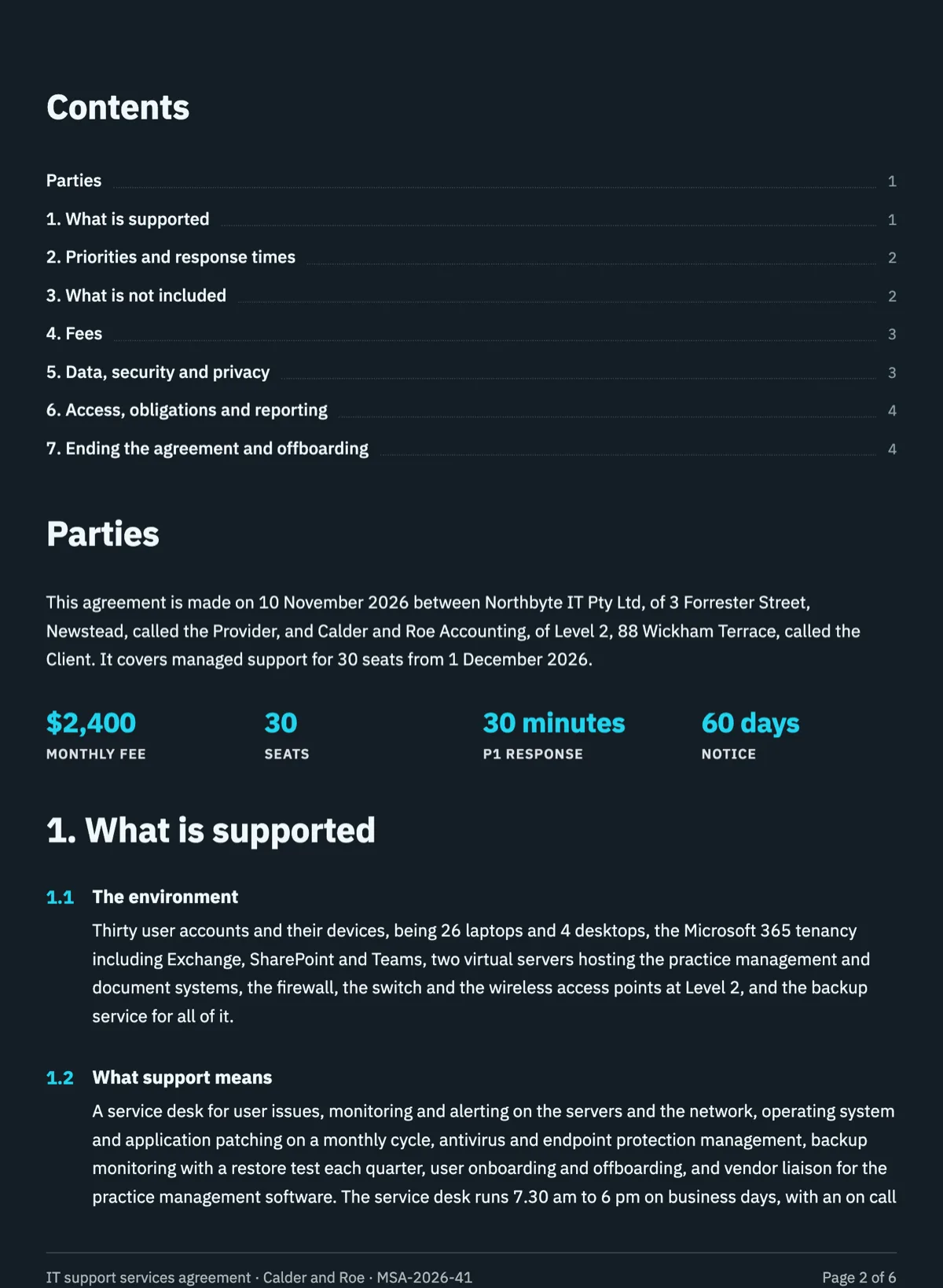 IT support services agreement with response times by priorityManaged support is sold on a monthly fee and judged on how fast the phone gets answered when nobody can work. This agreement grades every ticket into four priorities with a published response and resolution target, credits the fee when the target is missed, and writes down exactly what the provider hands back on the way out.
Questions people ask
Are service credits a penalty?
Usually not, if they are proportionate. Credits framed as a price adjustment reflecting the reduced value of a degraded service, and capped at a sensible share of the fee, are generally defensible. A credit far exceeding the fee or any plausible loss is where penalty arguments start to have force.
Should service credits be the customer's only remedy?
Suppliers usually ask for that, and in low cost standard services it is common. Customers of critical services generally keep a termination right for repeated or severe failures and exclude certain breaches, such as data loss or security incidents, from the sole remedy wording so those can still be claimed as damages.
What is a typical service credit cap?
Caps commonly fall between 10 and 25 percent of the monthly fee for the affected service, with some critical services agreed higher. The right number depends on how much of the supplier's margin sits in the fee: a cap that absorbs most of the margin changes behaviour, while a token cap does not.
Are service credits paid in cash?
Usually not. They are deducted from a future invoice. That creates a problem at the end of the contract, when there is no future invoice, so customers ask for unapplied credits to be paid out on expiry or termination. Suppliers sometimes accept that for credits already accrued.
When should credits be a fixed dollar amount?
When the fee varies from month to month, or the customer's cost of a failure is fairly constant, such as a missed service visit or a late delivery. Percentage credits suit stable subscriptions; fixed amounts suit per event failures where a percentage would give wildly different results in busy and quiet months.
Do credits stop the customer terminating?
Only if the contract says so. Most well balanced clauses keep a termination right for repeated failure, such as missing a critical service level in two months out of six. Without that trigger, a supplier could keep paying modest credits indefinitely while the service stays poor.
Put the clause in a finished document
The button opens the document generator with a starting description already filled in. Change it to match your own agreement before you run it.
Create a document with OneCraftRelated clauses
- Service level clause: turning good service into numbersA service level clause sets the measurable standards a service must meet. Sample uptime and response wording with a metrics table, and three variants.
- Liquidated damages clauseA liquidated damages clause fixes what delay costs before it happens. Sample fit out wording, the Australian penalty test, caps, and what each side negotiates.
- Termination for cause clauseA termination for cause clause ends a contract for serious breach. Sample wording, what counts as material, cure periods and immediate termination events.
- Limitation of liability clause: putting a ceiling on exposureA limitation of liability clause puts a ceiling on what one party can recover. Australian sample wording, three variants, the carve outs and the UK test.
For everything the document generator can do, see the document maker.
Step by step in the builder: Create a document with AI, then Document builder components.
Written and checked by the OneCraft team. Last checked .