Contract clause
Key personnel clause: keeping the people the client chose
A key personnel clause names specific individuals a supplier must use on an engagement, usually in a schedule, and restricts removing or replacing them without the customer's consent. It also sets what happens when a named person leaves anyway, such as approval of a suitable replacement, a handover at the supplier's cost, or a reduction in fees.
Clients often buy a consultancy because of the two people who pitched the work, then meet a different team on day one. A key personnel clause makes the pitch team part of the contract and puts a price on changing it.
Nuwan Madhusanka · Co-founder
4 min read · Published
Sample clause
a brand and digital strategy engagement between Ghost Gum Collective, a fictional design consultancy in Brisbane, and Paperdaisy Credit Union, which selected the consultancy after workshops led by its creative director and a senior project manager
10. Key Personnel 10.1 Ghost Gum Collective must ensure that the Key Personnel named in Schedule 3, being its Creative Director and Senior Project Manager, perform the roles described for them for the duration of the Services. 10.2 Ghost Gum Collective must not remove or replace any Key Personnel without Paperdaisy Credit Union's prior written consent, which must not be unreasonably withheld, except where the person dies, becomes seriously ill, takes parental leave or ceases to be employed by Ghost Gum Collective. 10.3 Any replacement must have skills and experience at least equivalent to the person replaced, and Paperdaisy Credit Union may interview the proposed replacement before consenting. 10.4 Ghost Gum Collective must provide a handover of at least 5 Business Days between the departing and replacement person at its own cost. 10.5 Paperdaisy Credit Union may, on reasonable grounds, require Ghost Gum Collective to remove a person from the Services, and Ghost Gum Collective must propose a replacement within 10 Business Days.
Sample wording, not legal advice.
Variants
Consent needed for any replacement
Engagements where the individual's personal expertise is the reason the supplier was chosen.
The Supplier must not change any Key Person without the Customer's prior written consent, which the Customer may give or withhold in its absolute discretion. If a Key Person becomes unavailable for reasons outside the Supplier's control, the Supplier must promptly notify the Customer and propose at least two candidates, and the Customer may terminate this Agreement without liability if it does not approve either candidate within 15 Business Days.
Equivalent replacement allowed on notice
Larger suppliers with deep benches that cannot guarantee any one individual across a long term arrangement.
The Supplier may replace a Key Person by giving the Customer at least 20 Business Days written notice, provided the replacement has equivalent qualifications, seniority and relevant experience, as shown in a resume given with the notice. The Customer may object on reasonable grounds within 5 Business Days, in which case the Supplier must propose another replacement. The Supplier must not replace Key Personnel more than twice in any 12 month period.
Fee reduction on replacement
A customer that wants a financial remedy rather than a veto when a named person leaves the project.
If a Key Person is replaced for any reason other than death, serious illness or statutory leave, the Supplier must not charge for the replacement's time during the first 10 Business Days on the Services, and the hourly rate for the replacement's role is reduced by 10 percent for the following three months. These reductions are in addition to the Supplier's handover obligations and do not limit the Customer's other rights.
What to negotiate
Exceptions the supplier cannot control
A supplier cannot stop someone resigning or becoming ill, and cannot lawfully refuse parental leave. Suppliers ask for those events to be excluded from any breach. Customers accept the exceptions but still want a replacement procedure, a handover and, where the individual was central, a right to end the engagement if no acceptable replacement is found.
Customer removal rights
Customers want to remove people who are disruptive, underperforming or breach site rules. Suppliers ask that removal be on reasonable grounds, explained in writing, and that it does not expose them to claims from the removed employee. Clauses often add that the supplier handles the employment consequences and the customer only decides who works on its project.
Time commitment
Naming someone means little if they spend a day a month on the project. Customers ask for a minimum time commitment or a defined role, such as attending every steering meeting. Suppliers resist percentages that are hard to track and prefer role descriptions, with time recorded in the monthly report.
The risk of leaving it out
Without a key personnel clause, the supplier is generally free to staff the engagement as it sees fit, provided the services meet the contractual standard. The customer loses the expertise it selected, cannot insist on a particular person, and has no agreed remedy when senior people are quietly moved to another client's project.
Why named people belong in a schedule
People change during a long engagement, and a clause that names individuals in its body needs a formal variation every time a name changes. Listing Key Personnel in a schedule, with their role, responsibilities and any time commitment, lets the replacement procedure update the schedule without rewriting the clause. Commonwealth contract terms follow a similar approach: the Department of Finance ClauseBank includes a Specified Personnel clause for engagements where particular people are central to the work. A schedule also gives the monthly report something to check against: each named person, the role they hold and the time they actually spent, which turns a quiet staffing change into a visible one that the customer can raise at the next review.
Key personnel and non solicitation
Customers who value a supplier's people may be tempted to hire them directly. Suppliers often pair a key personnel clause with a non solicitation clause preventing the customer from poaching named staff during the engagement and for a period afterwards. Customers accept a reasonable restriction but ask for carve outs for general job advertisements and for people who approach them independently. The two clauses should be read together, because a customer unable to hire a person and unable to insist on their staying may lose access to them entirely.
Where it sits in a generated document
A key personnel clause normally sits in the delivery or personnel section of a services agreement, with names and roles in a schedule. A generated agreement numbers the clause and can present the schedule as a table of name, role and commitment. The names, notice periods and any fee reduction come from the description, with no citations.
Documents that carry this clause
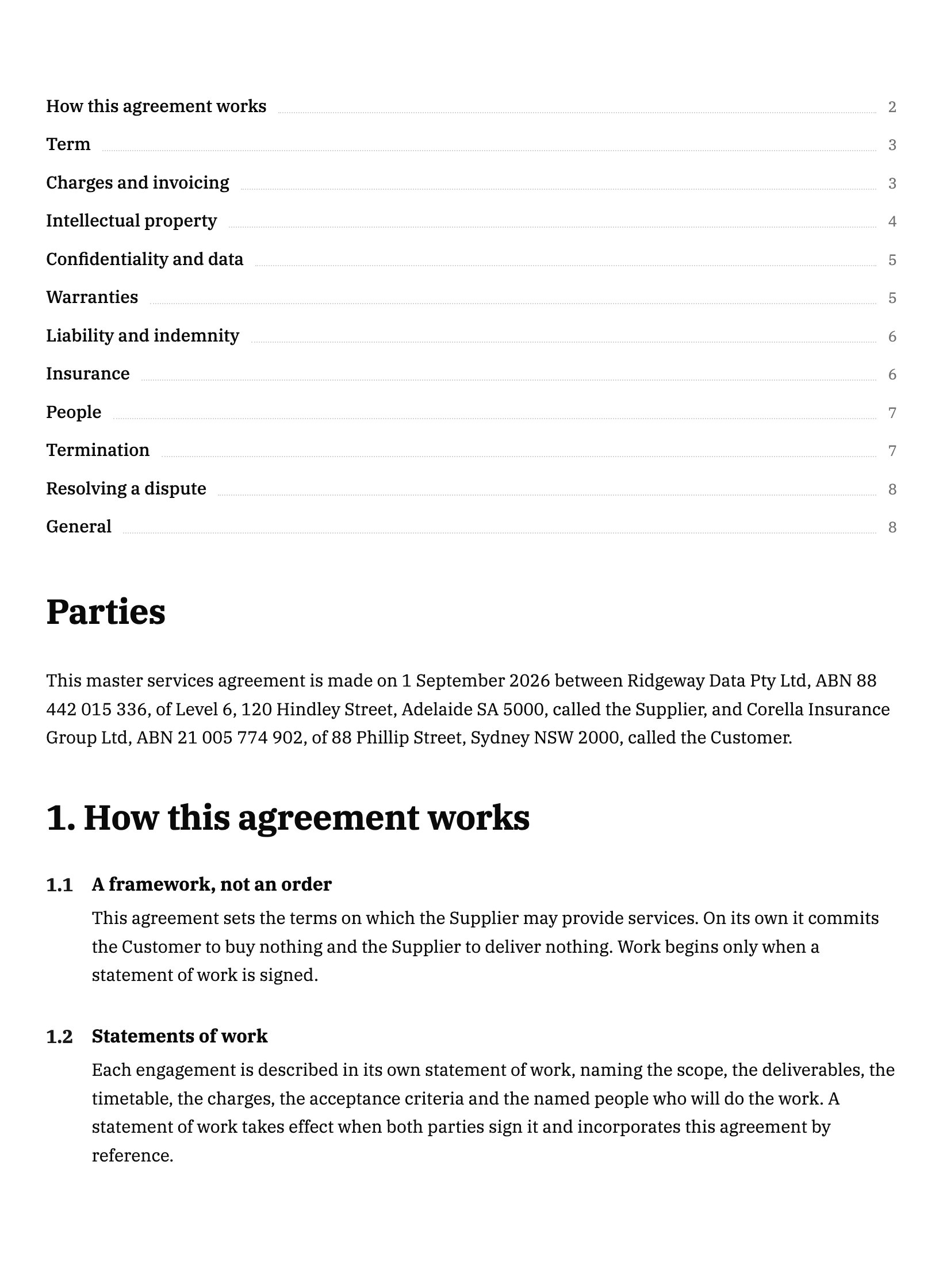 Master services agreementA data consultancy and an insurer sign this once and then buy work under it for three years. It is the rare contract whose whole purpose is to make the next twenty contracts short.
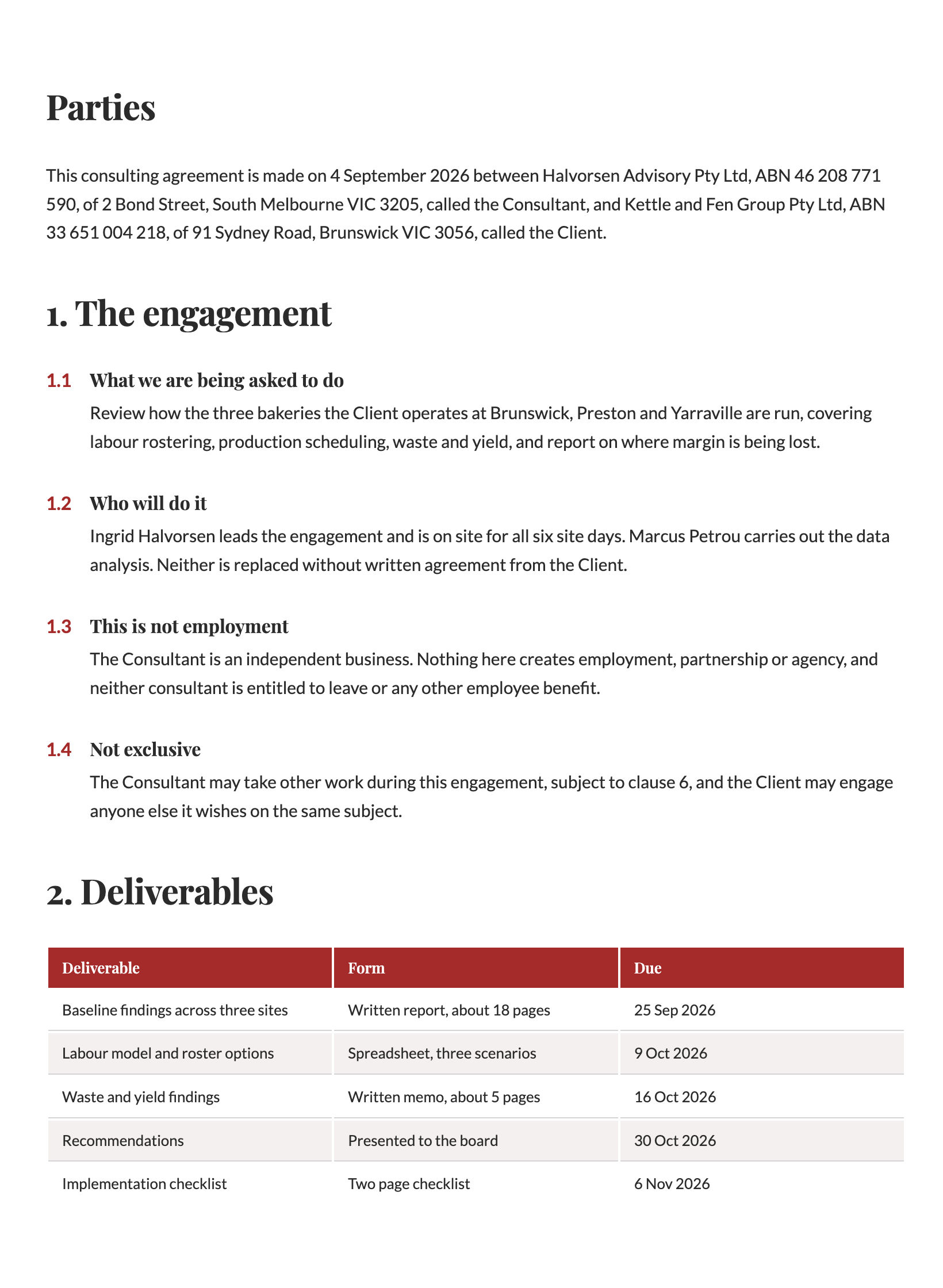 Consulting agreementAn advisory firm reviews three bakeries over seven weeks. What makes this agreement useful is not the fee clause but the two clauses that say what the advice is not.
Questions people ask
Can a supplier be in breach if a key person resigns?
Usually not, if the clause excludes events outside the supplier's control such as resignation, illness and leave. The supplier's obligation then becomes finding an acceptable replacement and managing the handover. Without such an exception, a strict clause could make a resignation a breach, which suppliers rarely accept.
How many people should be named as key personnel?
Few enough that the supplier can realistically keep them in place, usually the two to five people whose judgment shapes the outcome. Naming the entire team makes every staffing change a contractual event and tends to be ignored. Role descriptions for the wider team, without named individuals, work better.
Can the customer interview replacements?
Many clauses allow it, particularly for senior roles, and it is a reasonable request where the customer chose the supplier because of specific people. The supplier usually asks for the interview to take place within a short period so a vacancy does not delay the work.
Is a fee reduction on replacement fair?
It reflects the real cost to the customer of bringing a new person up to speed. Suppliers accept modest reductions, such as not charging for the first days of a replacement's time, particularly where the change was the supplier's choice. Larger reductions for replacements caused by illness or leave are commonly resisted.
Does the clause restrict the supplier's other work?
Only indirectly. If key personnel must devote a stated amount of time to the engagement, the supplier cannot allocate them elsewhere beyond that. Customers sometimes ask that key personnel not work for a direct competitor during the engagement, which is a separate restraint and should be drafted as one.
What if the customer removes a person unfairly?
The clause should require removal on reasonable grounds stated in writing. The supplier remains the employer and must handle any employment process itself, but a customer who removes people without reasonable grounds may be in breach of the clause, and the supplier may be entitled to a time extension for the disruption.
Put the clause in a finished document
The button opens the document generator with a starting description already filled in. Change it to match your own agreement before you run it.
Create a document with OneCraftRelated clauses
- Subcontracting clause: who else may do the work, and who answers for itA subcontracting clause decides whether a supplier can use others to do the work and who is liable when it does. Sample consent wording and three variants.
- Change control clause: requesting, pricing and approving a scope changeA change control clause sets how scope changes on a services or software project are requested, priced and approved. Sample procedure, form fields and variants.
- Relationship of the parties clause: no partnership, no agency, no employmentA relationship of the parties clause states a contract creates no partnership, agency or employment. Sample referral wording, four variants and its real limits.
- Service credits clause: what a missed service level costs the supplierA service credits clause sets the fee reduction a customer receives when a service level is missed. Sample credit table, percentage and fixed amount variants.
For everything the document generator can do, see the document maker.
Step by step in the builder: Create a document with AI, then Document builder components.
Written and checked by the OneCraft team. Last checked .