Contract clause
Further assurances clause: signing whatever else the deal needs
A further assurances clause obliges each party, after signing, to execute documents and take steps reasonably needed to give full effect to the agreement, such as signing registry forms, consents or notices. It fills the gap between what a contract promises and the separate paperwork that third parties, registers and regulators need before the promise works.
Contracts transfer rights on paper, but registers, banks and overseas offices often want their own forms signed by the original owner. A further assurances clause makes sure the person who has already been paid still has to pick up the pen.
Nuwan Madhusanka · Co-founder
4 min read · Published
Sample clause
an intellectual property assignment between Moonah Creative, a fictional brand designer in Launceston, and Clearwater Kombucha, which is buying the logo, label artwork and product name the studio created and plans to register trade marks in Australia and New Zealand
9. Further Assurances 9.1 Moonah Creative must, at the request of Clearwater Kombucha, promptly sign all documents and do all things reasonably required to give full effect to the assignment in clause 3, including signing confirmatory assignments and forms required by IP Australia or any overseas registry. 9.2 Moonah Creative must comply with a request under clause 9.1 within 10 Business Days of receiving the relevant document. 9.3 Clearwater Kombucha must pay Moonah Creative's reasonable out of pocket costs of complying with clause 9.1, and must reimburse time spent at the hourly rate in Schedule 2 if compliance takes more than two hours in any month. 9.4 If Moonah Creative does not comply within the time in clause 9.2, it irrevocably appoints Clearwater Kombucha as its attorney to sign the relevant document in its name, limited to documents that give effect to clause 3. 9.5 This clause continues after this Agreement ends.
Sample wording, not legal advice.
Variants
Mutual, at the requesting party's cost
A general commercial agreement where either side might need help with registrations, consents or notices later.
Each party must, at the request and cost of the other party, promptly sign all documents and do all things that the other party reasonably requires to give effect to this Agreement and the transactions it contemplates. A party is not required under this clause to incur any liability, give any warranty or take any step that would increase its obligations beyond those set out in this Agreement.
Within a set time, with a survival period
Sale of business or asset transfers, where registrations and licences continue to move for months after completion.
For 24 months after Completion, the Seller must, within 5 Business Days of a written request from the Buyer, sign and deliver any document and give any consent or notice reasonably required to transfer the Assets to the Buyer, or to record the Buyer as the owner of any Asset in any register. The Buyer must prepare the documents and bear the costs of registration.
What to negotiate
Scope of what may be asked
An open ended duty to do all things necessary can be used to extract new promises. The party giving the assurance asks for the obligation to be limited to steps reasonably required to give effect to what was already agreed, and for a sentence confirming it creates no new liability or warranty. That limitation is usually accepted without much argument.
Cost and time
Small suppliers can find themselves signing forms for years. Common protections are payment of out of pocket costs, payment for time beyond a modest threshold, a response period rather than immediate compliance, and an end date after which the obligation stops unless a registration is still pending.
Power of attorney
Buyers want a power of attorney so they can sign if the assignor disappears or refuses. Assignors accept one that is limited to documents implementing the assignment, arises only after a missed deadline, and cannot be used to sign away anything else. Registries may require the attorney appointment itself to be in a particular form.
The risk of leaving it out
Without the clause, a party may argue it has done everything the contract expressly requires and owes nothing more. The other party may then be unable to register a trade mark assignment, record a security interest, or complete a transfer abroad without going back to court, even though everyone agreed the rights had passed.
Why an assignment often needs more paperwork
Many transfers are effective between the parties when the contract is signed but still need separate steps before third parties recognise them. Under the Copyright Act 1968, an assignment of copyright must be in writing signed by the assignor, so a later confirmatory assignment is sometimes needed for a particular country's requirements. Trade mark owners record changes of ownership with IP Australia and overseas offices, which may ask for their own documents. Secured parties register on the Personal Property Securities Register and may need information from the grantor. A further assurances clause makes cooperation with all of those steps an enforceable obligation.
Implied duties to cooperate and why the clause still helps
Courts will often imply a duty for each party to do what is reasonably necessary to enable the other to receive the benefit of the contract. That implied duty is narrower and less certain than an express clause, and it rarely specifies time limits, cost allocation or a power of attorney. An express clause turns a general expectation of cooperation into a clear obligation with a deadline and a remedy, which is what the requesting party needs when the other party has lost interest in the deal. It also tells the party giving the assurance, in advance, what it may be asked to do and on what terms.
Where it sits in a generated document
Further assurances usually appears with the general clauses, but in an IP assignment or sale agreement it often sits next to the transfer clause itself. A generated agreement numbers each clause, so the further assurances clause can refer to the assignment clause by number and the survival clause can list it. The deadlines and hourly rate come from the description, and nothing is cited.
Documents that carry this clause
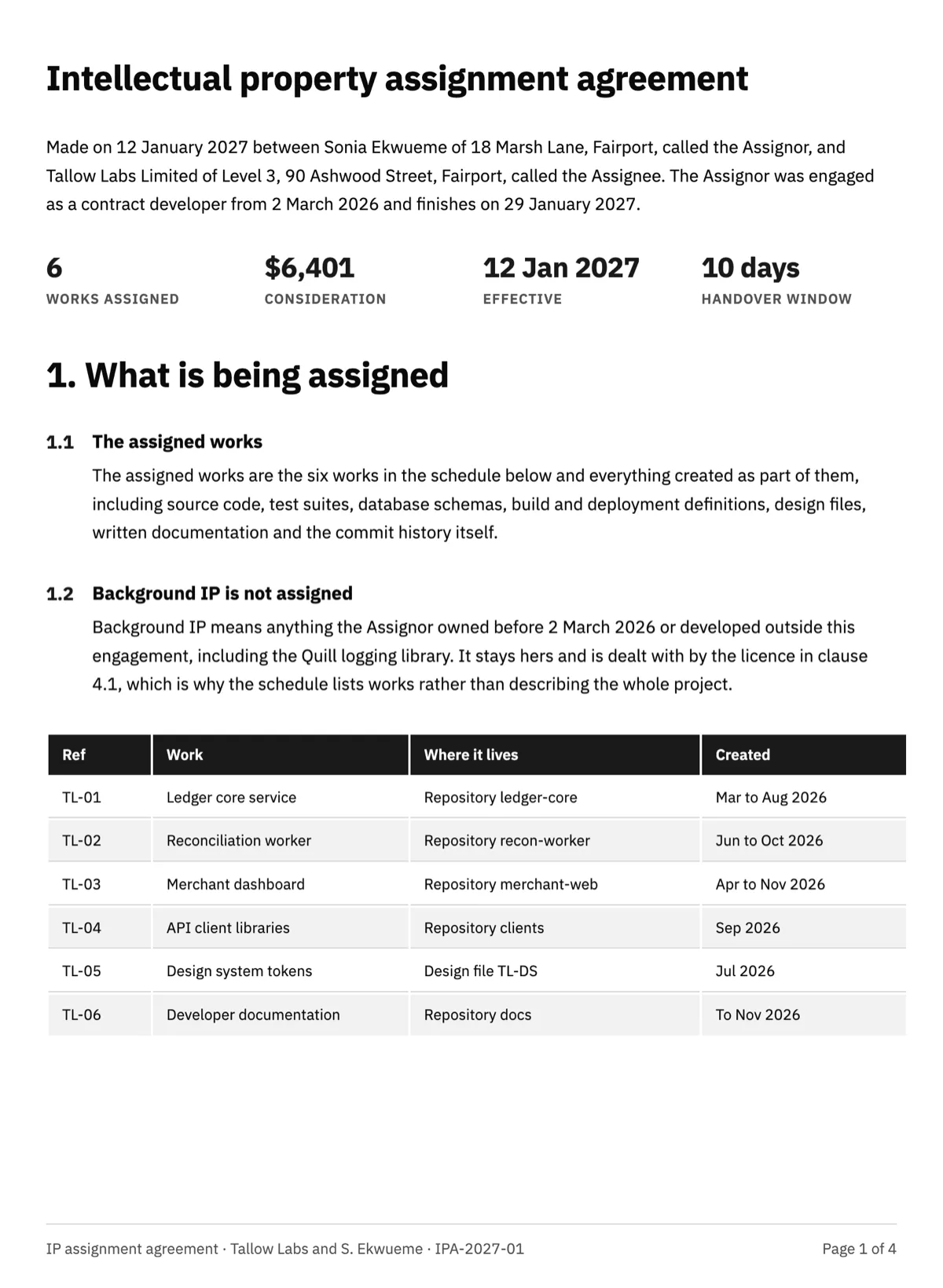 IP assignment agreement template with a schedule and moral rightsAn IP assignment transfers ownership of work that already exists, which is why the schedule matters more than the wording around it. This one moves six named works from a departing contract developer to the startup that paid for them, licenses back her own library, and lists what gets handed over in the ten days after signing.
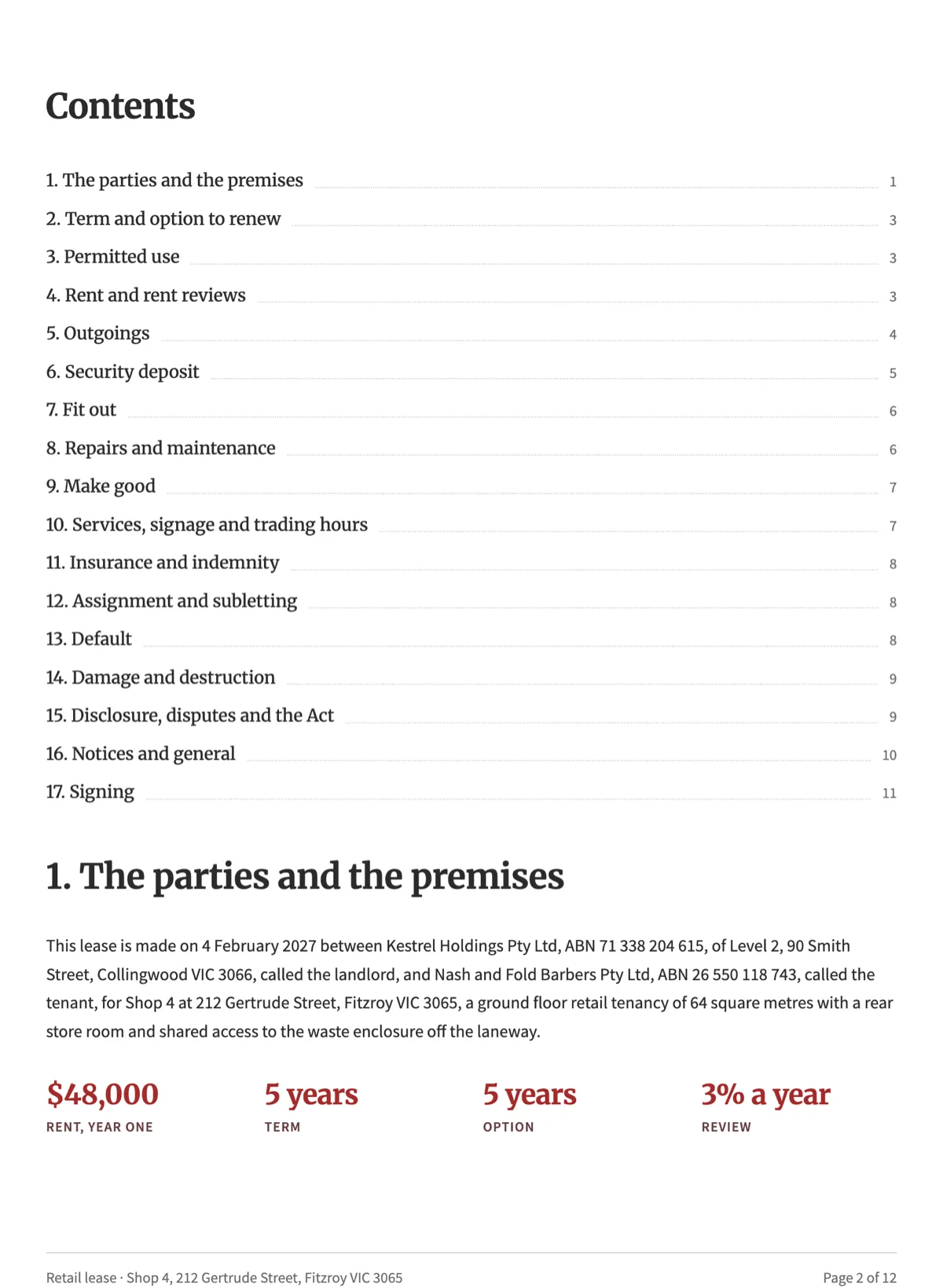 Commercial lease agreement template with outgoings and fit out termsA retail lease is decided by three numbers and two clauses: the rent, the review, the outgoings, the fit out contribution and the make good. This 12 page Victorian lease sets all five out in the open, including the outgoings the landlord is not allowed to recover at all.
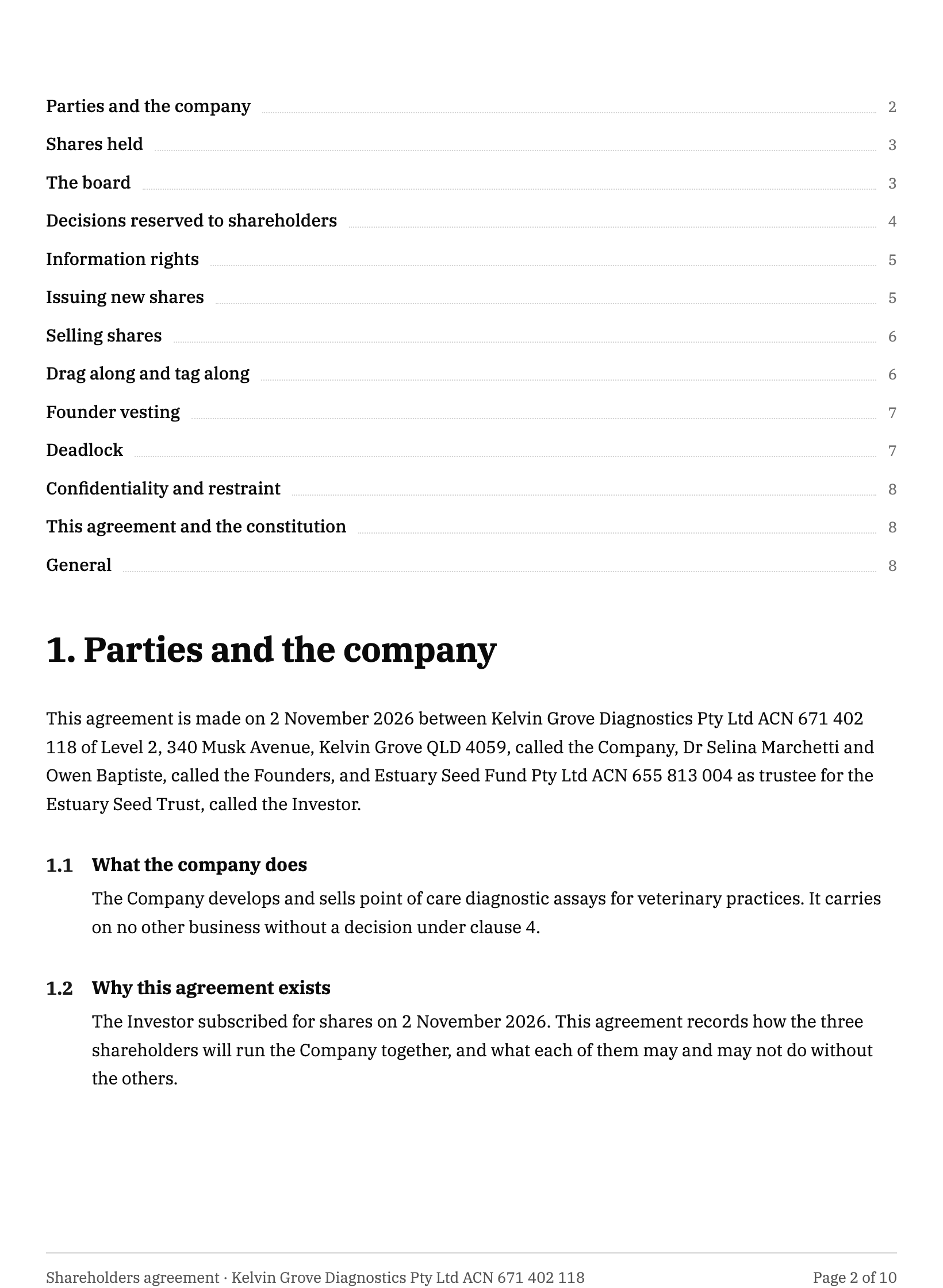 Shareholders agreement templateA veterinary diagnostics company has just taken $1.5 million from one seed fund. The founders keep 80 percent between them, so the whole agreement turns on a single number: the 75 percent consent threshold that puts the investor on one side of every decision that matters.
Questions people ask
Is a further assurances clause enforceable?
Yes, as an ordinary contractual obligation, provided the requested step is reasonably required to give effect to the agreement. A court can order a party to sign a document, and a power of attorney in the clause gives a faster route. Requests that go beyond the original bargain are not covered.
Can the clause be used to demand new warranties?
It should not be, and well drafted clauses say so expressly. The obligation is to give effect to what was already agreed, not to add new promises, liabilities or indemnities. A registry form that asks the assignor to warrant something new should be limited or accompanied by a statement that no further liability is assumed.
Who pays for complying with a further assurances request?
The contract should say. The common approaches are that the requesting party pays out of pocket costs, or that each party bears its own costs. Where the party giving assurances is an individual or small supplier, payment for time beyond a small threshold is a reasonable request.
How long does the obligation last?
Unless limited, for as long as a reasonable request can be made. Parties often cap it at a period after completion, such as two years, with an exception for registrations already under way. The survival clause should list the further assurances clause so it continues after the main agreement ends.
Why add a power of attorney?
Because a promise to sign is only useful if the person can be found and cooperates. A power of attorney lets the requesting party sign the needed document itself after a missed deadline. Limiting the power to documents implementing the agreement makes it acceptable to the grantor.
Does a lease need a further assurances clause?
Leases often include one because registration, mortgagee consent or a change in the premises' title may require extra documents from landlord or tenant. The clause is usually mutual and modest in scope, requiring each party to sign documents reasonably needed to register or give effect to the lease.
Put the clause in a finished document
The button opens the document generator with a starting description already filled in. Change it to match your own agreement before you run it.
Create a document with OneCraftRelated clauses
- Assignment clause: who else may step into the contract's benefitsAn assignment clause controls whether a party can transfer its rights under a contract. Sample consent wording, a change of control trigger and three variants.
- Novation clause: agreeing now to swap a party laterA novation clause commits the parties to replace one party with another when a trigger occurs. Australian sample wording, deed form and business sale variants.
- Intellectual property assignment clauseAn intellectual property assignment clause transfers ownership of created work to the client. Sample wording, assign on payment or creation, and moral rights.
- Counterparts clause: separate copies, one agreementA counterparts clause lets parties sign separate copies that together form one contract. Sample wording, electronic exchange and effective date variants, deeds.
For everything the document generator can do, see the document maker.
Step by step in the builder: Create a document with AI, then Document builder components.
Written and checked by the OneCraft team. Last checked .