Contract clause
Novation clause: agreeing now to swap a party later
A novation clause is a promise, made at signing, that a party will be replaced by a new party if a stated event happens, with the newcomer taking on obligations as well as rights. Because novation creates a fresh contract, the clause usually attaches an agreed form of deed that everyone must sign when the time comes.
Novation cannot be imposed on anyone, so a party who knows a swap is coming wants the consent locked in before the project starts. On construction and outsourcing projects that planned handover is common, and the clause is what stops the remaining party using its signature as leverage.
Indunil Asanka · Co-founder
4 min read · Published
Sample clause
a design consultancy agreement between Stringybark Engineering, a fictional structural engineer, and Harbourview Health Trust, which will novate the engineer to whichever builder wins the design and construct tender for a new clinic in Wollongong
15. Novation to the Contractor 15.1 Harbourview Health Trust may, by written notice, require Stringybark Engineering to novate this Agreement to the Contractor appointed under the Head Contract. 15.2 Within 10 Business Days of that notice, Stringybark Engineering must sign and deliver a deed of novation in the form of Annexure C, and Harbourview Health Trust must procure that the Contractor signs it. 15.3 From the Novation Date the Contractor replaces Harbourview Health Trust as the client under this Agreement, including for Services performed before that date, except that Harbourview Health Trust remains liable for fees for Services invoiced before the Novation Date. 15.4 Stringybark Engineering's professional indemnity insurance and the warranties in clause 9 extend to the Contractor from the Novation Date. 15.5 If Stringybark Engineering fails to comply with clause 15.2, it irrevocably appoints Harbourview Health Trust as its attorney to sign the deed of novation on its behalf.
Sample wording, not legal advice.
Variants
Pre agreed novation on a trigger
Outsourcing and supply arrangements where the customer expects to move the contract to a successor entity after a restructure.
If the Customer transfers the function to which this Agreement relates to a Successor Entity, the Supplier consents in advance to the novation of this Agreement to the Successor Entity and must sign a deed of novation in the form of Schedule 5 within 10 Business Days of request. The Customer is released from obligations arising after the novation date. The Supplier's rights against the Customer for amounts accrued before that date are not affected.
Novation only by deed, never implied
Parties who want certainty that no substitution happens through conduct, such as invoices addressed to a new company.
This Agreement may only be novated by a deed signed by each party and the incoming party. No novation is to be inferred from conduct, including the acceptance of payment from, the issue of invoices to, or the performance of obligations by or for a person who is not a party. Until a deed of novation takes effect, the original parties remain bound by all obligations under this Agreement.
Novation on sale of business
A small supplier that expects to sell its business during the term and wants customer contracts to move with the goodwill.
If the Provider sells the business through which it performs the Services, the Client agrees to novate this Agreement to the purchaser, provided the purchaser holds the licences and insurance required by this Agreement and gives the Client written evidence of its capacity to perform. The Client must sign a deed of novation in a form reasonably acceptable to it within 15 Business Days of receiving that evidence.
What to negotiate
Who answers for work done before the swap
The incoming party wants to be responsible only from the novation date. The remaining party wants one counterparty for the whole history. In design and construct novations the builder usually steps in as if it had always been the client, while the principal keeps liability for unpaid fees. Stating the split in the clause avoids a deed negotiation at the worst moment.
Conditions on the incoming party
A party agreeing in advance to accept an unknown successor wants protection. Common conditions are financial capacity, the same licences and insurance, and no adverse credit events. The party that benefits from the clause prefers a short list of objective tests so consent cannot be withheld for commercial reasons.
Attorney and deadline
A promise to sign a deed later can be broken. A deadline plus a power of attorney allowing the other party to sign on the defaulter's behalf makes the promise self executing. The party granting the power asks for it to be limited to the annexed form of deed, so it cannot be used to sign anything wider.
The risk of leaving it out
Without a novation clause the substitution needs every party's fresh agreement at the time, and the remaining party can refuse, delay or demand concessions. The fallback of assigning rights and subcontracting the work leaves the original party liable for everything, which is often the exact outcome the planned handover was meant to avoid.
Why design and construct projects rely on it
On a design and construct project an owner often hires architects and engineers early, develops the design to tender stage, then hands responsibility for the design to the builder. The builder wants a direct contract with those consultants so it can instruct them and claim against them, and the owner wants to step out. The consultant's appointment therefore carries a novation clause and an agreed form of deed from day one. The contested points are whether the builder can claim for design work done before it arrived, and whether the consultant owes the owner any continuing duty after the swap.
Execution, deeds and a clause is not a novation
The clause itself does not novate anything. It is a binding promise to novate, and the novation happens when the deed is signed. A deed is used because the outgoing party's release may lack clear consideration. For Australian companies, section 127 of the Corporations Act 2001 allows a deed to be executed by two directors, a director and secretary, or the sole director of a proprietary company, including electronically and without a witness, and a deed executed that way needs no delivery. Individuals and other entities follow the deed rules of the state or territory that applies, which can still require a witness.
Where it sits in a generated document
A novation clause is short but depends on an annexure, so a generated agreement should be asked for both: the numbered clause and an annexed form of deed with its own execution block. Signature blocks in a generated document carry one party each, which suits a three party deed where the outgoing, remaining and incoming parties each sign. The text comes from the description and cites nothing, so the deed form needs review.
Documents that carry this clause
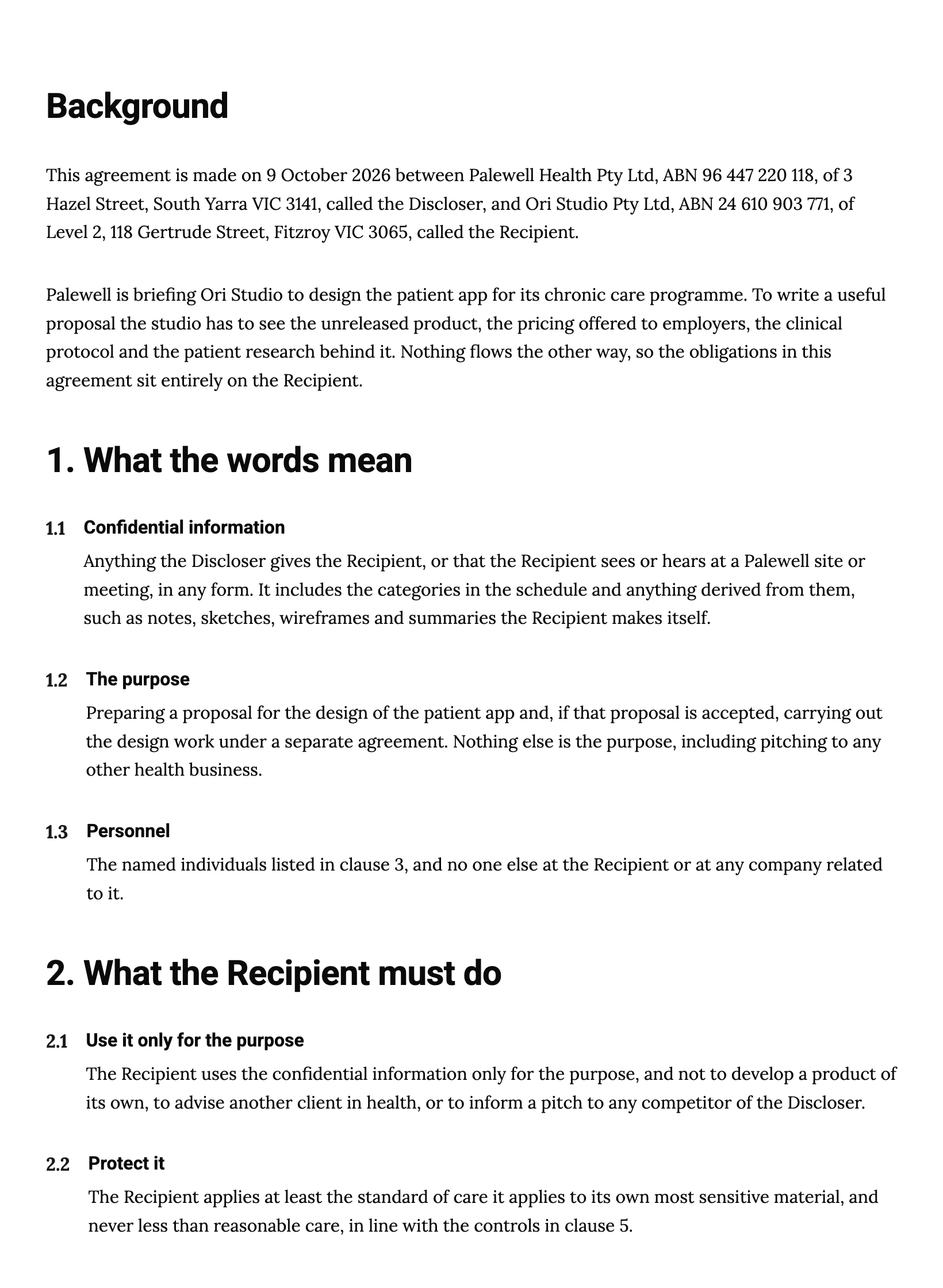 One way NDAA health company has to show a design studio an unreleased app, its employer pricing and its patient research. The studio is showing nothing back, which is exactly when an agreement should run in one direction.
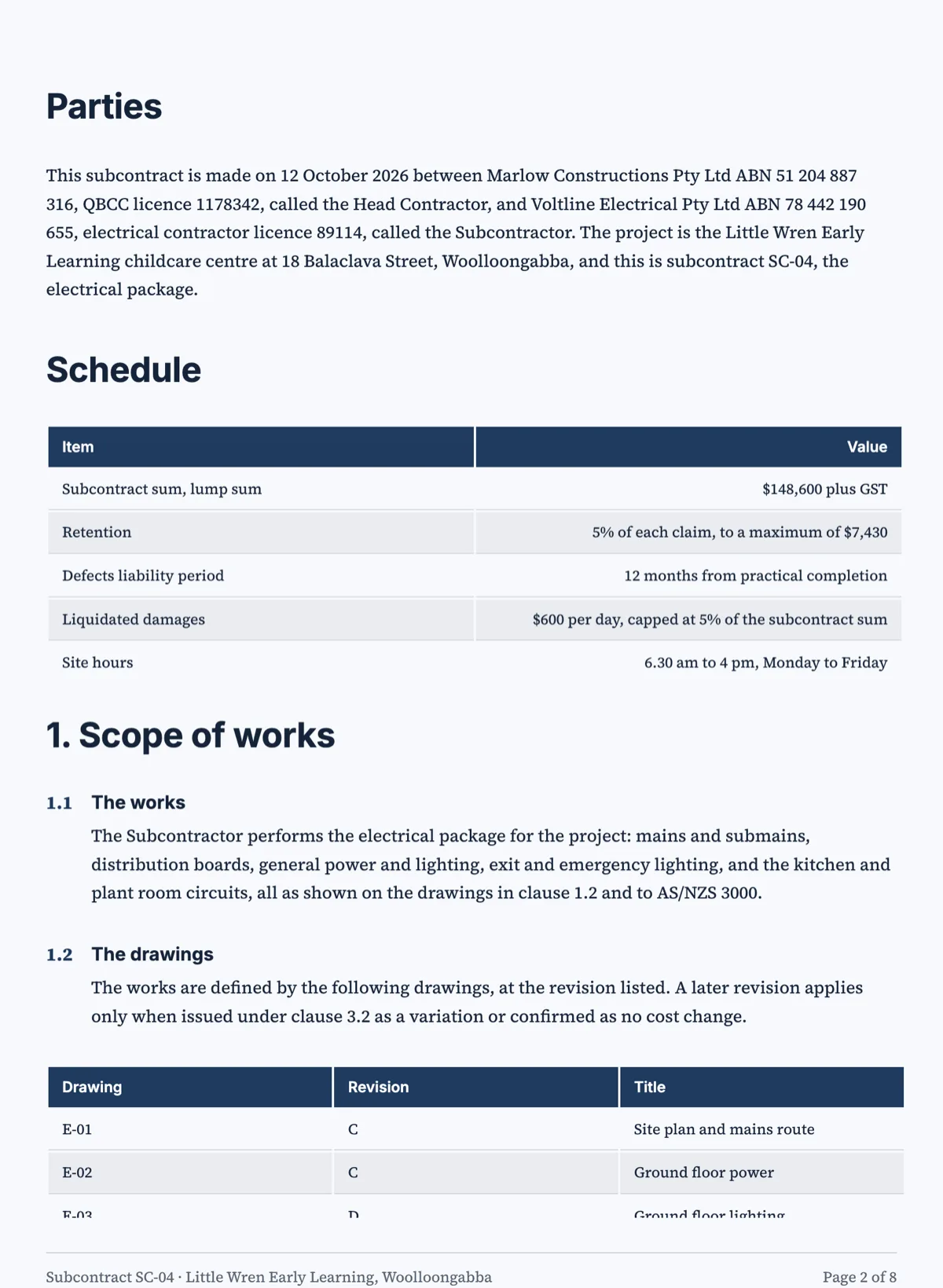 Subcontractor agreement template that flows the head contract downA subcontract exists to pass the head contract's obligations down one level and move the money back up on time. This one names the scope by drawing, sets the progress claim dates against the security of payment rules, holds retention and states the insurances, so the trade knows exactly when it is paid and for what.
Questions people ask
Is a novation clause enforceable if the new party is unknown at signing?
Generally yes, as a promise between the original parties to novate to a party identified later by an objective description. It becomes effective when the deed is signed. Conditions on the incoming party's capacity and a fixed form of deed make the promise certain enough to enforce.
Does the incoming party inherit past breaches?
Only if the deed says so. Deeds commonly make the incoming party responsible from the novation date and leave earlier liabilities with the outgoing party. In consultant novations the builder often steps into the owner's shoes for the whole engagement, which the consultant's insurer needs to know about.
Can novation happen through conduct?
Courts have occasionally inferred it where all three parties behaved as if a substitution had occurred, for example by invoicing and paying a new company for years. Relying on that is risky. A clause stating novation requires a deed and is not to be inferred from conduct removes the argument.
Why use a power of attorney in a novation clause?
Because the obligation to sign a deed is only as good as the party's willingness to sign. A power of attorney lets the other party execute the agreed deed if the obligor refuses or disappears. Australian drafting typically limits the power to the annexed form so it cannot be misused.
What happens to security when a contract is novated?
Bank guarantees, retention and parent company guarantees given for the original contract do not automatically support the new one. The novation clause or the deed should require replacement security from the incoming party, or confirm that existing security continues, with the guarantor signing to consent.
Does the remaining party get anything for agreeing in advance?
Usually the benefit is indirect: a project structure it wanted, such as a single point of responsibility through a builder. Where the remaining party is a supplier accepting a successor customer, it commonly asks for the conditions on the incoming party's credit and a right to be paid all accrued amounts first.
Put the clause in a finished document
The button opens the document generator with a starting description already filled in. Change it to match your own agreement before you run it.
Create a document with OneCraftRelated clauses
- Assignment clause: who else may step into the contract's benefitsAn assignment clause controls whether a party can transfer its rights under a contract. Sample consent wording, a change of control trigger and three variants.
- Further assurances clause: signing whatever else the deal needsA further assurances clause obliges each party to sign and do whatever else is needed to make the deal work. Sample IP assignment wording and variants.
- Subcontracting clause: who else may do the work, and who answers for itA subcontracting clause decides whether a supplier can use others to do the work and who is liable when it does. Sample consent wording and three variants.
For everything the document generator can do, see the document maker.
Step by step in the builder: Create a document with AI, then Document builder components.
Written and checked by the OneCraft team. Last checked .