Contract clause
Permitted use clause: what the premises may be used for
A permitted use clause states the purpose a tenant may use leased premises for and, by implication, everything it may not. It usually names the business, requires the tenant to hold the approvals that use needs, and sets out whether the landlord's consent is needed to change the use later in the lease.
The permitted use looks like a single line in the lease particulars, but it shapes the tenant's ability to adapt the business, sell it or assign the lease. It can also decide whether the retail leases legislation applies at all, so it deserves more than a one word description.
Nuwan Madhusanka · Co-founder
4 min read · Published
Sample clause
a retail lease in Victoria between Saltbush Property Trust, a fictional owner of a shopfront in Castlemaine, and Morning Tide Espresso, a cafe with a small bakery counter
8. Permitted Use 8.1 Morning Tide Espresso may use the Premises only as a cafe serving food and drinks for consumption on the Premises and for takeaway, including the baking of goods sold on the Premises. 8.2 The Tenant must obtain and keep current, at its cost, every planning permit, food business registration and other approval required for the Permitted Use, and give the Landlord copies on request. 8.3 Saltbush Property Trust gives no warranty that the Premises are suitable for the Permitted Use or that any approval will be granted. The Tenant has made its own enquiries. 8.4 The Tenant may ask to change the Permitted Use. The Landlord will not unreasonably withhold consent to a change to another food or retail use that does not require structural work or conflict with an exclusive use granted to another tenant of the building.
Sample wording, not legal advice.
Variants
Broad retail use
A tenant that wants room to change its offer over a long lease, or a landlord in a hard to let location.
The Tenant may use the Premises for any lawful retail purpose that is permitted under the planning scheme that applies to the land, other than the sale of adult products, a gaming venue or a use that requires a liquor licence for consumption on the Premises. The Tenant must obtain every approval its chosen use requires and must give the Landlord 30 days written notice before starting a different use.
Narrow use in a shopping centre
A centre manager curating a tenancy mix, where each shop is expected to trade in one category.
The Tenant may use the Premises only for the retail sale of prescription eyewear, sunglasses and related accessories, and for optometry consultations. The Tenant must not sell any other category of goods without the Landlord's written consent, which the Landlord may give or refuse having regard to the tenancy mix of the Centre and any exclusive use rights it has granted to other tenants.
Industrial lease with an environmental limit
A warehouse or workshop lease, where the landlord's main concern is contamination rather than the tenancy mix.
The Tenant may use the Premises as a warehouse and for the light assembly of furniture. The Tenant must not store or use any dangerous goods or hazardous substance on the Premises except in quantities permitted by law and disclosed to the Landlord in writing, and must not carry out any activity that requires an environmental licence or permit without the Landlord's prior written consent.
What to negotiate
Breadth of the description
A narrow use protects a landlord's tenancy mix but traps a tenant whose business evolves, and it makes the lease harder to assign. A broad use gives flexibility, but the market rent at a later review may be assessed on the premises being available for that wider use. The description should be as broad as the tenant genuinely needs.
Who carries the permit risk
Landlords routinely disclaim any warranty that the premises can lawfully be used for the stated purpose. Tenants should check the planning scheme and approvals before signing, or ask for the lease to be conditional on obtaining the permits within a set time, with a right to end the lease if they are refused.
The risk of leaving it out
Without a permitted use clause the tenant may argue it can use the premises for any lawful purpose, which can put the landlord in breach of exclusive use promises to other tenants, affect its insurance and invite uses the building was never designed for. The landlord loses its main tool for controlling what happens inside its property.
Why the use matters under the Victorian Act
The Retail Leases Act 2003 (Vic) applies to premises that, under the terms of the lease, are used or to be used wholly or predominantly for the sale or hire of goods by retail or the retail provision of services. The Victorian Small Business Commission notes that the Act can apply where goods or services are supplied to other businesses as end users, following the Court of Appeal decision in IMCC Group (Australia) Pty Ltd v CB Cold Storage Pty Ltd in 2017. The permitted use clause is therefore one of the first things checked to decide whether the Act applies.
Use, market rent and assignment
When a Victorian retail lease is reviewed to current market rent, the valuation has regard to the rent expected for the premises if offered for the same or a substantially similar use as the lease permits. A wide permitted use can therefore support a higher market rent. The use also shapes assignment, because a buyer of the business must be able to carry on a use within the clause, and a landlord asked to consent to an assignment will look at whether the incoming business fits.
Where it sits in a generated document
A generated lease states the permitted use in the numbered lease particulars and repeats the controls in a numbered use clause, so the assignment and default clauses can refer to it by number. The generated text does not cite sources, so a draft is checked against the planning controls and the retail leases legislation before signing.
Documents that carry this clause
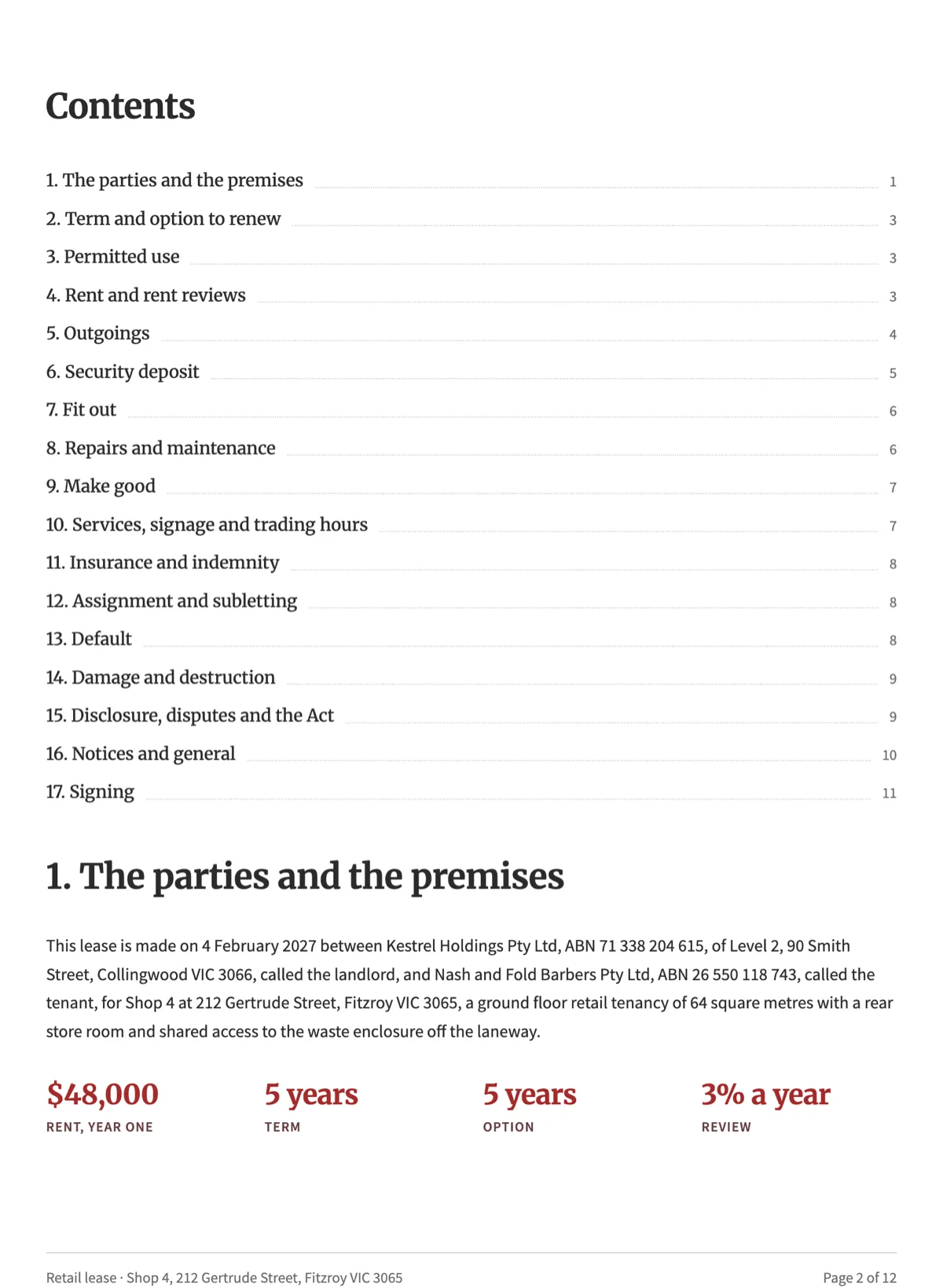 Commercial lease agreement template with outgoings and fit out termsA retail lease is decided by three numbers and two clauses: the rent, the review, the outgoings, the fit out contribution and the make good. This 12 page Victorian lease sets all five out in the open, including the outgoings the landlord is not allowed to recover at all.
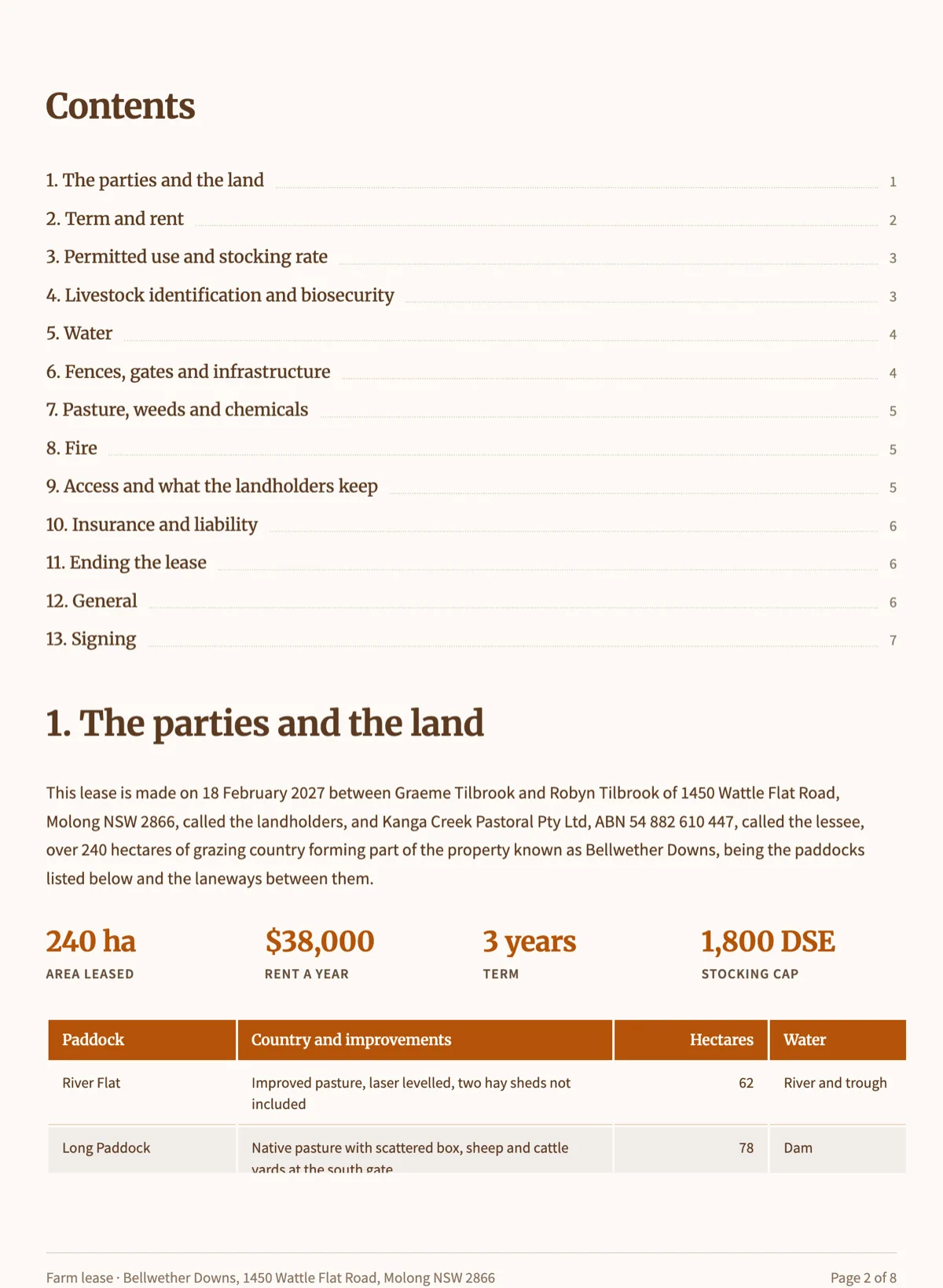 Farm lease agreement template with grazing rights and a fencing tableA grazing lease is a bet on country, and the two things that decide whether it was a good one are the stocking rate and who fixes the fence. This three year lease over 240 hectares caps stock in dry sheep equivalents, ties ground cover to a measurement twice a year, and puts every improvement in a table with a name beside it.
Questions people ask
Can a tenant change the use of leased premises?
Only as the lease allows. Most clauses require the landlord's written consent to a change, sometimes with a promise that consent will not be unreasonably withheld for similar uses. A change that needs a new planning permit also needs that permit, whatever the landlord agrees, and the tenant usually bears the cost and risk of applying.
Does the landlord promise the premises can be used for the permitted use?
Usually not. Leases commonly state that the landlord gives no warranty about suitability or approvals, and that the tenant has made its own enquiries. A tenant that needs a particular approval, such as a planning permit for a restaurant, should confirm it before signing or make the lease conditional on obtaining it.
What is an exclusive use clause?
It is a landlord's promise not to lease other premises in the same building or centre for a competing use, such as a second pharmacy. It works alongside the permitted use clause, because the landlord can only give that promise if every other tenant's permitted use is drawn narrowly enough to exclude the competing business.
Is a permitted use clause relevant to insurance?
Yes. Building insurance is priced on the uses carried on in the building, and a tenant using the premises outside its permitted use, for example by storing flammable goods, can affect the landlord's cover. Leases therefore often combine the use clause with an obligation not to do anything that could invalidate or increase the cost of the landlord's insurance.
How specific should the permitted use be?
Specific enough to protect the landlord's legitimate interests, and broad enough to let the tenant's business change in ordinary ways over the term. Naming a category of business with examples usually works better than naming a single product, which can put a tenant in breach simply by adding a new line of goods.
Does the permitted use decide whether the Retail Leases Act applies?
It is a large part of the test. In Victoria the Act applies to premises that, under the terms of the lease, are used wholly or predominantly for retail sale or hire of goods or the retail provision of services, subject to exclusions such as leases to listed corporations and premises with occupancy costs above the prescribed amount.
Put the clause in a finished document
The button opens the document generator with a starting description already filled in. Change it to match your own agreement before you run it.
Create a document with OneCraftRelated clauses
- Quiet enjoyment clause: what a tenant is actually promisedA quiet enjoyment clause protects a tenant's use of leased premises from landlord interference. Victorian sample wording, residential and office variants.
- Sublease clause: renting the premises on to someone elseA sublease clause controls whether a tenant can rent part or all of the premises to someone else. Victorian retail and residential sample wording and variants.
- Rent review clause: fixed, CPI or marketA rent review clause sets when lease rent changes and how. Victorian retail lease sample wording, fixed, CPI and market review variants, and the ratchet rule.
For everything the document generator can do, see the document maker.
Step by step in the builder: Create a document with AI, then Document builder components.
Written and checked by the OneCraft team. Last checked .