Contract clause
Rent review clause: fixed, CPI or market
A rent review clause says when the rent under a lease changes and the method used to change it, such as a fixed percentage, a price index, a fixed amount or a review to market rent. In a Victorian retail lease the method must be one that the Retail Leases Act 2003 allows.
A rent review looks like arithmetic until the market moves the wrong way. The method, the dates and what happens when the parties disagree about market rent decide whether a tenant can keep trading in year four, so they deserve more attention than the starting rent.
Nuwan Madhusanka · Co-founder
4 min read · Published
Sample clause
a five year retail lease in Victoria between Stonefruit Arcade Pty Ltd, a fictional shopping arcade owner in Shepparton, and Lantern Optometry, with an option for a further three years
6. Rent Review 6.1 On each anniversary of the Commencement Date during the Term, the Rent increases by 3 percent of the Rent payable immediately before that anniversary. 6.2 On the first day of any further term granted under the option in clause 22, the Rent is reviewed to the Current Market Rent of the Premises. 6.3 If the parties have not agreed the Current Market Rent within 30 days after either party gives the other written notice of the amount it proposes, the Current Market Rent is determined by a specialist retail valuer appointed under the Retail Leases Act 2003 (Vic), and the valuer's costs are shared equally. 6.4 Until the new Rent is agreed or determined, the Tenant continues to pay the Rent payable before the review date, and any adjustment is paid within 14 days after the determination. 6.5 A review under clause 6.2 may result in the Rent going down as well as up.
Sample wording, not legal advice.
Variants
CPI review
Longer leases where both sides prefer increases that track inflation rather than a percentage guessed at signing.
On each anniversary of the Commencement Date the Rent is adjusted by multiplying the Rent payable immediately before the review date by the CPI for the quarter ending immediately before the review date and dividing the result by the CPI for the quarter ending 12 months earlier. CPI means the Consumer Price Index All Groups for the capital city named in the Schedule, published by the Australian Bureau of Statistics. The Rent does not decrease under this clause.
Market review part way through the term
Prime locations where the landlord expects rents to move faster than a fixed increase.
On the third anniversary of the Commencement Date the Rent is reviewed to the Current Market Rent of the Premises as at that date. If the parties do not agree within 30 days after either gives written notice of a proposed amount, either party may apply for a specialist retail valuer to be appointed. The Rent determined may be higher or lower than the Rent payable before the review date.
Office lease outside the Act with a ratchet
A commercial office lease not covered by retail leases legislation, where the landlord wants to prevent any fall.
On each market review date the Rent is reviewed to the market rent for the Premises, but the reviewed Rent will not be less than the Rent payable immediately before the review date. The parties acknowledge that this clause is included because the Premises are not retail premises, and that a clause of this kind would be void to that extent in a lease to which the Retail Leases Act 2003 (Vic) applies.
What to negotiate
Fixed increase or market review
A fixed percentage gives both sides certainty and avoids valuation costs, but it can drift away from the market over a long lease. A market review tracks the market but brings uncertainty and a valuer's fee. Many retail leases use fixed increases during the term and a market review only at the start of an option term.
Who can start a review, and when
Landlords sometimes delay a market review until the market has risen. In a Victorian retail lease a review is to be conducted as early as practicable within the time the lease provides, and the tenant may start it if the landlord has not done so within 90 days after that time. Outside the Act, the lease itself needs a deadline.
The risk of leaving it out
Without a rent review clause the rent stays fixed for the whole term, which suits the tenant and exposes the landlord to years of inflation. In a Victorian retail lease, a review clause that does not say how the review is to be made is void, and the rent is then set by agreement or by a specialist retail valuer appointed through the Victorian Small Business Commission.
Review methods the Victorian Act allows
Under the Retail Leases Act 2003 (Vic) a retail lease that provides for rent reviews must state when they happen and the basis for each one. The basis must be a fixed percentage, an independently published index of prices or wages, a fixed annual amount, the current market rent, or a basis prescribed by regulation. A term that prevents the rent going down, often called a ratchet, is void, except where the review uses a fixed percentage, an index or a fixed amount. Current market rent disregards the value of the tenant's goodwill and of its fixtures and fittings.
When the parties disagree about market rent
If a landlord and tenant cannot agree on market rent or on a valuer, either can ask the Victorian Small Business Commission to appoint a specialist retail valuer, whose determination becomes the rent. The valuer's cost is shared equally and can be significant compared with the rent of a small shop, so the Commission suggests continued negotiation first. At an option renewal the tenant can also request an early market rent review within 28 days after receiving the landlord's option notice.
Where it sits in a generated document
A generated lease numbers the review clause directly after the rent clause, with the review dates and methods as sub clauses, so the option clause can refer to the review that applies on renewal. The generated text does not print sources, so the permitted review bases for the state are checked against the legislation before the lease is signed.
Documents that carry this clause
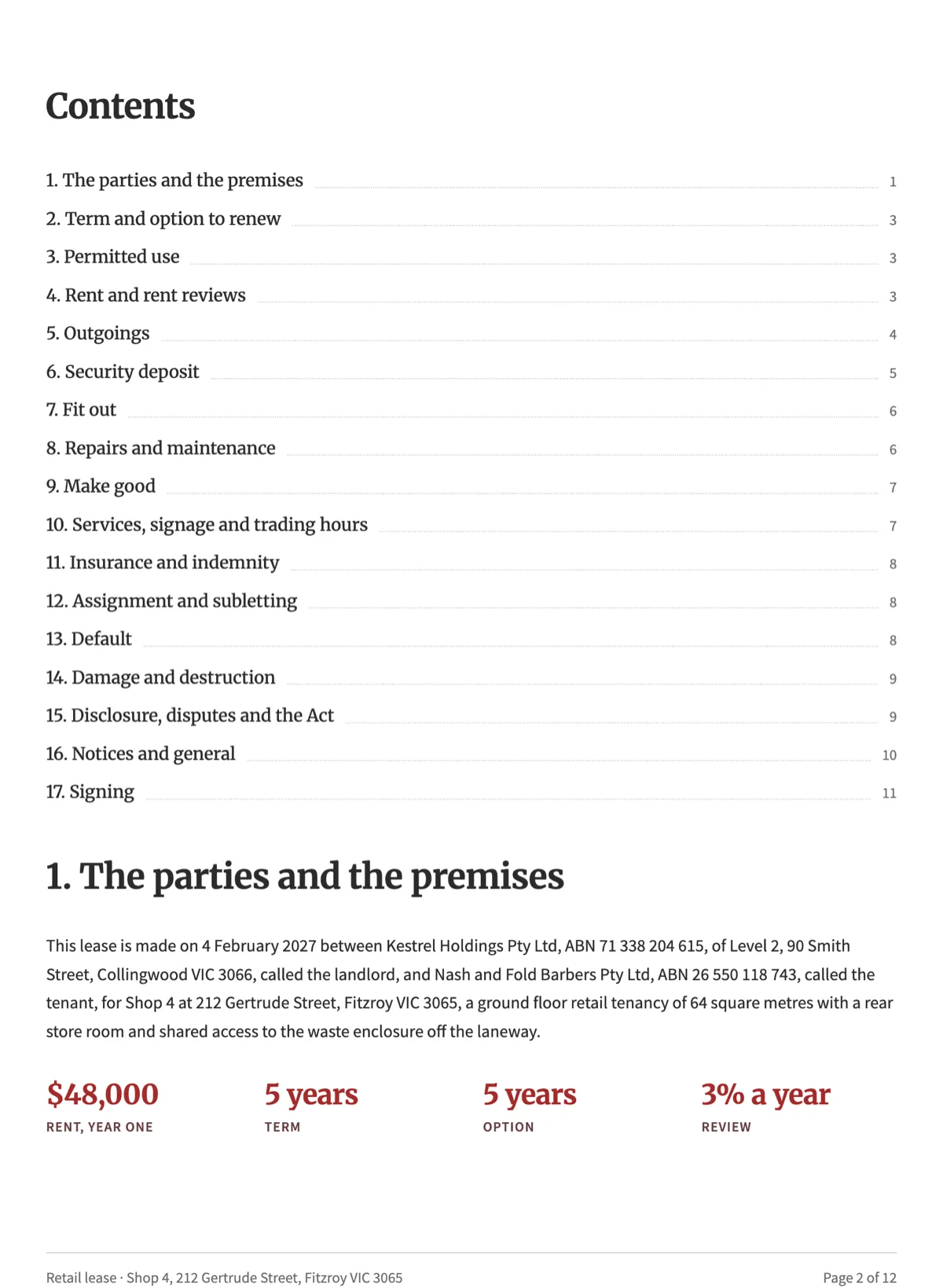 Commercial lease agreement template with outgoings and fit out termsA retail lease is decided by three numbers and two clauses: the rent, the review, the outgoings, the fit out contribution and the make good. This 12 page Victorian lease sets all five out in the open, including the outgoings the landlord is not allowed to recover at all.
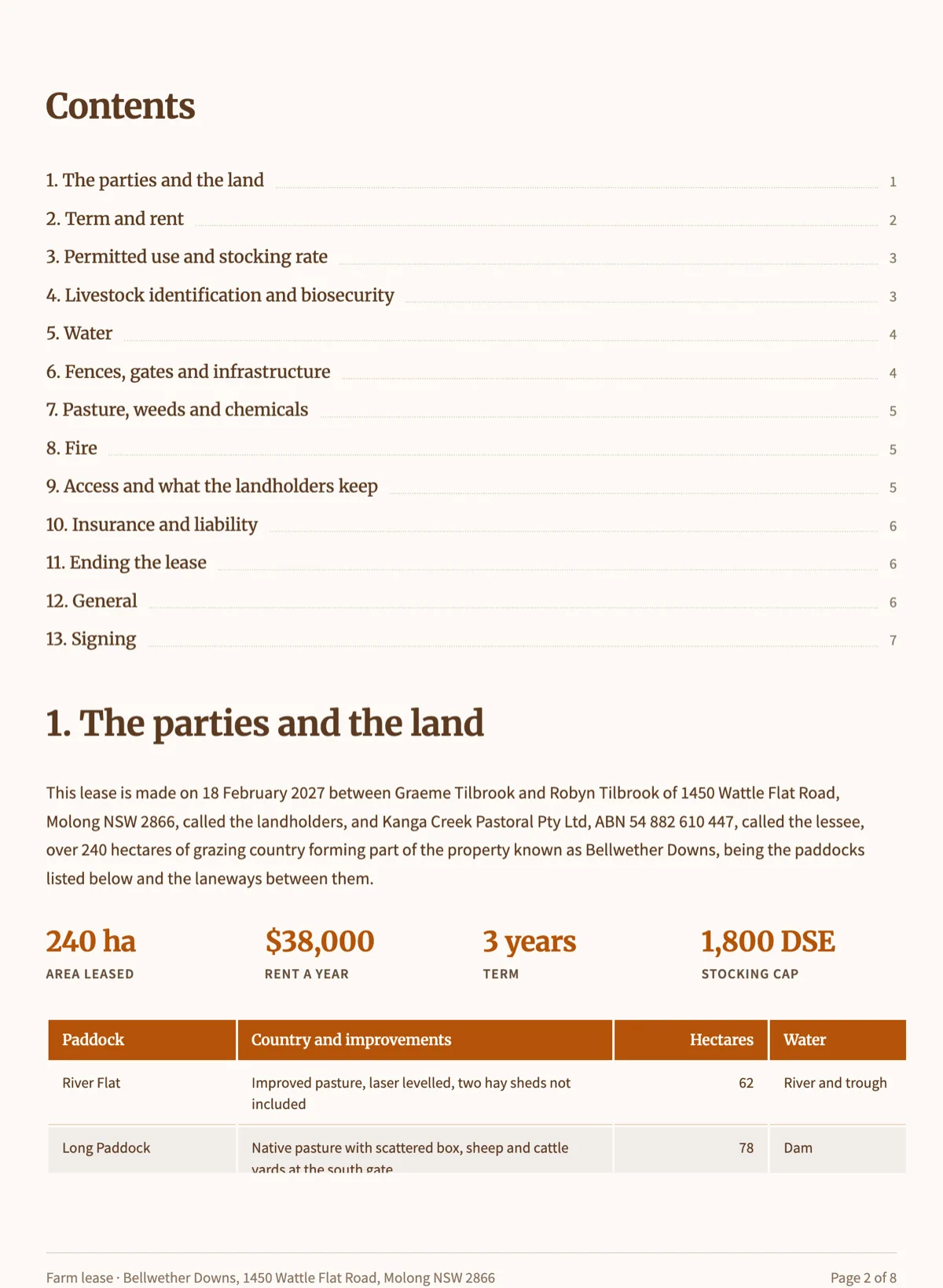 Farm lease agreement template with grazing rights and a fencing tableA grazing lease is a bet on country, and the two things that decide whether it was a good one are the stocking rate and who fixes the fence. This three year lease over 240 hectares caps stock in dry sheep equivalents, ties ground cover to a measurement twice a year, and puts every improvement in a table with a name beside it.
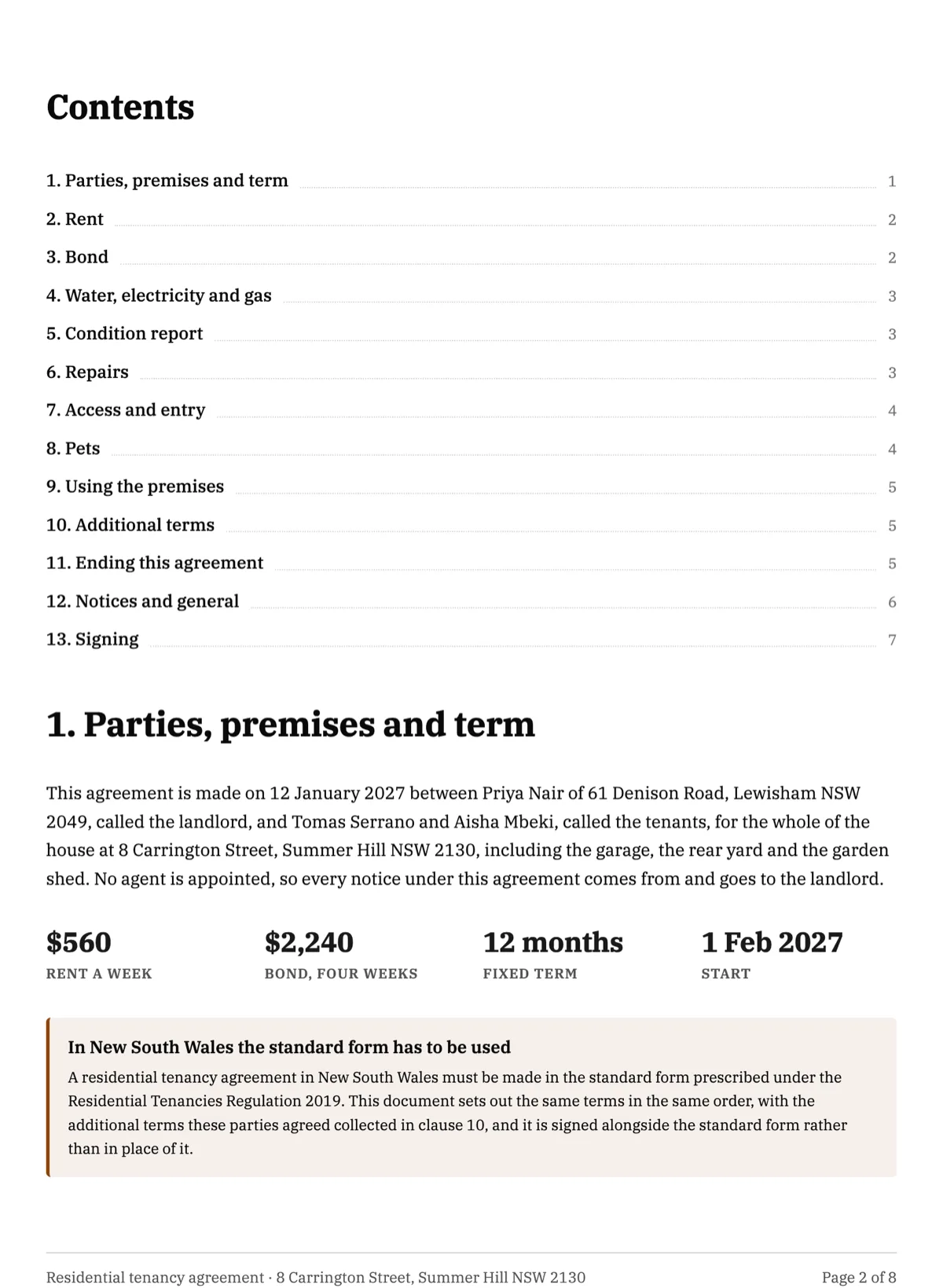 Residential lease agreement template for a New South Wales fixed termA residential tenancy is the one agreement where most of the terms are set by statute rather than by the parties, so the useful part of a template is the additional terms and the numbers. This one is a 12 month New South Wales fixed term at $560 a week, with the bond, the entry notice periods and the break fee written out exactly as the Act sets them.
Questions people ask
Can rent go down at a market review?
It can if the lease allows it, and in a Victorian retail lease a term stopping the rent from falling at a market review is void. Leases outside retail leases legislation often include a ratchet so the rent cannot fall below the previous figure, which is one reason tenants check early whether their premises count as retail premises.
How often can rent be reviewed in a commercial lease?
As often as the lease says, but the lease must state the timing. Annual fixed or CPI increases with a market review at the start of any option term is a common pattern for Victorian shops. Some leases add a market review part way through the term, which the tenant should price before signing.
What is a ratchet clause?
A ratchet clause says the rent after a review cannot be lower than the rent before it. In a Victorian retail lease a ratchet on a market review is void, while a fixed percentage or CPI increase is allowed because it only moves in one direction by design. In an office or industrial lease a ratchet is usually enforceable.
Who pays for a specialist retail valuer?
Under the Retail Leases Act 2003 (Vic) the landlord and tenant pay the valuer's costs in equal shares. The cost is set by the valuer and depends on the complexity of the premises and the rental evidence available, so for a small shop it may be worth continuing to negotiate before asking the Commission to appoint one.
What happens to rent while a review is being decided?
The tenant usually keeps paying the rent that applied before the review date, and once the new rent is agreed or determined the difference is paid or credited back to the review date. The clause should say so expressly and set a short deadline for the adjustment payment, so neither side carries the gap for long.
Is CPI escalation the same as a rent review?
It is one kind of rent review, using an independently published price index as the basis. The formula, the choice of index and the capital city are covered on the CPI escalation clause page. A lease can combine CPI reviews during the term with a market review when an option is exercised.
Put the clause in a finished document
The button opens the document generator with a starting description already filled in. Change it to match your own agreement before you run it.
Create a document with OneCraftRelated clauses
- Option to renew clause: the right to a further termAn option to renew clause gives a tenant the right to a further lease term if exercised in time. Victorian retail sample wording, variants and the notice rules.
- Outgoings clause: the building costs on top of rentAn outgoings clause sets which building costs a tenant pays on top of rent. Victorian retail sample wording, what is recoverable and gross lease variants.
- CPI escalation clause: the formula and the sample wordingA CPI escalation clause raises a price automatically with the consumer price index. Australian sample wording, the formula worked through, and four variants.
For everything the document generator can do, see the document maker.
Step by step in the builder: Create a document with AI, then Document builder components.
Written and checked by the OneCraft team. Last checked .