Contract clause
Outgoings clause: the building costs on top of rent
An outgoings clause states which costs of owning and running a building the tenant pays in addition to rent, such as council rates, water charges, insurance and common area cleaning. It sets how each cost is shared between tenants, how estimates are given and how the tenant's payments are reconciled against actual spending.
On a small shop, outgoings can add a large share to the rent, and the lease particulars rarely show how the estimate was built. A clause that lists each recoverable cost, the tenant's percentage and the statement timetable lets a tenant check the invoices instead of trusting them.
Nuwan Madhusanka · Co-founder
4 min read · Published
Sample clause
a retail lease in Victoria between Riverbend Plaza Pty Ltd, a fictional owner of a six shop neighbourhood centre in Wodonga, and Fernleaf Florist, which leases 18.5 percent of the lettable area
7. Outgoings 7.1 Fernleaf Florist must pay the Tenant's Proportion, being 18.5 percent, of the following Outgoings for the Centre: council rates and charges, water and sewerage charges, building insurance premiums, common area cleaning and gardening, common area electricity, and fire safety servicing. 7.2 Before each Accounting Period, and at least one month before it starts, Riverbend Plaza will give the Tenant a written itemised estimate of the Outgoings. The Tenant pays one twelfth of its share of the estimate with each monthly Rent payment. 7.3 Within 3 months after each Accounting Period ends, Riverbend Plaza will give the Tenant a statement of the actual Outgoings, accompanied by an auditor's report where the Retail Leases Act 2003 (Vic) requires one. 7.4 Any overpayment or underpayment is adjusted within one month after the statement is given. 7.5 The Tenant does not contribute to land tax, capital costs, depreciation, a sinking fund for capital works, or the Landlord's interest on borrowings.
Sample wording, not legal advice.
Variants
Gross lease
A small tenancy where both sides prefer one all inclusive figure to annual estimates and statements.
The Rent is a gross rent that includes the Tenant's contribution to all rates, taxes, insurance and other outgoings of the Premises and the building. The Tenant is not liable to pay any outgoings in addition to the Rent, except the cost of electricity, gas and telephone services separately metered to the Premises and any charge arising from the Tenant's particular use of the Premises.
Capped outgoings
A new tenant nervous about an estimate it cannot verify, or a landlord offering certainty as an incentive.
The Tenant's contribution to Outgoings in any Accounting Period will not exceed the amount of the estimate given for that period plus 5 percent, except to the extent that an increase results from a change in council rates, water charges or insurance premiums outside the Landlord's control. Any Outgoings above that limit are borne by the Landlord and may not be recovered from the Tenant in a later Accounting Period.
Net office lease outside the Act
An office or industrial lease not covered by retail leases legislation, where the landlord recovers a wider range of costs.
The Tenant must pay its Proportion of all Outgoings, meaning every cost the Landlord pays or incurs in owning, operating, insuring, managing and maintaining the building, including land tax calculated on a single holding basis and management fees not exceeding 5 percent of the other Outgoings. The Landlord will give an annual estimate and an audited annual statement, and adjustments are made within 30 days after the statement.
What to negotiate
Which costs are on the list
Every outgoing a tenant accepts is paid for the whole term, so the list is worth reading line by line. Tenants push back on management fees, marketing levies and costs that benefit other tenants only. Landlords want the list wide enough to cover the building. A closed list with named categories is easier for both sides to administer.
How the proportion is calculated
A share based on lettable area is common, but it can penalise a large tenant that uses few services or a ground floor shop that never uses the lift. Tenants can ask for costs that benefit only some premises to be shared only among those premises, which in a Victorian retail shopping centre is already the rule.
The risk of leaving it out
Under the Retail Leases Act 2003 (Vic) a tenant is not liable to pay outgoings except under lease provisions that specify them, so leaving the clause out means the landlord cannot recover them and must build the cost into the rent. Outside the Act the result is the same in practice, because an unlisted cost has no contractual basis for recovery.
What a Victorian retail landlord can and cannot recover
A Victorian retail tenant pays outgoings only where the lease specifies the recoverable outgoings, how they are determined and apportioned, and how they are recovered. The landlord must give an itemised estimate before the lease is entered into and at least one month before each accounting period, and the tenant is not liable until it receives that estimate. Terms requiring the tenant to pay land tax, capital costs of the building or plant, depreciation, sinking fund contributions, interest on the landlord's borrowings, or head lease rent are void.
Statements, audits and adjustments
The landlord must give the tenant a written statement of actual outgoings within 3 months after each accounting period ends. The statement needs an auditor's report unless it covers only GST, water and sewerage charges, council rates, insurance and other prescribed items and comes with copies of the invoices or other proof of payment. An adjustment for any overpayment or underpayment then follows within one month after the statement, or within 4 months after the period ends if that is earlier. The Victorian Small Business Commission can help resolve a dispute about outgoings.
Where it sits in a generated document
A generated lease places outgoings as its own numbered clause straight after rent and rent review, with the recoverable categories listed as sub clauses. The generated text does not cite the Act, so the list of recoverable and void items for the state is checked before the lease is signed.
Documents that carry this clause
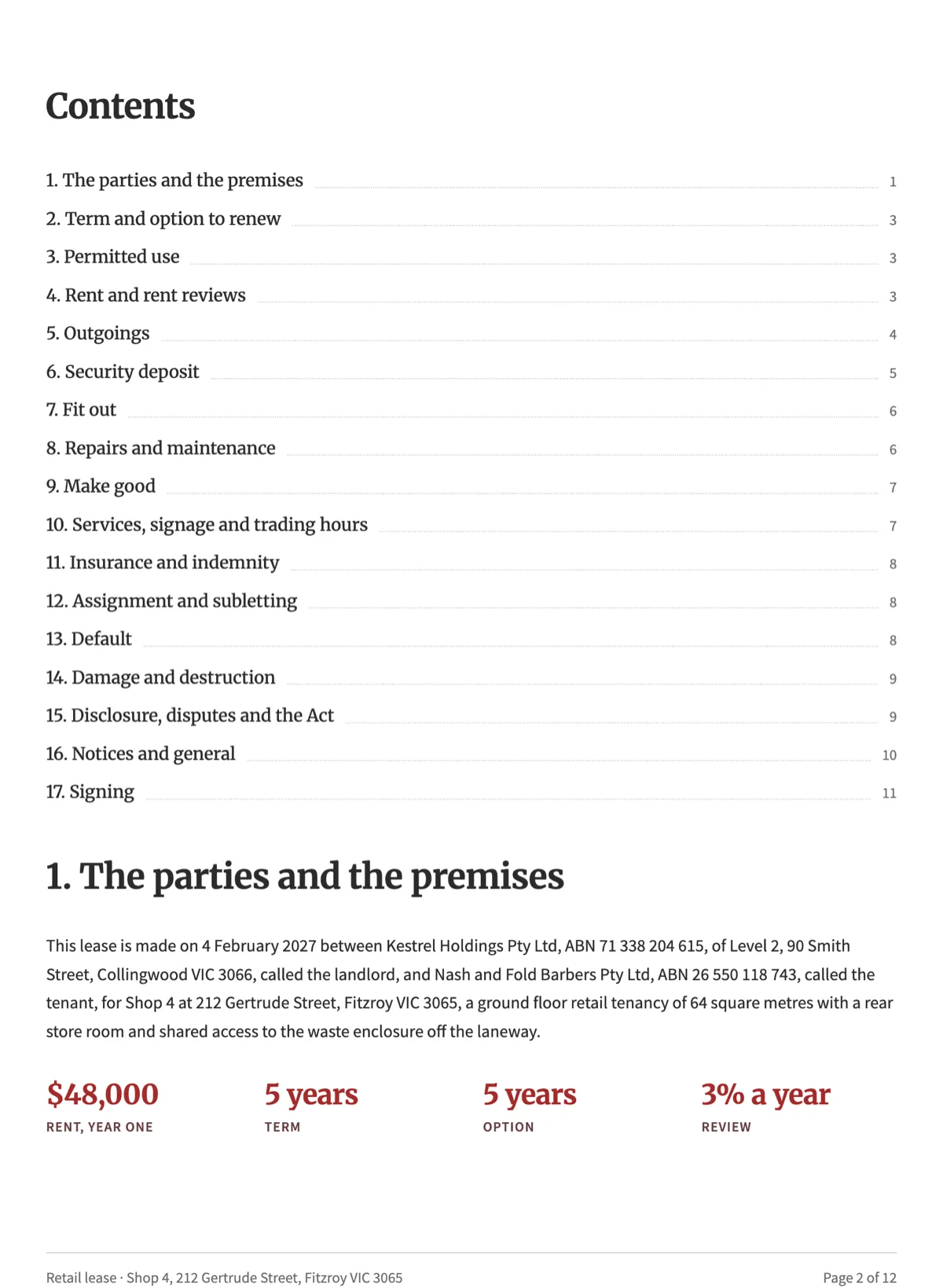 Commercial lease agreement template with outgoings and fit out termsA retail lease is decided by three numbers and two clauses: the rent, the review, the outgoings, the fit out contribution and the make good. This 12 page Victorian lease sets all five out in the open, including the outgoings the landlord is not allowed to recover at all.
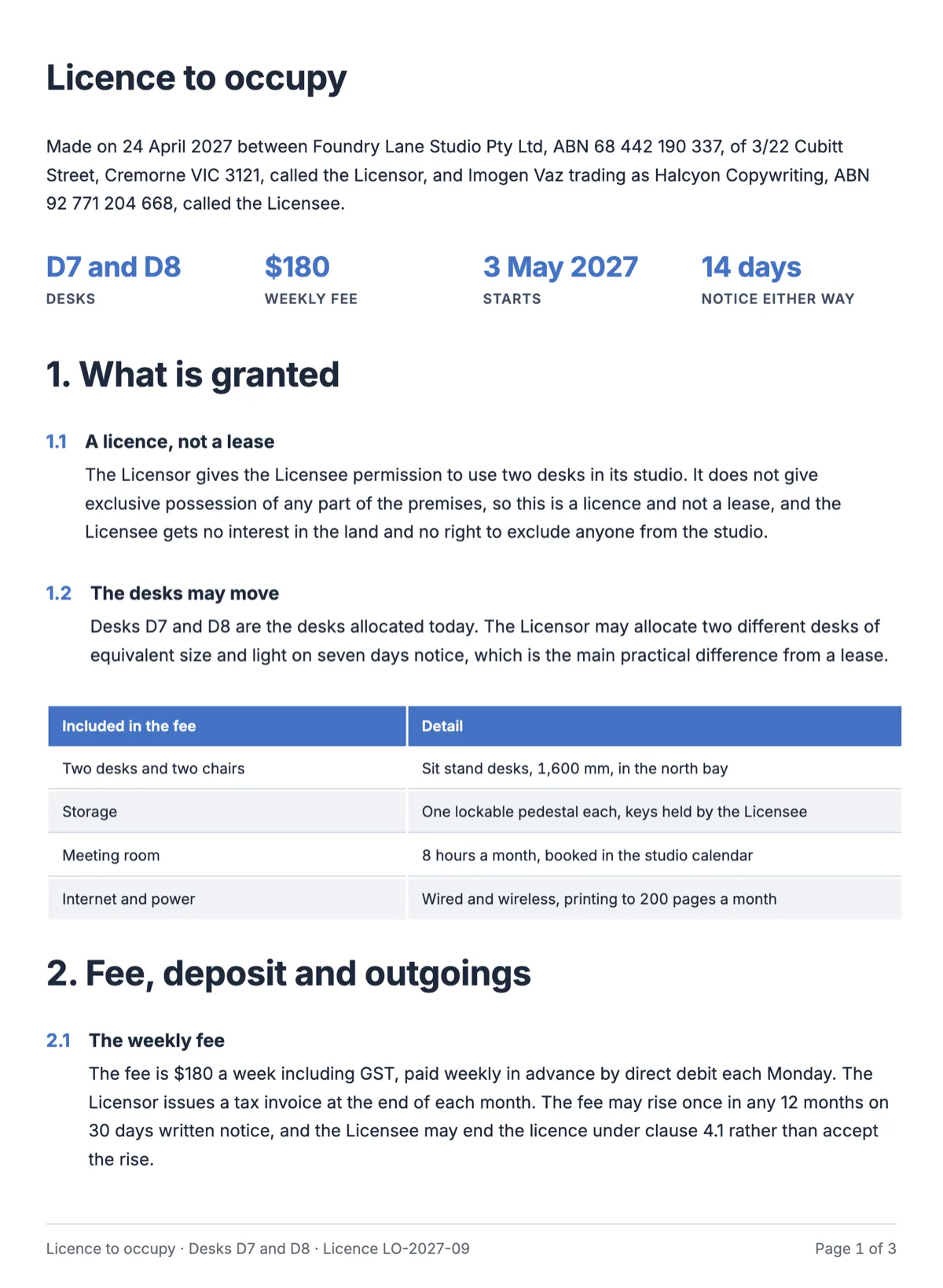 Licence to occupy template for desk space without a leaseA licence to occupy gives someone permission to use space without giving them exclusive possession of it, which is the line between a licence and a lease. This one covers two desks in a Melbourne studio at $180 a week including GST, with fixed access hours, a right to move the desks on seven days notice, and 14 days to end it from either side.
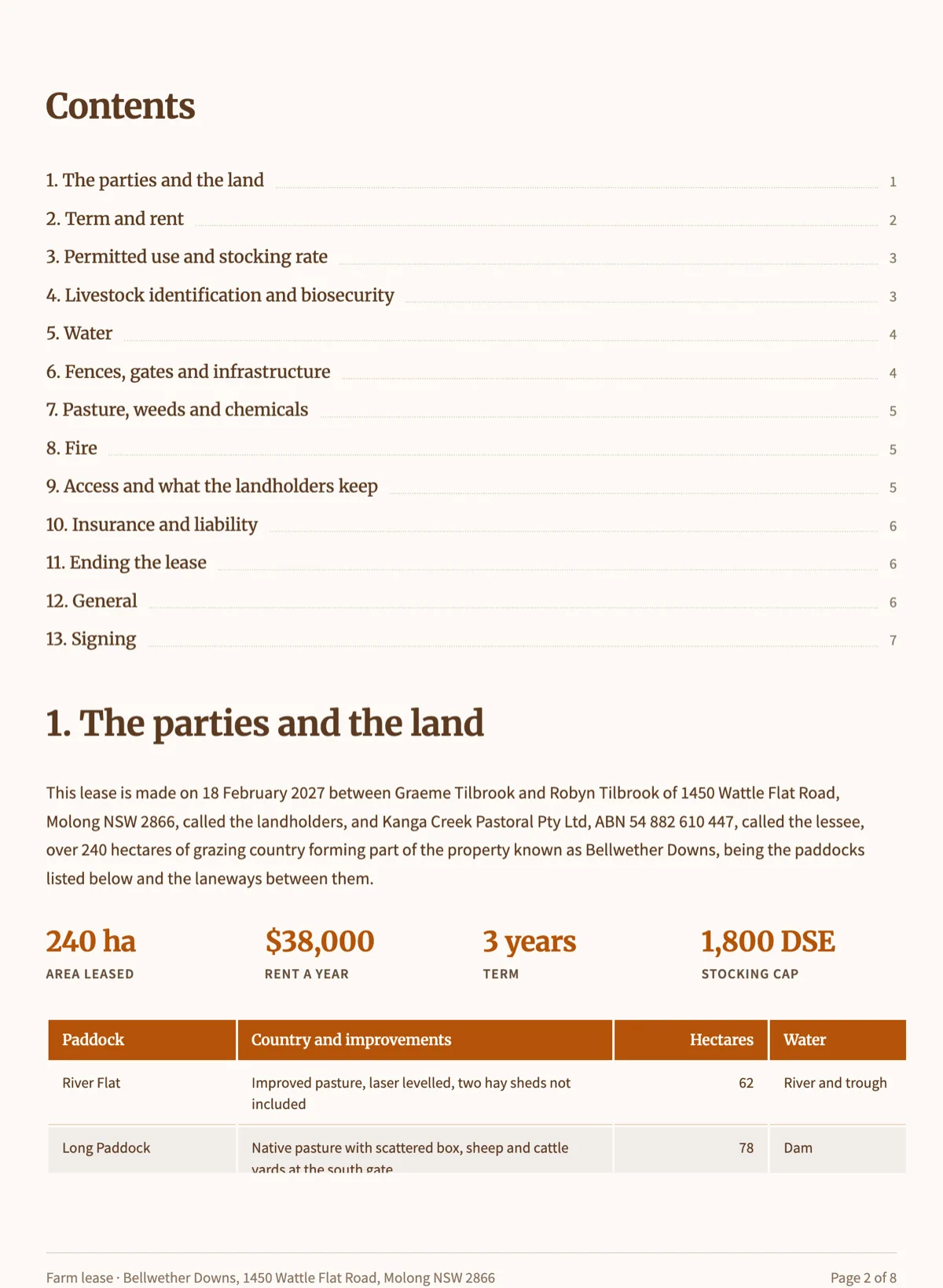 Farm lease agreement template with grazing rights and a fencing tableA grazing lease is a bet on country, and the two things that decide whether it was a good one are the stocking rate and who fixes the fence. This three year lease over 240 hectares caps stock in dry sheep equivalents, ties ground cover to a measurement twice a year, and puts every improvement in a table with a name beside it.
Questions people ask
Can a landlord charge land tax to a retail tenant in Victoria?
No. Under the Retail Leases Act 2003 (Vic) a provision of a retail premises lease is void to the extent it makes the tenant liable for land tax the landlord owes. Office and industrial leases outside the Act often do pass land tax on, which is one of the biggest cost differences between the two kinds of lease.
What if the landlord never gave an estimate of outgoings?
In a Victorian retail lease the tenant is not liable to contribute to an outgoing for which an estimate was required until it is given that estimate. The landlord must provide the itemised estimate before the lease is entered into and at least one month before each accounting period, so a missing estimate is worth raising promptly.
What is the difference between a gross lease and a net lease?
In a gross lease the rent includes the outgoings, so the tenant pays one figure and the landlord carries the risk of costs rising. In a net lease the tenant pays rent plus its share of outgoings, so the tenant carries that risk. Semi gross leases pass on some named costs, such as increases in rates above a base year.
Can a tenant be charged for a new roof or lift?
Not in a Victorian retail lease, because a term requiring the tenant to pay the capital costs of the building or its plant is void, as is a contribution to a sinking fund for capital works. The tenant can still agree to carry out capital works at its own cost, and repair costs for essential safety measures can be passed on.
Do outgoings attract GST?
Usually yes, because the tenant's contribution is part of the consideration for a taxable supply of commercial premises, so the landlord issues a tax invoice for the outgoings with GST added. The lease GST clause, not the outgoings clause, normally sets out how GST is charged on rent and outgoings together.
How can a tenant check an outgoings statement?
By comparing each line with the estimate and the prior year, asking for copies of invoices and rate notices, and checking that the tenant's proportion was applied correctly. In a Victorian retail lease an auditor preparing the report must give the tenant a reasonable opportunity to make a written submission about the statement's accuracy.
Put the clause in a finished document
The button opens the document generator with a starting description already filled in. Change it to match your own agreement before you run it.
Create a document with OneCraftRelated clauses
- Rent review clause: fixed, CPI or marketA rent review clause sets when lease rent changes and how. Victorian retail lease sample wording, fixed, CPI and market review variants, and the ratchet rule.
- Repairs and maintenance clause: who fixes what in a leaseA repairs and maintenance clause splits who fixes what in a lease. Victorian retail sample wording, residential urgent repairs rules and a tenant heavy variant.
- GST clause: saying whether the price includes GSTA GST clause says whether amounts include GST and who pays it. Australian sample wording, a gross up variant, adjustment events and reimbursed expenses.
For everything the document generator can do, see the document maker.
Step by step in the builder: Create a document with AI, then Document builder components.
Written and checked by the OneCraft team. Last checked .