Contract clause
Repairs and maintenance clause: who fixes what in a lease
A repairs and maintenance clause divides responsibility for keeping leased premises in working order between landlord and tenant. It usually gives the landlord the structure and major plant, gives the tenant cleaning and day to day upkeep, and sets out how urgent repairs are reported, carried out and paid for.
Most repair disputes are about one expensive item, usually air conditioning, a roof leak or a cool room, and whether it is structure, plant or wear and tear. A clause that lists the items and the procedure for urgent failures settles the question before the item breaks.
Indunil Asanka · Co-founder
4 min read · Published
Sample clause
a retail lease in Victoria between Paperbark Investments, a fictional owner of a shop in Mildura, and Greenhouse Grocer, a fruit and vegetable shop with a landlord supplied cool room
11. Repairs and Maintenance 11.1 Paperbark Investments must maintain the structure of the Premises, the Landlord's fixtures, the cool room and air conditioning plant, and the gas, electricity, water and drainage services it provides, in the condition they were in at the Commencement Date, except where the need for repair arises from the Tenant's misuse. 11.2 Greenhouse Grocer must keep the Premises clean and in good order, fair wear and tear excepted, and repair any damage it or its customers cause. 11.3 The Tenant must notify the Landlord in writing as soon as practicable of any damage or defect. 11.4 If an urgent repair that is the Landlord's responsibility substantially affects the Tenant's business and the Landlord does not arrange it despite the Tenant's reasonable efforts, the Tenant may arrange the repair, must give the Landlord written notice of the repair and its cost within 14 days, and is entitled to be reimbursed the reasonable cost. 11.5 The Landlord may not recover the cost of a repair under clause 11.4 as an outgoing.
Sample wording, not legal advice.
Variants
Residential rental agreement in Victoria
A lease of a home, where the Residential Tenancies Act 1997 sets the timeframes.
The Rental Provider must ensure the Premises are provided and maintained in good repair. The Rental Provider must arrange urgent repairs immediately after being notified and non urgent repairs within 14 days after a written request. If the Rental Provider does not respond promptly to a notified urgent repair costing $2,500 or less, the Renter may arrange it, must give written notice of the cost within 7 days after the repair, and is entitled to be repaid within 7 days after that notice.
Office lease with a tenant heavy split
A net office or industrial lease outside retail leases legislation, where the tenant takes most of the repair risk.
The Tenant must keep the Premises, including the Landlord's plant and equipment serving only the Premises, in good repair and working order, fair wear and tear and structural defects excepted. The Tenant must maintain that plant under a service contract with a qualified contractor and give the Landlord a copy of each service report. The Landlord is responsible only for the roof, external walls, foundations and any capital replacement of plant that cannot be repaired.
What to negotiate
Repair or replace
The expensive argument is whether an old item that fails is repaired, which a tenant may carry, or replaced, which is usually a capital cost for the landlord. A clause that makes replacement of plant at the end of its working life the landlord's responsibility, and routine servicing the tenant's, removes most of that argument.
The urgent repairs procedure
Tenants want the right to fix an urgent failure themselves and be reimbursed. Landlords want to be told first and to choose the contractor. A procedure that requires notice by phone and in writing, a short response time and then a right for the tenant to act gives both sides what they need.
The risk of leaving it out
Without a repairs clause the parties fall back on statute and implied terms, which for a Victorian retail lease already put structure and plant on the landlord, but leave the details of reporting, servicing and urgent repairs undefined. In a lease outside the Act the gap is larger, and a major plant failure can become a dispute about who owns the problem.
The Victorian retail lease split
The Retail Leases Act 2003 (Vic) makes the landlord responsible for maintaining the structure of the premises, the fixtures, the plant and equipment, and the landlord's appliances, fittings and fixtures for gas, electricity, water and drainage, in the condition they were in when the lease began. The landlord is not responsible where the repair arises from the tenant's misuse, or for items the tenant may or must remove at the end of the lease. Capital costs of the building and plant cannot be passed to the tenant as outgoings. The Victorian Small Business Commission notes that the Act overrides lease provisions that conflict with these duties.
Who fixes what, item by item
A practical split for a shop gives the landlord the roof, external walls, structural floor, main switchboard, hot water system, landlord supplied air conditioning and cool rooms, and the replacement of any of them. The tenant takes cleaning, light globes, internal painting during the term, its own fit out and equipment, damage caused by its staff or customers, and the removal of rubbish. Items that sit between the two, such as grease traps or shopfront glass, are worth naming in the clause rather than leaving to argument.
Where it sits in a generated document
A generated lease numbers repairs as its own clause, with the landlord's obligations, the tenant's obligations and the urgent repairs procedure as separate sub clauses. The generated draft does not cite sources, so statutory repair duties for the state are confirmed before the lease is signed.
Documents that carry this clause
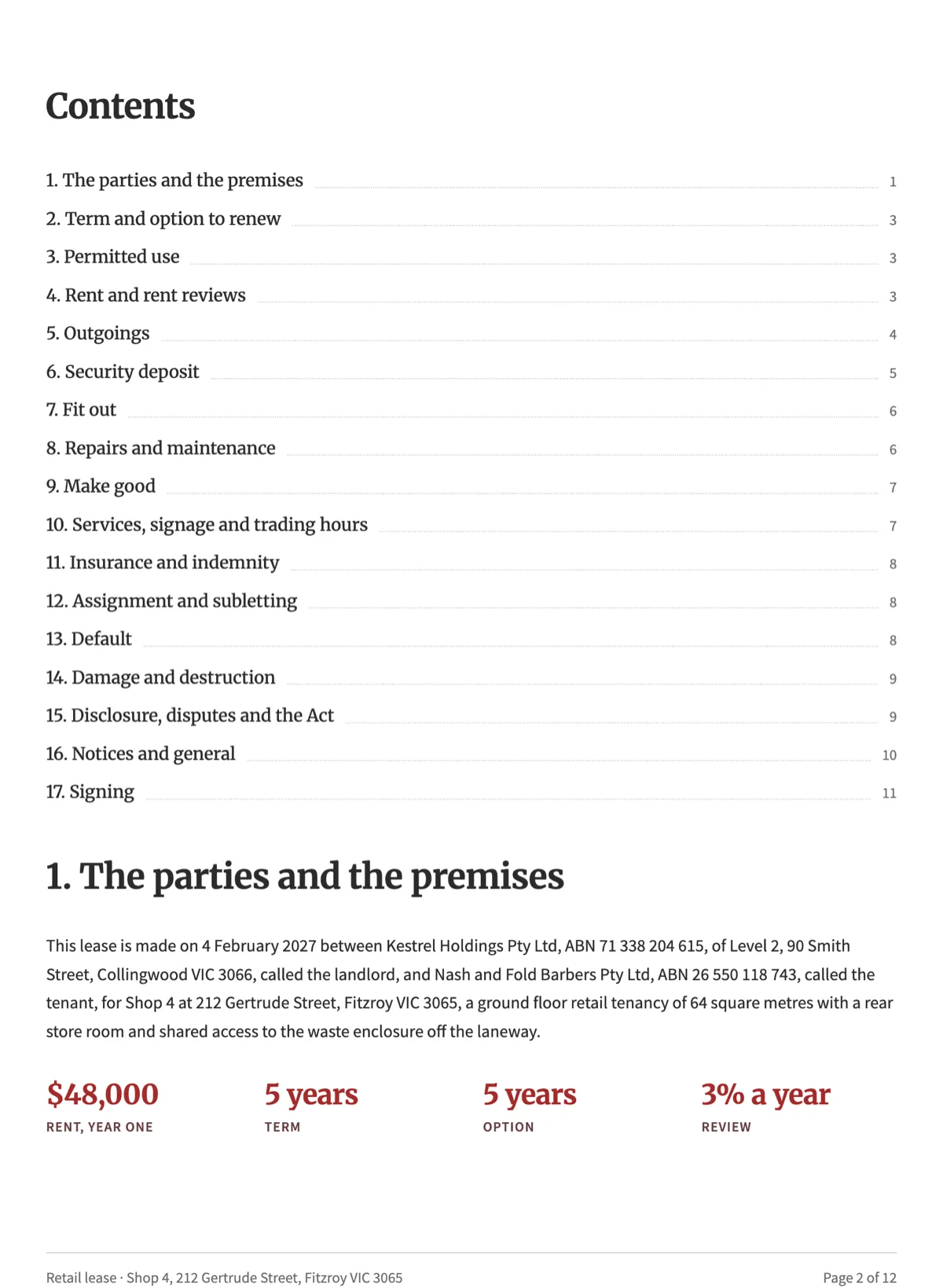 Commercial lease agreement template with outgoings and fit out termsA retail lease is decided by three numbers and two clauses: the rent, the review, the outgoings, the fit out contribution and the make good. This 12 page Victorian lease sets all five out in the open, including the outgoings the landlord is not allowed to recover at all.
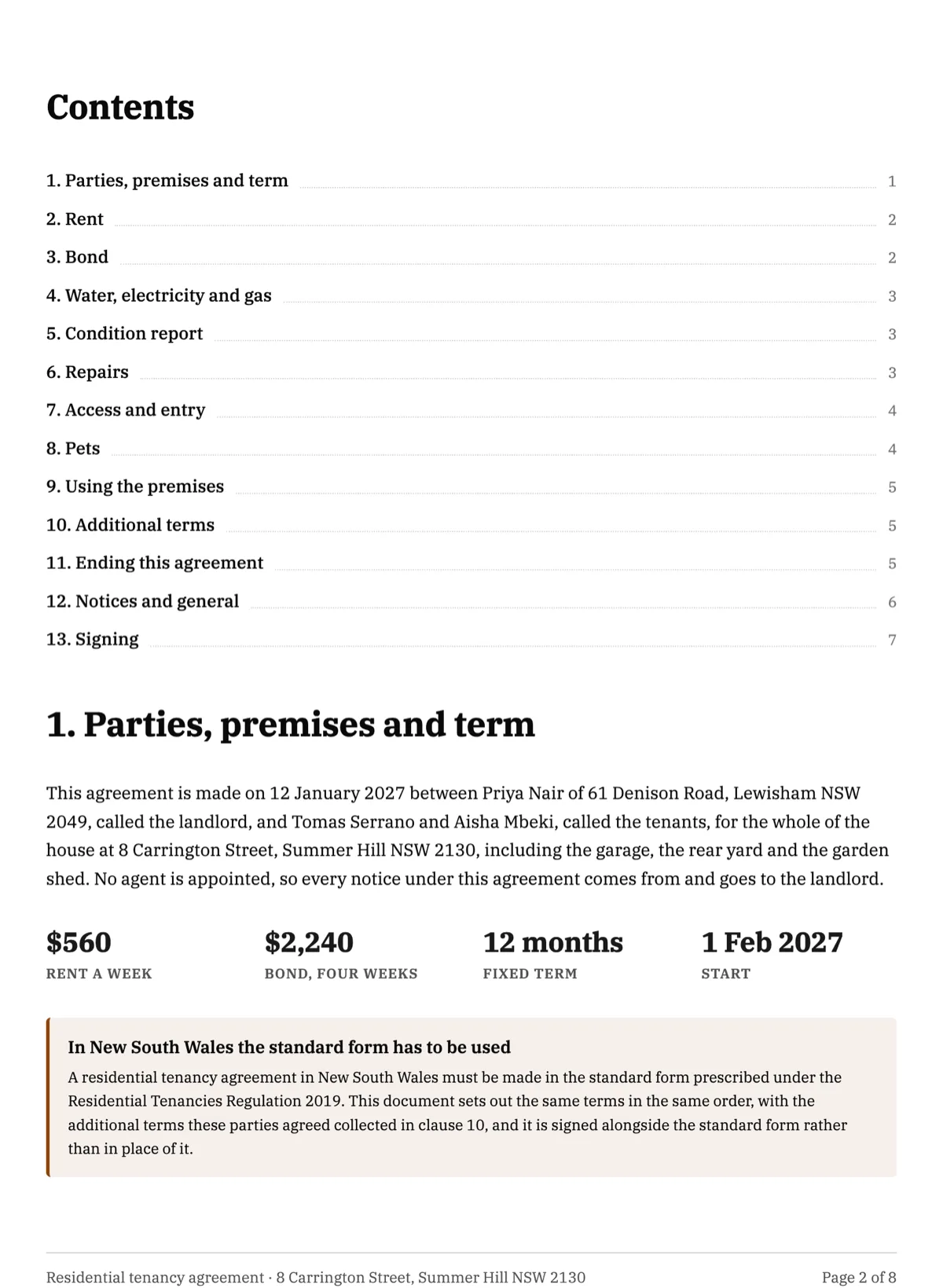 Residential lease agreement template for a New South Wales fixed termA residential tenancy is the one agreement where most of the terms are set by statute rather than by the parties, so the useful part of a template is the additional terms and the numbers. This one is a 12 month New South Wales fixed term at $560 a week, with the bond, the entry notice periods and the break fee written out exactly as the Act sets them.
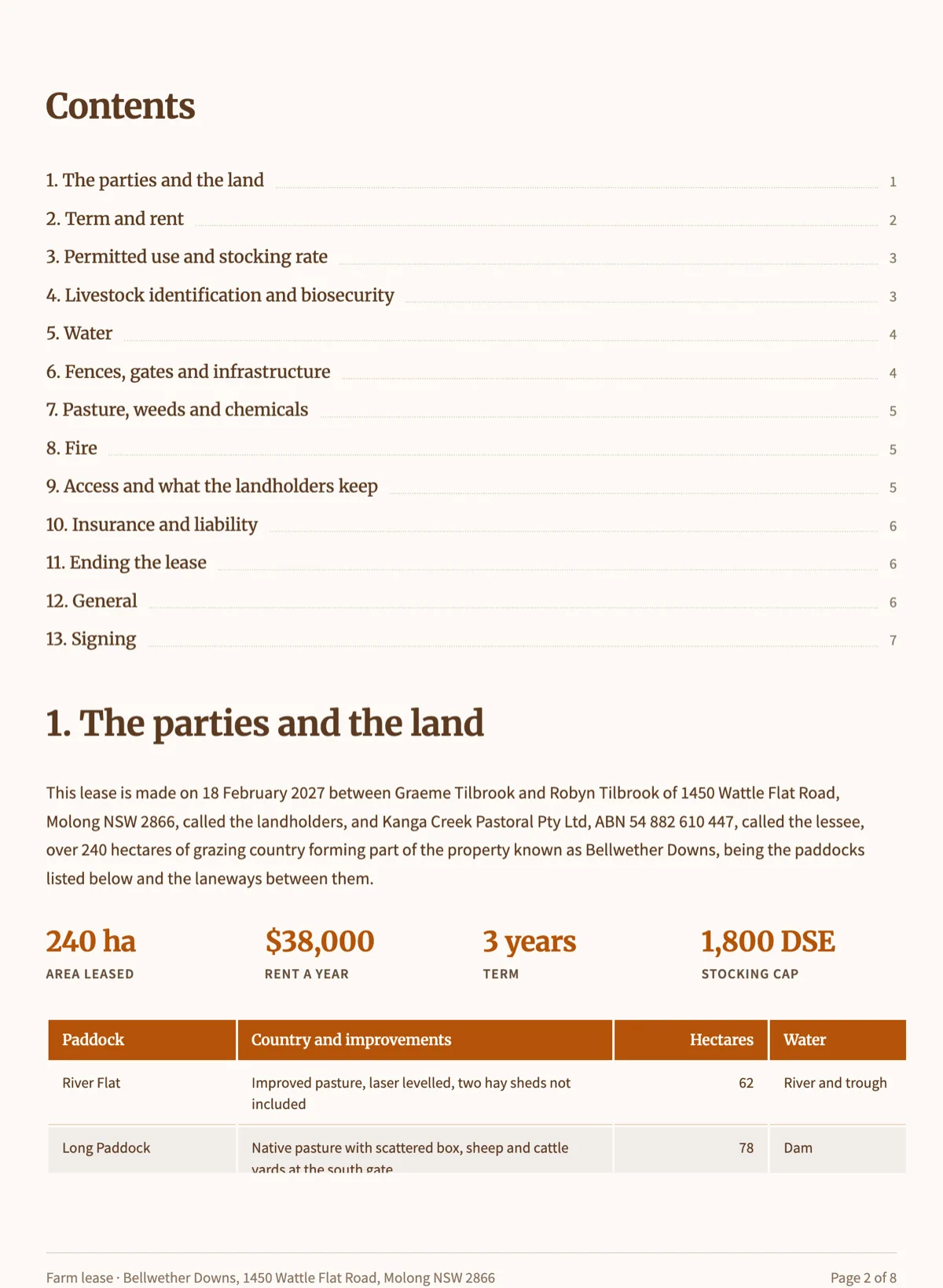 Farm lease agreement template with grazing rights and a fencing tableA grazing lease is a bet on country, and the two things that decide whether it was a good one are the stocking rate and who fixes the fence. This three year lease over 240 hectares caps stock in dry sheep equivalents, ties ground cover to a measurement twice a year, and puts every improvement in a table with a name beside it.
Questions people ask
Who pays to fix air conditioning in a commercial lease?
It depends on the lease and the legislation. In a Victorian retail lease the landlord must maintain plant and equipment it provides, such as an air conditioning system, unless the tenant misused it. In an office or industrial lease outside the Act the tenant often services and repairs the plant, while replacement stays with the landlord.
What counts as an urgent repair in a Victorian rental home?
The Residential Tenancies Act 1997 defines a list of urgent repairs, covering failures that make a home unsafe or difficult to live in, such as a burst water service or a dangerous electrical fault. Anything not on the list is a non urgent repair, which the rental provider must carry out within 14 days after a written request.
Can a Victorian renter arrange an urgent repair costing more than $2,500?
No. A renter can organise and pay for an urgent repair only if the rental provider was notified, did not respond promptly and the repair costs $2,500 or less. For a more expensive urgent repair the renter asks Rental Dispute Resolution Victoria for help instead, and receipts for anything already spent should be kept.
Can a tenant deduct repair costs from the rent?
Not unless the lease or the legislation allows it. The safer course is to follow the urgent repairs procedure, keep invoices and claim reimbursement. Under the Victorian retail leases legislation the landlord must reimburse the reasonable cost of an urgent repair the tenant properly arranged, and cannot then recover that cost as an outgoing.
What does fair wear and tear mean?
It means the deterioration that happens through ordinary, reasonable use of the premises over time, such as faded paint, worn carpet in walkways or loosened fittings. A tenant is not responsible for it. Damage caused by accident, neglect or misuse, such as a broken window or a stained floor, is not fair wear and tear.
Who is responsible for essential safety measures in a retail building?
As the owner of the building, the landlord keeps its obligations under building laws for essential safety measures. In Victoria the landlord and tenant can agree that the tenant carries out some of that maintenance on the landlord's behalf, but doing so does not change the landlord's own legal obligations as owner.
Put the clause in a finished document
The button opens the document generator with a starting description already filled in. Change it to match your own agreement before you run it.
Create a document with OneCraftRelated clauses
- Make good clause: what a tenant leaves behindA make good clause sets the condition a tenant leaves the premises in at the end of a lease. Victorian retail sample wording, scope checklist and variants.
- Outgoings clause: the building costs on top of rentAn outgoings clause sets which building costs a tenant pays on top of rent. Victorian retail sample wording, what is recoverable and gross lease variants.
- Landlord access clause: entry, inspections and noticeA landlord access clause sets when a landlord may enter rented premises and how much notice is needed. Victorian sample wording, NSW and commercial variants.
For everything the document generator can do, see the document maker.
Step by step in the builder: Create a document with AI, then Document builder components.
Written and checked by the OneCraft team. Last checked .