Contract clause
Landlord access clause: entry, inspections and notice
A landlord access clause sets out when a landlord or its agent may enter rented premises, for what reasons, at what times and on how much notice. For homes it restates the entry rules in the state tenancy legislation, and for commercial premises it creates the landlord's right of entry, which otherwise may not exist.
Entry disputes rarely involve a dramatic intrusion. They are about an inspection booked for the wrong day, a tradesperson arriving unannounced or an open home every Saturday, and a clause that lists each reason with its notice period prevents most of them.
Indunil Asanka · Co-founder
4 min read · Published
Sample clause
a residential rental agreement in Victoria between Silvereye Property Management, acting as fictional agent for a rental provider in Frankston, and a renter of a two bedroom unit
9. Access and Entry 9.1 The Rental Provider or its agent may enter the Premises only for a reason permitted by the Residential Tenancies Act 1997, between 8 am and 6 pm on a day that is not a public holiday, unless the Renter agrees to another time. 9.2 Written notice stating the reason for entry must be given at least: (a) 7 days before a general inspection, which may not take place in the first 3 months of this agreement or within 6 months after the previous general inspection; (b) 24 hours before entry to carry out repairs or another duty the law requires; and (c) 48 hours before showing the Premises to a prospective renter, buyer or lender. 9.3 While the Premises are for sale, the Rental Provider will pay the Renter the greater of half a day's rent and $30 for each inspection held to show the Premises to prospective buyers or lenders. 9.4 Anyone entering must act reasonably and must not stay longer than necessary for the purpose of the entry.
Sample wording, not legal advice.
Variants
Commercial lease entry
A shop or office lease, where access terms are contractual and can be tailored to trading.
The Landlord and persons it authorises may enter the Premises on at least 2 business days notice to inspect the Premises, carry out repairs, or show the Premises to prospective purchasers, lenders or, during the last 6 months of the Term, prospective tenants. Entry must be during business hours, accompanied by the Tenant if it asks, and cause as little disruption to trading as practicable. No notice is required in an emergency.
New South Wales residential tenancy
A home in New South Wales, where the notice periods and the limits on entry are different.
The Landlord or agent may enter the Premises without the Tenant's consent only as the Residential Tenancies Act 2010 allows, including to inspect on at least 7 days written notice no more than 4 times in any 12 months, to carry out or assess necessary repairs on at least 2 days notice, and without notice in an emergency or for urgent repairs. Except in those cases, entry is not permitted on a Sunday, a public holiday or outside 8 am to 8 pm unless the Tenant agrees.
What to negotiate
Inspections and privacy
Rental providers want regular inspections to catch damage early, while renters want as few visits as possible and a say in the timing. Because the statutory limits settle the frequency for homes, the practical negotiation is about agreeing convenient times in advance and whether photographs taken during an inspection may show the renter's belongings.
Showing the property to buyers
A sale campaign can mean many inspections in a short period. Renters in Victoria are compensated for each sales inspection, and many ask for a fixed weekly schedule and advance notice of open times. Rental providers benefit from agreeing a timetable early, because the renter's cooperation matters more to the campaign than the minimum notice.
The risk of leaving it out
For a Victorian or New South Wales home, leaving the clause out does not remove the statutory entry rules, but the parties often do not know them, which leads to refused entry and complaints. In a commercial lease the gap is larger, because without a clause the landlord may have no right to enter the premises at all during the term.
Victorian notice periods
In Victoria written notice stating the reason must be given at least 7 days before a general inspection, a valuation, or taking photos or videos for advertising; at least 24 hours before entry for repairs or other legal duties, or where the rental provider believes the renter has broken their obligations; and at least 48 hours before showing the property to prospective renters, buyers or lenders. Entry is allowed only between 8 am and 6 pm and not on public holidays unless the renter agrees, and a renter can refuse entry that does not follow these rules.
How New South Wales differs
New South Wales allows routine inspections on at least 7 days written notice, but no more than 4 times in any 12 months, and entry to carry out or assess necessary repairs on at least 2 days notice. No notice is required in an emergency or for urgent repairs. Outside those exceptions, entry without consent is generally not allowed on Sundays, public holidays or outside 8 am to 8 pm. The tenant's right to quiet enjoyment sits alongside these rules in section 50 of the Residential Tenancies Act 2010.
Where it sits in a generated document
A generated rental agreement or lease places access in a numbered clause next to the repairs clause, with each reason for entry and its notice period as a separate sub clause. The generated draft does not cite the Act, so the notice periods for the state are checked against the regulator's guidance before the document is used.
Documents that carry this clause
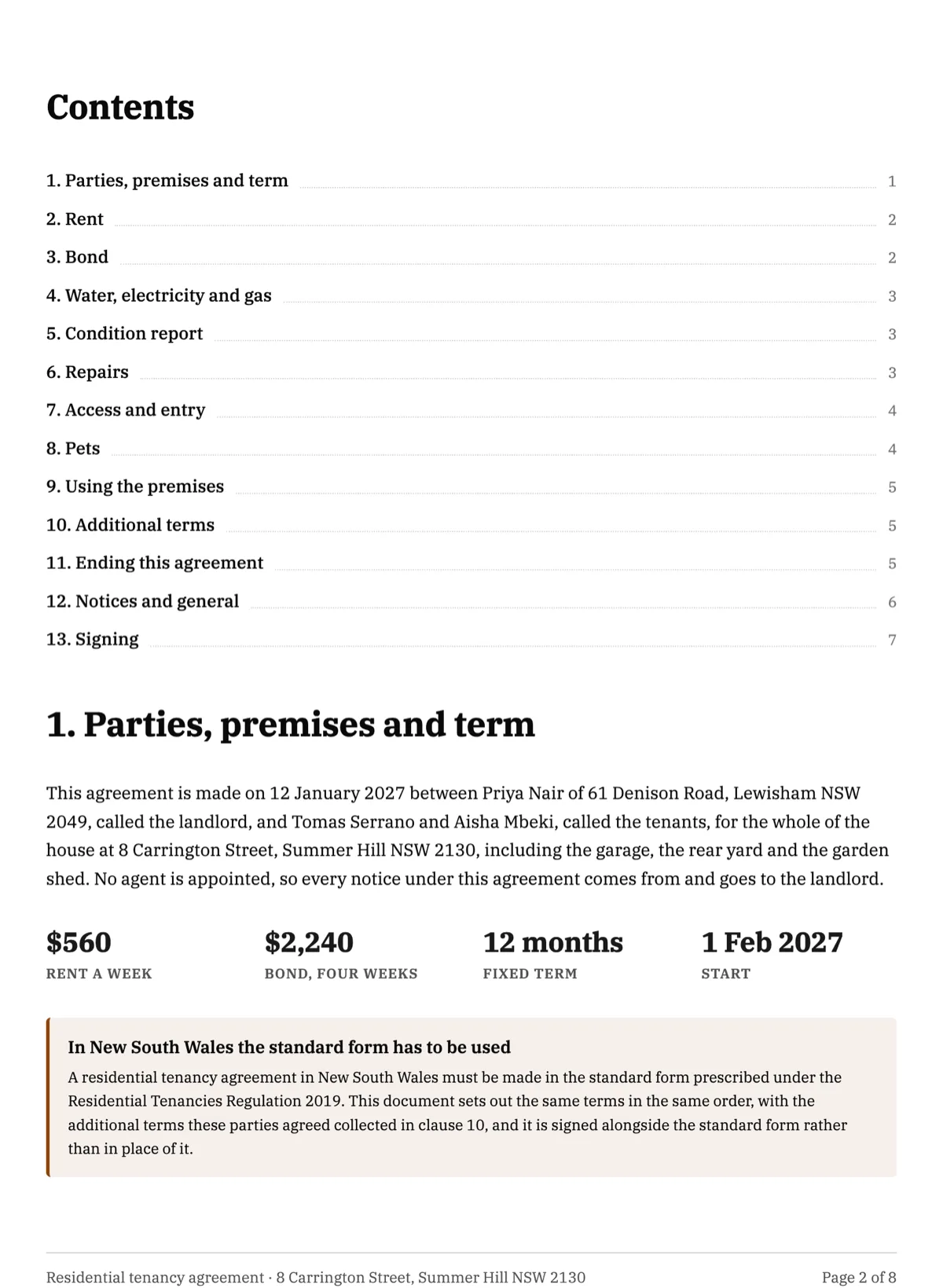 Residential lease agreement template for a New South Wales fixed termA residential tenancy is the one agreement where most of the terms are set by statute rather than by the parties, so the useful part of a template is the additional terms and the numbers. This one is a 12 month New South Wales fixed term at $560 a week, with the bond, the entry notice periods and the break fee written out exactly as the Act sets them.
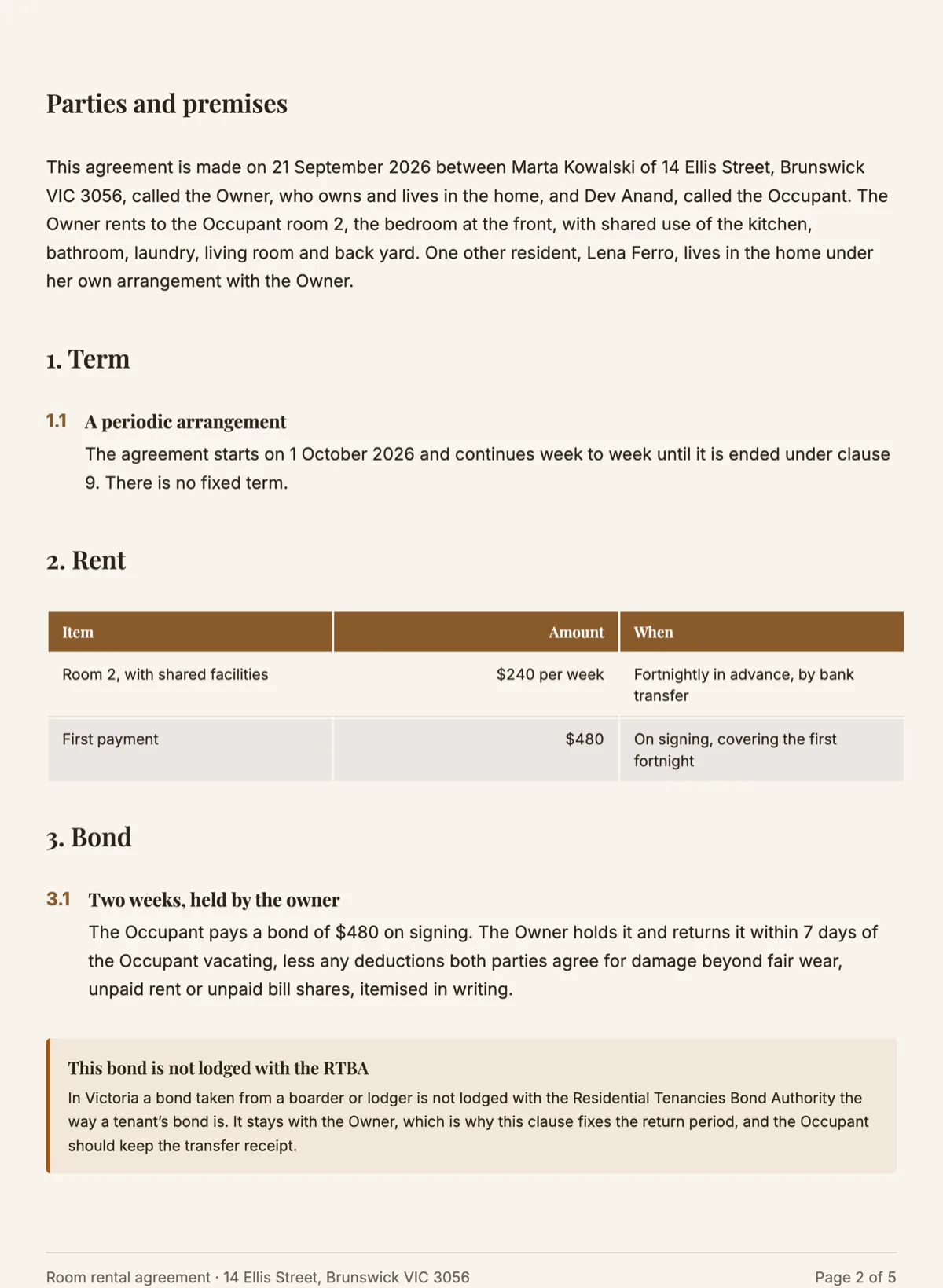 Room rental agreement template for one room in a shared homeRenting a room is not the same as renting a house, and most templates copy a residential lease and hope. This one is written for one room with shared kitchen and bathroom, prices the bills split, lists the rules that matter, and says plainly that the occupant is a boarder or lodger and what that changes.
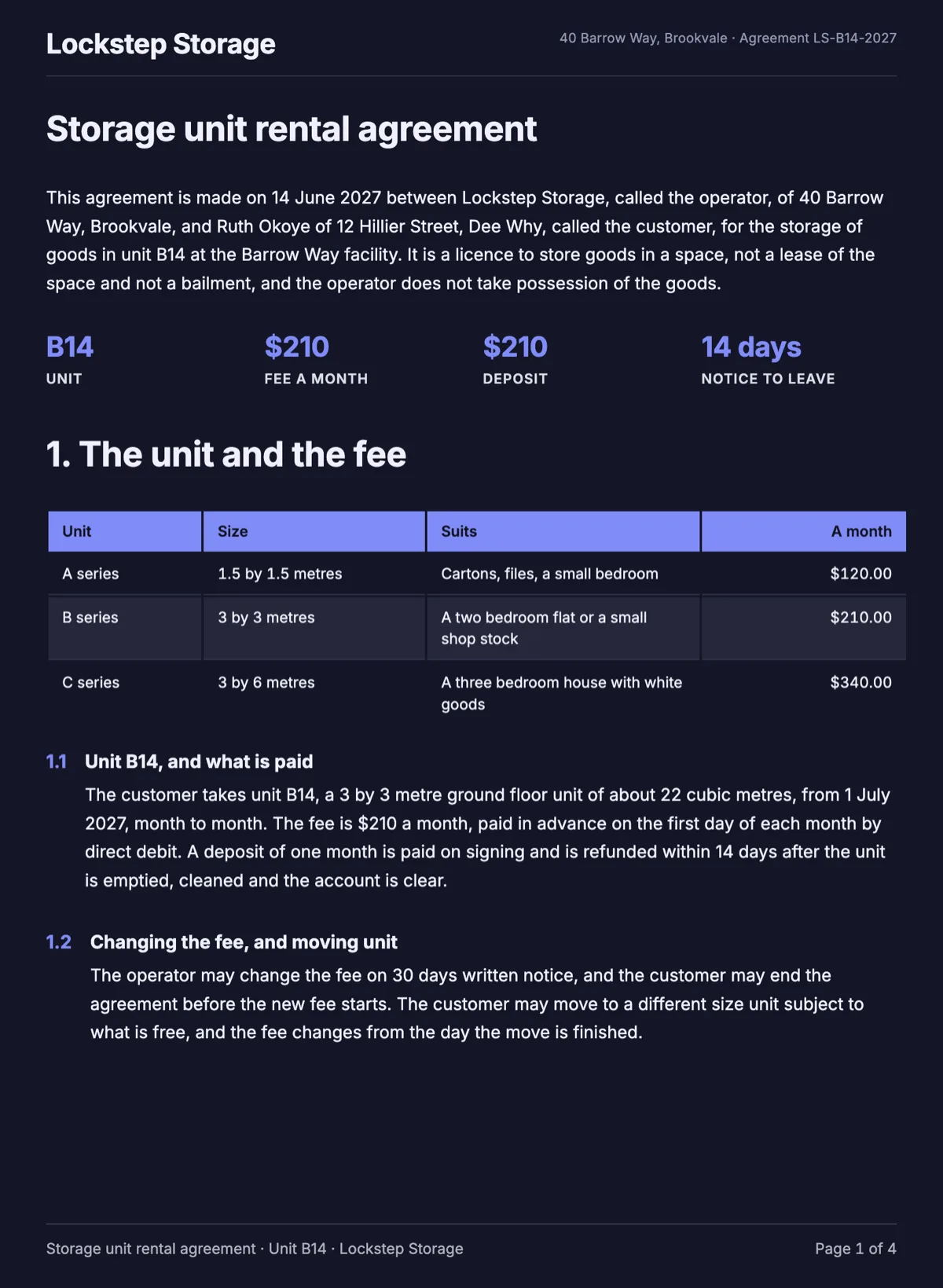 Storage unit rental agreement with access hours and a lien clauseSelf storage looks like a lease and is not one, which is why the agreement has to say what it actually is before it says anything else. This one opens by calling itself a licence to store goods in a space, then sets the access hours, the prohibited items and the exact sequence that happens when the account falls behind.
Questions people ask
How much notice must a landlord give before an inspection in Victoria?
At least 7 days written notice stating the reason. A general inspection cannot take place in the first 3 months of the rental agreement, and the renter can refuse entry if a general inspection has already been carried out in the previous 6 months. Entry must be between 8 am and 6 pm and not on a public holiday.
Can a landlord enter without notice?
In New South Wales, yes, in an emergency, for urgent repairs, where the property appears abandoned, under a Tribunal order or with the tenant's agreement. Victoria's rules centre on written notice for each permitted reason, and entry outside the normal hours needs the renter's agreement, made no more than 7 days before the entry.
Does a tenant have to be home for an inspection?
No. If proper notice has been given for a valid reason, the landlord or agent can generally enter while the tenant is out. A tenant who cannot be home can arrange for someone else to be there, and in New South Wales a tenant who prevents lawful entry may be in breach of the agreement.
Are renters compensated when the property is for sale?
In Victoria, yes. The rental provider must compensate the renter for each inspection held to show the property to prospective buyers or lenders, at the greater of half a day's rent or $30. For a property rented at $900 a week, that works out at about $64 for each inspection.
Can a commercial landlord enter whenever it likes?
No. A commercial landlord's right of entry comes from the lease, so the lease clause sets the reasons, the notice and the hours. In a Victorian retail lease, entry and works that substantially disrupt trading can also expose the landlord to a claim for compensation under the Retail Leases Act 2003.
What can a tenant do about unlawful entry?
Keep a record of each entry and raise it in writing with the landlord or agent. In New South Wales a tenant can complain to NSW Fair Trading and apply to the Tribunal if the problem is serious or persistent. In Victoria the Tribunal can make compensation or prohibition orders where a rental provider breaches its duties.
Put the clause in a finished document
The button opens the document generator with a starting description already filled in. Change it to match your own agreement before you run it.
Create a document with OneCraftRelated clauses
- Quiet enjoyment clause: what a tenant is actually promisedA quiet enjoyment clause protects a tenant's use of leased premises from landlord interference. Victorian sample wording, residential and office variants.
- Repairs and maintenance clause: who fixes what in a leaseA repairs and maintenance clause splits who fixes what in a lease. Victorian retail sample wording, residential urgent repairs rules and a tenant heavy variant.
- Pet clause in a lease: consent, conditions and refusalsA pet clause in a lease records consent for an animal and the conditions attached. NSW sample wording, the reasons a landlord can refuse, and Victorian variant.
For everything the document generator can do, see the document maker.
Step by step in the builder: Create a document with AI, then Send a document for signature.
Written and checked by the OneCraft team. Last checked .