Contract clause
Pet clause in a lease: consent, conditions and refusals
A pet clause in a lease states whether the tenant may keep animals at the rental property and on what conditions, such as the type and number of pets, cleaning at the end of the tenancy and responsibility for damage. In New South Wales a landlord can refuse a pet only for reasons the law allows.
Pet clauses used to be one line saying no pets, and in New South Wales that line no longer works. The clause now records the consent given for a particular animal and the reasonable conditions attached, which is exactly what gets examined if the tenancy ends in a dispute.
Nuwan Madhusanka · Co-founder
4 min read · Published
Sample clause
a residential tenancy in New South Wales between Juniper Lane Properties, a fictional landlord in Wollongong, and a tenant who applied to keep a small dog
10. Pets 10.1 The Landlord consents to the Tenant keeping one dog, a desexed miniature poodle named Biscuit, at the Premises, as recorded on the pet application form dated 3 August 2026. 10.2 The Tenant must keep the dog registered and microchipped as required by law, and must comply with any council rules and strata bylaws that apply to it. 10.3 Because the dog will live indoors, the Tenant must have the carpets professionally cleaned at the end of the tenancy. 10.4 The Tenant is responsible for any damage the dog causes beyond fair wear and tear and must not allow it to cause a nuisance to neighbours. 10.5 This consent applies only to the dog described in clause 10.1. The Tenant must apply using the pet application form before keeping any other animal, other than an assistance animal.
Sample wording, not legal advice.
Variants
No pet yet, process recorded
A New South Wales tenancy starting without any pet, where the clause records the process rather than a consent.
The Tenant must not keep an animal at the Premises, other than an assistance animal, without the Landlord's consent. The Tenant may apply for consent at any time during the tenancy using the pet application form. The Landlord must respond within 21 days, may refuse only for a reason permitted by law, and may attach only reasonable conditions to any consent it gives.
Victorian residential rental agreement
A rental in Victoria, where the rental provider must apply to the Tribunal to refuse a pet.
The Renter may keep a pet at the Premises with the Rental Provider's written consent or an order of the Tribunal. The Renter must request consent using the approved form. The Rental Provider must not unreasonably refuse consent, and is taken to have consented unless, within 14 days after receiving the request, it applies to the Tribunal for an order that it is reasonable to refuse.
Holiday rental booking
A short stay holiday rental, which is generally not a residential tenancy, so the owner sets its own rule.
Pets are not permitted at the Property during the Booking without the Owner's written approval given before arrival. If the Owner approves a pet, a cleaning fee of $120 applies and the Guest is responsible for any damage the pet causes to the Property or its contents. Assistance animals are always permitted, and no fee is charged for them.
What to negotiate
Conditions that are reasonable
NSW Fair Trading guidance accepts conditions such as professional carpet cleaning at the end of the tenancy where the animal lives indoors, and fumigation where it is a mammal living indoors. A landlord cannot make consent conditional on a higher bond or rent, or on the tenant taking out insurance, so conditions should match the animal and the property.
Describing the animal
Consent tied to one named animal gives the landlord certainty but means a new application for any replacement pet. Tenants may ask for consent to cover a type and size of animal, such as one small dog, so that a later replacement does not need fresh approval. Landlords can accept that with a cap on the number of animals.
The risk of leaving it out
Without a pet clause the tenant still needs consent in New South Wales, but there is no written record in the agreement of which animal was approved, what conditions were agreed or who pays for cleaning at the end. That gap usually surfaces in a bond dispute, when the landlord claims for damage the tenant says was never a condition of consent.
When a New South Wales landlord can refuse
Since 19 May 2025 a landlord can refuse a pet only for specific reasons, which include: the pet would mean an unreasonable number of animals, a reason that cannot apply to four or fewer; the fencing or open space is not appropriate for the animal; the animal cannot be kept humanely at the property; the animal is highly likely to cause damage costing more than the bond; keeping it would break another law, such as council limits; or the tenant would not agree to reasonable conditions. The landlord must respond on the form within 21 days, or the pet is approved without conditions.
How Victoria compares
Victoria also requires consent, but the burden runs the other way. A renter asks using the approved form, the rental provider must not unreasonably refuse, and consent is taken to be given unless the rental provider applies to the Victorian Civil and Administrative Tribunal within 14 days after receiving the request. The Tribunal then decides whether refusal is reasonable, having regard to matters such as the type of pet and whether refusal is permitted under another law. In both states assistance animals are treated differently from pets.
Where it sits in a generated document
A generated tenancy document places the pet terms in a numbered clause among the additional terms, so the named animal and the conditions can be matched against the pet application form. The generated text does not cite the tenancy legislation, so a draft is checked against the state regulator's current guidance before it is used.
Documents that carry this clause
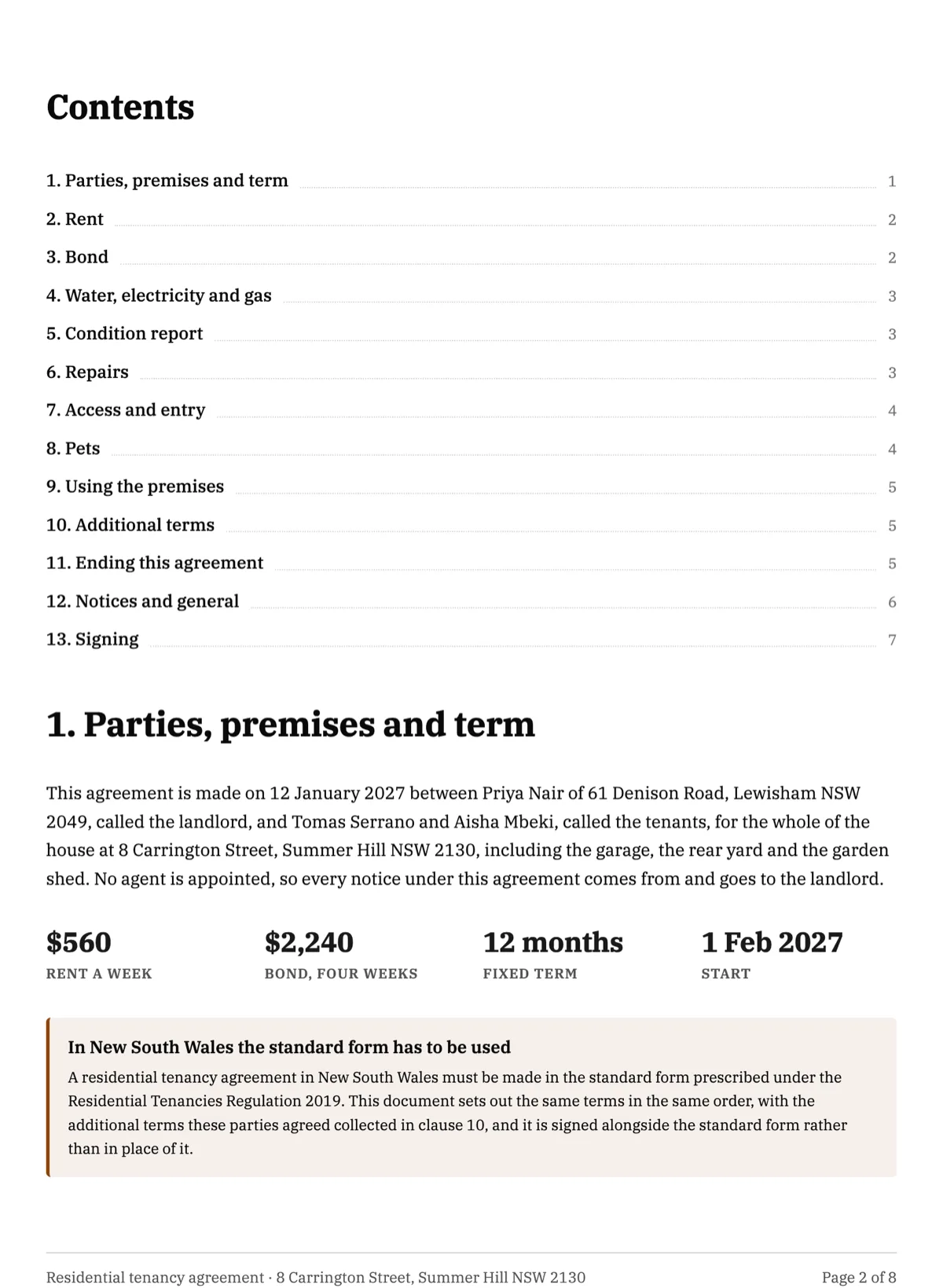 Residential lease agreement template for a New South Wales fixed termA residential tenancy is the one agreement where most of the terms are set by statute rather than by the parties, so the useful part of a template is the additional terms and the numbers. This one is a 12 month New South Wales fixed term at $560 a week, with the bond, the entry notice periods and the break fee written out exactly as the Act sets them.
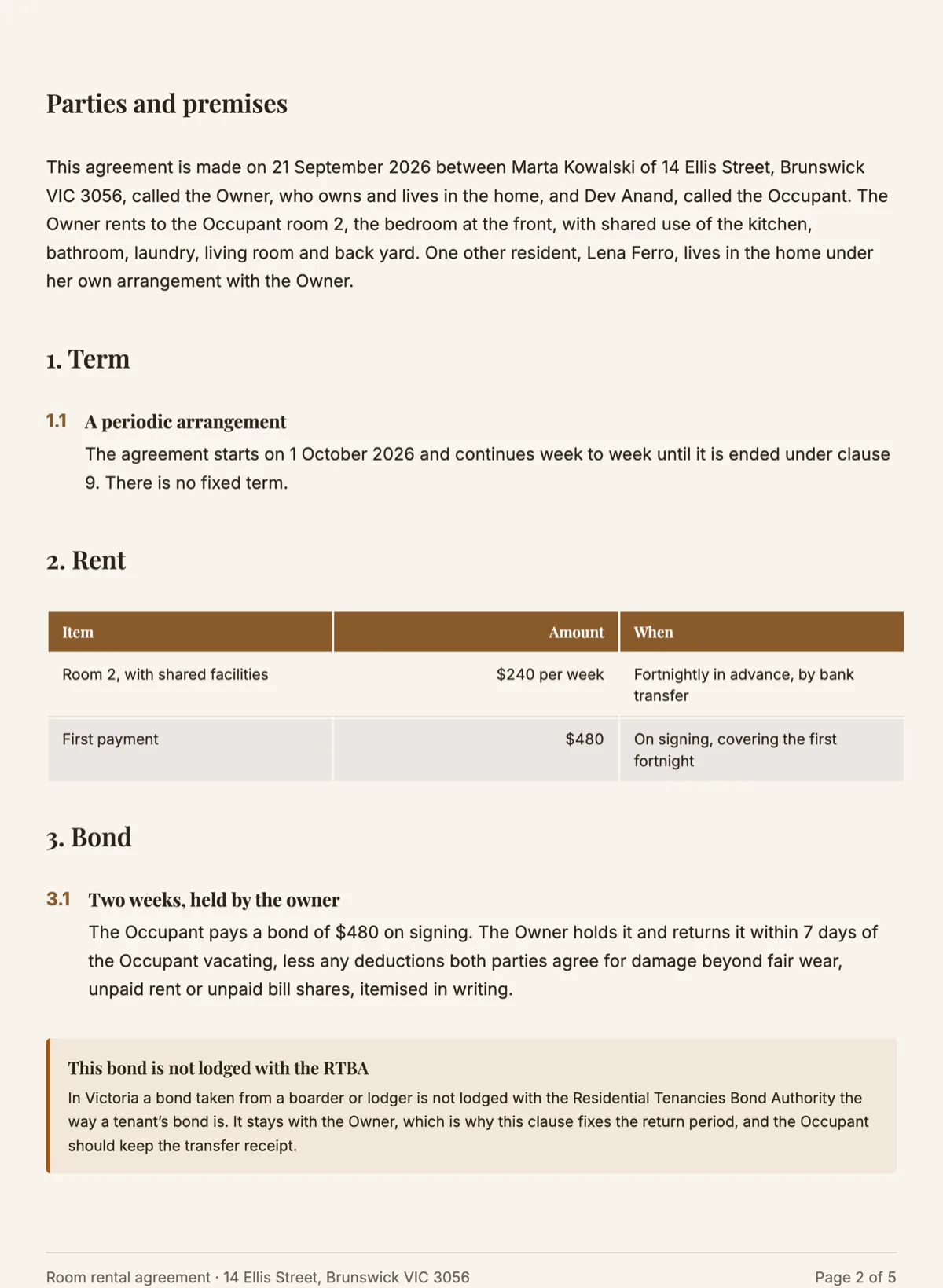 Room rental agreement template for one room in a shared homeRenting a room is not the same as renting a house, and most templates copy a residential lease and hope. This one is written for one room with shared kitchen and bathroom, prices the bills split, lists the rules that matter, and says plainly that the occupant is a boarder or lodger and what that changes.
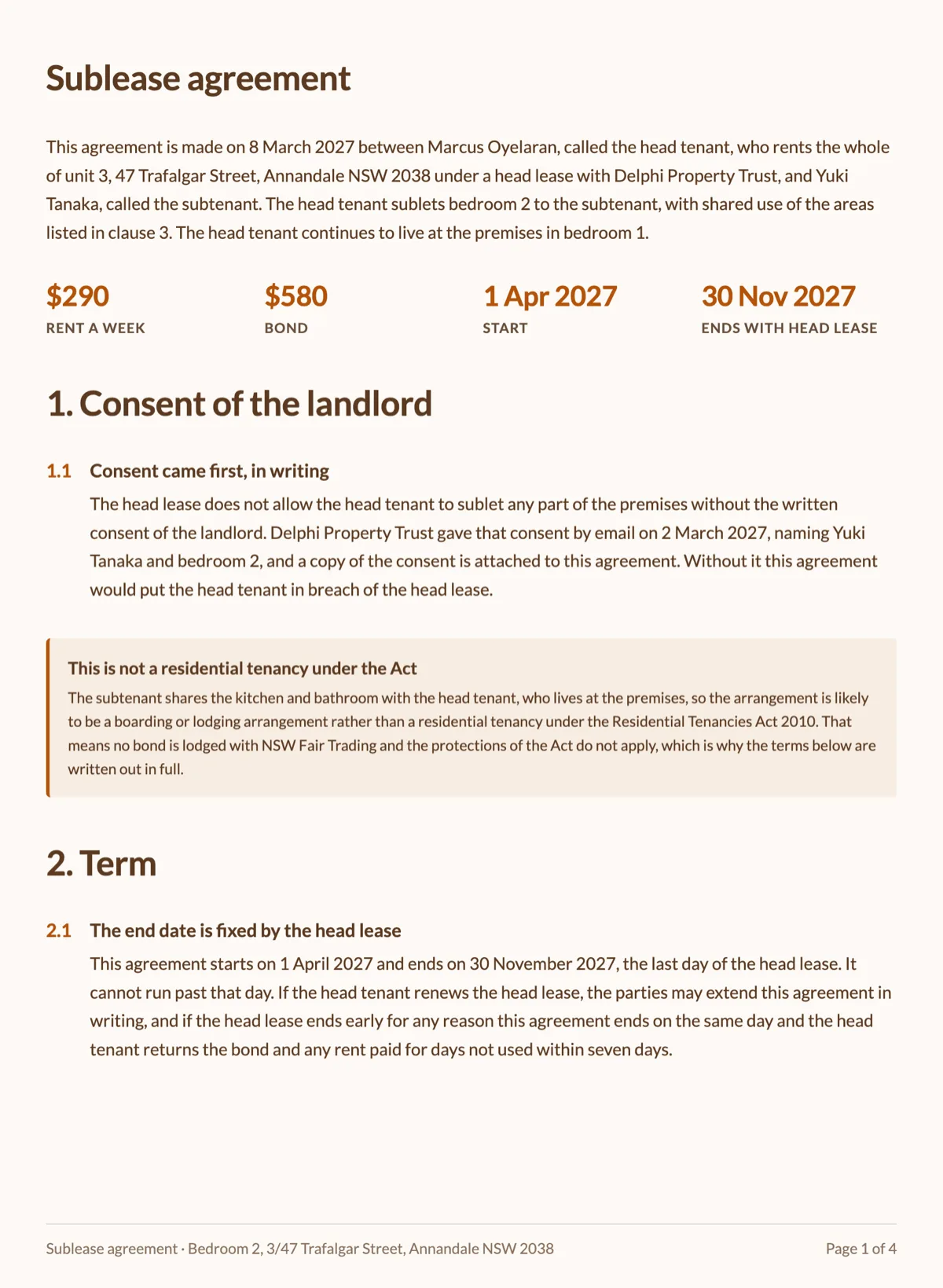 Sublease agreement template with the head lease consent recordedSubletting a room goes wrong in two places: the landlord never consented, and nobody wrote down what the occupant is actually renting. This agreement fixes the consent on the first page with a date and an email, then sets out the room, the shared areas and who keeps each one in order.
Questions people ask
Can a landlord say no pets in New South Wales?
Not as a blanket rule. Tenants still need consent to keep a pet, but a landlord can refuse only for the reasons the law allows, must respond within 21 days using the pet application form, and must explain why a reason for refusal applies. A rental property also cannot be advertised as no pets allowed.
Can a landlord charge a pet bond?
No. In New South Wales a landlord cannot increase the bond or the rent, or ask for another form of security such as insurance, as a condition of consenting to a pet. The landlord can attach reasonable conditions instead, such as professional carpet cleaning at the end of the tenancy for an animal that lives indoors.
What happens if the landlord does not respond to a pet application?
In New South Wales, if the landlord gives no response within 21 days after receiving the application, the pet is automatically approved without conditions. In Victoria, a rental provider that does not apply to the Tribunal within 14 days after receiving a pet request is taken to have consented to it.
Do tenants need consent for an assistance animal?
No. In New South Wales tenants do not need consent to keep an assistance animal, although they should tell the landlord about it, and the landlord may ask for supporting information such as accreditation or registration. Landlords should not ask for private medical records as that supporting information.
Can a tenant challenge a refusal or a condition?
Yes. In New South Wales a tenant who disagrees with a refusal or with the conditions can apply to the NSW Civil and Administrative Tribunal, within 28 days after receiving the landlord's response unless the Tribunal extends the time. The tenant should keep the completed application form and the landlord's written reasons, because both will be examined.
Does strata approval replace the landlord's consent?
No. A tenant in a strata property may need approval from the owners corporation under the strata bylaws as well as the landlord's consent. The two applications are separate, and a tenant can apply to the strata directly without asking the landlord to apply on its behalf, ideally at the same time as the landlord application.
Put the clause in a finished document
The button opens the document generator with a starting description already filled in. Change it to match your own agreement before you run it.
Create a document with OneCraftRelated clauses
- Bond clause in a lease: amount, lodgement and returnA bond clause in a lease sets the security amount, where it is held and when it comes back. Victorian sample wording, NSW and retail lease variants.
- Landlord access clause: entry, inspections and noticeA landlord access clause sets when a landlord may enter rented premises and how much notice is needed. Victorian sample wording, NSW and commercial variants.
- Quiet enjoyment clause: what a tenant is actually promisedA quiet enjoyment clause protects a tenant's use of leased premises from landlord interference. Victorian sample wording, residential and office variants.
For everything the document generator can do, see the document maker.
Step by step in the builder: Create a document with AI, then Send a document for signature.
Written and checked by the OneCraft team. Last checked .