Contract clause
Bond clause in a lease: amount, lodgement and return
A bond clause sets the amount of security a renter or tenant pays at the start of a lease, where that money is held, and when and how it is returned. In a Victorian residential tenancy the bond is capped by law and lodged with the Residential Tenancies Bond Authority rather than kept by the rental provider.
Bond disputes happen in the last week of a tenancy, but they are decided by what was done in the first week: the amount taken, the lodgement and the condition report. A clause that follows the statutory steps makes the eventual claim routine.
Indunil Asanka · Co-founder
4 min read · Published
Sample clause
a residential rental agreement in Victoria between Kingfisher Lane Rentals, a fictional private rental provider in Geelong, and two renters paying $620 a week for a townhouse
4. Bond 4.1 The Renters must pay a Bond of $2,480, being 4 weeks rent, on or before signing this agreement. 4.2 The Rental Provider will lodge the Bond with the Residential Tenancies Bond Authority within the time required by the Residential Tenancies Act 1997, and the Authority will send each Renter a receipt. 4.3 Before the Renters move in, the Rental Provider will complete a Condition Report and give the Renters a copy. The Renters may return a signed copy with their comments within the time the Act allows. 4.4 The Bond is security for the Renters' obligations under this agreement. It is not rent in advance and may not be used to pay rent during the tenancy. 4.5 At the end of the agreement the Bond is repaid through the Authority in the amounts the parties agree in a bond claim or, if they do not agree, as determined under the Act.
Sample wording, not legal advice.
Variants
Retail lease security deposit or bank guarantee
A shop or office lease, where no bond authority is involved and the amount is negotiated.
The Tenant must provide a Security Deposit equal to 3 months Rent, either in cash, which the Landlord will hold in an interest bearing account, or as an unconditional bank guarantee. The Landlord may apply the Security Deposit towards any amount the Tenant owes under this Lease after giving the Tenant written notice. If the Tenant has complied with this Lease, the Landlord must return the Security Deposit, with any interest earned, within 30 days after the Lease ends.
New South Wales residential bond
A rental in New South Wales, where the cap and the body that holds the bond are different.
The Tenant must pay a Rental Bond of $2,200, which is not more than 4 weeks rent. The Bond is paid through Rental Bonds Online or, if it is paid to the Landlord or agent, deposited with NSW Fair Trading within the time required by the Residential Tenancies Act 2010. The Bond is refunded through NSW Fair Trading at the end of the tenancy in the amounts the parties agree or the Tribunal orders.
What to negotiate
The amount against the rent
In a Victorian residential tenancy the bond generally cannot exceed one month's rent, so the only negotiation is whether to take less. For a commercial lease the amount is agreed freely and is usually expressed as a number of months of rent, and a tenant with a strong trading record can ask for a smaller figure.
Cash or a bank guarantee
A bank guarantee keeps the tenant's cash in its business but costs a fee and uses borrowing capacity. Landlords prefer guarantees that are unconditional, run past the end of the lease and can be called on without the tenant's consent. Tenants ask for the guarantee to be returned promptly once the lease ends and make good is complete.
The risk of leaving it out
Without a bond clause a Victorian rental provider has no right to a bond at all, because a bond is only payable if the rental agreement asks for one. In a commercial lease the landlord holds no security for unpaid rent or make good costs, and the tenant has no agreed timetable for getting its money back.
The Victorian rules in brief
Most Victorian residential bonds cannot be more than one month's rent. A higher bond is possible only where the weekly rent is more than $900 or the Victorian Civil and Administrative Tribunal has set a higher bond for the property. The bond is lodged with the Residential Tenancies Bond Authority, which gives a receipt to the rental provider and every renter, and a rental provider who takes a bond must complete a condition report and give the renter a copy before moving in. Extra bond can be requested only in limited cases, such as a rental agreement longer than 5 years.
How the rules differ elsewhere
In New South Wales a residential bond cannot be more than 4 weeks rent and is managed through NSW Fair Trading's Rental Bonds Online service. Victorian retail leases work differently again: the legislation does not cap a security deposit, nothing is lodged with a government body, and the landlord must hold a cash deposit in an interest bearing account and return it with the interest within 30 days after the lease ends if the tenant has met its obligations. Rooming houses and caravan parks have their own limits.
Where it sits in a generated document
A generated lease writes the bond as a short numbered clause beside rent, so the make good and default clauses can refer to it by number. The generated text never cites the Residential Tenancies Act or the bond authority's guidance, so the cap and the lodgement steps in a draft are checked against Consumer Affairs Victoria before the agreement is signed.
Documents that carry this clause
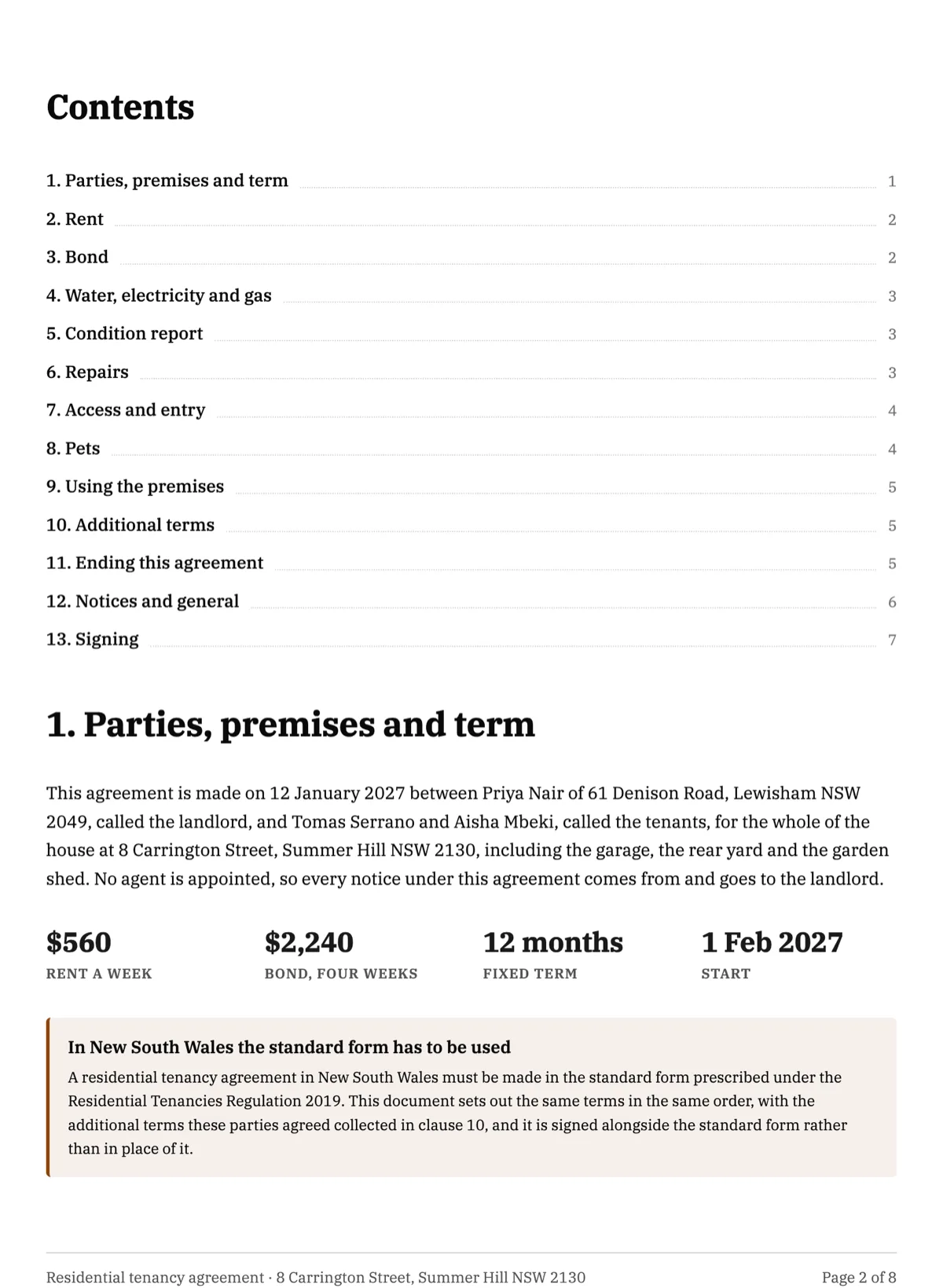 Residential lease agreement template for a New South Wales fixed termA residential tenancy is the one agreement where most of the terms are set by statute rather than by the parties, so the useful part of a template is the additional terms and the numbers. This one is a 12 month New South Wales fixed term at $560 a week, with the bond, the entry notice periods and the break fee written out exactly as the Act sets them.
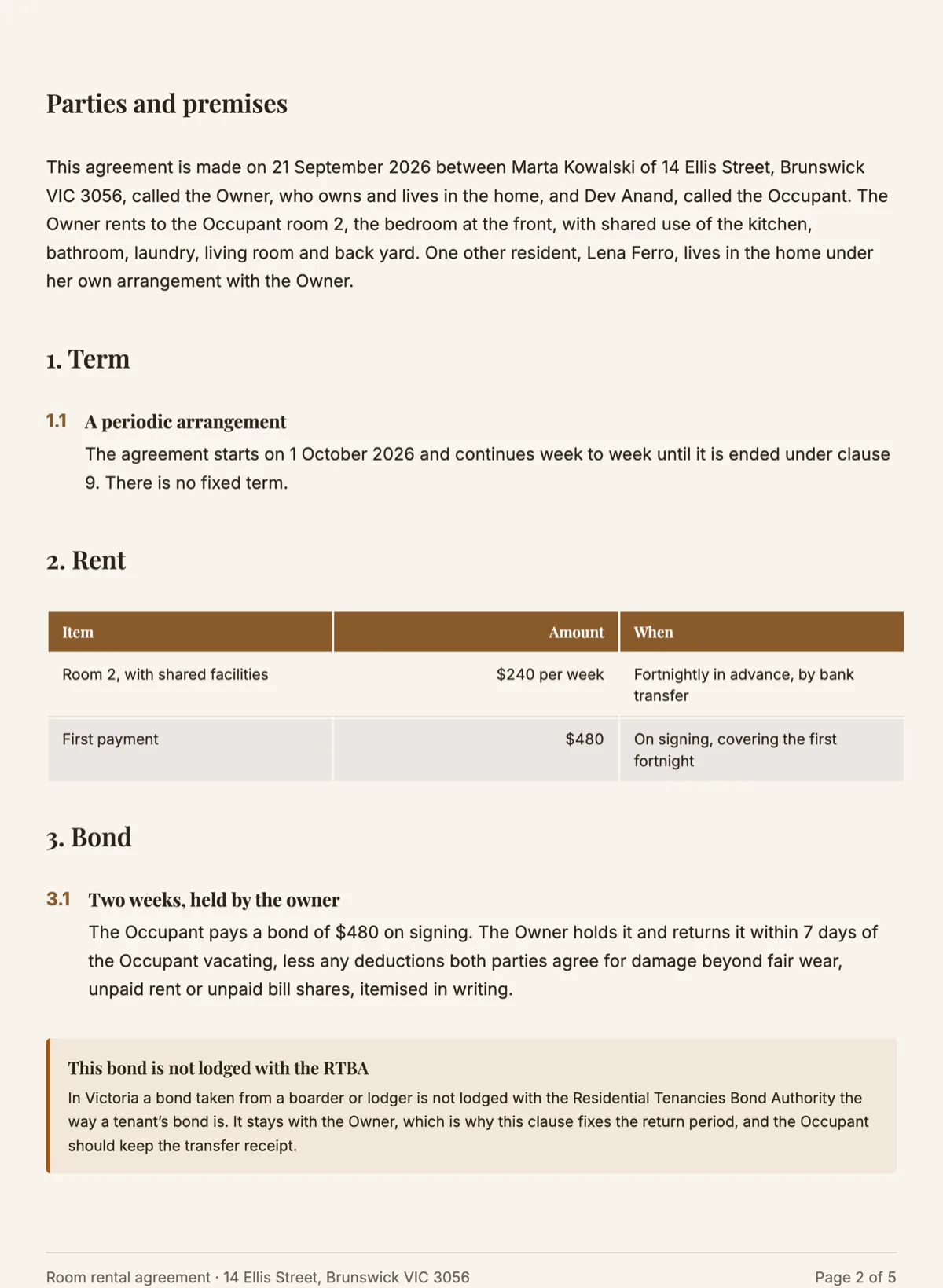 Room rental agreement template for one room in a shared homeRenting a room is not the same as renting a house, and most templates copy a residential lease and hope. This one is written for one room with shared kitchen and bathroom, prices the bills split, lists the rules that matter, and says plainly that the occupant is a boarder or lodger and what that changes.
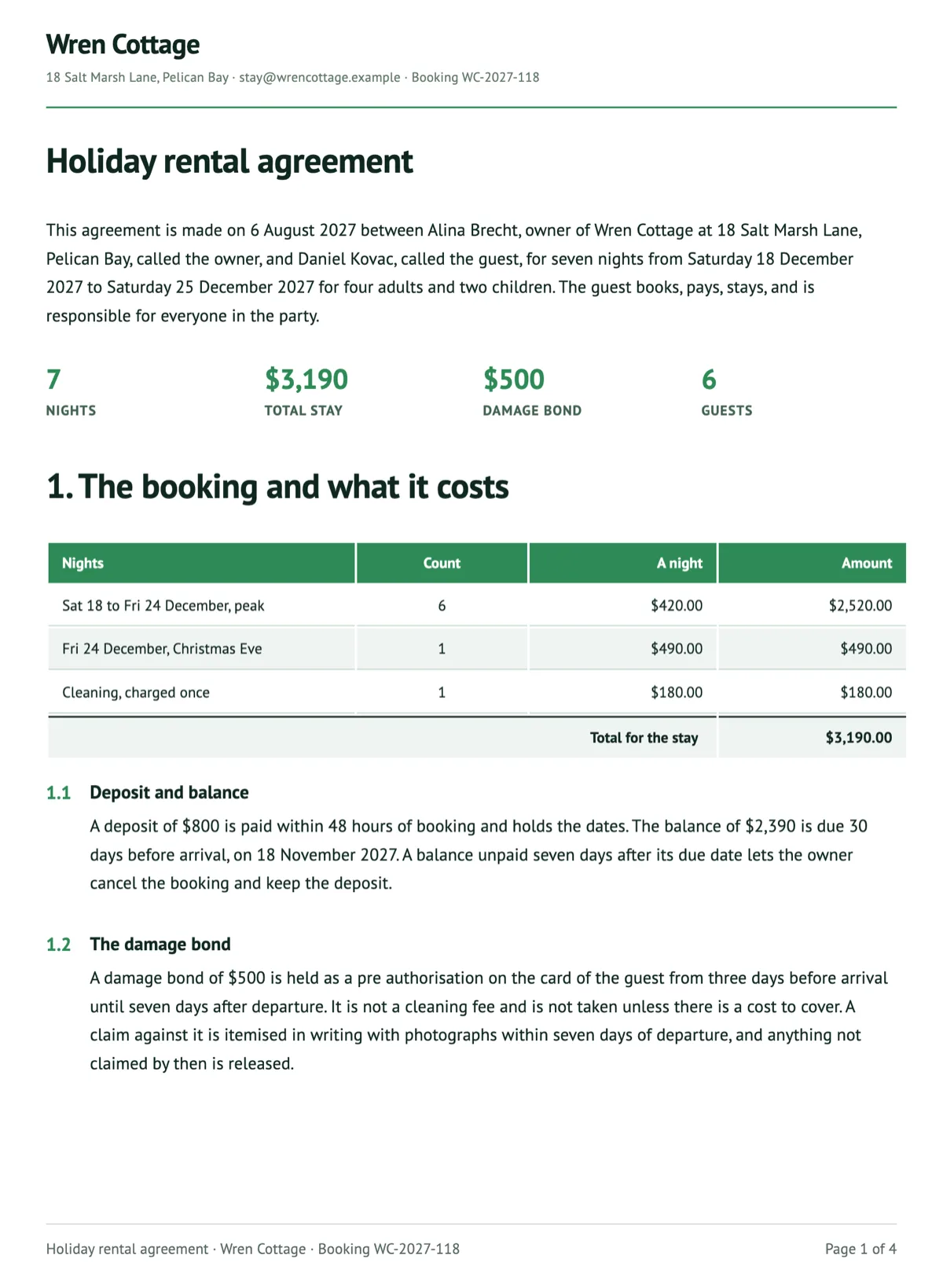 Holiday rental agreement template with house rules and a damage bondA short stay booking is a contract that lasts a week and is argued about for a month afterwards. This agreement prices the seven nights line by line, sets the damage bond as a pre authorisation with a seven day claim window, and puts the house rules where the guest signs rather than on a laminated card in the kitchen.
Questions people ask
What is the maximum bond in Victoria?
For most residential rental agreements, one month's rent. A rental provider can ask for more only if the weekly rent is more than $900 or the Victorian Civil and Administrative Tribunal has approved a higher bond for the property. Rooming houses and caravan parks have separate limits, and a retail lease security deposit is not capped by the legislation.
Can the bond be used to pay the last month of rent?
No. A residential bond is security for the renter's obligations and is kept separate from rent. It is held by the Residential Tenancies Bond Authority and repaid through a bond claim at the end of the agreement, so a renter who stops paying rent in the final month is in arrears even though a bond is held.
How is a bond returned at the end of a lease?
In Victoria the rental provider and renters agree how the bond should be repaid and submit a claim to the Residential Tenancies Bond Authority. If they cannot agree, the dispute is resolved through the Tribunal or Rental Dispute Resolution Victoria, and the Authority repays the bond in accordance with the order into the bank accounts nominated in the claim.
Can a landlord ask for a separate pet bond?
In New South Wales a landlord cannot increase the bond or ask for any other form of security as a condition of consenting to a pet. In Victoria extra bond can be requested only in the limited circumstances the Act allows, so a separate pet bond should not simply be added to a standard residential rental agreement.
What is the difference between a bond and a bank guarantee?
A cash bond is money paid and held as security. A bank guarantee is a promise by the tenant's bank to pay the landlord up to a stated amount on demand. Guarantees are common in commercial leases because the tenant keeps its cash, but the landlord needs one that stays valid long enough to cover the make good period.
Does a subtenant pay a bond?
A head renter who sublets in Victoria can ask the subtenant for a bond and must lodge it with the Residential Tenancies Bond Authority, registering as an individual landlord to do so. The head renter takes on the responsibilities of a rental provider towards the subtenant, including the bond, the rental minimum standards and urgent repairs.
Put the clause in a finished document
The button opens the document generator with a starting description already filled in. Change it to match your own agreement before you run it.
Create a document with OneCraftRelated clauses
- Make good clause: what a tenant leaves behindA make good clause sets the condition a tenant leaves the premises in at the end of a lease. Victorian retail sample wording, scope checklist and variants.
- Pet clause in a lease: consent, conditions and refusalsA pet clause in a lease records consent for an animal and the conditions attached. NSW sample wording, the reasons a landlord can refuse, and Victorian variant.
- Landlord access clause: entry, inspections and noticeA landlord access clause sets when a landlord may enter rented premises and how much notice is needed. Victorian sample wording, NSW and commercial variants.
For everything the document generator can do, see the document maker.
Step by step in the builder: Create a document with AI, then Send a document for signature.
Written and checked by the OneCraft team. Last checked .