Contract clause
Make good clause: what a tenant leaves behind
A make good clause sets out the condition a tenant must leave the premises in when a lease ends. It usually requires removal of the tenant's fit out and signage, repair of damage caused by the removal, repainting and cleaning, all measured against the condition of the premises at the start of the lease.
Make good is often the largest bill a commercial tenant faces at the end of a lease, and it arrives when the business has already moved on. A clause tied to a photographed condition report, with a landlord election made well before the last day, turns an open ended obligation into a list.
Nuwan Madhusanka · Co-founder
4 min read · Published
Sample clause
a retail lease in Victoria between Rosella Street Holdings, a fictional property owner in Bendigo, and Copper Kettle Cafe, which installed a kitchen, a counter and fixed seating
19. Make Good 19.1 By the Expiry Date, or within 10 business days after the Lease ends earlier, Copper Kettle Cafe must at its cost: (a) remove the Tenant's Fit Out, signage, equipment and cabling; (b) repair any damage caused by installing or removing them; (c) cap services at the points shown in the Condition Report; (d) repaint internal walls in the colour recorded in the Condition Report; and (e) leave the Premises clean and in the condition shown in the Condition Report, fair wear and tear excepted. 19.2 At least 3 months before the Expiry Date, Rosella Street Holdings may notify the Tenant in writing that it wants specified items of the Fit Out left in place. Those items then become the Landlord's property, are left clean and working, and need not be removed. 19.3 If the Tenant does not complete the make good works, Rosella Street Holdings may carry them out and recover the reasonable cost from the Tenant as a debt.
Sample wording, not legal advice.
Variants
Cash settlement instead of works
The landlord plans to refit or redevelop, so works by the outgoing tenant would be wasted.
Instead of carrying out the make good works under clause 19.1, the Tenant must pay the Landlord a Make Good Sum equal to the reasonable cost of those works, as assessed by an independent quantity surveyor appointed by agreement between the parties. If the parties cannot agree on a surveyor within 10 business days, either party may ask the president of the Australian Institute of Quantity Surveyors to nominate one. The Tenant is released from clause 19.1 when the Make Good Sum is paid.
Full reinstatement to base building
A landlord leasing a bare shell whose next tenant will expect an empty space.
At the end of the Lease the Tenant must reinstate the Premises to the Base Building Condition described in Schedule 3. That includes removing all partitions, floor coverings, ceilings, plumbing and electrical work installed by or for the Tenant, whether or not the Landlord consented to their installation, and any work installed by a previous tenant under a lease that was assigned to the Tenant.
Limited make good for a short lease
A short lease of a fitted space where the tenant made only minor changes.
At the end of the Lease the Tenant must remove its furniture, equipment and signage, repair damage caused by that removal, and leave the Premises clean. The Tenant is not required to remove, alter or reinstate any fit out that was in the Premises at the start of the Lease or that the Landlord approved in writing, and is not responsible for fair wear and tear.
What to negotiate
Define the starting condition
A make good obligation is only as clear as the record it is measured against. Tenants should insist on a dated condition report with photographs before taking possession, and exclude work done by a previous tenant. Without that record, the landlord's view of the original condition tends to prevail when the lease ends.
When the landlord must decide what stays
Landlords like to decide late whether to keep fit out, which leaves the tenant unable to plan removal. Tenants ask for a written election a set time before expiry, with anything not named removed. Three months is common, and it gives both sides time to price the works and book trades.
The risk of leaving it out
Without a make good clause the landlord relies on the general obligation to give the premises back and on whatever the repairs clause says, which rarely deals with removing fit out. The tenant may leave a kitchen the next tenant does not want, and the landlord may claim the cost of stripping it without any agreed standard to measure the claim against.
What a make good scope usually covers
A typical scope lists removal of the tenant's fit out, signage, equipment and data cabling; repair of damage caused by installing or removing them; capping of plumbing and electrical services; repainting; replacement of damaged floor coverings and ceiling tiles; cleaning and rubbish removal; and return of keys and access cards. The Victorian Small Business Commission suggests retail tenants work through each item well before the lease ends, including whether a painting obligation means internal walls, facades or both, and whether any items must be handed back in working order.
Victorian retail leases and repairs
Under the Retail Leases Act 2003 (Vic) the landlord of a retail premises lease must maintain the structure, fixtures, plant and equipment in the condition they were in when the lease was entered into, but not items the tenant is entitled or required to remove at the end of the lease. That makes the list of removable items in the make good clause doubly important, because it also decides who maintains those items during the term. Disputes about make good, and about deductions from a security deposit, can be taken to the Victorian Small Business Commission.
Where it sits in a generated document
A generated lease numbers make good as its own clause near the end of the document, with each item of work as a separate sub clause, so the landlord's election and the cost recovery right can refer to specific items. The generated draft does not cite sources, so any reference to the Retail Leases Act is checked before the lease is signed.
Documents that carry this clause
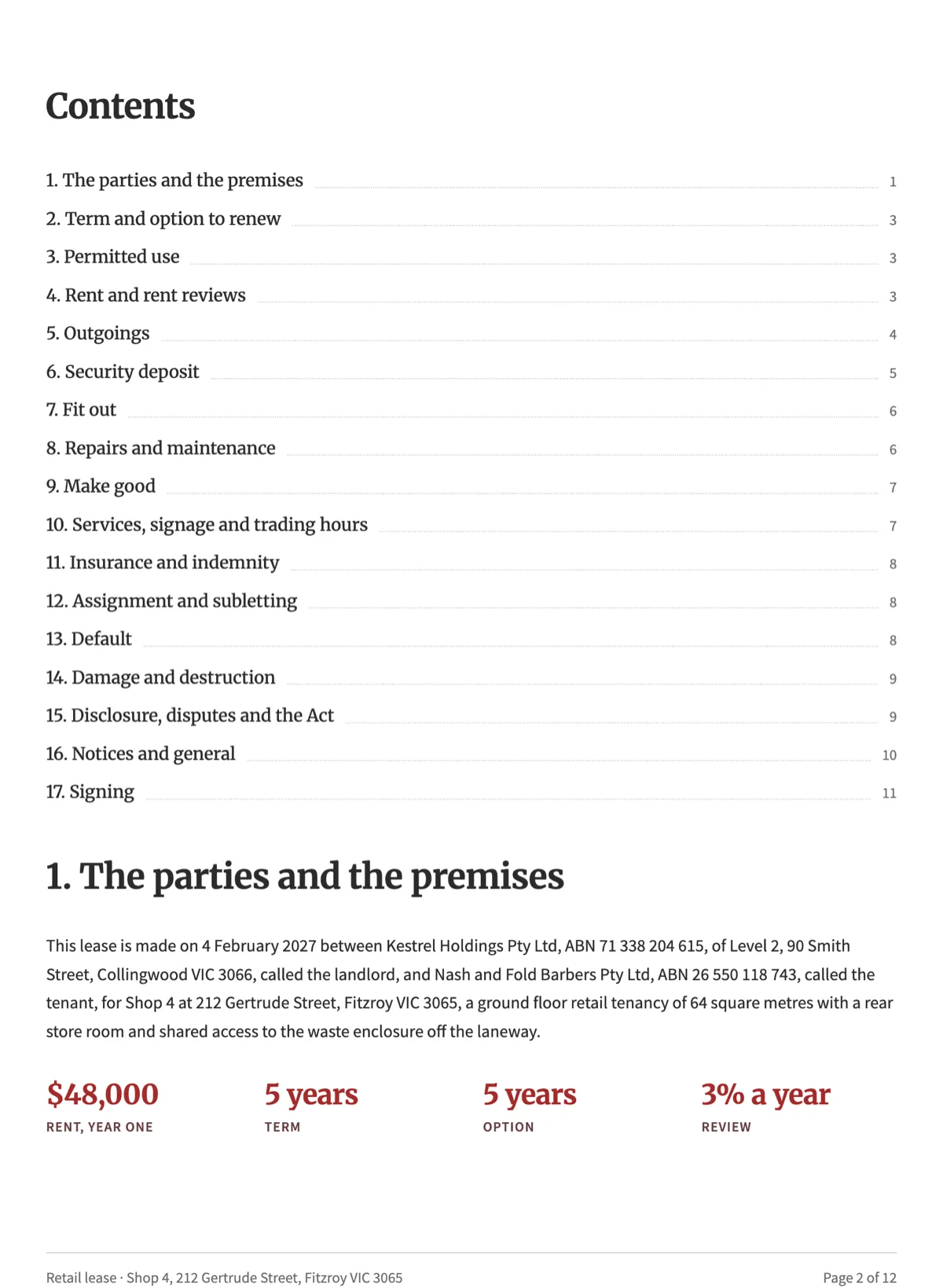 Commercial lease agreement template with outgoings and fit out termsA retail lease is decided by three numbers and two clauses: the rent, the review, the outgoings, the fit out contribution and the make good. This 12 page Victorian lease sets all five out in the open, including the outgoings the landlord is not allowed to recover at all.
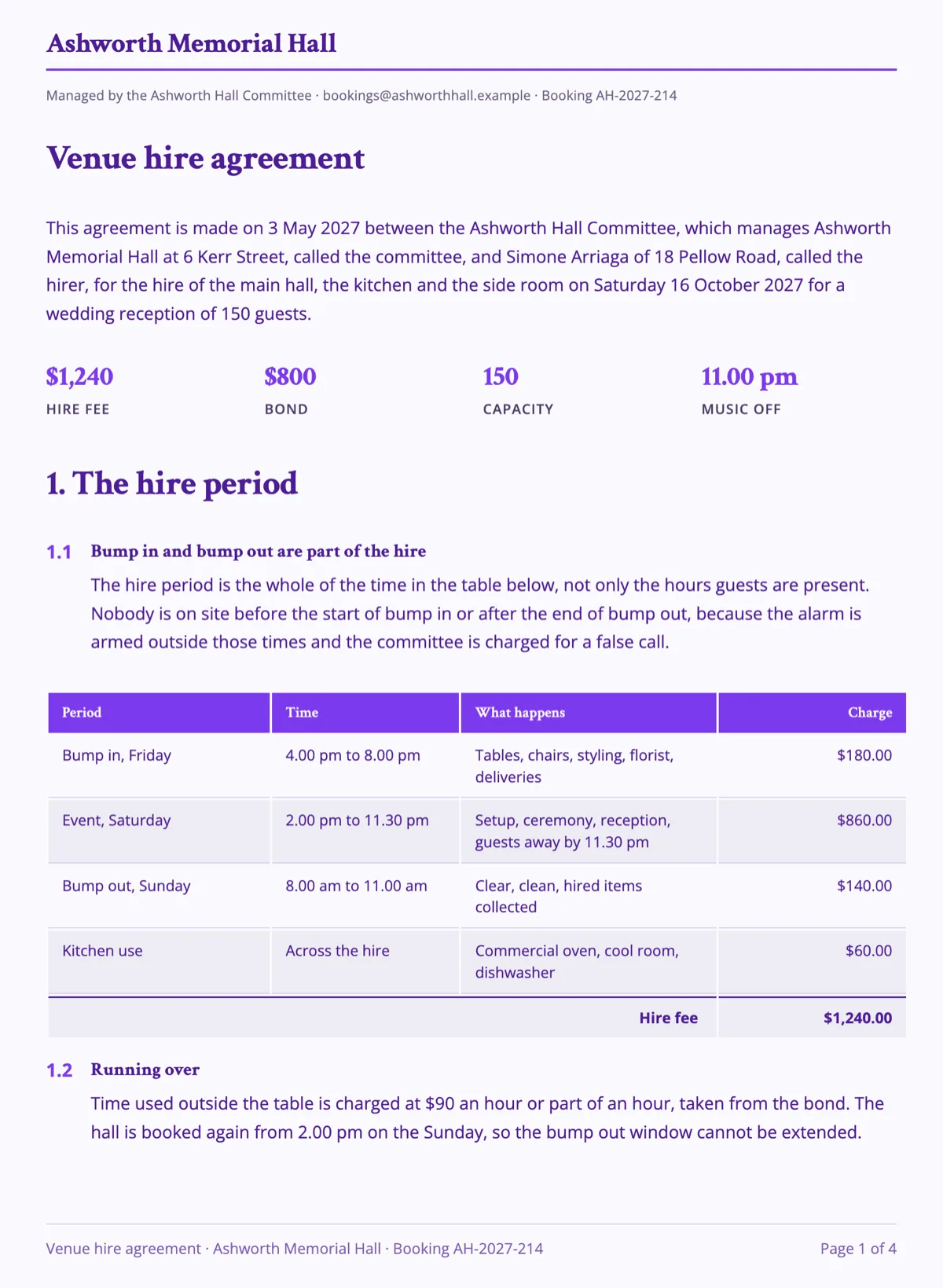 Venue hire agreement template with bump in, noise and a bondHall hire disputes are almost always about time and noise: the hirer thought the hire started when guests arrived, and the committee thought music stopped at eleven. This agreement prices bump in, the event and bump out as three separate periods, and ties the curfew to the planning permit rather than to a preference.
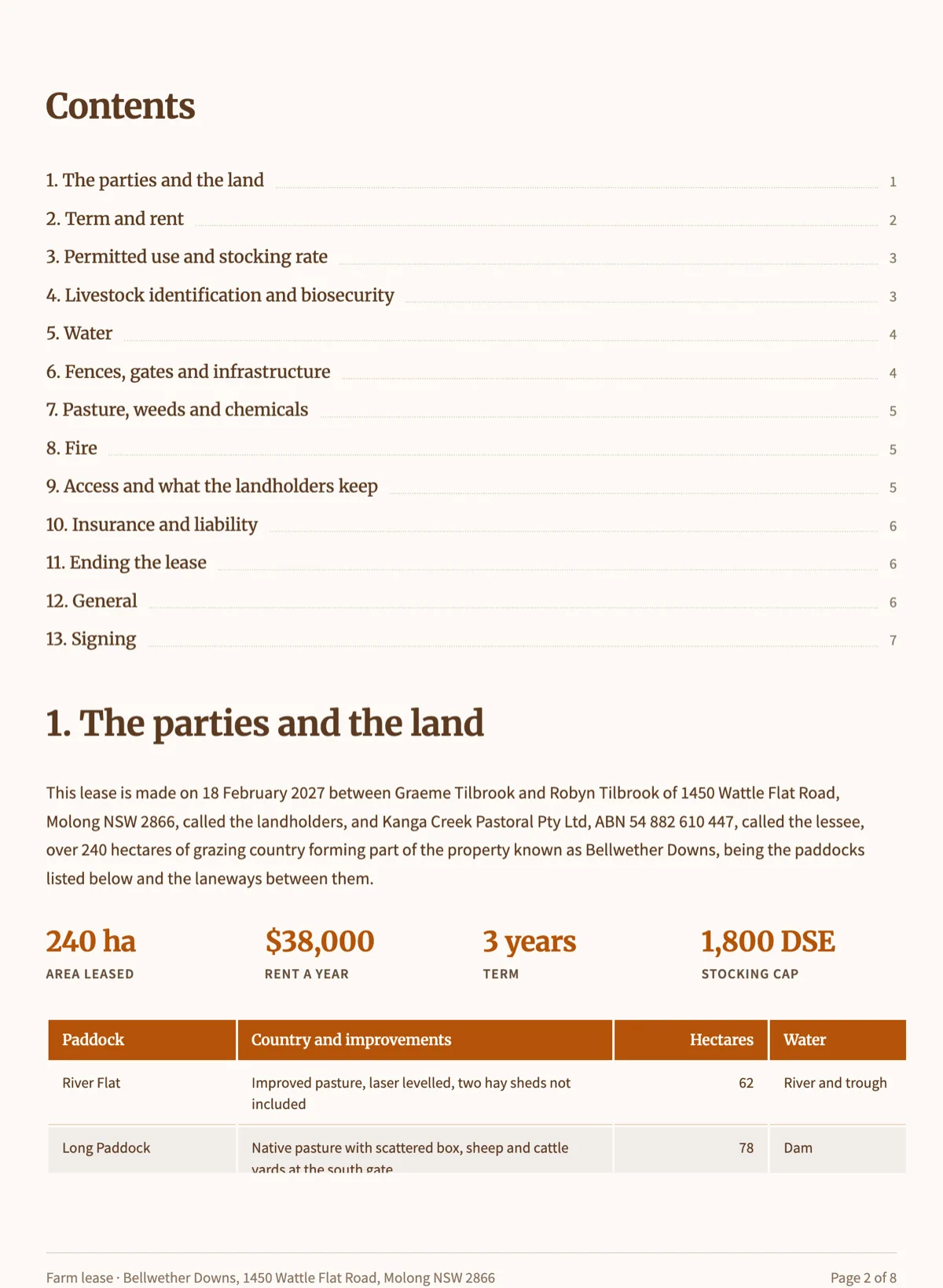 Farm lease agreement template with grazing rights and a fencing tableA grazing lease is a bet on country, and the two things that decide whether it was a good one are the stocking rate and who fixes the fence. This three year lease over 240 hectares caps stock in dry sheep equivalents, ties ground cover to a measurement twice a year, and puts every improvement in a table with a name beside it.
Questions people ask
Does make good mean returning the premises as brand new?
No. Most clauses measure the obligation against the condition at the start of the lease, with fair wear and tear excepted. A tenant who took a fitted shop is not normally required to improve it, but it must remove its own additions and repair damage beyond ordinary wear, unless the clause expressly requires reinstatement to a base building standard.
Can the landlord keep the fit out instead of having it removed?
Yes, if the clause gives the landlord that election. A well drafted clause requires the landlord to say in writing, a set period before expiry, which items it wants left in place, and says that anything not named must be removed. Items left behind at the landlord's request are usually left clean and working.
Is a tenant liable for a previous tenant's fit out?
It depends on the lease and on how the tenant came into the premises. A tenant that took an assignment of an existing lease may take on the original tenant's make good obligations. A tenant granted a new lease of fitted premises can negotiate to exclude existing fit out, which is why the condition report matters so much.
Can the landlord keep the security deposit to cover make good?
A lease usually allows the landlord to apply the deposit to unpaid make good costs. For a Victorian retail lease, if the tenant has met its obligations, the landlord must return the deposit and any interest earned within 30 days after the lease ends, and a dispute about deductions can be referred to the Victorian Small Business Commission.
When should make good works start?
Early enough to finish before the tenant's right to occupy ends. Staying on to complete works after expiry can leave the tenant holding over and paying rent. Walking through the premises with the landlord or agent a few months before expiry, and confirming agreed items in writing, reduces the risk of a late dispute about the scope.
What is a cash settlement for make good?
It is an agreed payment in place of the physical works, often used when the landlord plans to refit or redevelop the premises anyway. The amount is usually based on the reasonable cost of the works, sometimes assessed by an independent quantity surveyor, and the tenant is released from doing the works once it is paid.
Put the clause in a finished document
The button opens the document generator with a starting description already filled in. Change it to match your own agreement before you run it.
Create a document with OneCraftRelated clauses
- Holding over clause: staying on after the lease expiresA holding over clause sets the terms when a tenant stays on after a lease expires. Victorian retail sample wording, residential and UK variants, notice rules.
- Repairs and maintenance clause: who fixes what in a leaseA repairs and maintenance clause splits who fixes what in a lease. Victorian retail sample wording, residential urgent repairs rules and a tenant heavy variant.
- Bond clause in a lease: amount, lodgement and returnA bond clause in a lease sets the security amount, where it is held and when it comes back. Victorian sample wording, NSW and retail lease variants.
For everything the document generator can do, see the document maker.
Step by step in the builder: Create a document with AI, then Document builder components.
Written and checked by the OneCraft team. Last checked .