Marketing template
Competitor Analysis template
A competitor analysis that compares your business with five rivals on price, range, delivery and reviews, then maps positioning and lists the gaps to act on. It suits founders and marketing leads setting next year's prices and offer.
8 sections, 4 tables
Use this template opens a copy in the document builder after you sign in. Adapt it with AI opens the generator with this template chosen, so you can describe your business and get a version written for it.
What you fill in
- [Your company]
- [Date]
- [Your name]
- [Competitor 1]
- [Competitor 2]
- [Competitor 3]
- [Competitor 4]
- [Competitor 5]
The template, in full
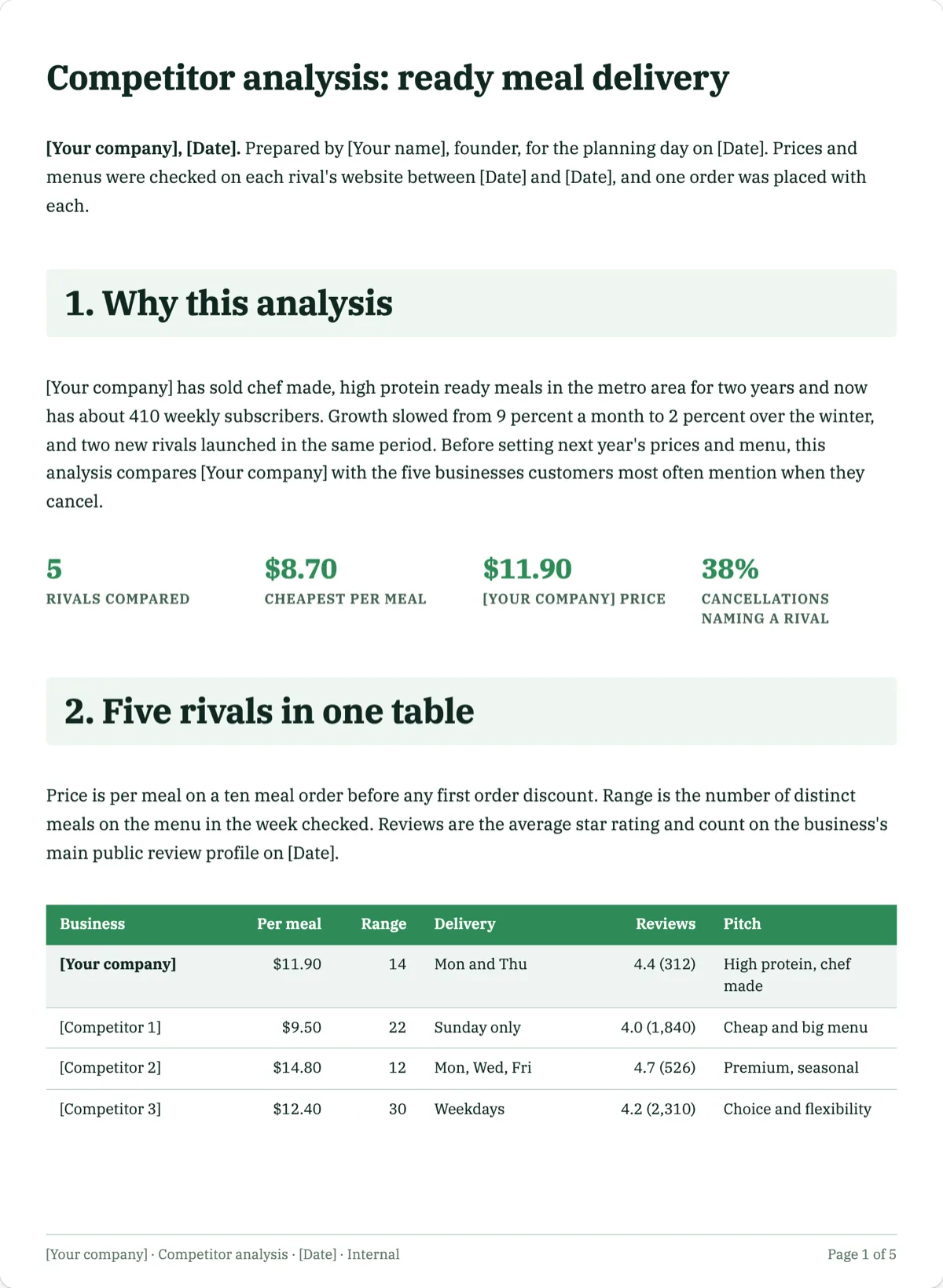
Competitor analysis: ready meal delivery
[Your company], [Date]. Prepared by [Your name], founder, for the planning day on [Date]. Prices and menus were checked on each rival's website between [Date] and [Date], and one order was placed with each.
1. Why this analysis
[Your company] has sold chef made, high protein ready meals in the metro area for two years and now has about 410 weekly subscribers. Growth slowed from 9 percent a month to 2 percent over the winter, and two new rivals launched in the same period. Before setting next year's prices and menu, this analysis compares [Your company] with the five businesses customers most often mention when they cancel.
2. Five rivals in one table
Price is per meal on a ten meal order before any first order discount. Range is the number of distinct meals on the menu in the week checked. Reviews are the average star rating and count on the business's main public review profile on [Date].
[Your company] sits in the middle on price, $2.40 above [Competitor 1] and $2.90 below [Competitor 2], with a smaller menu than the two biggest rivals. Its rating of 4.4 is behind only the two premium specialists. [Competitor 3] is the strongest all round competitor: a 30 meal menu, weekday delivery and the most reviews, at 50 cents more per meal than [Your company].
3. Delivery and ordering terms
The delivery fee changes the picture. A customer ordering ten meals pays $127.00 a week at [Your company] including delivery, $95.00 at [Competitor 1] and $130.50 at [Competitor 3]. [Competitor 1]'s free delivery is its main weapon, and four of the cancellations that named it mentioned the fee. [Your company] is the only rival besides [Competitor 4] with compostable trays, which nobody yet advertises prominently.
4. What reviewers say
The 50 most recent public reviews of each business were read and tagged by theme. The table shows the most common praise and complaint for each, with how many of its 50 reviews raised it.
5. Positioning map
The map places each business by price per meal, left to right from lower to higher, and by menu range, bottom to top from narrow to wide. The split points are $11.50 per meal and 15 meals, close to the middle of the six.
[Your company] shares the narrow and higher price corner with two specialists that charge more and rate higher. That is a weak spot: it is neither the cheapest nor the most premium, and its menu is not wide enough to compete with [Competitor 3] on choice.
6. Gaps and what to do
Comparisons in advertising. Any public comparison with a named rival, such as on price or delivery, must be accurate, current and like for like, and must be rechecked before each campaign. Rival prices in this report are as at [Date] and are for internal planning only.
7. Keeping it current
A competitor table goes stale within a quarter. The checks below take about two hours a month and are logged in the same spreadsheet the tables above came from, so the full repeat in April 2027 starts from data rather than memory and can measure the menu and delivery changes against the 38 percent cancellation baseline.